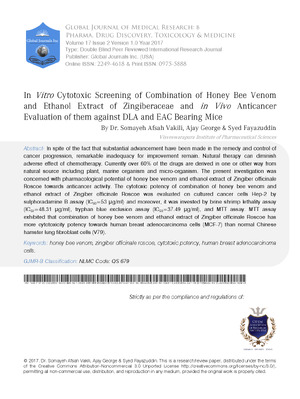
In vitro Cytotoxic Screening of Combination of Honey Bee Venom and Ethanol Extract of Zingiberaceae and i vivo Anticancer Evaluation of them against DLA and EAC Bearing Mice

§ Visveswarapura Institute of Pharmaceutical Sciences,

Send Message

To: Author

In vitro Cytotoxic Screening of Combination of Honey Bee Venom and Ethanol Extract of Zingiberaceae and i vivo Anticancer Evaluation of them against DLA and EAC Bearing Mice

Article Fingerprint

ReserarchID

MR3MUF5

In vitro Cytotoxic Screening of Combination of Honey Bee Venom and Ethanol Extract of Zingiberaceae and i vivo Anticancer Evaluation of them against DLA and EAC Bearing Mice Banner

Key Research Insights

Synthesized scholarly intelligence & interactive research assistant
  • English
  • Afrikaans
  • Albanian
  • Amharic
  • Arabic
  • Armenian
  • Azerbaijani
  • Basque
  • Belarusian
  • Bengali
  • Bosnian
  • Bulgarian
  • Catalan
  • Cebuano
  • Chichewa
  • Chinese (Simplified)
  • Chinese (Traditional)
  • Corsican
  • Croatian
  • Czech
  • Danish
  • Dutch
  • Esperanto
  • Estonian
  • Filipino
  • Finnish
  • French
  • Frisian
  • Galician
  • Georgian
  • German
  • Greek
  • Gujarati
  • Haitian Creole
  • Hausa
  • Hawaiian
  • Hebrew
  • Hindi
  • Hmong
  • Hungarian
  • Icelandic
  • Igbo
  • Indonesian
  • Irish
  • Italian
  • Japanese
  • Javanese
  • Kannada
  • Kazakh
  • Khmer
  • Korean
  • Kurdish (Kurmanji)
  • Kyrgyz
  • Lao
  • Latin
  • Latvian
  • Lithuanian
  • Luxembourgish
  • Macedonian
  • Malagasy
  • Malay
  • Malayalam
  • Maltese
  • Maori
  • Marathi
  • Mongolian
  • Myanmar (Burmese)
  • Nepali
  • Norwegian
  • Pashto
  • Persian
  • Polish
  • Portuguese
  • Punjabi
  • Romanian
  • Russian
  • Samoan
  • Scots Gaelic
  • Serbian
  • Sesotho
  • Shona
  • Sindhi
  • Sinhala
  • Slovak
  • Slovenian
  • Somali
  • Spanish
  • Sundanese
  • Swahili
  • Swedish
  • Tajik
  • Tamil
  • Telugu
  • Thai
  • Turkish
  • Ukrainian
  • Urdu
  • Uzbek
  • Vietnamese
  • Welsh
  • Xhosa
  • Yiddish
  • Yoruba
  • Zulu
Reading Preferences
Font Size
Line Spacing
Background
This converted HTML version may contain rendering inconsistencies. Please refer to the PDF for the authoritative version, or click here to provide feedback.

Abstract

In spite of the fact that substantial advancement have been made in the remedy and control of cancer progression, remarkable inadequacy for improvement remain. Natural therapy can diminish adverse effect of chemotherapy. Currently over 60% of the drugs are derived in one or other way from natural source including plant, marine organism and micro-organism. The present investigation was concerned with pharmacological potential of honey bee venom and ethanol extract of Zingiber officinale Roscoe towards anticancer activity. The cytotoxic potency of combination of honey bee venom and ethanol extract of Zingiber officinale Roscoe was evaluated on cultured cancer cells Hep-2 by sulphoradamine B assay (IC 50 =53 μg/ml) and moreover, it was invested by brine shrimp lethality assay (IC 50 =48.31 μg/ml), tryphan blue exclusion assay (IC 50 =37.49 μg/ml), and MTT assay. MTT assay exhibited that combination of honey bee venom and ethanol extract of Zingiber officinale Roscoe has more cytotoxicity potency towards human breast adenocarcinoma cells (MCF-7) than normal Chinese hamster lung fibroblast cells (V79).

References

19 Cites in Article
  1. 1. B Ames,M Shigenaga,T Hagen (1993). Oxidants, antioxidants, and the degenerative diseases of aging. Proceedings of the National Academy of Sciences, 90(17), 7915-7922.
  2. 2. Premalatha Balachandran,Rajgopal Govindarajan (2005). Cancer—an ayurvedic perspective. Pharmacological Research, 51(1), 19-30.
  3. 3. J Dai,R Mumper (2010). Plant phenolic: Extraction, Analysis and their antioxidant and anticancer properties. Molecules, 15, 7313-7352.
  4. 4. Ashok Durairaj,Thamil Vaiyapuri,Upal Mazumder,Malaya Gupta (2009). Antineoplastic and antioxidant activities of<i>Oxystelma esculentum</i>on Swiss albino mice bearing Ehrlich’s ascites carcinoma. Pharmaceutical Biology, 47(3), 195-202.
  5. 5. J Ferlay,H Shin,F Bray,D Forman,C Mather,D Parkin (2008). Global cancer facts and figures. Global cancer facts and figures
  6. 6. A Jain (2005). Mannual of Practical Physiology for MBBS. Mannual of Practical Physiology for MBBS
  7. 7. A Jemal,R Siegel,E Ward,T Murray,J Xu,M Thun (2007). Cancer statistics. CA Cancer J Clin, 57(1), 43-66.
  8. 8. Sue Kim,Joydeb Kundu,Young Shin,Jin-Hong Park,Myung-Haing Cho,Tae-Yoon Kim,Young-Joon Surh (2005). [6]-Gingerol inhibits COX-2 expression by blocking the activation of p38 MAP kinase and NF-κB in phorbol ester-stimulated mouse skin. Oncogene, 24(15), 2558-2567.
  9. 9. Li-Hua Lai,Qi-Hong Fu,Yang Liu,Kai Jiang,Qing-Ming Guo,Qing-Yun Chen,Bin Yan,Qing-Qing Wang,Jian-Gen Shen (2012). Piperine suppresses tumor growth and metastasis in vitro and in vivo in a 4T1 murine breast cancer model. Acta Pharmacologica Sinica, 33(4), 523-530.
  10. 10. A Lopez,C Mathers,M Ezzati,Jamison Murray,C (2006). Global and regional burden of disease and risk factors, 2001: systematic analysis of population health data. Lancet, 367, 1747-1757.
  11. 11. B Meyer,N Ferrigni,J Putnam,L Jacobsen,D Nichols,J Mclaughlin (1982). Brine Shrimp: A Convenient General Bioassay for Active Plant Constituents. Planta Medica, 45(05), 31-34.
  12. 12. J Mondal,Panigrahi Ak,Khuda Bukhsh,A (2014). Conventional chemotherapy: problems and scope for combined therapies with certain herbal products and dietary supplements. Austain J Mol Cell Biol, 1(1), 1-10.
  13. 13. Esteban Orellana,Andrea Kasinski (2016). Sulforhodamine B (SRB) Assay in Cell Culture to Investigate Cell Proliferation. BIO-PROTOCOL, 6(21), 1-7.
  14. 14. N Orsolic,P Josipovic,I Basic (2009). Direct antitumor activity of honey bee venom invivo and invitro. Egy J Nat Toxins, 6(1), 1-15.
  15. 15. J Poltronieri,A Becceneri,A Fuzer,J Filho,A Martin,P Vieira,N Pouliot,M Cominetti (2014). 6]-Gingerol as a cancer chemopreventive agaent: a review of its activity on different steps of the metastatic process. Mini Rev Med Chem, 14(4), 313-321.
  16. 16. E Radhakrishnan,Smitha Bava,Sai Narayanan,Lekshmi Nath,Arun Thulasidasan,Eppurathu Soniya,Ruby Anto (2014). [6]-Gingerol Induces Caspase-Dependent Apoptosis and Prevents PMA-Induced Proliferation in Colon Cancer Cells by Inhibiting MAPK/AP-1 Signaling. PLoS ONE, 9(8), e104401.
  17. 17. M Saluja,B Sangameswaran,I Hura,S Ajay,S Gupta,M Chaturvedi (2011). In-vitro cytotoxic activity of leaves of Madhuca longifolia against Ehrlich Ascites carcinoma (EAC) cell lines. IJDDHR, 1(Suppl 2), 55-57.
  18. 18. H Sharma,K Sharma (2007). Principles of pharmacology. Principles of pharmacology
  19. 19. Yan Shi,Ravi Sahu,Sanjay Srivastava (2008). Triphala inhibits both in vitro and in vivo xenograft growth of pancreatic tumor cells by inducing apoptosis. BMC Cancer, 8(1), 294.

Funding

No external funding was declared for this work.

Conflict of Interest

The authors declare no conflict of interest.

Ethical Approval

No ethics committee approval was required for this article type.

Data Availability

Not applicable for this article.

How to Cite This Article

Somayeh Afsah Vakili. 2017. "In vitro Cytotoxic Screening of Combination of Honey Bee Venom and Ethanol Extract of Zingiberaceae and i vivo Anticancer Evaluation of them against DLA and EAC Bearing Mice". Global Journal of Medical Research - B: Pharma, Drug Discovery, Toxicology & Medicine GJMR-B Volume 17 (GJMR Volume 17 Issue B2).
Download Citation

Journal Specifications

Crossref Journal DOI 10.17406/gjmr

Print ISSN 0975-5888

e-ISSN 2249-4618

Keywords
Classification
GJMR-B Classification NLMC Code: QS 679
Version of record

v1.2

Issue date
August 12, 2017

Language
English
Order Article Reprint
Experiance in AR

Explore published articles in an immersive Augmented Reality environment. Our platform converts research papers into interactive 3D books, allowing readers to view and interact with content using AR and VR compatible devices.

Read in 3D

Your published article is automatically converted into a realistic 3D book. Flip through pages and read research papers in a more engaging and interactive format.

Article Matrices
Total Views: 1.2K
Total Downloads: 73
All Trends

Request Access

Please fill out the form below to request access to this research paper. Your request will be reviewed by the editorial or author team.
X

This is the heading

Lorem ipsum dolor sit amet, consectetur adipiscing elit. Ut elit tellus, luctus nec ullamcorper mattis, pulvinar dapibus leo.


High-quality academic research articles on global topics and journals.

In vitro Cytotoxic Screening of Combination of Honey Bee Venom and Ethanol Extract of Zingiberaceae and i vivo Anticancer Evaluation of them against DLA and EAC Bearing Mice

Somayeh Vakili
Somayeh Vakili Visveswarapura Institute of Pharmaceutical Sciences,