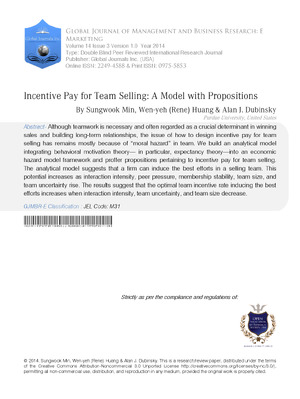
Incentive Pay for Team Selling: A Model with Propositions

§ Purdue University

Send Message

To: Author

Incentive Pay for Team Selling: A Model with Propositions

Article Fingerprint

ReserarchID

MBRB094H

Incentive Pay for Team Selling: A Model with Propositions Banner

AI TAKEAWAY

Connecting with the Eternal Ground
  • English
  • Afrikaans
  • Albanian
  • Amharic
  • Arabic
  • Armenian
  • Azerbaijani
  • Basque
  • Belarusian
  • Bengali
  • Bosnian
  • Bulgarian
  • Catalan
  • Cebuano
  • Chichewa
  • Chinese (Simplified)
  • Chinese (Traditional)
  • Corsican
  • Croatian
  • Czech
  • Danish
  • Dutch
  • Esperanto
  • Estonian
  • Filipino
  • Finnish
  • French
  • Frisian
  • Galician
  • Georgian
  • German
  • Greek
  • Gujarati
  • Haitian Creole
  • Hausa
  • Hawaiian
  • Hebrew
  • Hindi
  • Hmong
  • Hungarian
  • Icelandic
  • Igbo
  • Indonesian
  • Irish
  • Italian
  • Japanese
  • Javanese
  • Kannada
  • Kazakh
  • Khmer
  • Korean
  • Kurdish (Kurmanji)
  • Kyrgyz
  • Lao
  • Latin
  • Latvian
  • Lithuanian
  • Luxembourgish
  • Macedonian
  • Malagasy
  • Malay
  • Malayalam
  • Maltese
  • Maori
  • Marathi
  • Mongolian
  • Myanmar (Burmese)
  • Nepali
  • Norwegian
  • Pashto
  • Persian
  • Polish
  • Portuguese
  • Punjabi
  • Romanian
  • Russian
  • Samoan
  • Scots Gaelic
  • Serbian
  • Sesotho
  • Shona
  • Sindhi
  • Sinhala
  • Slovak
  • Slovenian
  • Somali
  • Spanish
  • Sundanese
  • Swahili
  • Swedish
  • Tajik
  • Tamil
  • Telugu
  • Thai
  • Turkish
  • Ukrainian
  • Urdu
  • Uzbek
  • Vietnamese
  • Welsh
  • Xhosa
  • Yiddish
  • Yoruba
  • Zulu
Font Type
Font Size
Font Size
Bedground

Abstract

Although teamwork is necessary and often regarded as a crucial determinant in winning sales and building long-term relationships, the issue of how to design incentive pay for team selling has remains mostly because of “moral hazard” in team. We build an analytical model integrating behavioral motivation theory-in particular, expectancy theory-into an economic hazard model framework and proffer propositions pertaining to incentive pay for team selling. The analytical model suggests that a firm can induce the best efforts in a selling team. This potential increases as interaction intensity, peer pressure, membership stability, team size, and team uncertainty rise. The results suggest that the optimal team incentive rate inducing the best efforts increases when interaction intensity, team uncertainty, and team size decrease.

References

48 Cites in Article
  1. J Adams (1965). Inequality in Social Exchange.
  2. Y Apasu (1987). The Importance of Value Structures in the Perception of Rewards by Industrial Salespersons.
  3. S Albert (2002). Salesforce Management: Compensation, Motivation, Selection and Training.
  4. Amiya Basu,Rajiv Lal,V Srinivasan,Richard Staelin (1985). Salesforce Compensation Plans: An Agency Theoretic Perspective.
  5. Bianca Beersma,John Hollenbeck,Henry Moon,Donald Conlon,Daniel Ilgen (2003). Cooperation, Competition, and Team Performance: Toward a Contingency Approach.
  6. D Bernheim (1994). A Theory of Conformity.
  7. Kenneth Bettenhausen,J Murnighan (1985). The Emergence of Norms in Competitive Decision-Making Groups.
  8. Steven Brown,Kenneth Evans,Murali Mantrala,Goutam Challagalla (2005). Adapting Motivation, Control, and Compensation Research to A New Environment.
  9. R Burke (2011). Compensating Sales Teams.
  10. Tat Chan,Jia Li,Lamar Pierce (2009). Compensation and Peer Effects in Competing Sales Teams.
  11. Churchill,G Pecotich,A (1982). A Structural Equation Investigation of the Pay Satisfaction Valence Relationship among Salespeople.
  12. Pascal Courty,Gerald Marschke (2004). An Empirical Investigation of Gaming Responses to Explicit Performance Incentives.
  13. Otto Davis,John Farley (1971). Allocating Sales Force Effort with Commissions and Quotas.
  14. Raul Fabella (1988). Natural Team Sharing and Team Productivity.
  15. John Farley (1964). An Optimal Plan for Salesmen's Compensation.
  16. M Fein (2010). Working with HTML Forms.
  17. Daniel Feldman (1984). The Development and Enforcement of Group Norms.
  18. J Hair,R Anderson,R Mehta,B Babin (2009). Book Review Preventable Diseases . By WoodsHutchinson, A.M., M.D. Boston and New York: Houghton, Mifflin Company. 1909. The Conquest of Consumption . By Woods Hutchinson, A.M., M.D. Boston and New York: Houghton, Mifflin Company. 1910..
  19. H Hollander (1990). A Social Exchange Approach to Voluntary Cooperation.
  20. Bergt Holmsrom (1982). Moral Hazard in Teams.
  21. Hideshi Itoh (1991). Incentives to Help in Multi-Agent Situations.
  22. Hideshi Itoh (1993). Coalitions, Incentives, and Risk Sharing.
  23. Donald Jackson,Stephen Tax,John Barnes (1994). Examining the Salesforce Culture: Managerial Applications and Research Propositions.
  24. Donald Jackson,Stephen Tax (1995). Managing the industrial salesforce culture.
  25. Eli Jones,Steven Brown,Andris Zoltners,Barton Weitz (2005). The Changing Environment of Selling and Sales Management.
  26. Eli Jones,Andrea Dixon,Lawrence Chonko,Joseph Cannon (2005). Key Accounts and Team Selling: A Review, Framework, and Research Agenda.
  27. Kissan Joseph,Manohar Kalwani (1995). The Impact of Environmental Uncertainty on the Design of Salesforce Compensation Plans.
  28. Eugene Kandel,Edward Lazear (1992). Peer Pressure and Partnerships.
  29. Steven Karau,D Kipling,Williams (1993). Social Loafing: A Meta-Analytic Review and Theoretical Integration.
  30. David Kreps,Paul Milgrom,John Robers,Robers Wilson (1982). Rational Cooperation in the Finitely Repeated Prisoners' Dilemma Game.
  31. Rajiv Lal,Donald Outland,Richard Staelin (1994). Salesforce compensation plans: An individual-level analysis.
  32. Rajiv Lal,V Srinivasan (1993). Compensation Plans for Single- and Multi-Product Salesforces: An Application of the Holmstrom-Milgrom Model.
  33. Ian Larkin (2008). The Cost of High-Powered Incentives: Employee Gaming in Enterprise Software Sales.
  34. E Locke (1975). Personnel Attitudes and Motivation.
  35. Glenn Macdonald,Leslie Marx (2001). Adverse Specialization.
  36. B Menguc,T Barker (2005). Re-Examining Field Sales Unit Performance: Insights from the Resource-Based View and Dynamic Capability Capabilities Perspective.
  37. W Moncrief,S Shipp (1997). Sales Management: Strategy, Technology, Skills.
  38. Mark Moon,M Gray,Armstrong (1994). Selling Teams: A Conceptual Framework and Research Agenda.
  39. Mark Moon,Susan Gupta (1997). Examining the Formation of Selling Centers: A Conceptual Framework.
  40. Craig Pinder (1991). Valence-Instrumentality-Expectancy Theory.
  41. Adam Rapp,Michael Ahearne,John Mathieu,Tammy Rapp (2010). Managing sales teams in a virtual environment.
  42. Ramaswami,N Sridhar,Jagdip Singh (2003). Antecedents and Consequences of Merit Pay Fairness for Industrial Salespeople.
  43. Eric Rasmusen (1987). Moral Hazard in Risk-Averse Teams.
  44. Shikhar Sarin,Vijay Mahajan (2001). The Effect of Reward Structures on the Performance of Cross-Functional Product Development Teams.
  45. Michael Segalla,Dominique Rouziez,Madeleine Besson,Barton Weitz (2006). A Cross-National Investigation of Incentive Sales Compensation.
  46. V Srinivasan (1981). An Investigation of the Equal Commission Rate Policy for a Multi-Product Salesforce.
  47. V Vroom (1964). Work and Motivation.
  48. Changning Zhang,Vijay Mahajan (1995). Development of optimal salesforce compensation plans for independent, complementary and substitutable products.

Funding

No external funding was declared for this work.

Conflict of Interest

The authors declare no conflict of interest.

Ethical Approval

No ethics committee approval was required for this article type.

Data Availability

Not applicable for this article.

How to Cite This Article

Alan Dubinsky, Sungwook Min. 2014. "Incentive Pay for Team Selling: A Model with Propositions". Global Journal of Management and Business Research, Global Journal of Management and Business Research - E: Marketing GJMBR-E Volume 14 (GJMBR Volume 14 Issue E3).
Download Citation

Journal Specifications

Crossref Journal DOI 10.17406/GJMBR

Print ISSN 0975-5853

e-ISSN 2249-4588

Keywords
Classification
GJMBR-E Classification JEL Code: M31
Version of record

v1.2

Issue date
June 30, 2014

Language
English
Experiance in AR

Explore published articles in an immersive Augmented Reality environment. Our platform converts research papers into interactive 3D books, allowing readers to view and interact with content using AR and VR compatible devices.

Read in 3D

Your published article is automatically converted into a realistic 3D book. Flip through pages and read research papers in a more engaging and interactive format.

Article Matrices
Total Views: 1.7K
Total Downloads: 97
All Trends

Request Access

Please fill out the form below to request access to this research paper. Your request will be reviewed by the editorial or author team.
X

This is the heading

Lorem ipsum dolor sit amet, consectetur adipiscing elit. Ut elit tellus, luctus nec ullamcorper mattis, pulvinar dapibus leo.


High-quality academic research articles on global topics and journals.

Incentive Pay for Team Selling: A Model with Propositions

Alan Dubinsky
Alan Dubinsky Purdue University
Sungwook Min
Sungwook Min