
I. INTRODUCTION
Mobile banking system is recognised as daily banking operations to customer with mobile handset and a supported application software, it includes all potential to provide access or delivery of very specific and highly necessary information to customer as given by Venugopal, H et al (2012) "Enhanced voice recognition to reduce fraudulence," it is driven by various facilities like convenience of banking operations, greater reach to consumers and Integration of other electronic commerce services with mobile banking as stated by Mohammad Shirali-Shahreza and Hassan Shirali-Shahreza (2007).
Recently there has been a tremendous increase in use of biometric features in recognition systems such as voice, fingerprints, face, iris etc. The development of real time Mobile Banking in Africa has taking another dimension and an avenue for criminals to hack customer account in case of misplacement of mobile devices or being stealing. The criminal gain access to the details of information, such as costumer bank transaction which are stored in individual handset. The ideal of mobile banking was to pave way for quick servicers and safety of customer's funds in the bank account but this objective were not met due to unlawfully accomplishments endanger by conspirator. Presently, the only method for authentication is customer entering his or her password in the device (mobile handset) in other to carry out transactions but it has some problems associated with it, if the user is not the actual owner of the device such password can be entered and the unauthorised person gain access to the account and perform his illegitimate activities on the account.
A voice-dependent access control system is necessary for third level validation and will help in verifying the authenticity of a person by the electronic assessment of voice characteristics of the person concerned. Of late, the biometric methods used to remove the loopholes associated with the Mobile banking and for validation of legitimate person for device accessibility may include any of the following face, voice, hand-shape, fingerprint and iris. This paper discusses a voice-dependent on Mobile transaction as a means of final level authentication and access control system which can provide correct verification of identity from individual's voice characteristics in term of pattern recognition store in the database of the bank databasetier (server). The preference of voice as a biometric feature is necessary because it is easily accepted by the users, can be recorded by any voice sensor, the hardware costs are reduced significantly etc.
However, there are several challenges that need to be addressed to completely utilize the benefits of the Mobile Banking like handset compatibility, security, scalability, reliability etc. Due to increase in use of mobile handsets for many electronic commerce applications, chances of mobile hacking for financial benefits are heavily increased. Currently, most banks in Nigeria and outside are sending text SMS directly to the customer handset for basic bank services without any security and this can be accessed by any malicious person because the information is over the air and can be hijacked. There is every likelihood that Mobile data can be hacked in network path from bank to customer mobile handset and all-inclusive in the device that can identify end user identity in Mobile banking. Thus, there is a need of secure and cost effective solution which can easily be available on all types of handsets. The significance of this research work is to include a voice authentication on the back end at customer server network in the banking system as additional security level for the protection and authorisation of an individual identity on Mobile banking in case of customer misplacement of their mobile phone or any form of being hacked.
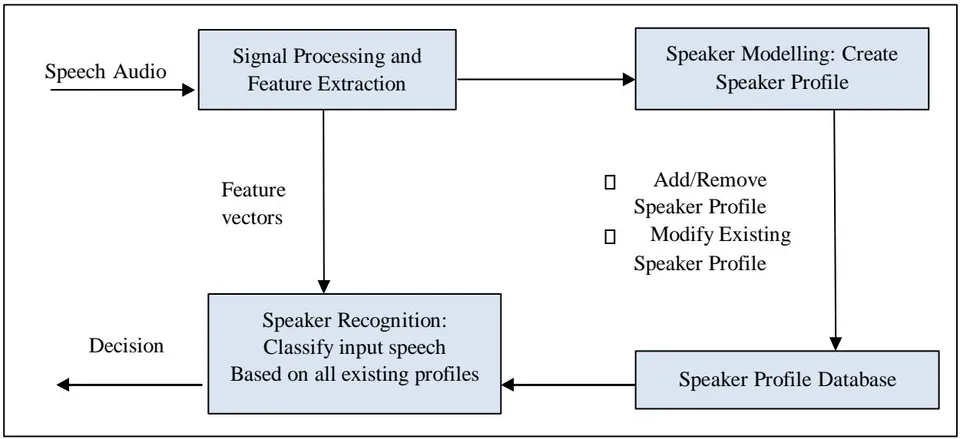
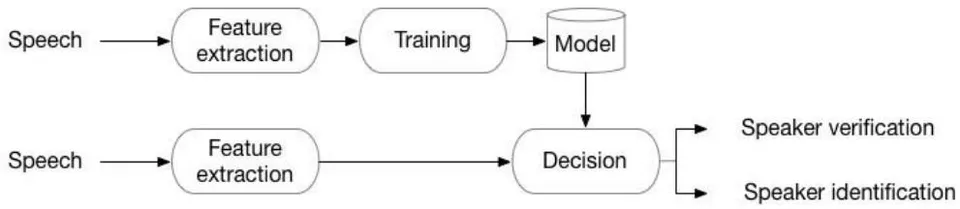
Voice signal identification transforms a speech signal into features which aid for further processing. Quite a number of algorithms and techniques are used as stated by Muda, M., Begam, and I. Elamvazuthi (2010), "Voice recognition algorithms using Mel frequency cepstral coefficient (MFCC) and dynamic time warping (DTW) techniques. The ability of a system or program to receive as well as interpret dictation, or to understand and follow the matching spoken instructions store in the database or inform of cloud storage of the Bank. In general, it is regarded as one of the convenient and safest recognition techniques. The basic block diagram for voice recognition is given in Figure 1. A big challenge of proliferating accuracy and recognition speed is faced by the real time automatic system for speech recognition. Degradation in performance of speech recognition system occurs due to noise. Also it is affected by modifying speech data due to dependence on speaker's gender, environmental conditions and style in which it is spoken. The accuracy of recognition depends on the method of feature extraction and training, so one of the core issues of speech recognition research is the recognition accuracy, speed and the aim.
Moreover, system performance improves in the presence of noise with the use of noise robust feature extraction and training technique Chavan R. C. and Sable, G.S (2013) "An Implementation of Text Dependent Speaker Independent Isolated Word Speech," International Journal of Engineering Sciences and Research Technology.
A two-factor authentication of an individual can help voice to combine what masses say and the way in which they say it. Other identifications such as fingerprints, handwriting, iris, retina, face scans can also help, whilst voice identification is required as an authentication that is not only secure but unique also. Voice recognition systems are economical and easily understood by users. There are some problems associated with Voice recognition such as However, it is the most popular and widely used method of password less authentication but it suffers from some inherent limitations of human voice given such as
Low Signal to Noise Ratio, which can be caused because of background noises, low quality microphone, interference by electrical devices.
Difficult to recognize and individual when in a meeting, conference, etc.
Unable to identify words that have similar spelling and pronunciation but differs in their meaning.
It is difficult to identify whether the voice sample submitted for authentication is presented by some machine (recorded voice) or by the individual itself.
II. RELATED WORK
[1] Human identification of characteristics such as: face, fingerprint, iris, hand geometry, voice, or Biological biometrics such as DNA, blood, hair, etc. and Behavioural biometrics such as the signature, the keystroke dynamics, the gait recognition, etc. In the literature, biometrics based mobile authentication is an emerging issue. Some researcher considers the following modalities as biometrics such as fingerprint, face, voice and iris. In the recent paper Wang, S. and Liu, J. (2011) on Biometrics on Mobile Phone, the authors propose an overview about biometrics on mobile phone through some standard modalities (fingerprint, speaker recognition, iris recognition, gait). Most authors recognise that specific Speaker Recognition for Mobile User Authentication modality as well as Face recognition is dealt with in the paper written by Hadid, A., Heikkila, A, J., Silven, O. and M. Pietikainen, M.(2017) on Face and eye detection for person authentication in mobile phones, or as in Mohammad Shirali-Shahreza (2016), where a real time training algorithm is developed for mobile devices. The authors propose to extract local face features using some local random bases and then to incrementally train a neural network. Image processing also concerns hand biometrics on mobile as in the reference, where hand images are acquired by a mobile device without any constraint in orientation, distance to camera or illumination. The author of Jiehua Wang, Song Yuan, "A Novel Security Mobile Payment System Based On Watermarked Voice Cheque". details an iris recognition system, based on a three-step pre-processing method relying on (a) automatic segmentation for pupil region, (b) helper data extraction and pupil detection and (c) eyelids detection and feature matching. Some recent papers N.L. Clarke and S.M. Furnell (2007). Advanced user authentication for mobile devices. Computers & Security, Mohammad Shirali-Shahreza and M. Hassan Shirali-Shahreza, (2007) "Text Steganography on International Conference on Convergence Information Technology, and Martinez Borreguero, F. Javier and Chaparro Peláez, Julián, "Spanish (2005) Mobile Banking Services: An Adoption Study", Proceedings of the International Conference on Mobile Business. deal with keystroke based recognition. The first paper makes a study about user identification using keystroke dynamics-based authentication (KDA) on mobile devices, relying on 11-digit telephone numbers and text messages as well as 4-digit PINs to classify users. The second develops a more performant KDA process, with optimized enrolment and verification steps, whose principle is extended in the latter paper for touch screen handled mobile devices, along with a pressure feature measurement. The reference [7] presents a new modality for authentication on mobile device, namely gait recognition. The first deals with text-dependent speaker verification. It means that both the user's voice and the uttered text itself are used for the verification. The second paper proposes a new method to extract features from speech spectra called slice features. The aforementioned references show that many biometric modalities can be used for user authentication on mobile device. Therefore, speaker recognition seems the most natural modality choice for implementation on
mobile phone. In the vast literature dealing with speaker recognition, two trends stand out: text dependent and text-independent speaker recognition techniques. We are only interested in the second field Yekini NA et al. (2012) presented a voice-dependent access control system for ATMs. Figure 3 shows the block diagram of the discussed system. The system consists of 3 important components: Voice sensor e.g. microphone, speaker verification system and access control system for ATM machine. A low cost voice sensor is used to record the ATM user's voice and subsequently send it to the voice-dependent verification system to validate the authenticity of the user[5].
The human voice is a complex information-bearing signal, depending on physical and behavioral characteristics. The raw speech signal, uttered by any person, is extremely rich in the sense that it involves high dimensional features. To perform efficient speaker recognition, one must reduce this complexity, while keeping sufficient information in the extracted feature vector.
a) Principles of Speaker Recognition
Both speaker recognition and speech recognition belong to the category of voice signal processing, but speaker recognition focuses on the identity information of the speaker, while speech recognition focuses on the text information corresponding to the voice Martinez Borreguero, F. Javier and Chaparro Pelaez, Julián, "Spanish Mobile Banking Services: An Adoption Study", Proceedings of the International Conference on Mobile Business 2005. Voiceprint can be understood as the pattern of the voice frequency spectrum obtained by the time-frequency analysis technology of the wave-form signal of human voice. Due to the inherent differences in the physiological structure of each person, it also causes the diversity of human speech styles, which provides us with a principle basis for automatically identifying the speaker's identity information through machines.
b) Speaker Recognition Classification
According to different application scenarios, speaker recognition can be divided into two tasks: speaker verification and speaker identification. The former refers to judging whether the current speaker is a certain identity entered in the system, which is a 1:1 confirmation question; The latter means that you don't know the identity of the current speaker, and you need to find the most similar one among the N speakers that the system has entered. It is an N:1 classification problem. According to the different recognition objects, speaker recognition can be divided into three categories: text-related, textindependent and text-prompt. The text-related speaker recognition method requires the speaker's pronunciation keywords and key sentences as training text, and the pronunciation is based on the same content during recognition. The text- independent speaker recognition method does not need to limit the speech content during training and recognition, and the recognition object is a free voice signal. The speaker recognition of text prompts, as the name suggests, the recognition object is the random generation of some specific text given by the system.
c) Speaker Recognition Process
Speaker recognition technology recognizes the identity of the speaker by analyzing the speaker characteristic information contained in the voice signal, which mainly includes two stages of training and recognition: In the training phase, according to the training speech of each speaker, feature parameters are extracted to establish a speaker model; in the recognition phase, after the speech features of the speaker to be recognized are extracted, it is matched with the established speaker model for judgment. The basic principle is shown in Figure 1.
III. RESEARCH METHODOLOGY
a) Proposed Work
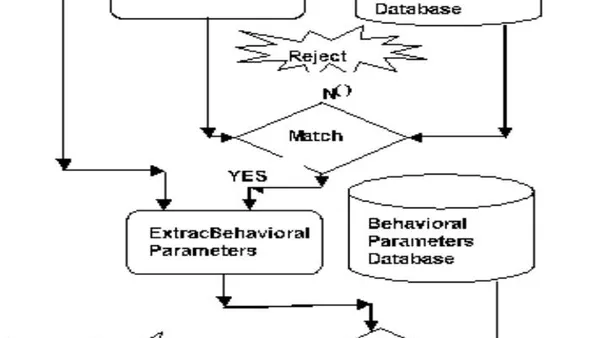
Getting motivated from the above discussed issues being faced in voice authentication system, a new method is proposed below. The proposed method is a hybrid of Behavioral Identification along with Voice Recognition. While registering an individual for first time, along with taking its voice samples for extracting voice prints, the behavioral parameters also get extracted and stored in a database. This behavioural parameter can be voice message identification, to be provided by end users for negative emotional information sympathy by the bank for reference purpose. Whenever an individual claims its identity for authentication, then it will be first verified message store in the database in line with the saved voice print as an additional layer of security. It will be authenticated automatically only after successful passing both the stages. It can be illustrated by following flow diagrams:
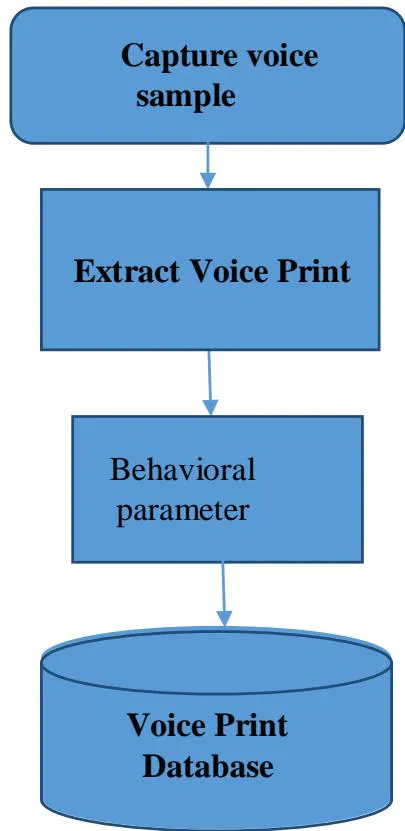
The voice samples of first time user are taken in order to extract and save its voice print as well as behavioural parameter in the databases.
b) Speech Verification Process
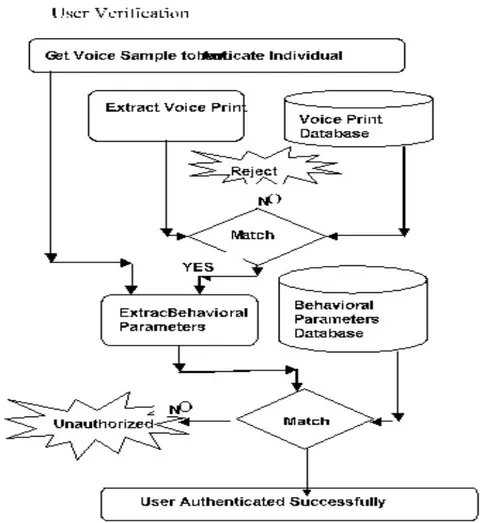
The Voice samples are presented for extraction of voice prints and matched with the saved details in database. If the match is successful, then the match of behavioral parameters is done. If the individual qualifies both the tests, only then the access is granted otherwise rejected.
Since the proposed method is verifying the individual with an additional layer, higher security is supposed to be achieved. The proposed method may be modified to counter attacks against impersonation where in the speaker's voice get recorded and presented later on impersonating the speaker. A human is not supposed to match behavioral parameters each time. There comes an obvious and slight deviation. If there is a case of impersonation of the speaker by some machine then there will be match of the behavioral parameters. On the basis of this fact, mathematical model can be prepared and simulated as well to justify the intended result.
IV. CONCLUSION
Different finance firms as well as industry are relying on voice recognition authentication for their security. Speech recognition can be used for disable person who are otherwise not able to authenticate themselves using traditional techniques. In Africa, it can play a major role in moving the technology to the door step of a common man who is not much literate and not familiar with digital media techniques. As the current system need to be changed for software only not specific hardware in order to deploy this technology, hence it is cost efficient and feasible to deploy too. In the current work, its hybridization with behavioral authentication technique is proposed as it would result in an additional layer of secure authentication and is expected to be withstand impersonation attack.
Nowadays, mobile Technology have become a definite requirement for carrying out millions of transactions that happen in day to day life. Large number of frauds can be carried out using mobile system, In order to overcome these problems hackers, misplacement of mobile phone, it is highly recommended that the banking sector should make the use of voice biometric. This method when fully taken into practise will not only enhance secured and correct authentication, but will also render support in the implementation of complex banking mobile transactions in terms of performs deposits and money transfer, as this system provides enhanced security.