
I. INTRODUCTION OF STUDY
Participatory media has consistently played a significant role in the development of society. By enabling active community engagement, it contributes to shaping public opinion and addressing the real needs of the people. Community media, particularly community radio, has long operated on the principle of being "by the people, for the people," working at the grassroots level to empower local voices and foster social development.
Traditionally, community media relied heavily on the participation of local populations, especially through community radio broadcasts tailored to specific regions. Community participation was facilitated through various means, such as live and recorded programs by local individuals, handwritten letters from listeners requesting particular content or providing feedback, and interviews or vox pops conducted by radio teams. These methods strengthened the connection between the media and the community, making communication more relatable and impactful.
In the pre-digital era, when internet connectivity and digital literacy were limited, community radio production teams would physically visit villages to record community voices, gather local news, and document daily activities. These recordings were then processed and produced into radio programs, which were broadcast to serve the informational and developmental needs of the community.
However, the advent of mobile technology and the rise in digital literacy have transformed the landscape of community participation in media. Mobile phones, particularly smartphones, along with internet connectivity, have emerged as powerful tools for participatory communication. With the use of social media applications such as WhatsApp and Facebook, community radio stations are now able to form digital groups, share updates, and engage with their audience in real-time.
These platforms have enabled community members to actively participate in the content creation process, offer immediate feedback, and stay informed about ongoing initiatives and local developments. As a result, smartphones and social media have become integral components of participatory media strategies.
Today, it is rare to find a community radio station that does not utilize WhatsApp or Facebook to connect with its audience. These tools have not only enhanced accessibility but have also revolutionized the way community media engages with the public. Community members can now contribute to and follow their local radio content through mobile applications, making participation more convenient, immediate, and effective.
The integration of digital tools into community media practices has significantly enhanced the participatory nature of community radio. The evolution from traditional forms of engagement to digital platforms underscores the transformative impact of mobile technology and internet accessibility in strengthening community media as a vehicle for social change.
a) Mobile Revolution in India
In today's era, especially in 2025, it is almost impossible to imagine doing anything without a mobile phone. We rely on mobile phones for nearly every aspect of daily life—whether it's making online payments, shopping, or using various applications for multiple purposes.
India's mobile revolution has profoundly transformed the nation's socio-economic landscape, driven by the widespread adoption of affordable smartphones and cellular data in the 2010s. This surge in connectivity has not only bridged the digital divide but also redefined traditional barriers of language, caste, class, gender, and geography.
In 2010, India had approximately 100 million internet users. By 2015, this number had quadrupled to 400 million and was projected to surpass 600 million by 2020, according to the Internet and Mobile Association of India. This exponential growth is largely attributed to the advent of inexpensive smartphones, which for many Indians have become multifunctional devices—serving as their first personal computers, internet access points, cameras, televisions, and alarm clocks. The transformative impact of these devices is evident across various facets of daily life.
One of the most significant outcomes of this mobile proliferation is the erosion of longstanding societal barriers. Voice-enabled smartphone technology has empowered India's 250 million illiterate individuals to access vast repositories of video and audio content online, fostering greater inclusivity. This technological democratization has enabled people from diverse backgrounds to engage with digital content, enhancing educational opportunities and access to information.
II. USE OF MOBILE PHONES IN COMMUNITY RADIO MEDIA
Mobile phones have become a powerful tool for breaking down barriers to community participation, especially at the local level. As highlighted in this research article, mobile phones serve as a key medium for fostering community engagement, with their multimedia capabilities. They enable seamless communication and help individuals stay connected with others. Through mobile internet, users can access a variety of applications—such as WhatsApp, Facebook, and other social media platforms—that support and enhance community participation. This connectivity allows people to share updates, organize events, and engage in meaningful dialogue, making mobile phones essential in strengthening community ties.
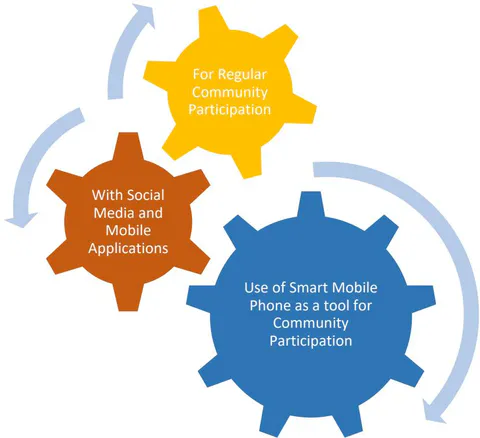
Use of mobile phone as a tool for active community participation in community media with multiple mobile application like:
| With the help of WhatsApp, it has become easy to stay connected with community members by creating WhatsApp groups and broadcasts to share regular updates and easy to do video calls for live participation. | |
| Facebook provides an excellent opportunity to create a dedicated page for community radio, allowing regular updates to be shared with the community and encouraging active participation. | |
| YouTube | Community radio stations can also create their own YouTube channels to expand their outreach, promoting community culture and values with both national and international audiences. |
| Phone Call | In disaster we can make emergency call with mobile phone in the community. |
| Phone Message | Also able to share message in community during emergency. |
This is not only way to connect with community but this is the best medium for effective community participation in community radio media. With the help of this participatory media tool we can shape the community and their community opinion for the development of the community culture and social values.
III. PARTICIPATORY MEDIA THEORY
Participatory Media Theory emphasizes the active involvement of individuals and communities in the creation and distribution of media content. Unlike traditional media systems where content is produced by professionals and consumed passively by audiences, participatory media allows users to become producers, critics, and collaborators. This theory is rooted in democratic ideals, advocating for media as a space where diverse voices, especially those from marginalized groups, can express themselves freely and influence public discourse. Scholars like Nico Carpentier argue that participation in media should not be seen as a simple act but as a deeply political and ideological process. He distinguishes between minimalist participation (limited access and influence) and maximalist participation (deep engagement and decision-making power). Participatory media challenges dominant power structures by decentralizing content creation and encouraging horizontal communication. It includes platforms such as community radio, social media, blogs, podcasts, and citizen journalism. These forms of media empower individuals to shape narratives, reflect community issues, and foster social change. Participatory media theory also draws from concepts like Deleuze and Guattari's "rhizome," suggesting media practices should be flexible, interconnected, and non-hierarchical. Ultimately, this theory promotes inclusivity, agency, and democratic engagement in the media landscape.
Participatory media functions through one of distinct theoretical approaches to broaden this perspective, one additional society-oriented approaches are introduced. Participatory media as an integral part of civil society. Drawing from civil society theory—particularly the relational insights of scholars like Walzer (1998)—this model is enriched by critiques of alternative media offered by Downing (2001) and Rodriguez (2001). This metaphor emphasizes the non-linear, adaptable, and unpredictable nature of participatory media, allowing for a more flexible and complex understanding of its operations and identity.
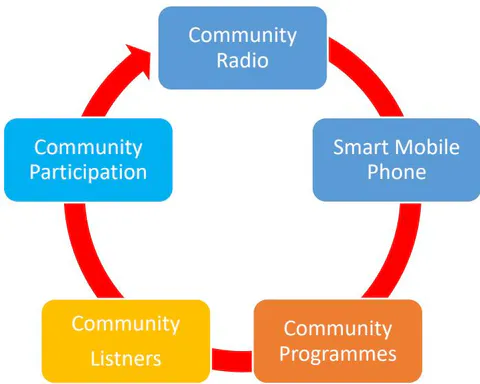
From community radio to community participation with the help of smartphone as a tool.
| Community Radio | "Regular broadcasting is essential for ensuring community participation in community radio. Consistent broadcasts have a direct impact on the community by encouraging continuous engagement and active involvement. Therefore, it is a fundamental principle of community radio that stations must maintain regular broadcasting schedules." |
| Community Programme | "Community radio should broadcast shows and programmes specifically designed for the local community. When radio content is tailored to the needs and interests of the community, it has a direct impact in fostering active listenership and engagement." |
| Community Participation | "Converting active listeners into regular participants in community radio is crucial, as it helps shape the community and contributes to the development of an informed and engaged society. Smartphones play a significant role in enabling direct and interactive participation during live shows through platforms such as WhatsApp, Facebook, YouTube, and live video calls. These tools facilitate real-time connection with the community and help broadcasters better understand the needs and demands of their audience. Community Radio WhatsApp groups, Facebook pages, and YouTube channels that provide updates and host live radio programmes are powerful resources for encouraging active community participation. These digital platforms help maintain regular contact with listeners, who often engage through phone calls, share comments, and join live video streams, thereby strengthening the station's relationship with its audience." |
| Smart Mobile Phones | "In the entire process—from community radio broadcasting to community participation—smartphones play a crucial role in facilitating active engagement. The integration of the internet with mobile applications serves as a highly effective medium for community interaction. These digital tools make it easier to connect with community members and act as powerful instruments for promoting active community participation." |
By incorporating regular day-to-day activities, community radio stations can ensure consistent and active community participation. In this context, smartphones serve as smart tools that significantly enhance the ability of community radio systems to connect with people. This represents a transformative shift in the digital era, where evolving technologies continue to reshape modes of communication. The integration of smart technologies has proven to be both effective and interactive, playing a vital role across various domains, including community media.
IV. DEVELOPMENT COMMUNICATION THEORY
According to communication development theory, the consistent dissemination of development-oriented content through mass media can have a significant and direct impact on societal progress. This includes formats such as public service announcements (PSAs), vox populi (vox-pop) interviews, street theatre (Nukkad Natak), community-based one-to-one interactions, health camps, and programming focused on child and women development, as well as regional and cultural issues. In recent years, the widespread penetration of mobile phones—particularly smartphones—has further enhanced this process by enabling direct, real-time interaction between media platforms and the community. This digital connectivity allows for the timely dissemination of information, thereby strengthening community engagement and accelerating development outcomes at the grassroots level. And under this theory if community radio play regular bases development programmes in the community radio station for the community by the community its defiantly effective.
V. CONCLUSION OF THIS STUDY
This study, titled "Influence of Smartphone as a Tool for Active Community Participation in Community Radio - A Study of Participatory Media," explores the transformative role of smartphones in enhancing community engagement within the realm of community radio. The findings indicate that smartphones have emerged as a significant medium for facilitating participatory communication, enabling real-time interaction between community members and radio stations.
Community radio stations are increasingly integrating smartphones into their operational frameworks, leveraging mobile technology to bridge the gap between broadcasters and listeners. Through voice calls, messaging apps, social media platforms, and audio-visual content sharing, smartphones are fostering inclusive dialogues, encouraging feedback, and empowering local voices to participate actively in the content creation and dissemination process.
This research underscores that smartphones are not only tools for communication but have evolved into participatory media platforms in themselves. They support a more dynamic and accessible model of community media that strengthens democratic discourse, amplifies marginalized voices, and enhances the overall effectiveness of community radio. As community media continues to evolve, the smartphone stands out as a key enabler of active, interactive, and sustainable community participation.