
I. INTRODUCTION
Leaders are characterized by different values, norms, attitudes, beliefs, procedures, conduct, behaviours and practices and which are to a certain extent dependent upon the organizational, professional or institutional culture (Mihelic, Lipicnik, & Tekavcic, 2010). The responsibility of school principals is to provide instructional leadership direction in the management of the school (Diliberti et al., 2019). The principal develops curricula standards to assess teaching methods and monitor student achievement. The school principal has to supervise the daily operation of the institution and facilitate establishment of academic goals through duty allocation to teachers (Horng & Loeb, 2010).
Studies indicate that discipline is fundamental in human conduct and if it lacks among the members of an institution, then the institution cannot perform towards its ideal targets (Ouma, Simatwa, & Serem, 2013). With regards to educational systems, disciplined students are those whose practices, actions and inactions adjust to the set standards and guidelines within the school, (Ali, Dada, Isiaka, and Salmon, 2014).
Discipline ideally implies more than adhering to the set guidelines and standards and involves the student's ability to differentiate right from wrong based on the societal expectations (Gitome, Katola, & Nyabwari, 2013). Discipline is a basic requirement for a successful school system and therefore a matter of interest for all school heads (Eshetu, 2014). He further argues that discipline is a parameter of someone's successful life and it is reflected through the accumulation one's daily activities and behaviours in terms of morals, values and ethics which are always connected and interrelated to the society and attached to societal culture. Indiscipline is argued to be a demonstration of unaccepted conduct in a social network set up or in the general public (Omote, Thinguri, & Moenga, 2015). In the school environment, Ali et al. (2014) argue that indiscipline is any kind of misconduct which learners exhibit in their actions. Currently school principals are faced with enormous challenges in addressing the rising cases of students' indiscipline. Therefore the role of school principals can be said to be perhaps the most dynamic and influential function in the education sector. The duties of school principals have evolved drastically and have been dominated by discourse around principals' responsibility in school achievement, effectiveness and students' moral growth. This requires school principals to embrace ethics in their communication by being truthful and unbiased. Exercising sound communication ethics requires competent communication skills which involve studying, understanding and applying them. It also entails knowing when to follow guidelines, using discernment and judgment of particular situations, environments, and audiences, and articulating sound and just reasons for a decision (Tompkins, 2011)
Bechuke and Debeila (2012) argue that with the ban of corporal punishment as a disciplinary measure, majority of the teachers have experienced difficulties to adopt the recommended alternatives in maintaining discipline in schools. As a result teachers tend to set very strict rules to guide students conduct in schools instead of considering the prevailing circumstances. They further argue that teachers are less knowledgeable on the methods that could enhance learners' self-reliance. Therefore this study sought to establish the influence of principals' communication skills on students' discipline.
II. PRINCIPAL'S COMMUNICATION SKILLS AND STUDENTS DISCIPLINE
Yalokwu, (2002) defines communication as the effective transmission of a common understanding among people through speaking, writing or the other methods. He asserts that unless there is a perfect understanding resulting from transmission of verbal or non-verbal symbols, communication will not be said have taken place. That is communication should result in what the communicator wants. It should generate the desired effect and maintain the effect.
(Littlejohn & Foss, 2010) opines that communication as a process encompasses the level of observation or abstractness, intentionality, and normative judgment. The level of observation or abstractness depends on how broad communication is done. There are different reasons for which people communicate. Some communicate to share ideas, express emotions and pass on information to others through a certain media or technology. Giambra (2014) agrees to this by stating that some people just communicate to meet their social needs.
Globally communication is a tool of relaying information of whichever kind, be it school regulations, government policies, rules and laws among others. According to Nakkazi (2012), communication should produce the desired effect.
In educational institutions communication is a vital tool used in the progress of the set programmes and with regard to handling student discipline. A communicative leadership is essential for any school or organizations with values that are non-negotiable (Zulch, 2014). He further argues that the desired end goal of a school is dependent on the manner in which communication takes place. Unavailability of communication and poor communication by teachers are the major factors that have led students to abandon their study objectives and begin to engage in deviant behaviours at a certain level (Dinu, 2015). The wholesome success of students is directly related to the effective communication of the teachers (Khan, et al 2017). Effective communication skills stimulate moral imaginations that are key the formation of ethical behaviour by the learners. The role of the principal, as an instructional leader, can only be realized by having comprehensive communication skills. Good communication skills help to develop better understanding and beliefs among people, inspire them to follow the principles and values which their leader wants to inculcate in them (Zulch, 2014). School principals as the lead ethical instructional leaders of educational institutions should build among students an understanding that education is embedded on promoting values and character formation which relies on the epistemic status of moral reflection and moral agency (Carr, 2014). Mendels (2012) believes that today's principals need to be focused on instruction and demonstrate effective communication skills so as to manage students moral development who have become more exposed to the world of technology.
A study by Kraft and Shaun (2013) on the effects of teacher- family communication on student engagement in Boston, Massachusetts revealed a positive relationship between teachers and parents communication on students engagement in U.S.A public schools. They further argued that effective teachers and students communication improves their sense of competence and behavioral change.
Myers (2011) opines in his study that the school head's communication is reflective of his or her leadership style. If the leader communicates well, the climate for learning is cultivated well to ensure effective learning. This expansive idea has not been actualized in our schools' reality. Nobody of us may intend to be a failure in his/her activity. Therefore, school heads for the present schools have at the top of the priority list that the brains and the contemplations of teachers and students that they manage are not the same as they were previously, the present individuals will never acknowledge to be treated as slaves or typical specialists who indiscriminately comply with the supervisor's orders.
According to Onyeiwu (2010), in his study in Nigeria, the realization of the goals of a secondary school as an educational organization hinges on effective communication among the various operating personnel. Communication acts as system binder that binds the parts of the system together and binds the system to its environment. In other words, no goal can be achieved if people do not communicate effectively with each other.
Different types of a principal's communication skills have a great effect on the learners' discipline. For a school to maintain a positive image in terms of discipline there ought to be effective communication between and among the education stakeholders (Bursalioğlu, 2013). He further argues that effective communication has to yield the initiated behavior on the part of the sender which conveys desired message to the receiver and causes desired response in behavior from the receiver. Leaders who communicate effectively encourage and stimulate their followers towards the intended goals. They ensure discipline, and a sense of responsibility among team members. Poor communication skills may lead to the failure of a school to yield the desired results as a social agent of change. The source of many personal, organizational and social problems can be found in the lack of effective communication. Ensuring that there is an effective communication system without any misunderstandings and communication misinterpretations should be main tasks of any principal who strives to create a dynamic and targeted relationship among all the organization's followers (Angelika Anderson, 2018). School principals while communicating must ensure that there would be no chance of any kind of miscommunication or misunderstandings. Therefore, the institutional head has to possess effective communication skills both verbal and written to ensure that no miscommunication takes place (Şişman, 2012). According to Mbiti, (1974), communication is essentially a bridge of understanding between people in any institution. Communication leads to good management which aids achievement of organizational goals.
Muriithi (2013) did a study to examine the influence of teachers' communication strategies on students' discipline in public secondary schools in Mukurweini district. Four objectives were formulated that sought to; establish the use of teachers' oral communication on students' discipline in public secondary schools in Mukurweini district; to establish the use of written communication by teachers on students' discipline in Mukurweini district; establish the use of non-verbal communication by teachers on student discipline in the same discipline and to determine the prevailing conditions that hinder effective communication towards student discipline. The study employed descriptive research design which is suitable in collecting both qualitative and quantitative data. The sample included 45 teachers and 540 students. Data was collected by the use of questionnaires. The findings indicated that holding of classroom meetings, use of school prefects, communication during assembly, use of guidance and counseling, use of rewards and incentives, holding of open forums, encouraging members to pass information among themselves are some of the communication strategies commonly used by teachers' in Mukurweini District that have positively impacted on student's discipline.
According to Kiprop (2012), most principals adopt a master-servant or superior-inferior attitude in dealing with students. Believing that students have nothing to offer; principals rarely listen to students. This creates tension, misunderstanding and stress eventually leading to frustrations and violence as manifested in strikes.
Mulwa (2014) conducted a study to investigate the effects of principals' alternative disciplinary methods on students' discipline in public secondary schools in Kitui County, Kenya. His main goal was to establish the use of class meetings with students for collaborative decision making on students' discipline. He based his study on the Systems theory. The findings showed that class meeting enhance decision making since the learners were fully involved during the class meeting. This kind of platform provided a window for the principal and the learners to interact in real time hence, bringing about effective communication.
The manner in which the principal communicates portrays his or her ability to cause change in a school. Hester and Killian (2011) argues that the school heads in their communication ought to consider the principles of ethics if it they have to achieve the desired goal. They further argue that for the principals to be the forces of change, they must be virtuous in their own moral standing. Upholding ethical communication skills for example honesty has profound effects in teaching morality and character formation (Sanderse, 2012). They should strive to be agents of change by being the servants of the people they serve. This implies that principals as ethical instructional leaders should in their communication be clear, brief and should value the thoughts, ideas and feeling of others.
According to Katolo (2016), school heads are critical in shaping an effective school administration where learners' discipline is catapulted by the burning desire for continuous improvement in their scholarly work. The most powerful predictor of a child's behaviour is the perception of control. Students who feel that their school head is not supportive to them mostly tend to display negative behaviours (Rimm-Kaufman & Sandilos, 2012).
Organisational leaders are both implicitly and explicitly charged with being ethical and moral in their communication (Shapiro & Stefkovich, 2011). Instructional leaders have a clear focus on student learning by having a vision, clear learning goals, and high expectations for learning for all students; interactions and cordial relationships with relevant stakeholders and interaction, emotional and interpersonal support, visibility and accessibility. The actualization of these values requires effective communication from the school principals. Oboegbulem and Onwura (2011) assert that effective communication occurs when the sender and receiver of a message deduce the same understanding of the content of the message. The success of secondary school functions depend on the effectiveness of communication from the school leadership to the followers.

From the literature review, it was observed that several studies have been done around the variable, principal communication but there is a research gap on the influence of effective communication skills on student discipline especially in West Pokot Sub- County. For instance, Myers assumes in his research that the principal is considered as the most powerful person to affect the work atmosphere in a school even with the understanding on the cultural change of the students handled today which has resulted from globalization and trends in information dissemination among the adolescents. However, no studies have been noted to have investigated any impact or influence of the principal's communication skills on students' discipline. This study sought therefore to fill the gap of the influence of the principal's communication skills on student discipline in public day secondary schools in West Pokot Sub-County, West Pokot County in Kenya.
III. MATERIALS AND METHODS
The study used a descriptive survey research design. The target population of the study was 3450 respondents. This comprised of 497 teachers and 2953 students from the public day secondary schools in the study area. Simple random and purposive sampling designs were used to arrive at a sample of 593 respondents. The study used research questionnaires, interview and document analysis guides to collect data. A pilot study was conducted in one school from Pokot South Sub County to establish reliability of the research instruments. The collected data was entered, edited, and analyzed by SPSS -26. Descriptive statistics, frequencies and means were used and the results presented by tables and graphs. Qualitative data was analyzed thematically according to the respective specific themes in the objective.
IV. KEY FINDINGS
a) Descriptive results for ethical communication skills and student's discipline
The study sought to find out the influence of the principals' communication and students' discipline. The respondents were required to use the scale which had a key of: 5=Strongly Disagree 4=Disagree 3=Not sure 2=Agree 1=Strongly Agree. The findings were recorded in table 1 communication strategies and student discipline.
| Communication statements | Mean | SD |
| Encourages open door policy where students are free to see the head of the institution to explain their problems. | 2.32 | .96 |
| Encourages students to bring new creative ideas on discipline. | 2.73 | 1.10 |
| Allowing students to have a say in determining the dress code of the school. | 2.33 | 1.13 |
| Setting aside specific day(s) in a week for meetings between the Principals and the students to discuss matters pertaining to student discipline. | 2.39 | 1.33 |
From the results in table 1, it was observed that, the principals encourage open door policy where students are free to see the head of the institution to explain their problems had a mean of 2.32 (Std.96) which was below average, encourages students to bring new creative ideas on discipline with a mean of 2.73 (Std 1.10) indicating an average effort from the principals, Allowing students to have a say in determining the dress code of the school had a mean of 2.33 (Std 1.13) and Setting aside specific day(s) in a week for meetings between the principals and the students to discuss matters pertaining to student discipline had a mean of 2.39 (Std. 1.33) indicating average participation. From the study findings it is observed therefore that the principals' ability to communicate can be considered average.
The teachers were asked to state the extent to which they believed that the principals' communication influenced the quality of student discipline in their schools. Their responses were as shown in figure 1.
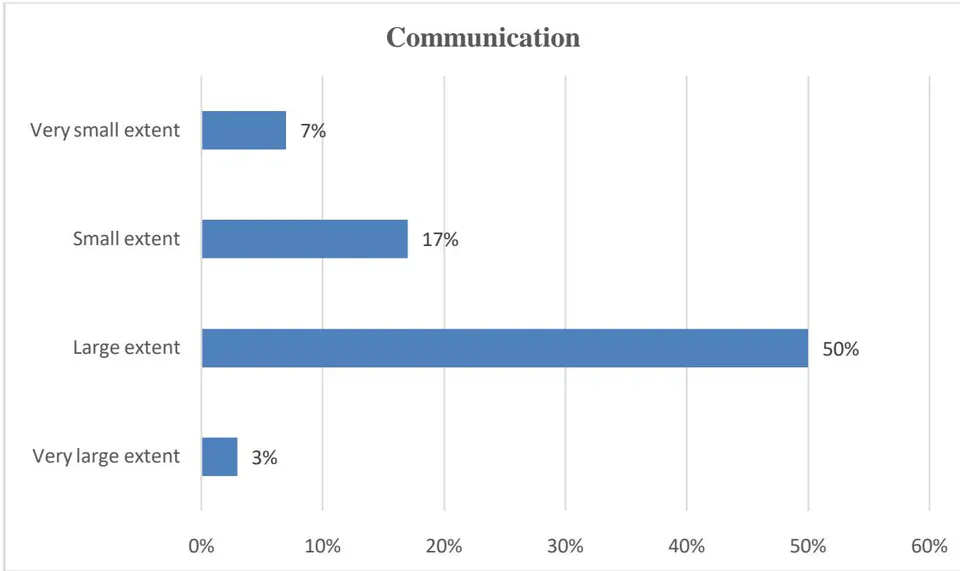
The results from the teacher's responses indicate that the teachers believed to a large extent that if the principals communicate effectively on the expected ethical standards, discipline will be enhanced. However, believed to a small extent that communication led to enhanced discipline among students, to a very small extent and to a very extent. This is validation from the students who also believed that with faultless communication on management of student discipline there will be improved student moral behaviour in schools. The findings conform to a study conducted by Sng Bee, (2012) which found out that good communication skills are not only important for teacher but also important for students for their educational success.
Principals were exposed to similar questions on communication in their daily endeavors in school and all of them were in agreement that teachers meet the threshold of teacher conduct and regulation to a larger extent. They said that this has remained a positive precursor in encouraging students to copy positive behaviour from the regulated code of conduct.
On which channels of communication, they use in their respective schools, announcements during assemblies played out as the common medium of communication, notice boards come out as the second most used method. For instance, one principal said: "...in my school I embrace many media as forms of relaying messages to both teachers and students. Key among them is announcements done during school assemblies and notices placed at different noticeboards in the school..." This conformed to Muriithi's study which found out that teachers' communication on students' discipline was done largely during assemblies.
Majority of the principals believed that to a larger extent good commination can lead to better school discipline.
On how effective the communication strategy leads to effective discipline among the students' in secondary schools, one principal said, "...... A principal may communicate as perfectly as possible but, the key question lies on the students being communicated to. Do the students appreciate the messages that are being put across? What if the principals and those involved in administration are doing the right thing in communicating and yet the consumer does to the contrary? Another principal quipped, "...... There is a gap between the communicator and the student being communicated to. Different people take the information given to them at the same time differently. If a for instance the question is absenteeism where the message is, seek for permission before getting out of school, there are those who in the same day of the message has been given will be absent without any official permission. Will it matter therefore how the communication was done or it more on the consumer of the information?
On the challenges that result from channels of communications in the schools, majority of the principals felt that that the major problems are not in the medium of communication but in the students' who are being communicated to. The communication channels are sufficient and pretty.
The deputy principals were also asked similar questions as the principals on channels of communication adopted in their respective schools. Like the principals, the deputy principals indicated that assembly announcements, noticeboards and fixed message posters were the most used media of communication in schools. It also came out from the deputy principals that principals communicated on matters of discipline from time to time. On the reaction of the students towards the messages, the deputy principals indicated that normally the students will behave like they have understood the information given but just like in any society; there are some who will behave to the contrary of what had been communicated.
The findings that effective communication skills enhance student discipline agree with theory and other studies on ethical researches. For instance, Nejati, and Shafaei (2018). Schools discipline thrives when the leadership communicates ethically and teachers feel valued for their expertise. Devine and Alger, (2011) argue that ethical communication creates transformational school environment that has far reaching positive effects in a school. Students in transformational schools develop positive attitude towards the school and are inspired to work towards positive outcomes (Veeriah, Chua & Siaw, 2017). Teachers and students develop trust in the leadership and they collaboratively strive towards maintaining high levels of discipline as long as the principals are perceived as trustworthy, honest, and admired (Oyer, 2015). School Principals in West Pokot can advance the overall mission of continuous improvement of good morals among students by developing superior ethical communication skills within their schools. The illusive student discipline among secondary school students in Kenya can then be addressed and properly managed.
V. CORRELATION RESULTS
In correlation analysis, the aim is to investigate the strength and nature of relationship between variables; especially, between independent variable and the dependent variable (Helwig, 2019).
Communication skills of the school principals were positively and significantly associated with the students' level of discipline ( , p<.001) an indication that ethical instructional leaders have to possess effective communication skills which are highly associated with good students' discipline. This emphasizes the critical role effective ethical communication skills play in achieving the desired students' discipline in secondary schools.
VI. CONCLUSIONS
The study concludes that there is a significant relationship between principals' ethical communication skills and students' discipline in secondary schools. It is argued that possession of ethical communication skills by the school leadership underpins positive behaviours among students. The study also concludes that the perception of teachers, students regarding principal's communication skills is average or below average among principals in West Pokot Sub County. Focusing on building students' discipline is to build noble and positive characters among the students and strengthening modern human resources. The Poor perception of teachers and students can impact negatively on levels of student discipline.
VII. RECOMMENDATIONS
Effective communication skills are critical today in transforming a society through education. Having leaders who are conscious of the role played by ethical communication skills in schools is a mandatory option. This can be achieved through an elaborate plan of continuous in-service training of current principals and other teachers with an aim of addressing student discipline.
On perceptions change, the current principals in West Pokot Sub County need to work towards understanding the reasons of their ethical rating with a view to strengthen their strong points and improve where they are not strong so has to build a positive attitude from their followers.