Influencia De Las Variables Sociodemográficas En El Rendimiento Escolar Del Alumnado De Educación Secundaria

1
María Ascensión Calcines Piñero
2
Jesús Aleman Falcon
Jesús Aleman Falcon
3
Josefa Rodriguez Pulido

Send Message

To: Author

GJHSS Volume 21 Issue G12

Article Fingerprint

ReserarchID

O2CET

Influencia De Las Variables Sociodemográficas En El Rendimiento Escolar Del Alumnado De Educación Secundaria Banner
  • English
  • Afrikaans
  • Albanian
  • Amharic
  • Arabic
  • Armenian
  • Azerbaijani
  • Basque
  • Belarusian
  • Bengali
  • Bosnian
  • Bulgarian
  • Catalan
  • Cebuano
  • Chichewa
  • Chinese (Simplified)
  • Chinese (Traditional)
  • Corsican
  • Croatian
  • Czech
  • Danish
  • Dutch
  • Esperanto
  • Estonian
  • Filipino
  • Finnish
  • French
  • Frisian
  • Galician
  • Georgian
  • German
  • Greek
  • Gujarati
  • Haitian Creole
  • Hausa
  • Hawaiian
  • Hebrew
  • Hindi
  • Hmong
  • Hungarian
  • Icelandic
  • Igbo
  • Indonesian
  • Irish
  • Italian
  • Japanese
  • Javanese
  • Kannada
  • Kazakh
  • Khmer
  • Korean
  • Kurdish (Kurmanji)
  • Kyrgyz
  • Lao
  • Latin
  • Latvian
  • Lithuanian
  • Luxembourgish
  • Macedonian
  • Malagasy
  • Malay
  • Malayalam
  • Maltese
  • Maori
  • Marathi
  • Mongolian
  • Myanmar (Burmese)
  • Nepali
  • Norwegian
  • Pashto
  • Persian
  • Polish
  • Portuguese
  • Punjabi
  • Romanian
  • Russian
  • Samoan
  • Scots Gaelic
  • Serbian
  • Sesotho
  • Shona
  • Sindhi
  • Sinhala
  • Slovak
  • Slovenian
  • Somali
  • Spanish
  • Sundanese
  • Swahili
  • Swedish
  • Tajik
  • Tamil
  • Telugu
  • Thai
  • Turkish
  • Ukrainian
  • Urdu
  • Uzbek
  • Vietnamese
  • Welsh
  • Xhosa
  • Yiddish
  • Yoruba
  • Zulu

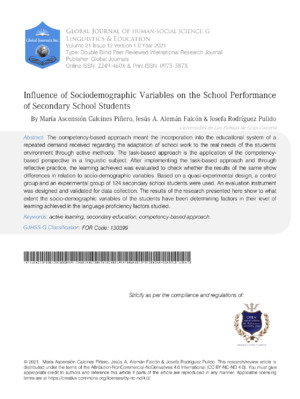
The competency-based approach meant the incorporation into the educational system of a repeated demand received regarding the adaptation of school work to the real needs of the students’ environment through active methods. The task-based approach is the application of the competencybased perspective in a linguistic subject. After implementing the task-based approach and through reflective practice, the learning achieved was evaluated to check whether the results of the same show differences in relation to socio-demographic variables. Based on a quasi-experimental design, a control group and an experimental group of 124 secondary school students were used. An evaluation instrument was designed and validated for data collection. The results of the research presented here show to what extent the socio-demographic variables of the students have been determining factors in their level of learning achieved in the language proficiency factors studied.

Funding

No external funding was declared for this work.

Conflict of Interest

The authors declare no conflict of interest.

Ethical Approval

No ethics committee approval was required for this article type.

Data Availability

Not applicable for this article.

María Ascensión Calcines Piñero. 2021. \u201cInfluencia De Las Variables Sociodemográficas En El Rendimiento Escolar Del Alumnado De Educación Secundaria\u201d. Global Journal of Human-Social Science - G: Linguistics & Education GJHSS-G Volume 21 (GJHSS Volume 21 Issue G12): .

Download Citation

Analysis of socioeconomic variables affecting secondary school performance.
Issue Cover
GJHSS Volume 21 Issue G12
Pg. 25- 32
Journal Specifications

Crossref Journal DOI 10.17406/GJHSS

Print ISSN 0975-587X

e-ISSN 2249-460X

Keywords
Classification
GJHSS-G Classification: FOR Code: 130399
Version of record

v1.2

Issue date

November 30, 2021

Language

English

Experiance in AR

The methods for personal identification and authentication are no exception.

Read in 3D

The methods for personal identification and authentication are no exception.

Article Matrices
Total Views: 2122
Total Downloads: 940
2026 Trends
Research Identity (RIN)
Related Research

Published Article

The competency-based approach meant the incorporation into the educational system of a repeated demand received regarding the adaptation of school work to the real needs of the students’ environment through active methods. The task-based approach is the application of the competencybased perspective in a linguistic subject. After implementing the task-based approach and through reflective practice, the learning achieved was evaluated to check whether the results of the same show differences in relation to socio-demographic variables. Based on a quasi-experimental design, a control group and an experimental group of 124 secondary school students were used. An evaluation instrument was designed and validated for data collection. The results of the research presented here show to what extent the socio-demographic variables of the students have been determining factors in their level of learning achieved in the language proficiency factors studied.

Our website is actively being updated, and changes may occur frequently. Please clear your browser cache if needed. For feedback or error reporting, please email [email protected]
×

This Page is Under Development

We are currently updating this article page for a better experience.

Request Access

Please fill out the form below to request access to this research paper. Your request will be reviewed by the editorial or author team.
X

Quote and Order Details

Contact Person

Invoice Address

Notes or Comments

This is the heading

Lorem ipsum dolor sit amet, consectetur adipiscing elit. Ut elit tellus, luctus nec ullamcorper mattis, pulvinar dapibus leo.

High-quality academic research articles on global topics and journals.

Influencia De Las Variables Sociodemográficas En El Rendimiento Escolar Del Alumnado De Educación Secundaria

María Ascensión Calcines Piñero
Jesús Aleman Falcon
Jesús Aleman Falcon
Josefa Rodriguez Pulido

Research Journals