This paper explores the role of informal cross-border trade (ICBT) along the Eritrean-Ethiopian borderlands amidst a situation of war and uncertainty. It seeks to understand whether ICBT has contributed to the socio-economic recovery of people living on either side of the border and to rebuilding peace. It draws on semi-structured interviews and focus group discussions conducted with local informants between May and November 2021, including smugglers, traders, local officials, border guards, and ordinary inhabitants of Serha and Senafe, as well as my previous fieldwork and personal experiences in Eritrea and Ethiopia. My findings reveal that despite some challenges, ICBT has the potential not only to mitigate socio-economic problems among war-torn borderland communities but also to enhance cross-border relations by breaking down the stereotypes of suspicion and mistrust concocted by the warring states.
## I. INTRODUCTION
Since 1998, the political and military tensions between Eritrea and Ethiopia across their shared border have inflicted immense suffering on the borderland communities of both states. The conflict has led to displacement, misery, and violence. It claimed the lives of between 70,000 and 120,000 innocent Eritrean and Ethiopian soldiers between 1998 and 2000, and resulted in the displacement of 600,000 borderland civilians from the Eritrean side alone (Mengisteab, 2011:17; Steves, 2004:119-33). It is also estimated to have cost Eritrea between $500 million and $1.5 billion, and Ethiopia over $2.5 billion.
The aftermath of the war heralded an even more dreadful situation known as the "no war, no peace" era. For almost 18 years between 2000 and 2018, the bilateral relationship between the two countries was marked by sustained propaganda campaigns, recurring cross-border skirmishes, and interference in each other's affairs (Kaleab, 2019), and resulted in loss of human life, displacement, family separations, and devastating losses of livelihood for the vast majority of the borderland populations (Okubagergis, 2023).
On November 4, 2021, another ruinous war broke out between the multi-ethnic Federal Government of Ethiopia and Ethiopia's Tigray State, one of the
country's ten constituent states, effectively sabotaging the 2018 peace deal in the region (Shaw 2021). The war quickly escalated into a regional crisis involving the Ethiopian National Defence Forces (ENDF), the Eritrean Defence Forces (EDF), and the Amhara Special Forces against the Tigrayan Defence Forces $(\mathsf{TDF})[^1]^{1}$, which resulted in the temporary loss of Mekelle, the TDF's power base. Although it is hard to gauge the full effects of this new cycle of humanitarian tragedy at the time of writing, the war has caused massive displacement and devastation, particularly among the borderland communities (Reuters, 2021).
Against this backdrop of tensions and conflict, engaging in informal cross-border trade (ICBT) $^2$[^2] between Eritrea and Ethiopia would appear to be an exceedingly risky enterprise, and yet across the decades, borderland communities have been actively involved in ICBT along the entire length of the shared border and on the front lines during periods of intense military and political insecurity, including the civil war in Tigray. Surprisingly, the relaxation of border controls by Eritrea and Ethiopia indirectly facilitated ICBT, contradicting the narratives of warring parties in which borders typically function as physical barriers and symbols of division among borderland communities. This relaxation was a consequence of the alliance between the ENDF and the EDF and their penetration deep into Tigray to pursue the TDF, which accidentally gave borderland civilians a degree of freedom.
This article uses a qualitative approach to address the following research question: How has informal cross-border trade contributed to socioeconomic development and rebuilding peace among the border communities amidst war and uncertainty in the Eritrean-Ethiopian border area? The period from November 2020 to June 2021, which was marked by the relaxation of border control systems due to the alliance between the Ethiopian and Eritrean forces, witnessed
ICBT activities across the common border, particularly in Senafe and Serha. The primary objective of this article is to contribute to the ongoing theoretical and policy debates on the interplay between trade and borders, and on the connection between trade and peacebuilding.
My findings demonstrate that the relaxation of controls at the border and its modified function as a consequence of the political and military alliances between the Federal Government of Ethiopia and the State of Eritrea have transformed the broader economic landscape of the border region. The borderland communities seized the new business opportunities that arose across the Serha-[^3]Zalambesa borderland, resulting in unauthorized flows of people and goods across the border. Despite a number of challenges, ICBT has become a significant livelihood for borderland communities who had lost their original sources of income because of the war. It has also played a role in de-escalating conflict and fostering peace among people living on both sides of the border, even though these encounters and interactions have been short-lived.
The article first provides notes on the methodology and contextual background and on the shifting conflict dynamics across the border region and the implications for the fate of its communities. It then situates the argument within the literature on the nexus between trade and peace-building, and goes on to focus on the war in Tigray and ICBT, what it means for socio-economic recovery, and the resulting challenges. The conclusion reflects on what ICBT might mean for the local people and offers academic reflections and policy implications.
## II. METHODOLOGY
The empirical data for this article were collected through focus group discussions, semi-structured interviews, field notes, and personal observations during fieldwork conducted between June and November 2021. These data sets were supplemented by my previous four-year-long ethnographic fieldwork and personal experiences in relation to trade, war, and livelihoods in the Senafe and Serha areas in Eritrea, and in Zalambesa in Ethiopia.3
A total of 29 people (8 women and 21 men) were interviewed. To safeguard their privacy, the personal details in this paper have been substituted with the initials of their first names. The participants include smugglers, traders, local officials, border guards, and ordinary inhabitants from Serha and Senafe. All of them were selected based on their grasp of past and present cross-border life among borderland communities. This study will only serve as an initial exploration, however, and I hope its findings will encourage further detailed investigations encompassing the entire borderland region once the political and military tensions among the warring parties have subsided.
The sensitive and emotive nature of the topic under investigation gave rise to a number of ethical issues. During my research, I interacted with people from diverse socio-economic backgrounds. Securing informed consent posed challenges, as many of my interlocutors preferred anonymity and declined to be recorded. Many of these individuals only felt relaxed when my voice and video recorders were switched off, which made the process of building trust longer.
In some instances, therefore, it took me much more time than I had expected to gain the participants' confidence in me. The restrictions and insecurity associated with conducting fieldwork were also additional barriers. I found it difficult, for instance, to access Zalambesa after the TPLF recaptured Mekelle on June 28, 2021 and the subsequent renewed closure of the border. This problem was overcome by relying on data from my previous fieldwork and the few residents of Zalambesa with whom I interacted in Serha. Fieldwork-related rules and restrictions were also barriers.
## III. THE STUDY AREA: SENAFE AND SERHA
My two case studies, Senafe and Serha, are located in the central section of the Eritrean-Ethiopian border (see map 1). These two sites were selected for three main reasons. Firstly, because they are located at a crossing point on the border between the two states, the borderland communities share long-standing bonds through friendship, intermarriage, and trade with their kin on the other side. Senafe is mostly populated by the Tigrinya- and Saho-speaking ethnic groups, while Serha is predominately inhabited by the Tigrinya-speaking ethnic group (Okubaghergis 2020: 65-89).
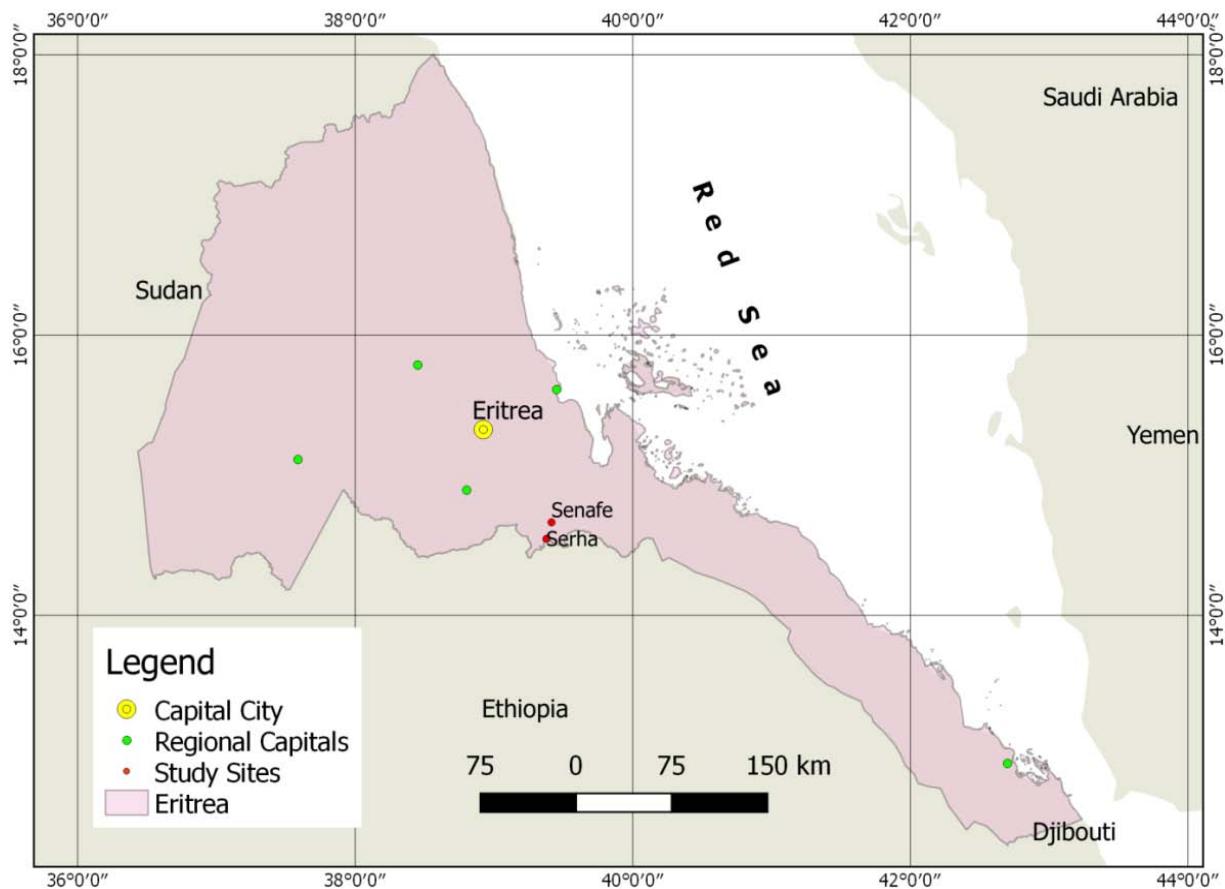 Source: GIS Lab, Department of Geography, College of Business and Social Sciences, Eritrea.
Secondly, over the last two decades, these towns have been the epicenter of deep-seated cross-border conflicts, proxy wars, and severe border enforcement practices between Eritrea and Ethiopia. Throughout the "no war, no peace" years, the Eritrean-Ethiopian border next to the border between the two Koreans was one of the world's "thick" borders, meaning a border that is exceptionally difficult to cross, both physically and mentally (Haselsberger, 2014). Consequently, traditional formal relations among families and friends across the border, particularly in Senafe and Serha, remained closed off for almost 20 years. The jubilation on both sides of the border when President Isaias Afowerki and Prime Minister Abiy Ahmed met at the Serha-Zalembesa crossing point on September 11, 2018 was a celebration marking the end of 20 years of deadlock (Eritrea Profile, 2018).
Thirdly, my previous ethnographic and personal observations reveal that the residents enjoyed particular benefits from the ICBT that began with the tightened border controls in April 2019 until the civil war in Ethiopia broke out in November 2020. It provided access to low-cost goods and services, and most importantly employment opportunities for Eritrean borderland communities, despite the rules and regulations imposed by Eritrea, Ethiopia, and the regional government of Tigray.
## IV. A REVIEW OF THE INFORMAL ECONOMY: INFORMAL CROSS-BORDER TRADE
The past two decades have seen the emergence of a branch of literature on borders and borderland studies informed by a wide range of academic disciplines, including anthropology, sociology, history, international relations, and economics. These studies offer valuable insights into the political, social, and economic implications of cross-border trade on populations living close to borders (Titeca, 2012; Wafula, 2010). Numerous scholarly and policy works have examined the impacts of ICBT, and have resulted in the development of several perspectives, a discipline-related lexicon, and theoretical frameworks.
From one perspective, ICBT has been seen as socially and economically undesirable for reasons associated with its unintended consequences for established local industries, including distortions of producers' price incentives (Ama et al., 2016). It has been accused of having latent effects that disrupt the efficiency and advantages of intra-regional cross-border networks (Healy, 2011). It is also viewed as a source of foreign currency deficits.
From another standpoint, ICBT is seen as a potential way of alleviating poverty and deprivation by providing economic benefits to marginalized borderland communities. As Minde (1998), Harper (1985), Echessah, and Ackello-Ogutu (1998) have demonstrated, households engaged in ICBT sustain themselves and their families through the income it generates for them. ICBT also serves as a source of employment for economically deprived segments of borderland communities where formal economic alternatives are unavailable (Titeca, 2012). However, it often goes unrecognized by governments as a legitimate part of a national or regional economy.
This latter view has found favor with many borderland scholars in Africa (Lesser & Moise-Leeman 2009). For example, in an effort to understand and map the day-to-day opportunities and problems facing borderland communities in the Mano River region of West Africa, Albrecht and Drew explored how "ICBT of livestock, agricultural and manufactured goods, and handcrafts forms the backbone of many locals' livelihood and deepens cross-border connections" (2011: 67-74). In their view, this ICBT network is fueled partly by cross-border familial relationships and partly by transnational networks among traders, as is the case in many parts of the Horn of Africa, which is the focus of this article.
Similarly, Tekere et al. (2000), Muzvidziwa (1998), and Mijere (2006) argue that ICBT has contributed not only to the livelihoods of borderland communities but also directly or indirectly to the socioeconomic rehabilitation of different socio-economic groups living across borders. In this sense, ICBT has become "a means of survival, a source of income and employment" for many underprivileged people living in border regions in Africa (Muzvidziwa, 1998). It also contributes towards rebuilding peace among borderland communities by offering them various opportunities, including employment (USAID, 2021).
In the same vein, a broad range of case studies has focused on border trade amidst conflicts in general and on ICBT and its implications for borderland communities in particular, especially in the Horn of Africa. For example, some scholars have observed the development and challenges of ICBT in the Ethiopian-Somalian, Ethiopian-Kenyan, Sudan-South Sudan, and Uganda-South Sudan borderlands (Little 2014; Rolandsen 2019; Carrington 2009; Little 2015). As Carrington boldly argues: "In places emerging from conflict, trade offers opportunities to revitalize a region, re-establish relationships and build new links between communities estranged by violence" (Ibid. 1). Similarly, ICBT can either help rebuild peace or become a conflict factor among individuals living on each side of a shared border (Rokhideh, 2021). However, I feel there is currently a gap in the research when it comes to understanding how ICBT makes a direct or indirect contribution to socio-economic recovery and rebuilding peace among people living in the Eritrean-Ethiopian border region.
This paper covers a particular aspect of these studies: ICBT from the theoretical perspectives of the borderland communities. It focuses on the role of ICBT for these communities as they seek means of survival amidst war and a state of uncertainty. When I use the term "informal cross-border trade", I am referring to the import and export of legal goods and services across internationally accepted borders that bypass the regulatory framework for taxation and other government-imposed systems (Lesser & Moise-Leeman 2009). This trade takes place through unauthorized or unofficial channels, and is mostly carried out by small businesses across borders. The term "borderland", on the other hand, refers to the physical space along the border. A good starting point for this endeavor is the history of this particular borderland and its changing significance over time.
## V. THE CHANGING SIGNIFICANCE OF THE ERITREAN-ETHIOPIAN BORDERLAND
This section offers a historical overview of the ever-changing status of the border and its implications for the fate of borderland communities. Over decades of shifting political and military circumstances between Eritrea and Ethiopia, the borderland communities have been able to learn not only how to live with uncertainty, restrictions, and war but also how to capitalize on their special geopolitical position and cross-border sociocultural and familial ties. In this context, borderland towns have assumed a central position in the relationships between the nationalities living on both sides of the border.
In 1991, the Ethiopian army crumbled in Eritrea and Ethiopia in the face of joint operations by the EPLF and the Ethiopian People's Revolutionary Democratic Front (EPRDF) (Welde Giorgis, 2014: 148-149). Eritrea gained its independence as a result, and the colonial border with Ethiopia was reinstated. These events changed the border's geopolitical function from an internal administrative border to an international border between two sovereign states. As the overwhelming majority of the interviewees from the Eritrean-Ethiopian border area confirmed, this transformation brought significant positive economic dividends to the border areas, including Serha, Senafe, and Zalambesa (Okubaghergis, 2018:8).
As the post-independence political economy of the case area shows, many borderland inhabitants seized the economic opportunities offered by the geopolitical reconfiguration and capitalized on a variety of border-related factors, including price differences and specialized products, to earn a livelihood and accumulate wealth. As one border-crossing resident put it, "The border turned out to be a new breadbasket for most borderland inhabitants" (YAS, 2017). The ability to exploit the price differences on either side of the political border was viewed as a good tactic for amassing wealth through formal and informal trading in the borderlands. As I have written elsewhere:
Senafe became a land port town, with booming centers of commerce and trade built from the wreckage of the war that had raged for thirty years, mainly with the support of local private investment, much of it from Senafe businessmen. This was further empowered by various social services that provided institutions built by the government of Eritrea. Many exported or imported goods destined for either Eritrea or Ethiopia were loaded, unloaded, and rerouted from here in different directions. The local people also derived a huge benefit from the network and other types of work (Okubaghergis, 2018:80).
It was a similar story in Serha, where formal and informal cross-border trade only continued for a short period until the outbreak of the border war in 1998. During an informal conversation at the Serha border crossing point after the peace deal between Eritrea and Ethiopia on November 27, 2018, an 89-year-old man told me:
I was born and brought up in Serha and worked across the border throughout my life. I have witnessed several phases of this border transformation and its implications for the local communities and the economy in Serha and Zalambesa. The dissolution of the Eritrea-Ethiopian Federation, the period of armed struggle, and postindependence Eritrea are just a few of them. The largest amount of cross-border business took place from 1991 to 1998. Formal and informal cross-border trade activities were common, and Serha was a well-known hub for the whole network (GMS, 2018).
In other words, during much of the 1990s, this border region served as a hub for formal and informal trade, contributing to local development and employment. These activities in turn fostered broader socio-economic relations within ethnic groups and families, allowing local communities to forge an extensive intra-ethnic cross-border network, and acted as a vital source of security and trust-building. In the region, the two towns and their inhabitants generated income as a result of their geostrategic location, and this was boosted further by the treaty of friendship and cooperation signed between Eritrea and Ethiopia in Addis Ababa on July 13, 1993, which resulted in an unprecedented surge in investment and infrastructure expansion (Tesfai, 1998).
However, circumstances changed with the outbreak of the two-year border war (1998-2000) and the subsequent "no war, no peace" situation, which lasted from 2000 to 2018 (Bereketeab 2013). The militarization and heightened security of the entire border area in response to an increase in the constant national security threats from one side or the other left the entire border region in a state of uncertainty. The borderland communities, which share the same culture and the same language, found themselves cut off from one another. In the words of an elderly woman whose daughter is married to a man from Zalambesa:
It has been exactly 20 years since my daughter and I saw each other. I have only received information about her whereabouts, health, and family situation from family members in the UK and Israel or through the Red Cross. I know that she already has a large family. But it is not possible for us to meet or speak to each other as there is no line of communication. The closure of the border has separated us from one another. Recently, I heard that her elder son has married, but nobody has crossed the border. She did it without our being there, which is not only hard to believe but difficult to even imagine (SSU, 2017).
After two decades of limited cross-border exchanges, the Eritrean-Ethiopian rapprochement of 2018 transformed the border region once again, drastically relaxing the strict border control mechanisms (Addis Standard, 2018). On September 11, 2018, the Eritrean-Ethiopian border reopened at Serha-Zalambesa, Bure-Debai-Sima, and Rama-Kisad-Iqa (Eritrea Profile, 2018). No barrier now existed to stop the mobility of people, goods, and services from one political jurisdiction to the other as regards reuniting families, engaging in trade, or establishing businesses. Economically, Senafe and Serha flourished once again as centers of informal and formal cross-border trade, and the residents resumed their main activities. According to one of my informants, more than 2,000 vehicles of different types and functions crossed the international border at the official Zalembesa-Serha (Senafe) crossing point every day (AGD, 2018).
The socio-economic uplift was short-lived. A mere eight months after it reopened, the border was formally closed once again on April 19, 2019 for unknown reasons (Africanews, 2019). The decision prompted shortages of foodstuffs, fuel, and medicines in the border area, particularly on the Eritrean side. Life along the shared border was also impacted by the presence of the army. Cross-border social visits, shopping, and trade were all affected. As a result, as many interviewees put it, the failure of both governments to address local people's concerns drove them to become involved in informal cross-border trade practices throughout the border region. For example:
For us, the borderland community, the border closure impacted every aspect of everyday life. The whole region was reduced to a pre-2018 situation. We are already cut off from our natural market and best livelihood alternative by the decision of the authorities from the two sides of border just for their respective competing agendas. It has caused a significant disruption of supply and demand chains, and so we are compelled to engage in this business, ICBT (MJM, 2019).
Local Ethiopian smugglers brought cheap goods to the Eritrean-Ethiopian border and sold them at reasonable prices to Eritrean traders there. The main imports from Ethiopia to Eritrea were foodstuffs, manufactured goods, and other materials that were expensive in Eritrea (Okubaghergis 2020: 188).
Worse still, the outbreak of war in Tigray in early November 2020 brought a costly cycle of perpetual crises to the region. Numerous reports have noted that the relationship between Eritrean President Isaias Afowerki and Ethiopian Prime Minister Abiy Ahmad, together with the intransigent and inflexible position of the TPLF were the causes of the war (Shaw 2021, 60-73; Africa Institute 2021). Whatever the reasons might have been, the war in Tigray triggered major military and political upheavals throughout the Eritrean-Ethiopian border areas. However, as the next part of this article will show, despite – and partly because of – war and conflict, ICBT offered the borderland communities new opportunities.
## VI. WAR IN TIGRAY AND ICBT IN THE BORDER AREA
This section of the article goes into detail on the impact of ICBT on the borderland communities' socio-economic recovery and its indirect involvement in building peace, drawing from accounts offered by smugglers, traders, local officials, border guards, and ordinary inhabitants from Serha and Senafe. The overwhelming majority of them highlighted the fact that ICBT has played a positive role in reducing the socioeconomic gaps created by war and uncertainty and in moderating tensions between the Eritrean and Ethiopian borderland communities. I will now take the discussion further by comparing the extent of this impact on the two towns, while also shedding light on the remaining impediments to the smooth operation of ICBT.
Within two weeks of the outbreak of war between the Federal Government of Ethiopia and the country's Tigray State in November 2020, the borderland communities found themselves caught in the middle of a military confrontation. As the Ethiopian Federal and Eritrean armies gathered for a ground invasion aimed at unseating the TPLF-led regional government in Tigray, the TDF shelled Senate and Serha from Irob and Adigirat respectively. The ENDF and EDF then launched a powerful counter-offensive at Zalambesa and cleared the TDF from the border areas near Adigirat (BMS, 2021), all just one week after the beginning of the all-out war.
The war in the borderlands remained at a relatively low level of intensity, but as the Eritrean army deployed along the border on high alert, tensions remained high and there was a pervasive climate of suspicion from November 2020 through June 2021 (field notes, June 20, 2021). There were sporadic clashes between the ENDF and the TDF. A 34-year-old Eritrean field commander described the situation on the ground in blunt terms:
Weyani stooges, including militias and former members of the TDF, are very much alive on the Ethiopian side of the border, although they are unable to cause significant disruptions on the Eritrean side. EDF members are present carrying out sensitization work. They prevent subversive activities... The people act as the eyes and ears of the government and automatically report back to the relevant parties when they see or suspect anyone. Nonetheless, these are episodic clashes between the ENDF and the TDF in certain isolated areas (MSO, 2021).
The conflagration in Tigray spiraled out of control, resulting in all-out war in all parts of the region. The war underscored the complexity of ethnic and political tensions in Ethiopia, and the conflict was fueled by historical grievances. The international community, including the UNO, the United States, and the European Union attempted to end the war, but in vain (Tronvoll, 2022). All the warring parties met, but with little success. The ENDF, the EDF and the local regional militias made initial gains on the battlefield, including capturing Mekelle. After seven months of fighting, the TDF managed to take Mekelle back by force and with the support of the Tigrayan people on June 21, 2021.
Amidst these confrontations, ICBT emerged as a new livelihood among borderland communities because of price differentials and an imbalance of demand and supply on the Eritrean side of the border. The border area rapidly turned into a site of socioeconomic exchanges as a result of the easing of checkpoint restrictions. As a 39-year-old Irob man told me:
Since the onset of the civil war in Ethiopia, we have been accorded special economic opportunities against our expectations. As you see, we have been trading across the border. Both men and women participate in small-scale trading of all types of goods, and all the border crossing points across Schimezana plain are increasingly busy. [...] We have gained significant benefits from this business, and have been making a living (GKM, 2021).
The Eritrean border towns of Serha and Senafe served as the central hubs, while Zalambesa, an Ethiopian border town, functioned as the primary operational area. All three places became focal points for local borderland communities from Eritrea and Ethiopia engaged in trade, including the exchange of various smuggled goods. The products imported from Ethiopia largely included foodstuffs, construction and agricultural materials, and electronic and household goods (see Table 1).
Table 1: Price differences in consumer and construction materials across the entire Eritrean side of the border before (Summer 2020) and after (post-November 2020) the outbreak of war in Tigray and the subsequent relaxation of border controls (field notes, 2021).
<table><tr><td rowspan="2">S. No.</td><td rowspan="2">Description</td><td rowspan="2">Unit</td><td colspan="2">Price in Nakfa</td></tr><tr><td>Summer 2020</td><td>Winter and Spring 2021</td></tr><tr><td>1.</td><td>Sorghum</td><td>quintal</td><td>1,500.00</td><td>700.00-800.00</td></tr><tr><td>2.</td><td>Wheat</td><td>"</td><td>2,000.00</td><td>700.00-800.00</td></tr><tr><td>3.</td><td>Rice</td><td>"</td><td>4,500.00</td><td>1,500.00</td></tr><tr><td>4.</td><td>Wheat flour</td><td>"</td><td>1,800.00</td><td>900.00</td></tr><tr><td>5.</td><td>Teff -white</td><td>"</td><td>4,00-5,000.00</td><td>2,300.00</td></tr><tr><td>6.</td><td>Teff -reddish</td><td>"</td><td>5,000- 6,000.00</td><td>2,500.00</td></tr><tr><td>7.</td><td>Red Paper</td><td>kg</td><td>130.00-200.00</td><td>60.00-70.00</td></tr><tr><td>8.</td><td>Pure water</td><td>litre</td><td>25.00-30.00</td><td>10.00-15.00</td></tr><tr><td>9.</td><td>Coffee</td><td>kg</td><td>160.00-260.00</td><td>50.00-60.00</td></tr><tr><td>10.</td><td>Sugar</td><td>kg</td><td>30.00-50.00</td><td>20.00-25.00</td></tr><tr><td></td><td>Fuel</td><td></td><td></td><td></td></tr><tr><td>1.</td><td>Benzene</td><td>litre</td><td>22.00-30.00</td><td>15.00-17.00</td></tr><tr><td>2.</td><td>Petrol</td><td>litre</td><td>26.00-30.00</td><td>12.00</td></tr><tr><td></td><td>Building materials</td><td></td><td></td><td></td></tr><tr><td>1.</td><td>Cement</td><td>quintal</td><td>2,500.00-2,800.00</td><td>300.00-400.00</td></tr><tr><td>2.</td><td>Joists</td><td>piece</td><td>350.00-400.00</td><td>100.00</td></tr><tr><td>3.</td><td>Galvanized steel sheets</td><td>piece</td><td>700.00-600.00</td><td>150.00-180.00</td></tr></table>
From the Eritrean side, traders traveled to the markets in Senafe and Serha from Zoba Debub (Southern zone), Zoba Meakel, and Semenawi Keih Bahr (Northern Red Sea zone). Most were small retail traders and business owners who arrived daily on donkeys, camels and bicycles, and even in small trucks. The largest volume of merchandise came via Adigrat and from as far away as Mekelle. The borderland smugglers, particularly those from Senafe, Serha, and Zalembesa, occupied a strategic position in this new contraband network on both sides of the border: the traders could not achieve their goals without the complicity of the smugglers.
Senafe also received goods from three other routes, however: Sebiya, Drim Ruma, and Mekheta. Residents and businessmen from Senafe brought supplies along four trading routes the most important source being the Zalembesa-Serha-Senafe route. Most of the smugglers who traveled along this route were between eighteen and fifty-five years old, and came mainly from the Irob ethnic tribes.4 As most of the interviewees underlined, and as my personal observations confirmed, the majority were men. They used this particular trade route for three reasons: the absence of critical security threats from the remnants of the TDF forces because the territory was controlled by the EDF, the relatively shorter distance compared to the Serha-Zalembesa route, and fewer checkpoints.
One smuggler explained this to me in greater detail:
Most of us smugglers use the Sebiya, Drim Ruma, and Mekheta trade route primarily because of the smaller numbers of checkpoints and local militia. There are also numerous hiding places and ways to escape unchecked. On the Serha-Zalembesa route, however, we face many challenges. There is also more anxiety at each checkpoint because of supervision, controls, and checks. Passing through each of the checkpoints without any hurdles or payments is very difficult (MZS, 2021).
The Eritrean smugglers usually leave from Zalembesa and other Tigrayan cities and towns and travel to Serha and Senafe during the night to hide from the Eritrean checkpoint guards, local militias, and other agencies. According to the interviewees, most of these were less vigilant between 1:00 a.m. and 5:00 a.m. after an exhausting day of work. Others, mainly smugglers who originally come from the border areas, leveraged their local knowledge of the land and people to easily slip out unnoticed at any time. Some used public buses or private cars and made payment or deals with checkpoint guards so they could pass through without any problem.
The Eritrean smugglers frequently made considerable profits by selling their imported Ethiopian items at higher prices than they would have been able to in their home country. They bought cheap goods in
Ethiopia, which they sold at a great profit on their return to Eritrea, albeit at lower than during pre-war prices (see Table 1). Eritrean smugglers wielded considerable financial power in the transaction process, driving the market and dictating the Nakfa-Birr exchange rates, which was received in Tigray with unqualified satisfaction.
The flourishing ICBT gave rise to a new service economy. Residents of Senafe and Serha offered hospitality services, setting up tearooms, small cateries, bars, stores, and hotels. A 47- year-old woman who owned a small fast-food and tearoom in Serha explained this development and its positive implications:
Immediately after the military build-up in this area, many Eritrean-Ethiopian soldiers gathered around this town and I started this business. The situation turned out to be a blessing in disguise for me and other residents. The fallout from the ongoing crisis is ICBT between the two borderland communities, which has resulted in increased cross-border economic activities and interactions. The town became a booming center of trade and commercial activities, attracting people from different directions. This in turn enabled us to make a living (LGA, 2021).
A similar version of this story was told to me by a 43-year old man who owned a small hotel with full facilities, including tea rooms and eateries:
Following the softening of the border controls, most of us (residents) reinvested our money intensely in the service sectors, as the town turned to being a hub for a growing network of cross-border mobility of goods and people from Ethiopia to different parts of Eritrea (ABQ, 2021).
The cross-border contraband also created employment opportunities for many unskilled and unemployed young people. It allowed them to make more money and had a significant impact on the daily lives of people who were affected by the conflict. Many young people were able to do various wage-paying jobs, including construction, loading and unloading, and service centers in Serha and Senafe, something that had previously been restricted by the strict border regulations. Tigrayan smugglers supplied cheap construction materials and the necessary consumables to regular markets, and sometimes to workplaces, particularly in Serha. A 23-year-old interviewee from Serha told me:
ICBT in this section of the border is not just a livelihood for people living on both sides of the border; it is also a source of stability and new fortunes, and has contributed to a surge in employment that has allowed many people to take different menial jobs. It is a key source of income for many borderland people, both Eritreans and Ethiopians (YGS, 2021).
In line with Tekere et al. (2000), Muzvidziwa (1998), and Mijere (2006), all these stories demonstrate how ICBT has contributed not only to the livelihoods of borderland communities, but also directly or indirectly to the socio-economic rehabilitation of various war-torn socio-economic groups living along the border, including farmers, smugglers, traders, intermediaries, women, and many young people who have been devastated by war. They also reveal how ICBT has helped to soften the hard border along the frontier between Eritrea and Ethiopia and re-establish ties between war-torn family members on both sides of the border while the two warring parties engaged in a terrible war (Tronvoll, 2022).
In this sense, the trade indirectly contributed to reconciling families. The towns, particularly Serha and Zalambessa, were meeting places for families who had been separated by war. People flocked to the market centers not only for the ICBT, but also to update one another about family members and other social issues. In particular, Eritrean families from mixed backgrounds crossed the border to find out about the fate and whereabouts of family members they had lost touch with because of the war in Tigray (field notes, 2021). During my fieldwork in Senafe, for example, I observed numerous clandestine funeral ceremonies in Senafe to honor family members who had been killed in the war.
ICBT therefore opened up opportunities for regular meetings and exchanges in market places, and these kinds of interaction and connection provided a platform for ethnic Tigrayan and Saho communities to reconnect and reintegrate family members who had been separated by war. As one local interviewee noted, this in turn allowed the borderland communities to gain a better understanding of how people can make the best of being trapped by the dynamics of conflict involving all the warring actors in the war in Tigrai (TAS, 2019).
## VII. THE CHALLENGES FOR ICBT
However, the socio-economic opportunities connected with ICBT were not always without their challenges. Many participants faced significant issues when it came to accessing local markets, especially on the Tigrayan side. As one interviewee put it: "Some pro-TPLF militia groups and scattered former TPLF members attack or attempt to confiscate the possessions of Eritrean smugglers in order to sever the existing cross-border trade network between the two peoples" (MKS, 2021).
Many Tigrayans, particularly Irob smugglers, faced intimidation from the TDF. Others were compelled to stop doing business and asked to join the struggle against the Federal Government and its regional allies in whatever capacity or ways they could. An Irob interviewee of mixed Eritrean-Ethiopian parentage revealed that in most isolated Tigrayan border areas, members of the TDF sometimes issued stern warnings or threats against ICBT activities during night-time (THS, 2021).
Smugglers, intermediaries, and local borderland residents on the Eritrean side also mentioned various other hurdles involved in carrying out ICBT. These challenges varied depending on the trade route because of the differing sets of rules and restrictions relating to the mobility of people, goods, and services, particularly those imposed by Eritrea for security reasons. Many participants encountered restrictions from local militia, members of the EDF, and local municipal workers after crossing the border into Eritrea, and expressed dissatisfaction with these limitations.
During my fieldwork in Senafe, one of the members of my focus group told me about his personal experiences:
From Zalambesa to Senafe or from Sebai to Senafe there are at least three checkpoints on average, though they are not as hard as during the "no war, no peace" decades. At each checkpoint, we have to take an informal route. Checkpoint guards, local militia, members of the EDF, and other local government authorities are everywhere. You have to hide from everybody, from staging places on the Ethiopian side to this town. This is why we resort to conducting our business under the cover of night (MIS, 2021).
The border restrictions on the Eritrean side were even stricter, however, and sometimes led to goods being confiscated. It might be argued that the aim of these security efforts was to contain threats from Tigrayans because of the war in Tigray. Many members of the Tigrayan political elites, scholars, and artists made hateful and derogatory speeches against Eritrea, even before the outbreak of the war in 2020. As one official from Serha said of the restrictions: "It also meant to contain trafficking of illegal and harmful goods such as drugs and weapons, which are categorically banned in Eritrea" (KMS, 2021).
There was a significant disparity in the level of border controls between the two case study towns, however: the Eritrean state deployed substantial forces in Serha and its surrounding villages because of its proximity to the international border and the fragile peace. By contrast, being a few kilometers away from the common border, Senafe and its people enjoyed a relatively safer position, leading Eritrea not to install as many checkpoints and patrol forces as in the Serha area.
Apart from the state-level restrictions, there were also other challenges from members of the local communities, some of whom bore grievances against the Eritreans because the war had damaged the exiting cross-border community relations. According to one interviewee from Serha:
The present situation on the ground is quite delicate. The humiliating defeat of the TPLF in November 2020 is widely perceived not just as a defeat but also as a humiliation for the people of Tigray, breeding a sense of betrayal and outrage among TPLF supporters against Eritreans, and resulting in a new uneasiness among the border area people. In fact, some of them bluntly tell us that the day will come to claim their return (YWS, 2021).
The Nakfa-Birr exchange rate and the dominance of Eritrean smugglers were another challenge, particularly for Tigrayans. As a Tigrayan interviewee in Zalembesa told me:
Eritrean smugglers control the market because they have a financial advantage. It is very difficult for us to compete with them. We need some regulatory mechanisms (AGZ, 2021).
This had been an area of concern for many Tigrayans even before the outbreak of the war in Tigray. During my fieldwork in Zalembesa in 2018, a 28-year-old businessman shared a similar story:
Eritreans are benefiting more than us. They take advantage of the exchange rate difference between the Nakfa and the Birr on the black market. With 100 nakfa, they can buy so many things from Ethiopian side of the border, but we cannot do the same on theirs. It would therefore be beneficial to have regularity in our cross-border exchanges (BSZ, 2021).
In short, this points out how in some cases the positive relationship shown by the Eritrean borderland communities was not reciprocated because the war in Tigray brought immense suffering to the people of Tigray. The smugglers faced challenges, particularly from the remnants of the Tigrayan militia, the Tigray Regional Special Forces, and TPLF party members, who lost ground following the fall of the regional dstate of Tigray to the ENDF and the EDF. This reveals that there were obstacles that hindered genuine people-to-people cross-border encounters and interactions, thereby obstructing the construction of a trajectory toward peace.
On June 21, 2021, the situation changed abruptly. Under massive pressure from the United States and the international community, the ENDF and the EDF withdrew all their forces from the interior of Tigray (Ghebreab, 2021). This move initially triggered a reorganization of supply circuits from the Ethiopian side to Eritrea. For the first time, Eritrean smugglers illegally sold goods brought from Eritrean markets including yeast, salt, edible oil, sugar, and wheat flour to Tigrayan traders. A few months later, however, Eritrea banned cross-border economic activities, and as a consequence Zalambesa, which was an epicenter of cross-border trade, became a frontier town. Most of its residents fled for their lives to the immediate neighboring villages, towns, and cities, and former ICBT hotspots and routes fell under the control of EDF or TDF forces.
## VIII. CONCLUSION
In this paper, I have sought to understand how ICBT offered economic opportunities during the war in Tigray and created a setting for encounters and interactions among the borderland communities inspired by Eritrea's softening of controls along the border with Ethiopia as a result of the countries' joint military enterprise in the war in Tigray. The objective of this article has therefore been to contribute to the ongoing theoretical and practical policy discourse on the nexus between trade and borders on the one hand, and trade and peace-building on the other.
My article is situated in broader contemporary borderland studies and draws on detailed fieldwork research carried out mainly on the Eritrean side of the borderlands. I argue that soft borders are helpful for border communities even where a war is under way. Through ICBT, which was historically the people's natural response to Ethiopia's deficit economy and later on to Eritrea's post-independence transition, the two communities were able to make a living, and as a result the borderlands rapidly became a center for socioeconomic exchanges.
As Rokhideh (2021) has noted, ICBT helped the border people make a socio-economic recovery amidst war and a state of uncertainty. In a technical sense, to use the words of Nugent and Asiwaju (1996), the common border served the border communities as "conducts and opportunities" in this context. Despite the complex and obscure military situation, many Eritreans crossed the border to shop in the markets of Zalembesa and Adigrat, where prices were much lower than they were in Eritrea. In turn, these constant encounters and interactions slowly provided them with a setting for rebuilding a feeling of trust toward each other.
Another important feature in this microcosm of war and trade is the primacy of intra-ethnic relations. It presents the complex dynamics of these family relations in the conflict in the region. Notwithstanding the effects of the state of war and the State narratives of exclusion and practices, the communities on both sides of the border, who are related by culture, history, and language, as well as by economic and other cross-cutting interests, maintained their ties and shaped their own world. This article therefore argues that ICBT not only has the potential to mitigate conflict amongst borderland communities, but also enhances cross-border relations by breaking down stereotypes of suspicion and mistrust concocted by States.
However, the socio-economic opportunities associated with ICBT were not without their problems. Many of those involved in the business faced significant challenges, including border controls, border regimes, limited access, and confiscations by various border authorities including border patrols, militias, local municipality officials, and members of the armed forces. For Tigrayans in particular, the Nakfa-Birr exchange rate and the dominance of the Eritrean smugglers were further challenges in the markets, which were controlled by Eritrean smugglers because of the financial advantage they held over Tigrayans, which was a source of dissatisfaction.
### ACKNOWLEDGMENT
I wish to thank Simon, Prof. Luca Puddu (University of Palermo), all participants of the Amplifying African Voices in Peacekeeping and State-building' writing workshop held in 2022, and two anonymous reviewers and editors of this journal for their insightful comments on an earlier draft of this article. This study was funded by African Peacebuilding Network (APN) individual fellowship programme.
Notes on contributor
Biyan Ghebreyesus Okubagherghis is Assistant Professor in the Department of History at the College of Business and Social Sciences, Eritrea. His earlier publications are: The Eritrea-Ethiopia Border Region (1991-98): People without a Border; Eritrea-Djibouti border dispute of 2008 and its impact on their bilateral relations; and intra-ethnic interaction across a militarized international borer: Evidence from the Eritrea-Ethiopian zone. His research interests include the History of the Horn of African Politics, Borders and Borderlands and International Relations.
[^1]: To avoid confusion, the term Tigray Defence Force (TDP) is used in this paper to refer to the Tigraya rebel forces, which the Federal Government of Ethiopia has branded as 'terrorists'. _(p.1)_
[^2]: In this paper the term "informal cross-border trade" refers to exports and imports of legal goods and services across internationally accepted borders that bypass the regulatory framework for taxation and other modalities set out by government. _(p.1)_
[^3]: Zalambesa is a small border town on the Ethiopian border. It is located in Gulomkada, the eastern zone of Tigrai state. It lies about 500 metres south of Serha, the Eritrean border town. _(p.2)_
[^4]: The Irob are a sub-group of the Saho ethnic group. They speak Saho and mostly live in the central area of the Eritrean-Ethiopian border region. They are partly Orthodox and partly Catholic, and predominantly farmers and pastoralists. _(p.7)_
Generating HTML Viewer...
References
46 Cites in Article
L Aalen,K Tronvoll (2009). The End of Democracy? Curtailing Political and Civil Rights in Ethiopia.
Worku Aberra (2016). Asymmetric Benefits: The Ethio-Eritrea Common Market (1991-1998).
C Ackello-Ogutu,P Echessah (1998). Unrecorded Cross-Border Trade between Tanzania and Neighbours Implication for Food Security.
Mehdi Labzaé (2021). The war in Tigray (2020–2021).
(2018). Full Text of the Ethio-Eritrea Agreement in Jeddah Https.
Africanews (2019). Ethiopia-Eritrea Relations Hampered by Closed Borders.
P Albrecht,E Drew (2011). Security Governance in the Mano River Borderlands.
James Anderson,Liam O'dowd (1999). Borders, Border Regions and Territoriality: Contradictory Meanings, Changing Significance.
M Baky (2018). Peacebuilding in Tunisian Border Regions: A Missing Piece of the Transition Process. Borderlands and Peacebuilding: A View from the Margins.
R Bereketeab (2013). The Complex Roots of the Second Eritrea-Ethiopia War: Re-eamining the Causes War.
N Cagatay (2001). Global Multidimensional Poverty Index 2021.
G Carrington (2009). Cross-Border Trade: Fuelling Conflict or Building Peace?.
M Harper (1985). Book Reviews : Managerial Communication: A Strategic Approach. Larry R. Smeltzer and John L. Waltman. New York: John Wiley and Sons, 1984. 556 pages. Hard bound.
B Haselsberger (2014). Decoding Borders. Appreciating Border Impacts on Space and People.
S Healy (2011). ECA : Towards a Sub-Regional Economic Cooperation.
E Kahiya,D Kadirov (2020). Informal Cross Border Trade as a Substratum Marketing System: A Review and Conceptual Framework.
C Lesser,E Moisé-Leeman (2009). Informal Cross-Border Trade and Trade Facilitation Reform in Sub-Saharan Africa.
Peter Little (2015). Unofficial Cross-border Trade in Eastern Africa.
Felix Makonye (2022). The Federal Democratic Republic of Ethiopia’s War with the Tigray Region: History, Causes of War, Humanitarian Crisis and Mitigation Measures to Stem Conflict.
Mbo (2016). Assessing the Participation of Men and Women in Cross-Border Trade in Agriculture: Evidence from Selected East African Countries.
Kidane Mengisteab (2011). Critical Factors in the Horn of Africa's Raging Conflicts.
J Mijere (2006). Informal Cross-Border Trade in the Southern African Development Community (SADC).
(2018). Joint Declaration of Peace and Friendship between Eritrea and Ethiopia.
Joseph Magnet (2018). Afar Perspectives on Ethiopia-Eritrea Rapproachment: Two Roads to Assab.
Victor Muzvidziwa (1998). Marriage as a survival strategy: The case of Masvingo, Zimbabwe.
B Okubaghergis (2023). Intra-ethnic interaactions across a militarized international border: evidence fron the Eritrean-Ethiopian border.
Jon Abbink (2020). Law Against Reality? Contextualizing The Ethiopian-Eritrean Border Problem.
(2019). The Eritrea-Ethiopia Border Region (1991-98): People without a Border.
P Nugent,A Asiwaju (1996). African Boundaries: Barrier, Conduits and Opportunities.
M Wilson (2006). The Business of Civil War: Military Mobilization and the State (1861-1865.
Muez Tewelde¹,Gizienesh Kahsay²,Tsgehana Gebregyorgis²,Yemane Leake³ (2021). Prevalence and Determinants of Post -Traumatic Stress Disorder Among Internally Displaced People in Aksum, Armed Conflict–Affected Tigray Region, Northern Ethiopia.
A Ramsbotham,I Zartman (2011). Paix sans Frontières Building Peace across Borders' Accord: An International Review of Peace Initiatives.
R Reid (2004). Old Problems in New Conflicts: Some observation on Eritrea and its Relations with Tigray, From Liberation Struggle to Inter-State.
M Rokhideh (2021). Leveraging the Peacebuilding Potential of Cross-Border Trader Networks in Sub-Saharan Africa.
Aging Unknown Title.
Ø Rolandsen (2019). Trade, Peace-Building and Hybrid Governance in the Sudan-South Sudan Borderlands.
A Shaw (2021). The Tigray War and Regional Implications. Ethiopia at War.
F Steves (2004). Regime Change and War: Domestic Politics and the Escalation of the Ethiopia-Eritrea Conflict.
M Tekere,P Nyatanga,S Mpofu (2000). Informal Cross-Border Trade: Salient Features and Impact on Welfare:Case Studies of Beitbridge and Chirundu Border Posts and Selected Households in Chitungwiza.
A Tesfai (1993). The Agreement of Friendship and Cooperation between the Transitional Government of Ethiopia and the Government of the State of Eritrea.
Kristof Titeca (2012). Tycoons and contraband: informal cross-border trade in West Nile, north-western Uganda.
Kjetil Tronvoll (2022). The Anatomy of Ethiopia’s Civil War.
Ronald Fisher (2012). Comparing a Problem-Solving Workshop to a Conflict Assessment Framework: Conflict Analysis versus Conflict Assessment in Practice.
D Washington (1997). Multi-agency radiation survey and site investigation manual (MARSIM). Final report.
W Wafula (2010). Magendo & Survivalism: Babukusu-Bagisu Relations & Economic Ingenuity on the Kenya-Uganda Border 1962-1980.
Z Yousuf (2018). Peacebuilding in Borderlands: A View from the Margins.
No ethics committee approval was required for this article type.
Data Availability
Not applicable for this article.
How to Cite This Article
Biyan Ghebreyesus Okubaghergis. 2026. \u201cInformal Cross-Border Trade along the Eritrean-Ethiopian Border: A Factor of Conflict or a Way of Building Peace?\u201d. Global Journal of Human-Social Science - E: Economics GJHSS-E Volume 24 (GJHSS Volume 24 Issue E1): .
Explore published articles in an immersive Augmented Reality environment. Our platform converts research papers into interactive 3D books, allowing readers to view and interact with content using AR and VR compatible devices.
Your published article is automatically converted into a realistic 3D book. Flip through pages and read research papers in a more engaging and interactive format.
This paper explores the role of informal cross-border trade (ICBT) along the Eritrean-Ethiopian borderlands amidst a situation of war and uncertainty. It seeks to understand whether ICBT has contributed to the socio-economic recovery of people living on either side of the border and to rebuilding peace. It draws on semi-structured interviews and focus group discussions conducted with local informants between May and November 2021, including smugglers, traders, local officials, border guards, and ordinary inhabitants of Serha and Senafe, as well as my previous fieldwork and personal experiences in Eritrea and Ethiopia. My findings reveal that despite some challenges, ICBT has the potential not only to mitigate socio-economic problems among war-torn borderland communities but also to enhance cross-border relations by breaking down the stereotypes of suspicion and mistrust concocted by the warring states.
Our website is actively being updated, and changes may occur frequently. Please clear your browser cache if needed. For feedback or error reporting, please email [email protected]
Thank you for connecting with us. We will respond to you shortly.