The environment in which Albanian business activities are carried out has changed continuously, as a result of changing economic, political, socio-cultural and technological factors. Businesses, which have become increasingly globalized and interdependent, have begun to carry out all organizational activities in a virtual environment. Businesses are constantly reviewing their managerial practices, to adapt to the constantly increasing complexity of the business landscape in order to benefit from the unique competitive advantage, knowledge. Even the Albanian government itself considers information and communication technology as one of the highest priorities to achieve high living standards and economic growth. Based on the characteristics of Albanian business and considering the fact that firms must struggle for a confrontation between environmental conditions and organizational structures and even more so when environmental conditions impose conflicting requirements on the desired organizational structure, we offer suggestions to make our business as competitive as possible, by getting involved in virtual organizations.
## I. INTRODUCTION
Management and especially organizational structuring, have been part of ongoing debates and analyses by researchers and businesses. We increasingly see a tendency for organizations to move from bureaucratic forms of organization to more flexible and entrepreneurial structures. One of the reasons for this movement is for organizations to adapt to the constantly increasing complexity of business and to benefit from the unique competitive advantage, knowledge.
Today, business profitability increases from the effective use of financial, human and technological resources. It is emphasized that those firms that invest in human capital will be more difficult to defeat by competitors in the near and distant future. But the process of human resource management carries complexities, because unlike all types of resources, human assets are difficult to replace. Technological progress has made the achievements of organizations and individuals extend in the same way, which makes it possible to have a power or resource without the intervention of any centralized authority. These technological achievements allow organizations to become more centralized or decentralized, in accordance with their strategic orientation and emphasize the efficiency of the global business management process. However, centralization is still a preferred way of management, despite the increasing desire for decentralization of operations. In view of the competition, which is evident in the new business world, a new perception of the organization, its structuring and management in general emerges as a necessity. Often these perceptions are defined as paradigms.
Management theories that have studied and examined the "virtual organization Network" are not clear and have not provided more than a basic explanation about technological developments related to business opportunities, to make organizations more flexible in the global market.
In the same way, not very deep analyses have not drawn any conclusions about the management of "virtual organizations" and the key factors that play a major role in the success or potential failure of this fluid organizational structure. Despite its impact on organi zations, it does not always guarantee optimal results for any organization or individual (Thuong, 2019).
Based on the characteristics of Albanian business and considering the fact that firms must fight for a confrontation between environmental conditions and organizational structures and even more so when environmental conditions impose conflicting requirements on the desired organizational structure, it is necessary to find mechanisms to make our business as competitive as possible, by engaging in virtual organizations.
## II. LITERATURE REVIEW
# a) The Evolution of Organizational Structure
Organizational structure plays a key role in how businesses function, influencing everything from decision-making processes to employee behavior. Traditionally, when talking about structures, the focus is on the hierarchical division of tasks and responsibilities in the organization, but modern perspectives expand this definition to include the regulation of activities, representation in decision-making and the structuring of legal entities (Albert, 2024).
P. Senge, "(1990) focused attention on the great importance of knowledge as a source of success. The role of knowledge is so critical that no organization can deny the importance of existing knowledge and the creation of new knowledge. His greatest contribution is the detailed treatment of the concepts of social systems theory and turned them in the opposite direction.
The organization as a social system is an information model, which connects everything in its capacity for self-design. The emphasis was now placed on organizational learning rather than individual learning. It was emphasized that organizations must learn to do different things in different ways. Here lies the difference between TQM and learning. Later, Hodgetts, Luthans and Lee, conceived of learning as the transformation of an organization, which focuses on the need for change. The "learning paradigm" suggested that power tendencies emerged in small firms because they learn relatively quickly (because large firms have to overcome bureaucratic obstacles). So gradually we see that we have moved from the traditional form of organization to new forms of organization. Elements of structure, such as chain of command, centralization, decentralization, formal authority, cooperation and coordination plans, fit together to form a complete structure.
In some organizations, the vertical hierarchical form is emphasized as the way to achieve control and coordination. In other organizations, decision-making is decentralized, there are cross-functional collaborations and workers are given great freedom to carry out their tasks as they see fit. The tendency to the shift from a horizontal structure to a vertical structure reflects the trend towards empowering employees, sharing infor mation, and decentralizing decision-making, and at the forefront of this movement is the "learning organization" type of organization. There is no single model of what a "learning organization" looks like.
In traditional organizations, vertical structures predominate with fewer tasks. There is a tendency for collaboration, or managerial efforts for horizontal coordination, but information is communicated up and down the organizational hierarchy, jobs are limited, tasks are specialized, and employees have little say in how their jobs are performed. The culture is rigid and does not encourage risk-taking; change and decision-making are centralized. The inverse form of this approach is the "learning organization." A "learning organization" is an organization in which everyone is involved in identifying and solving problems, enabling the organization to continue on the path of change and improvement, that is, to enable its capacity to grow and achieve its goal. The "learning organization" tries to break down boundaries with other companies. It can use a combination of real (actual) members, alliances and partnerships, to apply new structuring innovations, to promote cooperation inside and outside the organization.
To identify needs and to solve problems, people must be aware of what is happening. They must understand the organization as a whole, of which they are a component part.
In the "learning organization", electronic communication is essential for sharing information. But this form of organization also supports the importance of receiving information from people face to face, emphasizing listening.
In traditional organizations, decisions are made in a hierarchy. In the "learning organization", people are closely connected to the problems, they are given authority and responsibility in making decisions. In traditional vertical organizations, ideas, knowledge, and expertise drive the corporation. In a learning organization, leaders influence all visions and directions, but they do not control or direct strategy. In contrast to a traditional organization, people are encouraged to try new things and to accept failure. Learning organizations have permeable boundaries and are often connected to other companies, allowing each organization to learn about new strategic directions and needs.
Culture is the foundation of a learning organization, and an adaptive culture means that people care about their stakeholder groups. In a learning organization, culture genuinely encourages equity, continuous improvement, and change. G. Morgan supported the idea that learning is maximized as well as flexibility in decentralized models of operations. He insisted that a decentralized network organization is the best design, resembling a "spider web." He considered such a thing to be a pure risk, but modern times require taking risks in order to bring about innovation.
Organizations have long been treated as stable or resilient networks. The results of operating in this way vary widely. Some attribute them to fierce competition as the only way to adapt to volatile global consumer markets, as well as to new markets and technologies. Managers have prominently presented, even turning into myths, the advantages derived from networks and have often commented on the disadvantages of bureaucracy and command-control hierarchies. The greatest advantage of the network structure lies in competitiveness on a global scale, as well as the flexibility and challenges of the workforce.
The tendency to move towards such network structures comes as a result of the transition from an industrial society to an information society; from a national economy to a world economy; from centralization to decentralization; from hierarchy to networks., (J. Naisbitt, 2001). Network structures emphasize cooperation and interconnection, a strategy that is increasingly being adopted by global organizations that seek seamless integration in all operations (Ding et al., 2023). A network organization is a decentralized system that emphasizes communication and extensive mutual influence throughout its structure. In the context of a corporate merger, the development of such an organization can be assessed by analyzing changes in social dynamics using tools such as sociometric surveys (Ding et al., 2023). Papscott and Caston (2000) argued that hierarchical flow control and technological advantages favored the opening up of network organizations. Tab.1.
Table 1: From Closed Hierarchies to Open Network Organizations
<table><tr><td></td><td>Closed hierarchy</td><td>Network organization</td></tr><tr><td>Structure</td><td>Hierarchical</td><td>Network</td></tr><tr><td>Field of activity</td><td>Internal, closed</td><td>External, open</td></tr><tr><td>Focus of resources</td><td>Capital</td><td>Human resources, information</td></tr><tr><td>State</td><td>Stable</td><td>Dynamic, changing</td></tr><tr><td>Direction</td><td>Managerial commands</td><td>Self-management</td></tr><tr><td>Basis of action</td><td>Control</td><td>Authorization for action</td></tr><tr><td>Basis of compensation</td><td>Position in hierarchy</td><td>Level of competence</td></tr></table>
The purpose of a network platform is to attract participating companies to work together, to facilitate the exchange of knowledge between them. The treatment of the web focuses on: technological platforms and increased returns. The technological standard reduces risk, as a need of companies, realized through strong investments in R&D, while increased returns create an independence between participants, by attracting more producers and consumers. J. B. Quinn explained the importance of software in strategic importance and explained why they enable network structures, and introduced the concept of strategic outsourcing: In markets with rapid change and technological change this strategy reduces risk, accelerates learning and shortens development cycles. He imagines the firm as a package of service activities, and that services, not manufacturing activities, provide the main source of value to customers. Taking this vision into account, bureaucracy was attempted to be destroyed. Bureaucracy itself developed in the period when manufacturing was the main platform for value addition. He suggested that "...there is no reason why organizations cannot become "infinitely flat" (infinitely flat) guided by a computer system. He investigated the transformation as a "spider web" organization, which is a non-hierarchical network, and emphasized that creative organizational forms depend on software.
The apotheosis appeared, when he proved that software was so pervasive, becoming the primary element in all aspects of innovation from basic research to product introduction (presentation) and software is a facilitator of organizational learning. (Quinn, Baruch, Zien, 1996).
The effectiveness of any organizational structure lies in its ability to adapt to evolving business environments, while addressing deficiencies. Organizations must balance structural frameworks with mechanisms that empower employees, foster collaboration, and align behaviors with strategic objectives (Nwizia & Okachi-okereke, 2020).
### b) Virtual Organizations
The great advantages offered today by communication and information technology have led to the priority and emphasis being given to borderless organizations and virtual corporations. With the development of computer technologies, people can abstract from the real world and virtually feel as if they are in a virtual place. With virtual reality and computer technology, the place where we are is not important and we can walk to the shopping mall, do shopping; attend meetings, visit the museum or library, do research; talk to other users in different environments, see them and talk to them (Ataman, 2002: 400). It is a fact that today in our century organizations are becoming increasingly unstable, changeable and are in search of a new status, so they are part of the change. Organizations that resist change and fail to adapt to the changing business environment are generally considered to be resistant to progress (Cameron and Quinn, 2006, p. 1; Nydegger and Nydegger, 2010; Morrison-Smith and Ruiz, 2020; Cowling and Dvoulety, 2023; Yadav and Banerji, 2023). Driven by technological progress and globalization, the world is becoming increasingly interconnected, transcending time zones, regions, geography, and national boundaries (Abarca et al., 2020; Caputo et al., 2023; Pandey et al., 2024). Thus, the use of virtual teams has become a major trend within organizations (Kimura, 2024). These are networked organizations that use the latest technologies using a set of strategic alliances and business contracts, which keep operations alive and efficient without spending, or without the cost that the existence of all the supporting business functions would have. The virtual organization is essentially a traditional organization, but without its traditional physical boundaries (P. Christie & R. Levary, 1998), using the latest developments in information technology.
The term "virtual" means "physical inexistence, but the use of software" in the management literature identifies virtual organizations as an extreme form of outsourcing, or the opposition of Weber's bureaucracy.
Different organizations are distinguished from each other by the degree of virtuality applied. Today, many businesses are gaining competitive advantages by fostering global collaborations and reshaping their organizational activities by maximizing strength, addressing threats, and increasing speed as a result of digitalization (Duarte and Snyder, 2006; Horwitz et al., 2006; Olson and Olson, 2012). Given that the virtual organization can be treated as a combination of parts (people or organizations) geographically distributed and electronically connected, so that each contributes based on competencies and skills to achieve a common goal, we assert that this virtual organization allows each part to focus on those areas in which it possesses distinct competence. But not all organizations have this breadth of scope and application of virtuality. Some of them are in the earliest stage and are often limited to the creation of virtual teams. These teams are groups of employees set up by managers and, unlike other teams, function by breaking the boundaries of the organizational system in which we are accustomed to working before the use of modern information technology. These forms of organization allow the team to include individuals who are geographically distant from the center of the company. They can connect and communicate with each other on various work problems using the Internet or intranet.
The classics Davidow and Malone identified virtual organizations as a suitable organizational project that, through technology, replaces the control of information described in the bureaucracy and realizes communication between employees of each location, through electronic communication.
Virtual handling enables a company to create a collection of the best professional skills for a particular project. Some virtual organizations are very flexible and responsive. Like network organizations, virtual organizations can be global. The virtual form also enables companies to take advantage of world-class talent on a temporary basis without having to hire them full-time. Many professionals value personal time and autonomy over a stable job and income, so the virtual form gives them the opportunity to work on projects that are of particular interest to them. One of the main disadvantages is the lack of control. The boundaries of a virtual organization are weak and unclear. Top managers thus provide a strong definition of project goals to maintain focus groups, but also define new requirements for managers, who will constantly work with new people, new ideas, and new problems. Lipnack & Stamps define a virtual team as "a group of people interacting through independent tasks, guided by a common purpose," that "works across space, time, and organizational boundaries with lines empowered by networks of communication technology." We define a virtual organization as a geographically distributed organization whose members are linked by a common interest or long-term goal, and who communicate and coordinate their work through communication technology. In addition to technological adoption, they undertake initiatives to improve communication and motivation, via telephone and e-mail.
Communication is very important in the work of virtual teams, especially in defining goals and objectives that can be achieved. Many studies show that low quality of communication in virtual teams causes dissatisfaction among members. This situation is not healthy in the collaboration of virtual teams as it can cause failure in achieving their goals. Akkirman and Harris (2005) discuss that employees in a virtual workplace experienced lower levels of work stress, all related to the quality of communication. Normally, members who have poor communication skills are related to lower levels of commitment to their work. The problem will be compounded when they work together, because usually, employees who have a low level of communication and commitment to work will also have lower productivity. We know that low productivity will make employees not interested in their tasks.
The convenience of information technology and the role of the organization in providing knowledge to virtual workers about the technology help all workers to become more effective and productive. Clear communication can also be achieved using the technology that is available today. However, the most important thing is that virtual workers should undergo training in the use of virtual technology.
A key feature of virtual organizations is the high degree of informal communication. Because of a lack of formal rules, procedures, and clear reporting of relationships and norms, even more informal communication is necessary. (Monge & Contractor, in press). Formal communication networks, imposed, or mandated, represent a legitimate authority of the organization, reflected in the organizational chart. They are also representative of the communication channels that facilitate the downward transmission of orders and the upward transmission of information (Monge & Contractor, in press; Weber, 1947).
In contrast, informal communication is personal and interactive, involving media such as face-to-face meetings and e-mail.
Research shows that formal interaction is useful for structured activities but is ineffective when the situation lacks certainty and structure (Kraut & Streeter, 1995). Software development has been considered largely as an unstructured and non-routine task (Kraut & Streeter, 1995) and therefore requires informal interaction and coordination (Van de Ven, Delbecq, & Koening, 1976).
Communication plays a very important role in building trust among all members. Technology alone is not enough to build trust. Moreover, trust is closely related to interpersonal relationships. Trust also helps improve communication and performance in virtual teams. Impersonal and abstract trust relationships, as well as personal trust relationships, exist because the work of virtual teams can be permanent or temporary. Pateli and Duncan (2004) explain that rapid trust can be strong and durable enough to survive the entire life of a temporary group, as it is based on the competent and reliable realization of clear roles and tasks assigned to members. In addition, personal trust exists in the work of permanent or long-term virtual teams.
However, the biggest challenge in trust issues is how to build rapid trust between members who come from different cultures. Businesses also make a conscious effort to catch up with changing times, and the adoption of Professional Training remains an integral part of the process in this digital age as it brings together diverse members from different countries and cultures, bringing diverse work experiences and unique strategic perspectives (Thuong, 2019; Gliksona and Erezb, 2020). Communication and trust are closely intertwined. The first words, whether verbal or written through technological media, will determine the level of trust that can be built between members. Members who have difficulty communicating, especially those who do not know how to use the right language during communication, will cause failure in building trust in the work of virtual teams.
### c) Technology and the Impact of Computers on Organizational Structuring
The term technology refers to the way an organization transforms its inputs into outputs. An organization can have more than one technology in transforming its resources. In the last decade of the last century, the use of computers, not only in business but also among individual users, could no longer be considered a luxury item. A business organization today cannot conceive of effective work without the use of computers. Many organizations are currently also using management information systems based on sophisticated computer programs. The application of information systems reduces the need for direct physical control as well as frequent reporting of any problems to subordinates. Sophisticated information systems, based on the use of computers, allow management to be more oriented towards the practical application of an increasingly organic structure without weakening its control over operations and people's work.
It is understandable that many Albanian business firms have not reached the level of perfection necessary to apply sophisticated information systems for effective management, but even a relatively low level of computer use contains in itself the possibility of a more rational, less costly and more organically oriented organizational structure. Albanian businesses are mostly small, there are few medium-sized ones and very few large ones. Despite the bankruptcy of a large number of businesses, many others are strengthening their competitive positions in the market and gaining some stability in it. These established firms can face the challenge of exploring new, usually uncertain, opportunities while continuing to operate in their existing business. This confrontation becomes particularly critical when advanced technologies have new fields and new advanced industries, with a wide selection of new business opportunities in the existing market of firms.
Technological developments associated with the Internet are a good example of this phenomenon, which will become the focus of our arguments. While the Internet and the World – Wide – Web promise great opportunities, which have attracted these firms and certainly force them to explore, the reward of these enterprises is not immediately sufficient, so as to completely ignore existing businesses. Our firms are faced with the task of identifying new opportunities and at the same time continuing their current business.
In the current conditions of Albanian business, it is found that the environmental changes that have attracted attention include changes in consumer (client) demand, regulatory changes and changes in technology. Our attention is focused more on technological changes, which focus on the relationships between different types of innovations and the degree of difficulty of firms, which complement changes in organizational structures. As a firm grows, the demand for organization, involvement and leadership also increases. As a result, a firm must undergo major structural changes at periodic intervals. In this regard, when today the advantages brought by information technology are recognized, we see that computer equipment is no longer considered a luxury, but as a powerful tool for information, communication and progress. If we look a few years ago, not too long ago, the computer was considered a sophisticated device, which could be learned by people with special intellectual qualities. But in today's conditions it is seen as a necessity, it is enough to have the desire and will and it is a key that opens a new door for everyone. The use of the Internet has enabled the creation of an extraordinary power in strengthening and adapting the systems of the activities of firms, strengthening them towards the exploration of new opportunities and at the same time increasing the existing business. It is evident that both in the public and private sectors, computer technology has found its place. Despite the many shortcomings, in the primary sense of information technology, the need for computers and network connections is still clearly known and understood.
Private entities, being more sensitive to market changes and closer to the dynamics that the Albanian reality presents, support each event more quickly, part of which is the recognition and application of new forms of communication, considering it as a key to success. Some businesses, both sole proprietorships and joint
It is too early to hope for the existence of such a form of organization in Albanian business, considering the problems addressed so far regarding the structure of Albanian business. But if we look at large businesses, in the banking system, travel agencies, etc. there are favorable parameters that create a path, albeit narrow, where businesses that want to be an active part of the global market can pass. Virtual structures, being typical structures of multinational companies and while Albanian business is characterized by the qualities addressed above, the treatment of virtual structuring is unclear.
## III. METHODOLOGY
To conduct the study and investigate the situation of the use of information and communication technology, we focused on businesses operating in the Korca Region. In this Region, there are a total of 18,098 businesses, with a distribution of such businesses in the municipalities of the Korca Region Tab.
2.
Table 2: Businesses by sectors in Korca Region (Source. Author)
<table><tr><td>Sectors</td><td>Korce Municipality</td><td>Pogradec Municipality</td><td>Devoll Municipality</td><td>Kolonje Municipality</td></tr><tr><td>Manufacturing sector</td><td>44</td><td>154</td><td>69</td><td>42</td></tr><tr><td>Construction sector</td><td>185</td><td>41</td><td>14</td><td>8</td></tr><tr><td>Service sector</td><td>1587</td><td>651</td><td>171</td><td>103</td></tr><tr><td>Trade sector</td><td>260</td><td>134</td><td>56</td><td>10</td></tr><tr><td>Trade sector</td><td>1429</td><td>601</td><td>172</td><td>89</td></tr></table>
As can be seen, the dominant sector is the services sector, so the study focused on this sector.
The study was designed in a qualitative manner, focusing on the opinions, stories and experiences of employees in these sectors, using structured questionnaires to collect data. For the study, the formula developed by Yamane (1967) was selected:
$$
\mathrm {n} = \frac {N}{1 + N (e) ^ {2}}
$$
where:
$n =$ required sample size;
$e =$ margin of error;
$N =$ population size.
The population, in this study, consists of 2512 businesses, the sample size results in 345 businesses.
## IV. STUDY RESULTS
The research focused on businesses in the manufacturing sector in the Korca Region. From the data analysis, we find that in $100\%$ of cases, a great interest is shown in the use of electronic and virtual communication tools in all transactions. In $100\%$ of businesses, the computer was considered the main tool for every operation. A serious deficiency is observed in the use of computers by employees aged 45-60 years. Due to the lack of qualification of this category of employees, it is found that in these businesses the computer is used by 3-6 people, but there is an improvement trend if we compare it with previous studies which showed that the computer was used by 2-5 employees. This figure is relatively low, but the data may be somewhat acceptable if we consider that the businesses are small, medium and very few large. But this indicator also highlights the need that our businesses have for effective training in terms of technological advancement and awareness of the workforce for individual and organizational qualitative progress. The improvement of the production process and the facilitation of operational, financial and other transactions highlight the need for information technology specialists, but reality shows that there is still much to be done in terms of raising awareness among businesses to understand the importance of their presence and finding motivational mechanisms for them. Only $15\%$ of the businesses in the study have an IT specialist, while $20\%$ of them declare that they do not need one.
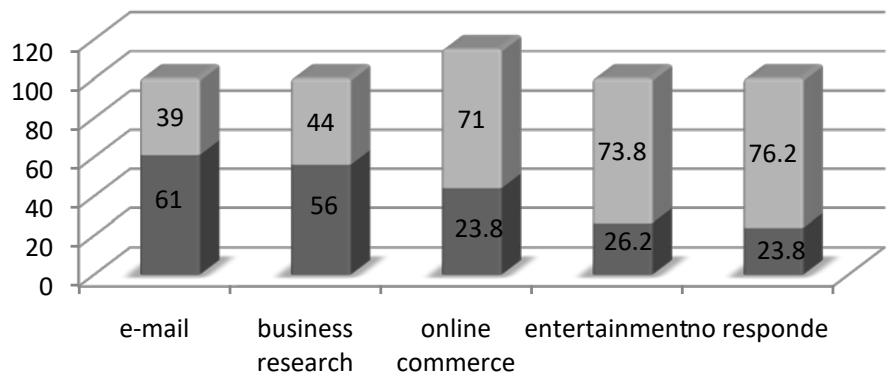 Figure 1: Internet usage
The technology used to create intranets has begun to be applied within companies and organizations to create intranets that allow people within an organization to exchange information. In our region, $32\%$ of businesses have an intranet, $16\%$ do not need one and a significant $16\%$ of businesses do not know what an intranet is. Being aware of the importance of network connections, businesses also have their own website. As can be seen from figure 2, $28\%$ of businesses have a website, $18\%$ do not need one and $7\%$ do not know about it. Although we would like a greater number of businesses with websites, we again see that there is a tendency to expand the scope of action and attempts at globalization.
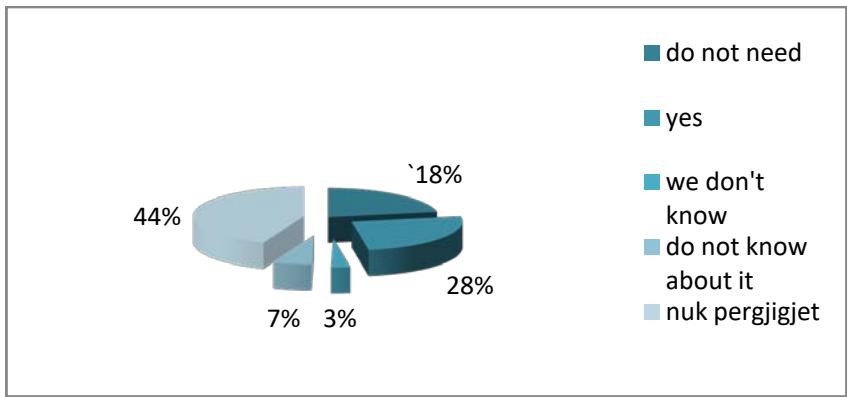 Figure 2: Websites from Businesses
Businesses say they value the use of official government websites very much. $14\%$ of them use these websites every day, while $15\%$ use them once a week and $25\%$, once a month.
But is having a website, an indicator that shows the virtuality of the company, sufficient? This is a simple treatment, but it concludes in the fact that large businesses in Albania have started to operate through network systems, but although they should be congratulated for their attempts to get involved in virtuality, they are still far away.
It is too early to hope for the existence of such a form of organization in Albanian business, taking into account the problems addressed so far regarding the structure of Albanian business. But if we look at large businesses, in the banking system, travel agencies, etc. There are favorable parameters that create a path, albeit narrow, that businesses that want to be an active part of the global market can take. Virtual structuring, being typical structures of multinational companies and while Albanian business is characterized by the qualities discussed above, the treatment of virtual structuring is unclear.
## V. CONCLUSIONS
The need to emphasize organizational learning, rather than individual learning, has led to the necessity for organizations to learn to do different things in different ways. It is precisely this fact that shows the difference between total quality management and the "learning organization". In addition, learning is conceived as a transformative process for organizations, which focuses on the need for change. This change is realized because it is favored by open information and the gradual break from traditional forms of organization, through the decentralization of decision-making and the application of participatory strategies.
Despite the risk that accompanies modern times and the tendencies to move from industrial societies to information societies, from national economies to world economies, from centralization to decentralization and with the aim of bringing about innovations, it is insisted that a decentralized network organization is the best project. Globalization and the need to create a collection of the best professional skills, require the application of virtual structures. Virtuality is considered as a pure opposition to Weber's bureaucracy. Defining the virtual organization as a geographically distributed organization whose members are linked by a long-term interest and goal and where communication and coordination of work is carried out by information technology, we again say that due to the lack of formal rules, procedures and clear reporting of relationships and norms, we again say that the key feature of virtual organizations is the high degree of informal communication.
Organizations function within a context of diverse possibilities and moreover, the concept that continuity has strength, brings a significant dilemma in today's organizational structuring, this is because the structural implications of any continuity cannot be the same.
Based on the experience of developed countries and if we also analyze the trends of organizational structuring in our businesses, we see that the tendency of transition to decentralized systems of public institutions and private activity is gradually crystallizing.
A good indicator of the structural form and trends for decentralization is also the participation of individuals in decision-making. If we think about the debate that is taking place today, to answer the question of whether participation exists or not, we say that despite all the difficulties that have appeared, it is still gaining ground.
Based on the conclusions drawn and the features of the organization and structuring of our businesses, the creation of new, almost independent units can be suggested, to discover new opportunities. A primary role in the economy of the Korca Region is played by trade and in this context we have the opportunity to suggest that firms can create hybrid structures, through the combination of existing and new initiatives. Businesses must struggle for a match between environmental conditions and organizational structures. Organizational structures can change – not to adjust to the specifics of the environment, because such a match may be impossible, but to guide the organizational research process. The Internet should be seen as an opportunity to create an extraordinary power in empowering and adapting the systems of activities of firms, empowering them to explore new opportunities and at the same time to grow the existing business. In a virtual organization, high (low), the routine of organizational tasks coupled with a high (low) degree of hierarchy, centralization and hierarchical levels will be associated with great network performance. This type of structuring, to bring the right effectiveness, must rely on qualified human resources in the fields of information and communication technology and businesses must find the right methods for rewarding and motivating them. We believe that the investigation of the main criteria in improving the management of virtual organizations as well as the design of a new architecture for members in a collaborative environment should be a continuation of our research in this field of study.
Generating HTML Viewer...
References
19 Cites in Article
prominent perspectives.
H Ali Ahmada,Dr Fakhr (2022). Unknown Title.
Andrew Thomson (2001). New Issues in Management Development (Management, Organization and Business.
Rajat Bhatt,Deepali Garge (2023). Efficiency in Emergency: A Perception Study of Hierarchical Versus Flat Organizational Structures for Joint Disaster Response in the Bay of Bengal Region.
Pernille Bjørn,Ojelanki Ngwenyama (2009). Virtual team collaboration: building shared meaning, resolving breakdowns and creating translucence.
I Chester,Barnart (2003). Organization and Management.
A David,Cenzo (2003). Fundamentals of Management.
Xue Ding,Long Feng,Yao Huang,Wei Li (2023). The Interactive Effects of Communication Network Structure and Organizational Size on Task Performance in Project-Based Organizations: The Mediating Role of Bootleg Innovation Behavior.
M Easterby (1998). Organization Learning and The learning Organization: Developments in theory and practice.
C Handy (1995). Trust and the Virtual Organization.
G Hertel,S Geister,U Konradt (2005). Managing virtual teams: A review of current empirical research.
Jason Hubbart (2023). Organizational Change: The Challenge of Change Aversion.
J Koh,Y-G Kim (2004). Knowledge sharing in virtual communities: an e-business.
Lars Groth (1999). Future Organization Design.
M Lazarević,M Ružičić (2023). Organizational Structure and Organizational Culture.
J Rodrigue (2020). a Flat Organizational Structure for an Inclusive, Interdisciplinary, International, and Undergraduate-Led Team.
P Stephen,Robbins (2001). Robbins, Stephen Dennis, (born 11 Jan. 1948), a Circuit Judge, since 1994.
Steven Alter (1998). Information Systems: A management perspective 19.
Batia Wiesenfeld,Sumita Raghuram,Raghu Garud (1999). Communication Patterns as Determinants of Organizational Identification in a Virtual Organization.
No ethics committee approval was required for this article type.
Data Availability
Not applicable for this article.
How to Cite This Article
Sonela Stillo. 2026. \u201cInformation and communication technology, a necessity to adapt to virtual organizations (Case study, businesses in Korca Region)\u201d. Global Journal of Management and Business Research - A: Administration & Management GJMBR A Volume 25 (GJMBR Volume 25 Issue A6): .
Explore published articles in an immersive Augmented Reality environment. Our platform converts research papers into interactive 3D books, allowing readers to view and interact with content using AR and VR compatible devices.
Your published article is automatically converted into a realistic 3D book. Flip through pages and read research papers in a more engaging and interactive format.
The environment in which Albanian business activities are carried out has changed continuously, as a result of changing economic, political, socio-cultural and technological factors. Businesses, which have become increasingly globalized and interdependent, have begun to carry out all organizational activities in a virtual environment. Businesses are constantly reviewing their managerial practices, to adapt to the constantly increasing complexity of the business landscape in order to benefit from the unique competitive advantage, knowledge. Even the Albanian government itself considers information and communication technology as one of the highest priorities to achieve high living standards and economic growth. Based on the characteristics of Albanian business and considering the fact that firms must struggle for a confrontation between environmental conditions and organizational structures and even more so when environmental conditions impose conflicting requirements on the desired organizational structure, we offer suggestions to make our business as competitive as possible, by getting involved in virtual organizations.
Our website is actively being updated, and changes may occur frequently. Please clear your browser cache if needed. For feedback or error reporting, please email [email protected]
Thank you for connecting with us. We will respond to you shortly.