This paper analyzed Brazilian authors’ works on school administration, focusing on the 1930-1969 period, to construct a historical analysis on principals’ training. One of the main difficulties of the research was defining its study object. Although we could highlight the main aspects of principals’ training in Brazil within the selected time frame, there was difficulty in constructing the inferences. The methodology adopted is qualitative and exploratory. For the analysis, we employed Content Analysis, categorizing the material -which represents each of the decades -according to the rule of homogeneity. One of the main findings reveals that the field of study concerning principals’ training has advanced very little. This stagnation is attributed to the fact that Brazil had virtually no investigations on the topic for four decades. Nonetheless, the period analyzed exhibited several significant initiatives aimed at principals’ initial and continuing training, which could be considered pioneering efforts in Brazil.
## I. INTRODUCTION
School administration is a relatively recent function in public schools. According to Keller (1999) Stanford University professor Ellwood Patterson Cubberley proposed the role of school principal in the United States. This author references, "The teacher and scholar [...] fostered the careers of two generations of school administrators. Cubberley, in fact, helped create the profession. In large part as a result of his work, school administration parted ways with teaching, growing into a separate field with its own conventions and body of knowledge" (Keller, 1999). This paper aimed to analyze Brazilian literature on principals' training from the 1930s to the 1960s, beginning with a historical overview to contextualize school administration in Brazil. Our primary objective was to understand how and why scholars of school administration began to write papers on principals' training. We can cite the renowned Brazilian scholar and Universidade de Sao Paulo (USP) professor Moyses Brejon (1958). He pointed out that in the nineteenth century, when the State and the Catholic Church shared educational responsibilities, most teachers in Brazil lacked adequate training for the teaching profession. This scenario necessitated the assignment of specific professionals within schools to coordinate and supervise their work. On the other hand, administration as a human activity is much older. According to another renowned Stanford University professor, Jesse Brundage Sears, administration as a human activity began when primitive men went out to hunt for food. Sears' (1950) detailed description of the rise of administrative functions is so clear that one can create a mental image of the process simply by reading his text. In his widely recognized scientific text published in Brazil, titled "The Nature of the Administrative Process. With special reference to Public School Administration", Sears (1950) describes and analyzes the emergence of the administrative function. These two scholars and their books, along with the renowned University of Michigan professor Arthur Bernard Moehlman and his work "School Administration. Its Development, Principles, and Function in the United States" (1940), are highly significant to the field of school administration research. Their strong influence in Brazil is evident as four of the five most influential researchers and authors in this study area cite their works. Although these three textbooks were widely quoted in Brazil from the 1930s to the 1960s, it is essential to highlight that, according to Glass (2004), they were not the first textbooks in this field to be published in the United States. The author identifies at least six works released between the late nineteenth century and the first decade of the twentieth century. We can observe that at the time, some authors referred to school administration as "school-keeping" in the titles of their books (Glass, 2004). Nonetheless, before identifying the Brazilian scholars who can be considered pioneers in this field, it is essential to highlight that our research has identified four distinct yet complementary types of activities related to school administration. The first one is the role occupied by public school principals themselves, namely, school administration as conducted by school administrators[^1]. It can be assumed that the role emerged as Brazilian public schools expanded, necessitating someone to manage their educational and administrative processes. Additionally, its origin was previously discussed based on Brejon's (1958) investigations into the topic. From this perspective,
school administration as a professional activity predates the other three tasks we will discuss subsequently. The second activity, closely related to the first, involves the systematic study of principals' daily work and its challenges, enabling analysis, interpretation, understanding, and explanation of the role, thereby defining school administration itself. This second endeavour can be identified as the research on school administration. The third activity related to Brazilian school administration was the initial training of principals. Many scholars who studied school administration as a social and professional activity were also among the first to train principals in Brazil. This scenario emerged as an extension of the third type of activity related to school administration. It is essential to highlight that, according to Carneiro Leão (1953), Brazil's first initiative to provide initial training for school administrators began at the Faculdade Nacional de Filosofia (could be translated as Philosophy National College) in 1939. Another reference to this topic is found in a Brazilian Federal Law enacted in 1939, which introduced the Pedagogy course. This course included two disciplines explicitly labelled as "school administration" in its curriculum (Brasil, 1939). This program spanned three years, with the mentioned disciplines being taught during the second and third years of the course. The fourth activity concerning principals' training involves scientific research on the topic. This development paralleled the evolution of school administration as a managerial function in public schools and the academic inquiry into this field. Some of the Brazilian scholars and university professors who mentored principals were also among the first authors of textbooks on the subject. Regarding these four types of activities described above, it is possible to identify five Brazilian scholars who were among the most influential educators in the country's history. We are referring to those who could be considered pioneers in the field of school administration in Brazil. To organize this paper chronologically, we will cite the books of these scholars based on the decades in which their most significant works were published, beginning with the 1930s. The first author to be mentioned is Aníso Spínola Teixeira, who remains one of the most influential educators in Brazil to this day. He completed his law degree at the Universidade do Rio de Janeiro in 1922 but had a distinguished career in public education. His initial role in public educational administration was as the head of the Department of Education in Bahia state from 1924 to 1928. Afterwards, he served as the head of the Department of Education in Rio de Janeiro city from 1931 to 1935. Following his tenure as head of the Departments of Education in two different Brazilian states, Aníso Teixeira published two books based on reports he wrote during each of these terms. The second Brazilian scholar to be mentioned is the first to systematically research and formalize school administration as a field of theoretical investigation in Brazil. We are referring to distinguished USP professor José Querino Ribeiro. He graduated from Normal School and became a primary education teacher in 1924. In 1934, following the establishment of USP, José Querino Ribeiro enrolled in Social Sciences and obtained his degree in 1940. Before that, in 1936, he became an assistant professor at USP and published his first book in 1938. In this work, he employed Henri Fayol's administrative ideas to establish a theoretical framework for the initial study, analysis, and understanding of several principles of public school administration in Brazil. The third scholar is Antonio Carneiro Leão. He graduated from Law School in Recife in 1911 and held various administrative positions in Brazilian education. Antonio Carneiro Leão published the book of interest for this research, "Introdução à Administração Escolar" [could be translated as Introduction to School Administration], in $1939^{2}$. It is essential to highlight that the scholar is among the intellectuals mentioned here known for a distinguished international career, having been awarded honorary doctorates from two foreign universities. Additionally, he became a member of the Brazilian Academy of Letters [Academia Brasileira de Letras] in 1944. José Querino Ribeiro, in turn, followed up his pioneering 1938 work with a thesis in 1952, which was a requirement for him to become a full professor at USP. In this paper, he describes school administration as a social function and a complex area of scientific investigation. According to the author, it requires studies by researchers in History, Philosophy, and Sociology, and other fields of Social Sciences. The fourth scholar discussed here is Moysés Brejon, who published the book "Inspeção Escolar e Administração" in 1958 \[could be translated as School Supervision[^3] and Administration\]. The fifth scholar to conduct an in-depth analysis of school administration in Brazil before the 1970s is Manoel Bergström Lourenço Filho. He completed his studies at the Normal School in 1914 and later graduated from Law School in São Paulo in 1929. Lourenço Filho published his most significant book on school administration in 1963, presenting a critical analysis of the topic. Since then, it has been widely utilized in Brazil as a primary text for principals' training, particularly at the undergraduate level. This work's significance lies in its focus on principals' initial training within colleges, as indicated by the inclusion of "Curso Basics" in its title [could be translated as Basic Course]. Indeed, the initial efforts towards principals' training in Brazil commenced in the 1930s with the establishment of the Pedagogy major in specialized colleges, dedicated to the education and graduation of teachers for primary education. During the 1930s, the Brazilian government, along with the newly formed National Department of Health and Education, initiated the establishment of specialized colleges known as Faculdades de Filosofia e Ciências [could be translated as Philosophy and Science Colleges]. During that period, school administration had already become a significant responsibility in Brazilian public schools. And teachers graduating from these colleges were required to take at least two courses in this field. However, systematic research on principals' training as a distinct academic subject in universities and research centres did not begin until the 1960s. Given the historical context outlined above, this paper seeks to summarize findings from our ongoing three-year research on initial and continuing training of public school principals in Brazil.
## II. METHODS
The research we have been conducting over the past three years, which forms the basis of this paper, is a theoretical study of an exploratory and qualitative nature. We consider it exploratory because the field of study has not been established for a long time in Brazil. Additionally, this exploratory perspective aligns with our initial attempt to research the topic. Thus, delving into its various facets necessitates a qualitative inquiry. As Sherman and Webb (2005, p. 5) assert, "The aim of qualitative research is not verification of a predetermined idea, but discovery that leads to new insights". Given this reality, a qualitative approach is applicable because Brazilian scholars' perspectives on principals' training during the period we examined are not exclusively rooted in management theories in Brazil. Hence, the research necessitates exploratory and qualitative perspectives aimed at generating insights through the examination of open-ended ideas and concepts. Moreover, the limited number of Brazilian authors addressing this issue underscores the appropriateness of a qualitative, rather than quantitative, approach. Additionally, it is pertinent to consider that contextual factors play a crucial role in this type of research, as noted by Sherman and Webb (2005). In this regard, what matters is that insights and conclusions can be drawn from the context and the textual content, referred to by Bardin (1977) as the "text surface". Moreover, the context in which principals' training is discussed holds more significance than its mere frequency of mention, particularly in terms of qualitative research. Hence, from this perspective, understanding the context is far more important than conducting a statistical analysis. Again, Sherman and Webb (2005, p. 17) provide support to the use of the word "understanding" in this context: "The aim of research, of course, is to understand things better. But 'understanding' is ambiguous. It can mean 'explanation' or 'interpretation'. [...] if our aim is to interact with each other, rather than control, social scientists need to act as interpreters, so we can converse more effectively". Building on the insights of these authors, our exploratory research aimed to deepen our understanding of principals' training in Brazilian education through the analysis of key works in this field of study. Given the ambiguous nature of the term "understanding", the qualitative research conducted aimed at interpreting data rather than providing definitive explanations on the subject. For this purpose, Content Analysis was used as the methodological framework, with Laurence Bardin's work titled "Content Analysis", dating back to the 1970s, serving as our primary reference in this field of study. In this book, we found a significant methodological framework for analyzing the data gathered from various texts, including those referenced in this paper. One of the most important techniques mentioned by Bardin (1977) is based on controlled chemeneutics and involves making inferences through deduction. It is important to highlight that when analyzing works from the early 1930s, such as those by Anisio Teixeira, inferences are the primary conclusions a researcher can draw. This scholar, within his works (Teixeira, 1962, 1968, 1997, 2001), does not present ideas on educational administration separately from his holistic view on education. Teixeira's approach makes it challenging for researchers to assert definitively that the author addressed specific topics on school administration. It is even more difficult to pinpoint his ideas on principals' training. An example of a specific challenge in this research is found in Teixeira's (1997) book, initially published in 1936, which consists of fourteen chapters; notably, only the eleventh chapter includes the term "training" in its title. However, the chapter focuses on the training of primary school teachers. Despite the author's administrative analysis of the Rio de Janeiro city educational system, none of the chapters in the book include the term "principals' training" in their titles. Additionally, Anisio Teixeira did not write textbooks for principals' daily consultation and use. His works, especially the two books cited here, are reports on his activities as Head of the Department of Education, which makes the analytical process even more complicated. To achieve this analytical purpose, we developed a coding scheme based on Content Analysis, employing deduction and inference processes to extract data from Teixeira's works. Our focus was on identifying passages where training issues were indirectly referenced by the author. Readers might
question the use of Content Analysis for investigating principals' training, given its specific association with educational and sociological research. This scepticism arises because Content Analysis originally focused on analyzing politicians' speeches and other mass media information. Nonetheless, one of its characteristics made Content Analysis the preferred method for this investigative purpose. One of the techniques learned from Bardin (1977) involves reading the deep structure of a text, going beyond the original meaning of its words, which the author refers to as the text surface. This technique is suitable for researching materials produced within a specific social context and historical period of a given culture, allowing for the inference of concepts related to school administration and principals' training, for example. The ability to read beyond the text surface enables the researcher to infer contextual elements that are not directly present in the text but influence how ideas are developed and interpreted when made public. For example, although Querino Ribeiro (1938) did not initially intend for his book to become a principals' training textbook, contextual information from other works indicates that it was widely used for principals' initial training in Brazil. Before delving deep into text structures, Bardin (1977) highlights an important initial aspect as part of pre-analysis: the floating reading technique. It involves reading the gathered material for the first time without rigorous concern for deep understanding. This technique allows the researcher to simultaneously become familiar with the authors' writing style and collect ideas related to the investigation topic, facilitating the development of research objectives and main hypotheses. As a follow-up step in researching using Content Analysis, Bardin (1977) emphasizes the importance of constructing a research corpus. The author defines a corpus as the collection of documents assembled for analysis using Content Analysis techniques. One of the main rules outlined by Bardin (1977) for constructing the research corpus is the rule of homogeneity. This rule involves identifying texts that, among other characteristics, represent a broader field of study due to their adherence to common aspects of the area. The research that originated this paper used that definition to construct the corpus we analyzed. The books and other works selected and analyzed, while not exhibiting consistent homogeneity in the field since they were not written with this objective in mind, are representative pieces capable of illustrating our main hypothesis: how principals' training evolved in Brazil through the twentieth century, drawing on investigations conducted on school administration by renowned Brazilian authors. In that sense, this paper and the research it originated from share similarities with Glass's (2004) and Silva's (2007) works. When it comes to singing out specific books, especially on school administration in Brazil, the ones analyzed in our research effort precisely represent the literature produced in each of the decades mentioned here in the field of study. To illustrate this point, one could search for Brazilian scholars' works on school administration from the 1930s and would likely come across the same four books we analyzed: Teixeira (2001; 1997), Querino Ribeiro (1938), and Carneiro Leão (1953). Furthermore, pertaining to the rule of homogeneity, it is noteworthy to consider that Carneiro Leão's book on school administration stands as the author's singular publication on this topic. Thus, the scholar comprehensively presented all his reflections on the subject within a single work, which renders it impossible for the researcher to compare and contextualize his publications concerning school administration. Another significant principle outlined by Bardin (1977) pertains to representativeness. In fields of study characterized by numerous publications, one of the primary challenges is constructing a valid sample of materials for analysis. In such instances, researchers must exert additional efforts to ensure that the sample adequately represents the study area. A markedly different scenario arises when researchers undertake comprehensive research, aiming to encompass all works within a specific field of study, for instance. In the analyzed case, the field of school administration in Brazil between the 1930s and the 1960s exhibits a degree of homogeneity, characterized by a limited number of publications and a reduced and consistent group of authors. This scenario further contributes to the homogeneity of the field of study on principals' training, in terms of the number of publications and the diversity of authors. Therefore, the sample of studies we compiled for analysis in this research adhered significantly to the rule of representativeness, as outlined by Bardin (1977), particularly concerning the theme of school administration. However, despite the renown of these authors and scholars in the field, none of the books analyzed explicitly includes the phrase "principals' training" in their titles. This challenge led us to employ another significant technique within Content Analysis: the categorization technique (Bardin, 1977). Focusing our data collection on the term "administration", particularly when associated with "school" and "educational", allowed us to create the category "administration/education". Using this category to search for relevant works led to the texts selected and analyzed in this study. Once again, Bardin's (1977) significant analysis on the potentialities of the technique demonstrates its utility. In our application, we found that the term "administration", when associated with "school" and "educational", appeared in the titles of eight out of the ten works analyzed in the research reported in this paper. Bardin's (1977) suggested synchronic comparison reveals that the field of study experienced few variations over a forty-year period. However, this does not imply a lack of deeper and more
meaningful studies during that time. This characteristic reinforced the validity of the rules of homogeneity and representativeness within the research.
## III. THE 1930s: THE FIRST INITIATIVES IN PRINCIPALS' INITIAL TRAINING
The 1930s is one of the most vital decades in Brazilian public educational history. If we were to paraphrase renowned British historian Eric Hobsbawm, we might say that the 1930s was a densely packed decade for Brazilian public education, marked by numerous important events and publications. From the educational historical perspective we analyzed, the decade began in November 1930, when President Getúlio Dornelles Vargas decided to create a National Education and Health Department, and it concluded in November 1937 with the establishment of Brazil's fourth Constitution. After establishing the National Education and Health Department in 1930, the following educational events during the decade, in chronological order, can be highlighted. In 1932, the Manifesto dos Pioneiros da Educação Nova was published, advocating for profound changes in public education, especially in teaching. In 1934, Brazil's third Constitution was established, considered one of the most advanced regarding people's educational rights, primarily influenced by the 1932 Manifesto dos Pioneiros da Educação Nova. In 1937, President Getúlio Vargas closed the Brazilian Congress, and his Minister Francisco Campos wrote a Constitution considered one of the most restrictive regarding people's educational rights. The decade in Brazilian scholars' publications commenced with two works by Aníso Teixeira. The first was his report following the conclusion of his term as head of the Department of Education of Bahia state. It was likely published between 1929 and 1930 under "O ensino no Estado da Bahia". His second book, titled "Educação para a Democracia: Introdução à Administração Educacional" (1936), was based on a report following his tenure as the head of the Department of Education of Rio de Janeiro city. In 1938, Querino Ribeiro published "Fayolismo na Administração das Escolas Púbicas", while in 1939, Carneiro Leão released "Introdução à Administração Escolar". After briefly summarizing these educational events, we can better understand the decade as follows. Two years after the establishment of the National Education and Health Department, a group of 26 Brazilian educators, scholars, educational administrators, and renowned writers, including Cecília Meireles, published one of the most critical documents in Brazilian educational history: the Manifesto dos Pioneiros da Educação Nova (1932), as cited in Azevedo et al. (2006). In the document, school administration is highlighted as an urgent issue to be addressed, particularly from a scientific standpoint, as the authors of the Manifesto considered the field of study practically nonexistent in Brazil at that time. Another significant criticism articulated in this document pertained to the Brazilian scientific and academic community's approach to educational issues. The authors of the Manifesto argued that one of Brazil's most pressing educational issues was what they identified as "empirismo grosseo" (Azevedo et al., 2006) [could be translated as crude empiricism]. With this expression, the authors meant that at Brazil lacked a robust academic and research practice within its universities. Consequently, educational issues were addressed through ad-hoc efforts rather than on a scientific basis. The Manifesto also advocated for substantial advancements in Brazilian educational policies, particularly in providing universal access to public schools for all children and ensuring quality learning outcomes for everyone. Due to the significant influence of that document on national education, the Brazilian Third Constitution was ratified in 1934, marking the first time in our history that an entire chapter was dedicated exclusively to public education. Furthermore, for the first time, education is enshrined in this Constitution as a right for all Brazilians. Herein, we analyze Brazilian scholars' perspectives on school administration and principals' training during the 1930s.
a) "O ensino no Estado da Bahia" (1930) and "Educao para a Democracia" (1936), by Anisio Teixeira: reports on public educational administration As previously mentioned, Anísio Spínola Teixeira was head of the Department of Education of Bahia state from 1924 to 1928. During this period, Anísio Teixeira's primary challenge was combating illiteracy in Bahia state, where the educational infrastructure was limited, with few schools and low student enrollment. Consequently, a significant proportion of children had completed no more than one year of schooling. One of his initial findings was the pressing need for Bahia state to construct additional schools and recruit more teachers. When he assumed office in 1924, the state had 21 schools. By February 1928, when his term concluded, this number had increased to 32 schools in regular operation, with an additional 17 under construction (Teixeira, 2001). His second challenge concerning public education in Bahia state pertained to teachers' training, which he identified as a significant concern across the state. We derived this information from his book, likely compiled as a report on administrative activities from 1924 to 1928. The document was submitted to the state governor
immediately after he concluded his tenure as the head of the Department of Education. The text was published a few years later, likely in the 1930s, under "O Ensino no Estado da Bahia" [could be translated as Teaching in Bahia State]. At that time, as inferred from Teixeira's (2001) report, there was no discussion on principals' training. The primary concerns were teacher recruitment and training, enrollment in-state public schools, and the high levels of illiteracy among children. Nonetheless, just a few years later, in 1932, Aníso Teixeira, along with Fernando de Azevedo, became the leading author of one of the most significant documents in the history of Brazilian educational policies: the Manifesto dos Pioneiros da Educação Nova. In this text, Aníso Teixeira's ideas on Brazil's most pressing issues are clearly evident, including the urgent need to provide quality public education for all. Directly related to this critical issue is the need for teacher training and a concern for principal training. At the time, the latter was not explicitly mentioned in the document. The year the Manifesto was published, Aníso Teixeira was the head of the Department of Education for Rio de Janeiro. It is important to inform readers that Rio de Janeiro city was Brazil's capital until 1960. During his tenure, Aníso Teixeira documented his experiences and reflections as an administrator, culminating in another book: "Educação para a Democracia. Introdução à administradora educacional" [could be translated as Education for Democracy. Introduction to educational administration]. It is worth noting that similar inferences can be drawn from reading both this report and the 1932 Manifesto, as it is evident that Aníso Teixeira's ideas played a leading role in the drafting of the latter document. On the other hand, readers can infer the strong influence of John Dewey's ideas on the Brazilian educator, as Dewey's educational philosophies profoundly shaped Aníso Teixeira's writings. Together with Godofredo Rangel, Teixeira translated one of Dewey's most significant works, "Democracy and Education", into Portuguese. Two noteworthy coincidences can be highlighted here: the translation was published in Brazil in 1936, the same year as Teixeira's book "Educação para a Democracia". Another unmistakable coincidence is the similarity in the titles of the books by the Brazilian author. Additionally, it is noteworthy that Aníso Teixeira studied at the Teachers College of Columbia University in New York, USA, under the supervision of John Dewey, sometime between 1927 and 1929. However, we could not find evidence to support claims from those close to Aníso Teixeira that he completed a Master's Degree in Education at Columbia. It is not possible to confirm whether Aníso Teixeira was directly supervised by John Dewey or if they ever met in person. Returning the analysis of Aníso Teixeira's second report, it is important to note that although the book's title references to educational administration, his ideas on Brazilian education encompass much more than a single theme. In this same book, where he reflects on his tenure as the head of the Department of Education in Rio de Janeiro, Teixeira (1997) also critiques how the Brazilian legislature formulates the country's educational laws. Additionally, he examines significant issues concerning higher education in Brazil, particularly since he established a public university in Rio de Janeiro during his tenure. This institution, Universidade do Distrito Federal (UDF), was founded in 1935. Considering these facts, our analysis made a concerted effort to find evidence that Teixeira (1997) identified theoretical principles related to principals' training in Brazil. At the same time, we were extremely cautious not to attribute words to him that he did not say or write during our analysis. However, Anisio Teixeira's role as the head of the Department of Education in Rio de Janeiro city can be analyzed from the perspective of educational administration. Similarly to his work in Bahia state during the 1920s, Anisio Teixeira's tenure in Rio de Janeiro city focused primarily on recruiting and training teachers, as well as addressing child illiteracy. Furthermore, he achieved what can be inferred as unprecedented in our nation's history: constructing over ten school buildings designed specifically for educational purposes. Teixeira's (1997) analysis suggests that public schools in Rio de Janeiro operated in makeshift houses for teaching during that period. During the 1950s, Brazilian scholars of school administration compared Anisio Teixeira's reports to successful pioneering works by American educational administrators. The Portuguese translation of this idea became closer to the expression "well-succeeded school administrators' reports", though we recognize that the sentence is grammatically incorrect in American English. In the United States, these reports can be traced back to the early days of American school administration as a professional activity and scientific research area, as demonstrated by Silva (2007). Some American scholars gained recognition in Brazil for their roles as successful school administrators during their tenures as primary education principals, superintendents, and heads of education departments. They also contributed by publishing reports or surveys that became textbooks on educational administration. Glass (2004) analyzed some of these books published in the United States. During their roles, they documented numerous reflections on daily administrative routines, papers that became significant as exemplary experiences of successful principals for Brazilian researchers. One American scholar previously discussed in this paper, whose reports can be classified as such, is Arthur Bernard Moehlman and his extensive surveys on primary education in Michigan state. In Brazil, Anisio Teixeira and the two cited books were regarded this way. Moreover, these books, particularly the second one published in 1936, were crucial reading materials for the
initial training of principals from the late 1930s through the 1940s.
b) "Fayolismo na Administração das Escolas Púbicas" (1938), by José Querino Ribeiro
Jose Querino Ribeiro was responsible for one of the first systematic attempts to apply administrative theory to the administration of public schools in Brazil. We are referring to the previously cited work "Fayolismo na Administração das Escolas Públicos" (1938) [could be translated as Fayolism in the Administration of Public Schools]. In this book, Querino Ribeiro (1938) questions the necessity for principals' initial training to be structured similarly to the training provided for teachers in São Paulo state, specifically organized initial training based on scientific principles. According to the author, common sense at the time suggested assigning the best teacher in a given public school as its principal. Querino Ribeiro (1938) advised otherwise, arguing that even though a teacher demonstrated all the necessary qualities to be regarded as an excellent teaching professional, they would not become an effective school administrator without proper initial training. His central thesis on school administration, specifically in this book, was based on Fayol's administrative method, known in Brazil as the department method. The French author developed an administrative theory that established a command structure organized around managerial positions, or decision-making spots, throughout the organizational structure of an enterprise. Thus, Querino Ribeiro (1938) employed what he considered the most advanced administrative theory at the time, considering his book was likely written between 1936 and 1938. When it was published, the two most advanced administrative theories he could use as paradigms were Fayol's and Taylor's. A specific situation regarding essential references that Querino Ribeiro used in his writings was: when Querino Ribeiro (1938) was writing this book, three important works of reference for his theory had not yet been published. The first essential reference for Querino Ribeiro (1952), in chronological order, is "Notes on the Theory of Organization" (1937) by Luther Gulick. The other two, already mentioned in this paper, are Moehlman (1940) and Sears (1950). Given this scientific context regarding administrative theories, Querino Ribeiro (1938) might have considered Fayol's method one of the most suitable and adaptable to Brazilian public school administration. Thus, the author proposed to organize the administration of public schools based on Fayol's principles. Some developments of this theory, especially those made by Gulick (1937), led the author to create an acrostic, namely, POSDCORB, containing the words Planning, Organizing, Staffing, Directing, Coordinating, Reporting, and Budgeting. Querino Ribeiro (1938) also refers to this acrostic in his book, which later became widely known in Brazil. Additionally, each word in this abbreviation influenced his ideas on principals' initial training. His proposal for their training included disciplines named after each of those administrative principles.
c) "Introdução à Administração Escolar" (1939), by Antonio Carneiro Leão
Carneiro Leão's comprehensive study was published for the first time in 1939. It is a compendium that contains a substantial amount of information on school administration in Brazil and other countries. The author examines various aspects of school administration in France, Russia, Germany, Chile, the United States, Italy, and England. Concerning the United States of America, the book includes a fairly extensive analysis of the educational system in New York. His primary thesis on school administration emphasizes the critical role of effective leadership in achieving school success, underscoring the necessity for principals to undergo formal training. This idea contrasts the Brazilian context, where many educational administrators historically acquired skills through on-the-job experience. The author suggests that during the 1930s, before the introduction of Pedagogy as a major at the National College of Philosophy, there were no formal programs for the initial or continuing training of school administrators, despite the consensus among scholars, including himself, on their crucial importance for effective education. Carneiro Leão (1953) also discusses the 1930s in Brazilian history as a pivotal era when the country embraced scientific methods across all fields of study and social activities. However, according to the author, Brazilian school administration remained, until the 1930s, a profession primarily rooted in experiential learning, characterized by what he terms as an occupation based solely on empiricism from that historical period. In addressing this issue, his book puts forward a proposal that includes essential guidelines for the initial and continuing training of principals, emphasizing the study of Sociology, Philosophy, and Psychology in particular. It can be asserted that his perspective on the importance of selecting school principals from the faculty aligns with Anísio Teixeira's. It is widely known in Brazil that both scholars advocated the same academic stance on this issue: principals should be chosen from school faculty. However, Carneiro Leão (1953) cautioned that being the most skilled teacher in teaching methods and techniques alone does not necessarily qualify someone to be a successful principal. This advice stems from his earlier emphasis on the need for training tailored for the position.
## IV. THE 1940s: PRINCIPALS' GENDER MIGRATION
Readers might consider it scientifically inaccurate that we do not discuss works published in the 1940s on public school principals' training in Brazil in our research. So far, our investigations have not uncovered any research papers that specifically analyze the topic during the mentioned period. Given that this is a relatively new field of inquiry in Brazil, the scarcity of publications on the subject in the 1940s likely reflects an unfortunate but true aspect of the Brazilian academic landscape. Another likely reason for the lack of studies is that one of the most influential scholars in the field of school administration in Brazil, Aníso Teixeira, was persona non grata in public education during President Getúlio Vargas's Estado Novo regime, from 1937 to 1945. After Vargas's tenure, there was a rapid increase in enrollments in Brazilian public schools, spurred by the social movements inspired by the ideas of the 1932 Manifesto. Starting in 1946, the Brazilian government increased the number of public schools nationwide, making it possible for a large portion of the population, particularly the poorer segments, to attend public schools. As a result, many new schools were established, more teachers were hired, and there was an increased demand for principals to manage these institutions. An unfortunate aspect of that period in Brazilian history was that the rapid expansion of educational opportunities rendered careers in public schools increasingly unattractive in terms of salary and daily working conditions. One of the key characteristics of public school staffing in Brazil during that period was that most principals were male. According to Werle (2005), the late nineteenth century in Brazil experienced a phenomenon referred to here as a gender migration issue within the teaching profession. During that period, male teachers began seeking other occupations, particularly those offering higher wages. This phenomenon intensified during the first half of the twentieth century. According to Werle (2005), although Normal Schools in the nineteenth century were open to both genders, they were predominantly attended by female students. The author notes that the administrative staff of these schools simplified their programs, particularly in the state of Rio Grande do Sul, where many female students came from orphanages. The author further highlights that these students sought better professional opportunities, and due to their social and cultural backgrounds, the teaching at Normal Schools was simplified. This cultural understanding might have influenced principals' training programs in Brazil in the subsequent decades, suggesting that programs tailored for female principals should prioritize less depth in administrative content. During the early decades of the twentieth century, a notable increase occurred in the hiring of female teachers to fill the positions vacated by male teachers who left, as well as to teach at newly established public schools. A second characteristic observed is what we refer to as gender migration: male teachers found it advantageous to become principals since it offered better wages within a similar professional field. One unfortunate aspect is that
during the 1940s, and particularly in the following decade, working conditions in Brazilian public schools did not improve, especially concerning income-related issues. What can be observed is a relatively intensified gender migration, characterized by male professionals, those remaining as public school principals, leaving the educational system altogether. Starting in the 1960s, a predominant number of female professionals began working in public schools. By the mid-1960s in Brazil, nearly all teachers, approximately ninety percent, were female, along with a significant percentage of public school principals. According to the 2023 Educational Census, Brazil had approximately 190,000 school principals, with eighty percent of them being female (INEP, 2023).
## V. THE 1950s: THE FIRST INITIATIVES IN SUPERVISORS' CONTINUING TRAINING
In the 1950s, two distinct but complementary activities in the field of school administration in Brazil can be highlighted. One of these activities is theoretical research, with José Querino Ribeiro being recognized as the leading researcher in the field during that decade. One of his most important works, previously mentioned, was likely written during the 1940s and published in 1952: "Ensaio de uma teoria da administração escolar". It is the seminal research paper of the decade on school administration in Brazil. There is much to analyze regarding USP professor José Querino Ribeiro's contributions to the training of Brazilian public school principals. First and foremost, Querino Ribeiro (1938) developed one of the earliest, if not the very first, scientific approaches to analyzing and understanding school administration in Brazil during the 1930s, as previously mentioned. He aimed to contribute to this field of study and overcome the crude empiricism highlighted by the authors of the 1932 Manifesto. Continuing his scientific approach, he expanded on these ideas in his full professor thesis at USP, which forms the foundation of his book "Ensaio de uma teoria da administração escolar" (1952) [could be translated as Essay on School Administration Theory]. The author's rationale for selecting the term "essay" in the book title is to outline a theoretical framework for the field of school administration study in Brazil. Concerning one of the fundamental principles of this theory, it is noteworthy that Querino Ribeiro held administrative positions in public education in São Paulo state from the 1940s onward. Consequently, one of his primary concerns was the efficient utilization of public funds. This factor alone could be considered to elucidate his stance on principals' training, despite the absence of a specific theory developed by him on the subject. Given that two of his major contributions to public school administration in Brazil were his works that established a theoretical framework based on scientific principles, particularly regarding the efficient use of public funds, it can be concluded that these two principles began to guide principals' training in Brazil: a scientific approach and efficiency. Some critiques of Querino Ribeiro's thesis suggested that his ideas were linked to rational industrial processes and scientific management principles attributed to Frederick Winslow Taylor. Indeed, Querino Ribeiro was genuinely concerned with public school efficiency, which prompted improved planning, including the training of principals. However, his ideas were not primarily influenced by Taylor's theories of industrial management. Conversely, as noted earlier, his works were influenced by Henri Fayol's administrative ideas. In his book, Querino Ribeiro (1952) advocates for principals' initial training at the graduate level, rather than as undergraduates. Vitor Henrique Paro, a prominent Brazilian scholar in the field of public school administration since the 1980s, highlighted that Querino Ribeiro's ideas, particularly those found in this book, were extensively debated and served as a reference across Brazil for both initial and continuing training of school principals (Paro, 2009). According to Paro (2009), there exists a notable paradox within Querino Ribeiro's (1952) work. While the latter views education as a social process that fosters autonomous and critical citizenship, this perspective appears incongruent with the principles of capitalist industrial administration. Since his seminal work on school administration in 1938, Querino Ribeiro's approach has been rooted in Fayol's theory, closely linked to capitalist industrial management principles. In Paro's (2009) analysis, given that capitalist principles fundamentally involve workforce exploitation, the progressive basis of school administration and capitalist administrative concepts are not congruent. While Paro (2009) is correct in his assessment, Querino Ribeiro's (1952) book was developed within a social and academic context where this paradox was not recognized as such. In Brazilian school administration research during the 1950s, employing the Classical Administration theoretical framework was among the few viable approaches to foster scientific inquiry in the field, aiming once more to move away from crude empiricism. Another facet of activity within school administration during the decade involves the continuing training of educational administrators. Once more, Querino Ribeiro's influence on the subject is notable. Moysés Brejon, Querino Ribeiro's assistant as a full professor at USP, was the leading scholar during the 1950s researching the continuing training of educational administrators. He is among the earliest Brazilian scholars to assume the role of training school supervisors, responsible for their continuing training as public servants in São Paulo state, commencing in 1958. It is important to note that the continuing training of supervisors in Brazil during the 1950s represents a significant advancement compared to the initial initiatives introduced by Carneiro Leão
(1953) regarding the training of principals in the 1930s. In 1964, Moysés Brejon published one of the earliest papers specifically focused on the topic, "Alguns aspectos da formação de Administrações Escolares" [could be translated as Some aspects of School Administrators' training]. The report by Brejon (1964) on supervisor training programs, a higher position in Brazilian public educational administration hierarchy, suggests that initial and continuing training for principals was more effective by then, evolving from initial training only in the 1930s. Despite Brejon (1964) publishing his report in the 1960s, no other studies specifically addressing principals' or supervisors' training during the 1950s could be identified.
## VI. PRINCIPALS' TRAINING IN BRAZIL IN THE 1960S
This decade began for this field of study in 1961, when university professors of school administration established the Associação Nacional de Professores de Administração Escobar (ANPAE) (could be translated to National Association of Professors of School Administration). Although we could not find direct evidence in our research, it appears that the establishment of the National Council of Professors of Educational Administration in the United States in 1947 had a strong influence. The Brazilian association was founded during the first Simposio Brasileiro de Administração Escobar [could be translated to First Brazilian Symposium on School Administration], held at USP in February 1961. Of course, Anísio Spínola Teixeira, José Querino Ribeiro, Moysés Brejon and Manoel Bergström Lourenço Filho were present on this occasion. Initially, the Association brought together scholars interested in researching school administration. Consequently, these researches led to investigations into principals' training. We had access to the final report on that Symposium (ANPAE, 1962). We gained a deeper understanding of those scholars' concerns by reading, for example, one of the letters written by Symposium organizing committee president José Querino Ribeiro. He addresses the issue related to school administration studies and how they were introduced as disciplines into the curricula of the previously mentioned Philosophy and Science Colleges. According to the author, school administration as an academic discipline was not correctly included in Brazilian higher and secondary education, as it was not fully integrated into teachers' training and could not adequately emphasize its importance for principals' training. Furthermore, he adds that Brazilian school administration professors were, at the time, self-trained scholars, revealing a lack of structure for integrating full professors in the area. This scenario made universities' roles in training principals less efficient than they should be (Querino Ribeiro, 1962). In his speech on the day ANPAE was established, Anísio Teixeira emphasized his


concern that Brazilian governmental authorities were not committed to principals' training. He added to his impressions that in Brazil, there was no formal teaching and learning process for someone to become a school administrator (Teixeira, 1962). After the establishment of the National Association of Professors of School Administration (ANPAE) in 1961, there was a growing interest in researching school administration and its related fields of study. One of the new areas of interest was principals' training, as the 1960s were a significant decade for higher education in Brazil, mainly in consolidating an ongoing research topic: teachers' training. As mentioned earlier, one of the most important scientific works we can identify in Brazil, used as a textbook for principals' training is Lourenço Filho's (1963) book. However, Carneiro Leão (1953) also presented relevant information on the topic. In this book, Lourenço Filho (1963) analyzed the various aspects surrounding transitioning a teacher into a principal. This characteristic is the first to highlight: Brazilian scholars have emphasized the necessity for a principal to have prior experience as a primary education teacher before assuming the role. This experience provides them with a comprehensive understanding of educational processes stemming from classroom routines. The thesis that principals should be chosen from the school faculty, often referred to in Brazil as principals coming from the classroom, is based on ideas first presented by Anisio Teixeira and Carneiro Leão in the 1930s. These ideas were adequately documented in subsequent papers: "Natureza e Funcao da Administracao Escolar" (1968) and "Introducao à Administração Escolar" (1953), respectively [could be translated as Nature and Function of School Administration and Introduction to School Administration]. It is also important to inform readers that renowned USP professor Moysés Brejon played a significant role in the field of study by publishing the paper "Alguns aspectos da formação de Administadores Escolares" in 1964 [could be translated as Some aspects of School Administrators' training].
a) "Organização e Administração Escolar. Curoso Básico" (1963), by Manoel Bergström Lourenço Filho
One of the initial points of significance in Lourenço Filho's professional career in Brazilian public education is that, unlike Anísio Teixeira and Carneiro Leão, who served as heads of Departments of Education within the Brazilian state structure, Lourenço Filho played a role as an educational reformer. He was entrusted with restructuring the public education system of Ceará state in the 1920s. Possibly due to his background as educational reformer and organizer of public education, he emphasizes the term "organization" more than "administration" in the title of his book. Lourenço Filho's (1963) work holds significant importance for the field of study, as the author compiled an extensive compendium of administrative theories published in various countries up to that time. He classified all the theories examined into two categories: Classical Theories and New Theories (Lourenço Filho, 1963). The author classified as classical Taylor's and Fayol's scientific works, along with other papers strongly influenced by them. Conversely, Lourenço Filho (1963) emphasized what he referred to as New Theories, which encompassed advancements in the field of administrative theory, contributed not only by Brazilian authors but notably by foreign scholars. Some of his primary references include works by Chester Barnard, Daniel Griffiths, Luther Gulick, Andrew Halpin, Herbert Simon, James March, Lyndall Urwick, Roald Campbell, and notably, the three most influential figures in the field in Brazil: Cubberley, Moehlman and Sears. Due to Lourenço Filho's extensive analysis of diverse materials, including education, sociology, mainly social psychology and history, and his translation of significant global publications into Portuguese, his theory of school administration incorporates a broad spectrum of elements beyond purely managerial concepts. His book can be highlighted as a precursor to the 1970s discussion in Brazil on General Systems Theory, which introduced concepts such as "function" and "role" into the field of school administration, particularly drawing from Talcott Parsons' theories.
b) Alguns Aspectos da Formação de Administrações Escolares (1964), by Moysés Brejon In this text, the author emphasizes the necessity for principals' initial training, especially to prepare new professionals to assume the function, as well as the importance of continuing training for those already on the job. Both initial and continuing training are related, according to the author, to a vital need for professionalism in the public school principal occupation. At the time, Brejon (1964) also emphasized the need for principals to integrate scientific and technological developments into schools' daily routines in Brazil during the 1960s. On the other hand, while Brejon (1964) acknowledges the strong need for principals' training, he also highlights a significant challenge: the difficulty in organizing an appropriate body of knowledge regarding school administration as a scientific field of study, to be used as a training curriculum. The author points out three primary deficiencies in the area from his point of view: the body of knowledge available at the time for principals' training was fragmentary; consequently, the field of study struggled with terminological imprecision; and as an outcome of these two issues, school administration as an academic discipline had little or no autonomy within college curricula (Brejon, 1964). Besides identifying an almost total absence of principals' preparation programs in Brazil at the time, Brejon (1964) urges for comprehensive programs to train not only K-12 principals but also educational administrators for a wide
range of occupations in the Brazilian public educational system. Furthermore, Brejon (1964) analyzes not only the technical issues related to principals' training but also the political ones. He argues for an urgent need to reform the Brazilian public educational system to provide more autonomy for public schools. Without such independence, even though principals' training would improve their administrative capabilities, their effectiveness would be undermined by the system's political and election-related issues. Given that scenario, Brejon (1964) also argues that with reduced or no autonomy, principals would not be able to improve school administration, as they would become mere executors of educational policies dictated by higher levels of the system. Another issue wisely analyzed by Professor Brejon is the construction of a curriculum capable of effectively preparing school and educational administrators. He questions the curriculum for training educational administrators, indicating the need for further reflection on what content would be appropriate to train principals, supervisors, and superintendents. Although these functions are related, they are significantly different from each other. One final issue posed by Brejon (1964) concerns the nature of training program content: should it focus on theoretical school administration, should it be based on actual school management situations, or should it incorporate both approaches so that principals could benefit from each type of knowledge? We assume these questions remain unanswered up to today in Brazil.
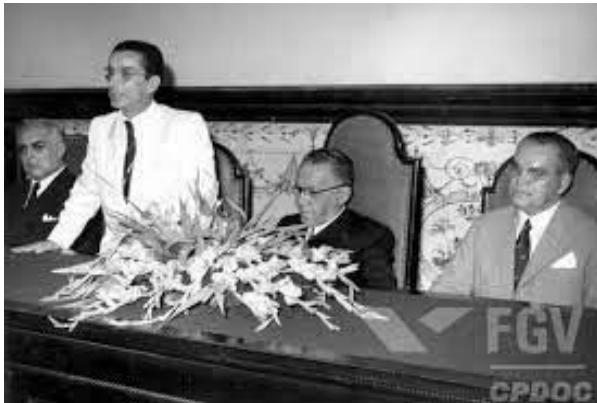 Source: FGV/CPDOC Fig. 1: Anísio Teixeira (standing/white suit) during his speech on the day National Association of Professors of School Administration was established.
## VII. PRINCIPALS' CONTINUING TRAINING IN BRAZIL IN THE 21ST CENTURY: A POLITICAL ISSUE?
After discussing all the issues presented in this paper, we conclude that principals' initial training in Brazil in the 21st century is no longer an overlooked subject. This assertion is supported by the numerous colleges and universities throughout the country that now provide initial training for principals. Additionally, there is a substantial body of research on the subject, as evidenced by the works of Oliveira et al. (2020), Pimenta et al. (2022), and Alves and Bispo (2022). On the other hand, principals' continuing training in Brazil has regrettably evolved into a political issue. Considering that the Brazilian government links educational quality with principals' continuing training in its policies, it appears to politicize an educational issue. If the working conditions that Brazilian public school principals face daily is analyzed objectively, it might be possible to affirm that their training does not align with the desirable educational quality that remains unmet. During our research, we spoke with some public school principals and concluded that their initial and continuing training are entirely satisfactory for the administrative routines they face. In this regard, one of Grissom et al.'s (2019) conclusions regarding Principal Preparation Programs (PPP) in Tennessee, USA, indicates no direct relationship between principals' training and school performance. This conclusion suggests that the government cannot hold principals or their training programs solely accountable for educational quality. Some Brazilian schools' structural conditions do not contribute to simplifying school administration. Besides that, one of the main challenges for principals is the lack of autonomy in public schools concerning teaching and evaluation processes. Another challenge is managing the daily working routines and schedules of the school. Additionally, one main issue identified during research is that inclusive education happened suddenly in Brazil in the 1990s, mostly influenced by the Salamanca Declaration in Spain. This situation arose regardless of teachers' training. Furthermore, public school administrative staff had no preparation for enrolling and managing disabled children. Given that inclusive education is socially important and an educational right that no one refutes, principals had to suddenly confront an administrative reality for which they were unprepared. This scenario is compounded by the lack of training to use Brazilian Sign Language, for example. Since researchers who study Educational Policies in Brazil can conclude that the main unofficial policy regarding teaching and evaluation in general is to pass children regardless of their learning skills, it makes no sense to hold principals accountable for educational quality, or its lack, especially by connecting it to their lack of training. On the other hand, it is important to note that the Brazilian government has provided continuing training programs for public school principals. A regrettable aspect, in our evaluation, is that principals' training, as well as teachers' training in general, often takes place on weekends. This situation prevents these professionals from resting after an exhausting work week, and more critically, it limits their ability to spend quality time with their families. Given this characteristic of principals' continuing training in Brazil, it is possible to
question its quality due to the adverse learning conditions they face. Additionally, the Brazilian government utilizes Distance Learning as a critical tool to address the challenges associated with providing continuing training to teachers and principals. However, we will not delve into this field of study in this paper, even though we have published a book documenting our teaching experience during the Covid-19 pandemic's remote learning period (Sampaio; Ribeiro, 2022). Another key issue in the debate on principals' training is the Brazilian government's overly paternalistic approach to training teachers and principals. Since we are referring to highly skilled professionals, certain types of training, due to their approach and quality, make little sense for experienced principals. Rather, we propose that the Brazilian government ensures teachers and principals have access to adequate conditions – including time, financial support, and equipment – to independently select the type of continuing training they wish to pursue. This approach would better meet the diverse needs of professionals, considering their varying levels of knowledge and skills. Additionally, each public school requires different types of training for principals, as pointed out by Alves and Bispo (2002). Based on Grissom et al.'s (2019) discussion of Tennessee's Principal Preparation Programs, it is noteworthy to mention that few Brazilian universities provide analogous training opportunities. While certain training initiatives are offered by the Federal Government, the majority of principals' continuing education is administered by municipal and state educational authorities. In Brazil, unlike the situation analyzed by Bastian and Drake (2023) concerning North Carolina/USA, there is a notable absence of widely recognized strong university-district partnerships for principals' continuing training. We find it extremely outdated that the Brazilian government still treats important and intelligent professionals in such a condescending manner, particularly by deciding their training for them. Regrettably, in Brazil, there are significant issues concerning the continuity of educational policies. Every four years, with changes in governmental leadership, we witness significant policy shifts emanating from the National Department of Education. In light of this, we ask: to what extent is there a lack of planning regarding new proposals for principals' training, thereby diminishing the relevance of attending new programs that offer nothing genuinely novel? Moreover, it's pertinent to question to what extent providing principals with the same types of training, particularly those used since the 1990s, is suitable for advancing their knowledge. Considering the evolving nature of schools today, and the markedly different ways in which children think and act compared to ten to twenty years ago, such traditional training methods may be inadequate. Schools vary, children exhibit diverse personalities, learning methods differ, yet public school principals in Brazil continue to receive training akin to that provided two decades ago. How can this contribute to their ability to exercise effective leadership? Another factor to consider, particularly in Brazil, regarding the initial and continuing training of principals, is the variability in the methods through which principals are appointed in public schools. It is noteworthy, especially for foreign readers, that Brazilian principals can attain their positions through four different methods, as outlined by Oliveira and Carvalho (2018). Today, the most common method is election, which is adopted in several Brazilian states, including Bahia. Principals are elected by members of the school community, including teachers, staff, students, and their families. A principal's term is three years, with the possibility of running for one re-election. Only teachers can run for the position of principal, implying that candidates must hold at least a degree in Education. A brief comparison between papers published in Brazil and the United States reveals that the term "school leadership" is predominantly used in Brazilian literature in the context of principal's elections. In contrast to American literature, Brazilian research on school leadership is relatively scarce, despite the fact that elected principals in Brazil are widely recognized as institutional leaders. Another common method for principals to attain office is through state-administered exams, similar to the licensure examinations in the United States. For example, in São Paulo state, principals who pass the licensure examinations remain in office until retirement, typically serving at the same public school where they were initially appointed. Like the election process, principals applying for positions through state-administered examinations must possess a degree in Education. The third method for principals to assume office is through political nomination, which is more prevalent in municipal public schools than in state schools. In such cases, principals are typically appointed by mayors. Most Brazilian scholars criticize this method by which principals assume their roles, despite it being the most common approach in Brazil. According to Oliveira and Carvalho (2018), nearly fifty percent of public school principals are appointed through this type of nomination process. Critics of the method for selecting public school principals argue that appointments based on political nominations often prioritize trust relationships over merit-based competence for the role. This method of appointing principals to manage public schools differs entirely from the others previously discussed. Political appointments often result in individuals without a degree in Education being chosen for the role. Additionally, Alves and Bispo (2022) highlight other issues related to the political appointment of principals, such as the loss of autonomy and the obligation to implement educational policies formulated outside the school. Sometimes politicians choose individuals without any higher education degree, demonstrating
that the appointment is based purely on trust. Given these characteristics, some scholars question the degree of autonomy that such principals have in making administrative decisions within public schools. In some states in Brazil, the fourth method for principals to assume office is a combination of a licensure examination and an election. Teachers who intend to run for the position of principal must first apply for a licensure examination. Those with the highest scores can then campaign for the election within the school district. Analyzing public school principals' continuing training from this perspective, especially in the context of 21st-century Brazil, poses a significant challenge. Given the vastly different professional profiles of principals in public schools, developing effective educational policies for their continuing training becomes even more demanding. Furthermore, as analyzed by DeMatthews et al. (2021), regarding the challenges of inclusive education and school leadership, Brazilian principals encounter substantial professional difficulties. One of these significant obstacles is implementing educational policies that genuinely integrate children with disabilities into the schools they manage. This situation makes it even more challenging to promote meaningful changes in educational outcomes. In the 21st century, Brazilian principals' continuing training faces a long journey in adjusting school administrative routines and providing meaningful training. One proposed solution is to conduct more research on the subject.
## VIII. CONCLUSION
After briefly analyzing data from a historical perspective on principals' initial and continuing training in Brazilian education, one of our initial conclusions highlights the need for further research on the subject. Although school administration is a well-established field of investigation in Brazil, principals' training still requires a more in-depth approach from Brazilian researchers. A second conclusion from this reflection suggests that it is impossible to develop a one-size-fits-all training program for public school principals nationwide. Based on the works analyzed, we understand that education, including school administration and principals' training, are social phenomena that do not align well with pre-established models. Regarding principals' initial training in Brazil, there are no complex issues, as the establishment of Pedagogy courses in the 1930s appears to have resolved the matter. Pedagogy programs, which continue to operate nationwide to this day, provide the foundational training for principals. According to Pimenta et al. (2022), more than 800,000 students were enrolled in Pedagogy courses across Brazil in 2020. However, closely related to this subject but still needing further advancements is the field of research on principals' initial training, which can only progress through more in-depth investigations. One significant gap identified in principals' initial training research is the need for better integration of school administration courses and internships within Pedagogy programs. Regarding principals' continuing training, it is evident that Brazil has made very little progress. Most continuing training programs designed by the National Department of Education are constructed on a broad, generalized basis. This method means these programs are developed to be delivered to large groups of individuals, irrespective of their academic backgrounds, professional experiences, and working conditions in their respective public schools. This approach fails to consider that these three elements - academic background, professional experience, and working conditions - often differ significantly between schools, educational systems, and regions of the country. As previously stated, we firmly believe the Brazilian government should offer clear career paths for these professionals. This scenario would allow them to fully dedicate themselves to their current roles while also freely and consciously choosing the types of continuing training they wish to pursue. The free and conscious selection of training programs would enable these professionals to make decisions based on their specific working conditions and their assessment of the areas where they need further training. It is inconceivable that Brazilian professionals with higher education degrees and often more than ten years of experience in their roles must be guided by a public office disregarding the apparent ineffectiveness of principals' continuing training policies in Brazil. As highlighted by Alves and Bispo (2022), one of the main challenges public school principals face daily is the lack of training to effectively manage their administrative routines. One of the most frequent complaints from school principals concerns difficulties in navigating state bureaucracy, managing accountability, and handling school assets. We recommend that Brazilian policymakers consider what content is educationally relevant for principals' continuing training. Such reflection should lead to training programs better suited to address the real challenges of managing Brazilian public schools in the twenty-first century.
[^1]: For the purposes of this paper, we employ "school administrator" as a synonym for "school principal", as used in Brazilian literature within this field. _(p.1)_
[^3]: It is important to note that we translated "Inspeçao Escolar" as 'School Supervision', which corresponds to a position within the public educational system in Brazil. In certain Brazilian states, professionals in this role are responsible for supervising public schools within specific areas, given that Brazil does not have districts akin to those in the United States. In the Brazilian public educational system, there is another administrative position known as "Supervisor Escolar". This function could be translated as 'Superintendent'. _(p.2)_
Generating HTML Viewer...
References
31 Cites in Article
Thaís Alves,Marcelo Bispo (2022). Formação de gestores públicos escolares à luz da reflexividade prática.
Maria De Fatima Costa Felix (1962). Administração de empresa e administração escolar - administração cientifica?.
Fernando Azevedo (1932). Manifesto dos Pioneiros da Educação Nova.
Laurence Bardin (1977). Content Analysis.
Kevin Bastian,Timothy Drake (2023). School Leader Apprenticeships: Assessing the Characteristics of Interns, Internship Schools, and Mentor Principals.
Brasil (1939). Decreto-Lei nº 1.190.
Moysés Brejon (1964). Alguns aspectos da formação de Administradores Escolares.
Moysés Brejon (1958). Inspeção Escolar e Administração.
Ellwood Cubberley,Patterson (1916). Public School Administration.
David Dematthews,Amy Serafini,Terri Watson (2021). Leading Inclusive Schools: Principal Perceptions, Practices, and Challenges to Meaningful Change.
Thomas Glass (2004). The History of Educational Administration Viewed through Its Textbooks.
Jason Grissom,Hajime Mitani,David Woo (2019). Principal Preparation Programs and Principal Outcomes.
Luther Gulick (1937). Papers on the Science of Administration.
Juliane Diniz,Murilo Pires (2023). A atuação docente na Educação a Distância a partir do Censo da Educação Superior do Instituto Nacional de Estudos e Pesquisas Educacionais Anísio Teixeira - INEP (2018).
Bess Keller (1999). Stanford Professor Created a New Breed of Professional.
Antônio Leão,Carneiro (1953). Introdução à Administração Escolar. 3ª edição.
Ana Oliveira,Cynthia Carvalho (2018). Gestão escolar, liderança do diretor e resultados educacionais no Brasil.
Ana Oliveira,Cristina Prado De; Carvalho,Cynthia Paes De; Brito,Murillo Marschner Alves,De (2020). Gestão escolar: um olhar sobre a formação inicial dos diretores das escolas públicas brasileiras.
Vitor Paro,Henrique (2009). Formação de Gestores Escolares: a atualidade de José Querino Ribeiro.
Selma Pimenta,Umberto Pinto,José Severo (2022). PANORAMA DA PEDAGOGIA NO BRASIL: CIÊNCIA, CURSO E PROFISSÃO.
José Querino Ribeiro (1952). 75 anos de alemão na USP: refexões sobre uma germanística brasileira.
José Querino Ribeiro (1938). Fayolismo na administração das escolas públicas. Brasília: ANPAE.
Daiane Sampaio,Djeissom Alves Dos Santos; Ribeiro,Silva (2022). E agora? Virei YouTuber: vida de professor(a) na pandemia.
Jesse Sears,Brundage (1950). The Nature of the Administrative Process (with special reference to Public School Administration).
Robert Sherman,Webb,B Rodman (2005). Qualitative Research In Education.
Guilherme Silva,Rego Da (2007). Tendências actuais na formação em Administração Educacional.
Anísio Teixeira,Spínola (1997). Educação para a Democracia: introdução à administração educacional.
Anísio Teixeira,Spínola (1968). Natureza e Função da Administração Escolar.
Ednei Santos,Alfredo Matta,Jaci De Menezes (2001). DESENVOLVIMENTO DE DESIGN COGNITIVO SÓCIO-INTERACIONISTA EM UMA PESQUISA DBR PARA REPRESENTAÇÃO VIRTUAL DA ESCOLA PARQUE IDEALIZADA POR ANÍSIO TEIXEIRA.
Anísio Teixeira,Spínola (1962). Que é Administração Escolar? In: Relatório do I Simpósio Brasileiro de Administração Escolar.
Flávia Werle,Obino Corrêa (2005). Práticas de gestão e feminização do magistério.
Explore published articles in an immersive Augmented Reality environment. Our platform converts research papers into interactive 3D books, allowing readers to view and interact with content using AR and VR compatible devices.
Your published article is automatically converted into a realistic 3D book. Flip through pages and read research papers in a more engaging and interactive format.
This paper analyzed Brazilian authors’ works on school administration, focusing on the 1930-1969 period, to construct a historical analysis on principals’ training. One of the main difficulties of the research was defining its study object. Although we could highlight the main aspects of principals’ training in Brazil within the selected time frame, there was difficulty in constructing the inferences. The methodology adopted is qualitative and exploratory. For the analysis, we employed Content Analysis, categorizing the material -which represents each of the decades -according to the rule of homogeneity. One of the main findings reveals that the field of study concerning principals’ training has advanced very little. This stagnation is attributed to the fact that Brazil had virtually no investigations on the topic for four decades. Nonetheless, the period analyzed exhibited several significant initiatives aimed at principals’ initial and continuing training, which could be considered pioneering efforts in Brazil.
Our website is actively being updated, and changes may occur frequently. Please clear your browser cache if needed. For feedback or error reporting, please email [email protected]
Thank you for connecting with us. We will respond to you shortly.