In Tanzania, livestock significantly contributes to the national economy, with the beef sub-sector accounting for 2.2% of the GDP. However, unfinished cattle at slaughterhouses result in suboptimal beef quality. Proper finishing is crucial because it adds value to the quality of beef meat. Apart from genetics, applying the right feed technology and feeding strategies on beef cattle before slaughter can increase output by 70% and perhaps coequal with health. The current study developed two feed diet formulas using local feed materials given the high quality and affordable cost for the Zebu cattle finishing business.
## I. INTRODUCTION
In Tanzania, livestock plays an important role in building a national economy as considered the first and second livelihood drivers. Tanzania has approximately 33.9 million cattle, predominantly indigenous breeds, making it the second-largest cattle population in Africa after Ethiopia (MLF, 2023). The beef sub-sector contributes about $2.2\%$ to the GDP compared to other livestock species and products (Ministry of Livestock and Fisheries (MLF), 2023). Several initiatives and platforms for the improved beef industry in the country are evident this include; the presence of 50-improved abattoirs, 532-markets (506-primary, 14 second aries, and 12-borders), 15 national ranches, and 5 livestock multiplications units of which some have been newly constructed between 2015-2021 (MLF, 2023).
Despite the initiatives, less effort has been made to improve the quality of beef meat. Today most cattle are brought at slaughterhouses without a special diet. Proper feeding cattle before slaughters crucial because it adds value to the quality of beef meat and as are sult more income for improved livelihood and a sustainable market. To achieve that appropriate knowledge, technology, and capacity building on cattle feeds for beef cattle finishing are key. Apart from genetics, the application of the right feed technology and feeding strategies can increase its output by $70\%$ and perhaps be coequal with health. Several studies recommended the importance of cattle finishing practice (FAO, 2022, Muzzo and Provenza, 2018 Asimwe, 2016). The application of cattle finishing technique is not new in Tanzania, however; the questions lie in what quality of feeds is used as supplements and its associated costs per unit kilogram.
To answer that, the current project was dedicated to developing Innovative and Affordable Feed Solutions for Enhanced beef quality in the market, employment, and livelihood and hence increased contributions to the national economy on a sustainable basis.
### a) General Objective
Develop and enhance the availability of quality and cost-effective beef cattle feeds for increased beef meat quality in Tanzania.
### b) Specific Objectives
- Developed Innovative and Affordable Feed Solutions by considering locally available feed resources for cattle finishing in Tanga region
- Enhanced participation of stakeholders by genderin developing Innovative and Affordable Feed Solutions for cattle finishing in Tanga region
## II. MATERIALS AND METHODS
### a) Study Location and Stakeholders
- This research work was conducted on-stations at TALIRI Tanga. TALIRI Tanga was chosen because of the available resources and infrastructures necessary for the experiment which included animal scientists, a feed mixing machine, and an experimental building for individual feed cattle testing. The majority (90%) of stakeholders involved in the study were from the Tanga region.
b) Experimental Design
Infrastructures, feed materials, and beef animals necessary for developing the innovative and affordable feed solutions and testing experiments were locally outsourced from within the Tanga region. A total of 60 beef cattle were involved in the feeding experiment. 40 indigenous cattle (Tanzanian Short-horned Zebu-TSHZ) and 20 crossbred cattle (mainly Boran and Holsten Friesian) were used in the first experiment. The Complete Randomized Block Design (CRBD) in a $3 \times 2 \times 3 \times 2$ factorial arrangement was used given every experimental unit to have the same probability of receiving any treatment. Four factors were considered: dietary treatment, Sex, Age, and Row pen with three levels ( $D_{1}$, $D_{2}$, and $D_{3}$ ), two levels (male and female), three levels of age categories ( $<3$, 3-4, >4 years) and two levels of pen (Row1 and Row2), respectively. The experimental animals were randomly assigned to individual pens with specific treatment as per protocol for 11 weeks.
Phase II for validation considered the same feed formulas and feeding protocols as in Phase I. However, based on the recommendations of phase I, in phase II only Diet 1 and TSHZ cattle were considered. At all stages of the experiment, the private sector on feed manufacturing and gender engagement were considered and given priority.
### c) Dietary Treatments
The four dietary treatments were $\mathsf{D}_1$ (contained maize meal, Leucaena, cassava leaves, and sunflower seed cakes' meal), $\mathsf{D}_2$ (contained processed cassava roots as an energy source mixed with leucaena, cassava leaf, and sunflower seed cakes' meals), and $\mathsf{D}_3$ (Control-Hay). The diet composition and balancing as per animal requirements were done by using Win Feed a computer software.
### d) Animal Management
## i. Housing
An experiment was done in an open side and roofed house made of poles with two rows (30x2) of individual pens and a concrete floor facing North-South set in an are a where Mosoon wind is common. In addition, good ventilation, shading, drainage, hygiene, and water were prerequisites maintained.
## ii. Feeding
Beef cattle assigned to diet $_1$ ( $D_1$ ) and diet $_2$ ( $D_2$ ) were supplied with basal diet in ad-lib and supplemented with 2kg of formulated diet every morning. The group assigned to the control diet ( $D_3$ )(hay and corn silage) was not supplemented with concentrate in the formulated diets. The mixed grass hay with corn silage and ad-lib water was the main basal diet and was given across all animals under the experiment.
### e) Health Management
Two weeks before the experiment all health aspects such as deworming individual identification, and animal acclimatization processes were conducted. Acclimatization was necessary because animals were purchased from local markets by different pastoralists with different environments and management before being brought to TALIRI with new environments and feed types.
### f) Data Collection
Data collection covered a period of 11 weeks and only 8 weeks (Week 3 to Week 10 of the experiment) of its data were considered in the current analysis report. Because in the first two and last weeks of the experiment, Walter became a major challenge.
Data collected included the quantity and quality of feed materials and formulated diets, the initiallive weight of cattle for the experiment, and subsequent weekly live weight data measured using a digital weighbridge scale. Apart from live weight gain information, the health and eating habits of individual animals were monitored. Optimal feed required for maintenance and live weight gain of Zebu cattle given the cost for producing one kg of potential formula for cattle finishing diet by a Win Feed a computer software. The general linear model procedure using SAS software was used to obtain the means.
## III. RESULTS AND DISCUSSION
### a) Stakeholder Participation by Gender
The smallholders included smallholder farmers (agro-pastoralists), private sectors mainly animal feed processors, beef business people, researchers, and policymakers who participated in the current study as part of awareness creation and capacity building. They were engaged during project inception, research works and data collection, training on the project outcome, selection and purchase of cattle for the experiment, and mobilization and processing of local feed resources (cassava, leucaena, maize, hay, and silage). Overall women constituted $50.41\%$ of the participants who participated in different project activities (Table 1). The feed resource mobilization and processing activity engaged more women than men by $86\%$, since equal opportunity was provided to men and women, the observed results possibly because the feed materials
(Leucaena and cassava leaves) were easily accessible and light to carry. Also, suggests that the engagement opportunities are beneficial and gender-sensitive (Obosha, 2021). On the other hand, training fetched the least women participation, which can be explained by the time limit for women to travel for the meeting as they were occupied with various home activities. Participated stakeholders benefited abundantly both economically and socially (Peña and Valls, 2023).
Table 1: Stakeholders by gender engagement during the development of innovative and affordable feed solutions for cattle finishing in Tanga region
<table><tr><td>Activity description</td><td>Men</td><td>Female</td><td>%Female</td></tr><tr><td>Project Inception meeting</td><td>5</td><td>7</td><td>58</td></tr><tr><td>Research and data collection</td><td>10</td><td>5</td><td>33</td></tr><tr><td>Purchase of beef animals from markets</td><td>5</td><td>2</td><td>29</td></tr><tr><td>Hay and Silage preparation for finishing cattle</td><td>30</td><td>34</td><td>53</td></tr><tr><td>Labor contract</td><td>1</td><td>2</td><td>67</td></tr><tr><td>Mobilization and processing of local feed resources</td><td>10</td><td>60</td><td>86</td></tr><tr><td>Training workshop, project outcome</td><td>60</td><td>13</td><td>17</td></tr><tr><td>Total</td><td>121</td><td>123</td><td>50.41</td></tr></table>
# b) Feed Ingredients, Chemical Composition of Feeds, and Cost of Formulated Diet Used
The analysis of feed ingredients, chemical composition, and diet costs used in developing feed solutions are presented in Table 2. Eight feed ingredients were locally sourced for diet formulation based on percentages. Also, the composition was measured in particular energy in MJ/kg DM and the cost was per kilogram.
## i. Feed Ingredients
Nine (9) feed ingredients were used to formulate two diets for the cattle finishing feed solution experiment (Table 2). Besides the basal diet, corn, rice polish, and cassava roots were the main energy sources, while leucaena leaf, sunflower seed cake, and soya beans for protein. These feed ingredients are all sourced locally and seem available in the Tang a Region abundantly.
## ii. Chemical Composition
Both diets (one and two) were of high quality in terms of crude protein (CP%, DM) of $16.2\%$ and 14.60; and metabolizable energy (ME) of 11.16 and 10.36 MJ/kg DM (Table 2). The results are of high quality compared to values reported in the work by Gebremariam and Belay, 2021 and Mrema et al. (2022) reported CP% DM of 2.76 to 10.9, and 6.08 to 11.60 MJ/kg DM from local feed materials in Tanzania, respectively. The current analysis results suggest that feed materials obtained from the Tanga region are of high-quality potential for formulating cattle finishing diets.
### c) Costs Per Kilogram of Formulated Diets for Cattle Finishing
The cost analysis associated results associated with producing one Kilogram of the formulated feed diet is presented in Table 2. Without adding a profit margin, Diet One cost was about TSHs 498 and TSHs—490 for Diet two per kilogram, respectively. The reported costs were considered cheap for Tanga region, such that the average price of one Kilogram for concentrates with a similar ingredient composition was about TSHs 500 to 1000 (Mlote et al., 2012) as a field survey in 2011/2022. Equally, the requirement of finishing cattle and feeding at optimal was considered as per recommendation in the nutritional requirement for beef cattle (NRC, 1996). At this point, these obtained results on diet quality and cost evaluation given the locally sourced feed materials were considered a feasible feed solution for cattle finishing in Tang a region. Therefore, given a room to select quality high-quality ingredients
Table 2: Feed ingredients, chemical composition, and cost of formulated diets used
<table><tr><td>Feed Ingredients</td><td>Diet 1%</td><td>Diet 2%</td><td>Control%</td></tr><tr><td>Hay & silage (Basal diet)</td><td>45</td><td>56.6</td><td>100</td></tr><tr><td>Maize meal</td><td>11.92</td><td>9.6</td><td>0</td></tr><tr><td>Rice polish</td><td>6.92</td><td>2.62</td><td>0</td></tr><tr><td>Cassava root meal</td><td>1.92</td><td>4.62</td><td>0</td></tr><tr><td>Leucaena leaf meal</td><td>18</td><td>4.62</td><td>0</td></tr><tr><td>Sunflower seed cake</td><td>1.9</td><td>12.66</td><td>0</td></tr><tr><td>Soya bean meal</td><td>6.44</td><td>8.24</td><td>0</td></tr><tr><td>Minerals Conc</td><td>2.9</td><td>0.94</td><td>0</td></tr><tr><td>Chemical composition</td><td></td><td></td><td></td></tr><tr><td>ME (MJ/kg DM)</td><td>11.16</td><td>10.36</td><td>6.95</td></tr><tr><td>CP</td><td>16.20</td><td>14.60</td><td>4.90</td></tr><tr><td>Ca</td><td>1.66</td><td>0.5</td><td>0.37</td></tr><tr><td>P</td><td>1.24</td><td>0.72</td><td>0.19</td></tr><tr><td>Cost per kilogram</td><td></td><td></td><td></td></tr><tr><td>Price/kg (TSH)</td><td>498.69</td><td>495.76</td><td>225.22</td></tr></table>
### d) Effects of Diets on Performance of Finishing Cattle
Table 3 shows Phase I results tested at $\mathrm{P} \geq 0.5$; whereby age category, sex, and penning were not significant. Crosses responded better significantly to the diets than the TSHZ cattle for weekly and total weight gain, respectively. The mean comparison on diets 1 & 2 was all significant to diet control with diet 1 ranking first for both weekly and total weight gain, respectively.
The higher gain from crossbred cattle could be a result of better adaptation to the finishing experiment as reported by (Bertipaglia et al., 2010), genetic characteristics and environment (Sakowsk et al.2022),and diet quality and dry matter intake per body weight (DMI/BWT)(Marshall et al 2009)compared to TSHZ that are originally raised and adopted in free grazing. However, Diet 1 seemed to perform better for TSHZ than Diet 2, which can be explained by the possible differences in diet energy density (Bertipaglia a et al., 2010).
Table 3: Effects of diet, genotype, Age, sex, and pen on weight gain of finishing cattle
<table><tr><td>Factors</td><td colspan="3">Parameters</td></tr><tr><td>Dietary</td><td>Weekly gain</td><td colspan="2">Total gainP≥ 0.5</td></tr><tr><td>D1</td><td>8.04a</td><td>88.50a</td><td>***</td></tr><tr><td>D2</td><td>7.58a</td><td>83.41a</td><td>***</td></tr><tr><td>D3</td><td>3.87b</td><td></td><td>42.58b***</td></tr><tr><td>Genotype</td><td></td><td></td><td></td></tr><tr><td>Crossbred</td><td>6.82a</td><td></td><td>75.00a</td></tr><tr><td>TSHZ</td><td>6.23b</td><td></td><td>68.60b</td></tr><tr><td>Age category</td><td></td><td></td><td></td></tr><tr><td><3 years</td><td>6.61a</td><td></td><td>72.20a</td></tr><tr><td>3 - 4 years</td><td>6.53a</td><td></td><td>71.82a</td></tr><tr><td>>4 years</td><td>6.29a</td><td></td><td>69.16a</td></tr><tr><td>Sex</td><td></td><td></td><td></td></tr><tr><td>Female</td><td>6.52a</td><td></td><td>71.67a</td></tr><tr><td>Male</td><td>6.43a</td><td></td><td>70.69a</td></tr><tr><td>Row pen</td><td></td><td></td><td></td></tr><tr><td>1</td><td>6.50a</td><td></td><td>71.52a</td></tr><tr><td>2</td><td>6.44a</td><td></td><td>70.80a</td></tr></table>
Table 4 shows the interaction effects of genotype and diet. TSHZ responded better to Diet 1 and crossbred for Diet 2. Suggesting that diets1 and 2 its economically efficient and are genotype dependent (Mollel et al., 2014; Neto et al.2023)un improved cattlegeno type attained higher gain per small amount of feeds
due to lower Feed Conversion Ratio (FCR) and a short period in weight change.
Table 4: Interaction effects of genotype and dieton finishing cattle weight gain
<table><tr><td rowspan="2">Parameters</td><td colspan="4">TSHZ</td><td colspan="2">Crossbred</td></tr><tr><td>Diet1</td><td>Diet2</td><td>Control</td><td>Diet1</td><td>Diet2</td><td>Control</td></tr><tr><td>Weekly gain (Kg/week)</td><td>7.82</td><td>7.23</td><td>3.84</td><td>8.22</td><td>8.72</td><td>3.92</td></tr><tr><td>Total gain (Kg/11 weeks)</td><td>86.00</td><td>76.54</td><td>42.20</td><td>90.44</td><td>96.00</td><td>43.14</td></tr></table>
### e) Validation
Table 5 shows the Phase II results that were inconsistent with Phase I and performed significantly better than the control. The recorded average daily live weight gain of $0.62\mathrm{kg/day}$ in 11 weeks for the best- ranked formulated diet against $0.02 / \mathrm{kg/day}$ for the control is significant studies reported by Kimirei et al., 2022 and Asimwe et al., 2015 for TSHZ supports the current findings.
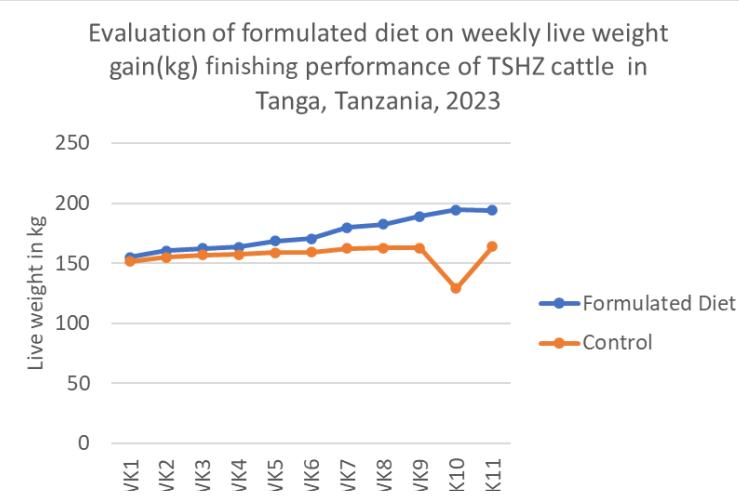 Figure 1: Evaluation of formulated diet on weekly live weight gain (kg) finishing performance of TSHZ cattle in Tanga, Tanzania
## IV. CONCLUSION
This study demonstrated that developing local feed formulas for cattle finishing can significantly enhance the quality of beef, leading to increased profitability for producers and contributing to the national economy, job creation, and the potential for commercial application. The locally developed feed formula prototype by TALIRI not only reduces costs but also creates job opportunities for youth, the private sector, and scientists in Tanzania. Engagement of the private sector, coupled with research expertise, was crucial in the successful development and potential commercialization of the feed formula. Further research should focus on developing feed formulas for other livestock species such as chickens, fish, and dairy cattle. This expansion is essential for diversifying and strengthening the livestock industry in Tanzania.
1. Alex Goodluck Mrema, Sebastian Wilson Chenyambuga, Esron Karimuribo, Angaza Gimbi
- and Lughano Jeremy Moses Kusiluka, 2022. Evaluation of locally available feed resources for fattening of zebu cattle in the Lake zone of Tanzania. Journal of Research in Agriculture and Animal Science Volume 9 ~ Issue 12 (2022) pp: 34-4.
2. Asimwe L, Kimambo A E, Laswai G H, Mtenga L A, Weisbjerg M R and Madsen J 2016: Economics of finishing Tanzania Shorthorn Zebu cattle in feedlot and optimum finishing period. Livestock Research for Rural Development. Volume 28, Article #201.
3. Bertipaglia, L. M. A., Silva, R. R., do Prado, R. M., Rotta, P. P., Valero, M. V., do Prado, I. N., & Dian, P. H. M. (2010). Levels of replacing corn by cassava starch on performance and carcass characteristics of bulls finished in feedlot/Substituição do milhoço peso resíduo da fecularia de mandioca no desempinho e nas caractécticas de carneça de bovinos terminados em confinamento.
4. João B. Silva Neto, Lucio F. M. Mota, Sabrina T. Amorim, Elisa Peripolli, Luiz F. Brito Claudio U. Magnabosco and Fernando Baldi, 2023. Genotype-by-environment interactions for feed
- efficiency traits in Nellore cattle based on bi-trait reaction norm models. Silva Neto et al. Genetics Selection Evolution (2023) 55:93. https://doi.org/10.1186/s12711-023-00867-2.
5. Lovince Asimwe, A.E. Kimambo, Germana H Laswai, Daniel Elias Mushi, L.A. Mtenga, Martin Riis Weisbjerg, J. Madsen, 2015. Growth performance and carcass characteristics of Tanzania Shorthorn Zebu cattle finished on molasses or maize grain with rice or maize by-products. Livestock Science182. DOI: 10.1016/j.livsci.2015.11.001.
6. Malole, J. L., Kadigi, R. J. M., & Sangeda, A. Z. (2014). Costs and benefits of beef cattle fattening schemes in some selected areas of west-northwest Tanzania. Iranian Journal of Applied Animal Science, 4(4).
7. Marshall B, Bredon RM, Juko CD, 2009. The nutrition of zebu cattle Part IV. The intake of dry matter by cattle with some notes on the digestibility of Rhodes grass and Star grass hays. The Journal of Agricultural Science. 1961;56(2):191-196. doi:10.1017/S0021859600024631
8. MLF, 2022. Ministry of Livestock and Fisheries. Annual Budget Speech.
9. Muzzo and Provenza, 2028. A review of strategies for overcoming challenges of beef production in Tanzania. https://works.bepress.com/frederick_provenza/493/
10. Obosha, D. W. (2021). Analysis Gender Roles in Beef Cattle Value Chain: In West Shewa Zone, Oromia National Regional State, Ethiopia. Journal of Science and Sustainable Development, 9(1), 21-38.
11. Piotr Kostusiak, Paweł Solarczyk and Kamila Puppe, 2022. Genetic and Environmental Determinants of Beef Quality—A Review. Frontiers in Veterinary Science. REVIEW. doi: 10.3389/fvets.2022.819605.
12. Saning'o Gabriel Kimirei, Sebastian Wilson Chenyambuga, Daniel Elia Mushi, George Mutani Msalya, Zena Mpenda, 2022. Feedlot Performance and Profitability of Tanzania Shorthorn Zebu Finished on Local Feed Resources in Kongwa District, Tanzania. International Journal of Animal Science and Technology. 2022; 6(4): 78-85.
13. Marta Peña and Elisabet Mas de les Valls., 2023. Inclusion of the gender equality sustainable development goal in engineering teaching and research. Environment, Development and Sustainability https://doi.org/10.1007/s10668-023-03667-2.
14. Mlote S N, Mdoe NSY, Isinika A and Mtenga L A 2012: Value addition of beef cattle fattening in the Lake Zone in Tanzania: Challenges and opportunities. Livestock Research for Rural Development. Volume 24, Article #95. Retrieved August 7, 2024, from http://www.lrrd.org/lrrd24/6/mlot24095.htm.
Generating HTML Viewer...
Funding
No external funding was declared for this work.
Conflict of Interest
The authors declare no conflict of interest.
Ethical Approval
No ethics committee approval was required for this article type.
Data Availability
Not applicable for this article.
Zabron Nziku,. 2026. \u201cInnovative and Affordable Feed Solutions for Enhancing Cattle Finishing in Tanzania\u201d. Global Journal of Science Frontier Research - D: Agriculture & Veterinary GJSFR-D Volume 24 (GJSFR Volume 24 Issue D1): .
In Tanzania, livestock significantly contributes to the national economy, with the beef sub-sector accounting for 2.2% of the GDP. However, unfinished cattle at slaughterhouses result in suboptimal beef quality. Proper finishing is crucial because it adds value to the quality of beef meat. Apart from genetics, applying the right feed technology and feeding strategies on beef cattle before slaughter can increase output by 70% and perhaps coequal with health. The current study developed two feed diet formulas using local feed materials given the high quality and affordable cost for the Zebu cattle finishing business.
Our website is actively being updated, and changes may occur frequently. Please clear your browser cache if needed. For feedback or error reporting, please email [email protected]
×
This Page is Under Development
We are currently updating this article page for a better experience.
Thank you for connecting with us. We will respond to you shortly.