
Innovativeness as an Enssential Part of Entrepreneurial Training in Developing the Competitive Advantage: Terengganu Creative Industry

§ Universiti Teknologi MARA (Terengganu) Universiti Teknologi MARA (Terengganu)

Send Message

To: Author

Innovativeness as an Enssential Part of Entrepreneurial Training in Developing the Competitive Advantage: Terengganu Creative Industry

Article Fingerprint

ReserarchID

832KP

Innovativeness as an Enssential Part of Entrepreneurial Training in Developing the Competitive Advantage: Terengganu Creative Industry Banner

AI TAKEAWAY

Connecting with the Eternal Ground
  • English
  • Afrikaans
  • Albanian
  • Amharic
  • Arabic
  • Armenian
  • Azerbaijani
  • Basque
  • Belarusian
  • Bengali
  • Bosnian
  • Bulgarian
  • Catalan
  • Cebuano
  • Chichewa
  • Chinese (Simplified)
  • Chinese (Traditional)
  • Corsican
  • Croatian
  • Czech
  • Danish
  • Dutch
  • Esperanto
  • Estonian
  • Filipino
  • Finnish
  • French
  • Frisian
  • Galician
  • Georgian
  • German
  • Greek
  • Gujarati
  • Haitian Creole
  • Hausa
  • Hawaiian
  • Hebrew
  • Hindi
  • Hmong
  • Hungarian
  • Icelandic
  • Igbo
  • Indonesian
  • Irish
  • Italian
  • Japanese
  • Javanese
  • Kannada
  • Kazakh
  • Khmer
  • Korean
  • Kurdish (Kurmanji)
  • Kyrgyz
  • Lao
  • Latin
  • Latvian
  • Lithuanian
  • Luxembourgish
  • Macedonian
  • Malagasy
  • Malay
  • Malayalam
  • Maltese
  • Maori
  • Marathi
  • Mongolian
  • Myanmar (Burmese)
  • Nepali
  • Norwegian
  • Pashto
  • Persian
  • Polish
  • Portuguese
  • Punjabi
  • Romanian
  • Russian
  • Samoan
  • Scots Gaelic
  • Serbian
  • Sesotho
  • Shona
  • Sindhi
  • Sinhala
  • Slovak
  • Slovenian
  • Somali
  • Spanish
  • Sundanese
  • Swahili
  • Swedish
  • Tajik
  • Tamil
  • Telugu
  • Thai
  • Turkish
  • Ukrainian
  • Urdu
  • Uzbek
  • Vietnamese
  • Welsh
  • Xhosa
  • Yiddish
  • Yoruba
  • Zulu
Font Type
Font Size
Font Size
Bedground

Abstract

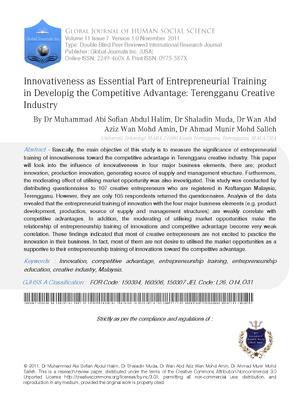
Basically, the main objective of this study is to measure the significance of entrepreneurial training of innovativeness toward the competitive advantage in Terengganu creative industry. This paper will look into the influence of innovativeness in four major business elements, there are; product innovation, production innovation, generating source of supply and management structure. Furthermore, the moderating effect of utilising market opportunity was also investigated. This study was conducted by distributing questionnaires to 107 creative entrepreneurs who are registered in Kraftangan Malaysia, Terengganu. However, they are only 105 respondents returned the questionnaires. Analysis of the data revealed that the entrepreneurial training of innovation with the four major business elements (e.g. product development, production, source of supply and management structures) are weakly correlate with competitive advantages. In addition, the moderating of utilising market opportunities make the relationship of entrepreneurship training of innovations and competitive advantage become very weak correlation. These findings indicated that most of creative entrepreneurs are not excited to practice the innovation in their business. In fact, most of them are not desire to utilised the market opportunities as a supportive to their entrepreneurship training of innovations toward the competitive advantage.

References

21 Cites in Article
  1. Nor Nor,Filzah Filzah,Rusmadi Rusmadi (2009). Menelusuri Budaya Literasi Masyarakat Melayu melalui Kajian Manuskrip Ilmu Bedil.
  2. Bor Bregant,Daniel Doz,Sanela Hudovernik (2004). Factors Influencing Tandem Learning in Mathematics.
  3. B Bird (1989). Entrepreneurial Behavior.
  4. Jim Ridgway,James Nicholson,Sinclair Sutherland,Spencer Hedger (1988). Strategies for public engagement with official statistics.
  5. C Carey,A Naudin (2006). Enterprise Curriculum for Creative Industries Students: An Exploration of Current Attitudes and Issues.
  6. M Casson (1982). The Entrepreneur: An Economic Theory.
  7. S Ehrlich,A Noble,D Jung,D Pearson (2000). The Impact of Entrepreneurship Training Program on an Individual's entrepreneurial Self-Efficacy.
  8. A Einarsson (2002). Entrepreneurship as a Part of the Creative Industries within the Cultural Sector in a Small Society.
  9. W Gartner (1990). Entrepreneurial Characteristics amongst University Students: Some insights for Entrepreneurship Education and Training in Turkey.
  10. Hatta Azad Khan (2006). Industri Budaya dan Kreatif dalam Konteks Globalisasi.
  11. A Ibrahim,K Soufani (2002). Entrepreneurship Education and Training in Canada: A Critical Assessment.
  12. Hannu Littunen (2000). Entrepreneurship and the characteristics of the entrepreneurial personality.
  13. D Mcclelland (1987). Characteristics of Successful Entrepreneurs.
  14. S Mike,Tuck,S Bellamy (2004). Small Business Success Factor: The Role of Education and Training.
  15. Rais Yatim (2006). Ministry of of Arts, Culture and Heritage: Keynote address in Majlis Perasmian Persidangan Seni Budaya dan Warisan.
  16. Julian Rotter (1966). Generalized expectancies for internal versus external control of reinforcement..
  17. U Sekaran (2005). Research Methods for Business: A Skill Building Approaches.
  18. Scott Shane,Edwin Locke,Christopher Collins (2003). Entrepreneurial motivation.
  19. W Stewart,J Carland,J Carland,W Watson,R Sweo (2003). Entrepreneurial Dispositions and Goal Orientations: A Comparative Exploration of United States and Russian Entrepreneurs.
  20. T Zimmerer,N Scarborough (2005). Essentials of Entrepreneurship and Small Business Management (4 th and International Edition).
  21. A Zackharakis (1997). Entrepreneurial Entry into Foreign markets.

Funding

No external funding was declared for this work.

Conflict of Interest

The authors declare no conflict of interest.

Ethical Approval

No ethics committee approval was required for this article type.

Data Availability

Not applicable for this article.

How to Cite This Article

Muhammad Halim, Dr Muda, Dr Amin. . "Innovativeness as an Enssential Part of Entrepreneurial Training in Developing the Competitive Advantage: Terengganu Creative Industry". Global Journal of Human-Social Science, Global Journal of Human-Social Science - A: Arts & Humanities GJHSS-A Volume 11 (GJHSS Volume 11 Issue A7).

Download Citation

Journal Specifications

Crossref Journal DOI 10.17406/GJHSS

Print ISSN 0975-587X

e-ISSN 2249-460X

Keywords
Classification
GJHSS-A Classification FOR Code: 150304
160506
150307 JEL Code L26
O14
O31
Version of record

v1.2

Language
English
Experiance in AR

Explore published articles in an immersive Augmented Reality environment. Our platform converts research papers into interactive 3D books, allowing readers to view and interact with content using AR and VR compatible devices.

Read in 3D

Your published article is automatically converted into a realistic 3D book. Flip through pages and read research papers in a more engaging and interactive format.

Article Matrices
Total Views: 4.6K
Total Downloads: 231
All Trends

Request Access

Please fill out the form below to request access to this research paper. Your request will be reviewed by the editorial or author team.
X

This is the heading

Lorem ipsum dolor sit amet, consectetur adipiscing elit. Ut elit tellus, luctus nec ullamcorper mattis, pulvinar dapibus leo.


High-quality academic research articles on global topics and journals.

Innovativeness as an Enssential Part of Entrepreneurial Training in Developing the Competitive Advantage: Terengganu Creative Industry

Muhammad Halim
Muhammad Halim Universiti Teknologi MARA (Terengganu)
Dr Muda
Dr Muda
Dr Amin
Dr Amin