Instrumental System of Distance Learning DL.GSU.BY and Examples of its Application

α
Michael Dolinsky
Michael Dolinsky

Send Message

To: Author

Instrumental System of Distance Learning DL.GSU.BY  and Examples of its Application

Article Fingerprint

ReserarchID

VK728

Instrumental System of Distance Learning DL.GSU.BY  and Examples of its Application Banner

AI TAKEAWAY

Connecting with the Eternal Ground
  • English
  • Afrikaans
  • Albanian
  • Amharic
  • Arabic
  • Armenian
  • Azerbaijani
  • Basque
  • Belarusian
  • Bengali
  • Bosnian
  • Bulgarian
  • Catalan
  • Cebuano
  • Chichewa
  • Chinese (Simplified)
  • Chinese (Traditional)
  • Corsican
  • Croatian
  • Czech
  • Danish
  • Dutch
  • Esperanto
  • Estonian
  • Filipino
  • Finnish
  • French
  • Frisian
  • Galician
  • Georgian
  • German
  • Greek
  • Gujarati
  • Haitian Creole
  • Hausa
  • Hawaiian
  • Hebrew
  • Hindi
  • Hmong
  • Hungarian
  • Icelandic
  • Igbo
  • Indonesian
  • Irish
  • Italian
  • Japanese
  • Javanese
  • Kannada
  • Kazakh
  • Khmer
  • Korean
  • Kurdish (Kurmanji)
  • Kyrgyz
  • Lao
  • Latin
  • Latvian
  • Lithuanian
  • Luxembourgish
  • Macedonian
  • Malagasy
  • Malay
  • Malayalam
  • Maltese
  • Maori
  • Marathi
  • Mongolian
  • Myanmar (Burmese)
  • Nepali
  • Norwegian
  • Pashto
  • Persian
  • Polish
  • Portuguese
  • Punjabi
  • Romanian
  • Russian
  • Samoan
  • Scots Gaelic
  • Serbian
  • Sesotho
  • Shona
  • Sindhi
  • Sinhala
  • Slovak
  • Slovenian
  • Somali
  • Spanish
  • Sundanese
  • Swahili
  • Swedish
  • Tajik
  • Tamil
  • Telugu
  • Thai
  • Turkish
  • Ukrainian
  • Urdu
  • Uzbek
  • Vietnamese
  • Welsh
  • Xhosa
  • Yiddish
  • Yoruba
  • Zulu

Abstract

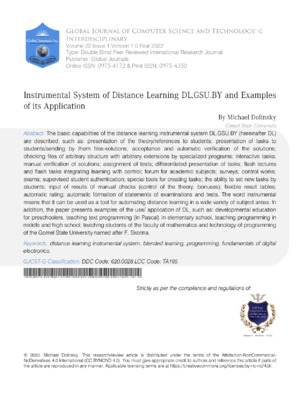
The basic capabilities of the distance learning instrumental system DL.GSU.BY (hereinafter DL) are described, such as: presentation of the theory/references to students; presentation of tasks to students/sending by them files-solutions; acceptance and automatic verification of the solutions; checking files of arbitrary structure with arbitrary extensions by specialized programs; interactive tasks; manual verification of solutions; assignment of tests; differentiated presentation of tasks; flash lectures and flash tasks integrating learning with control; forum for academic subjects; surveys; control works; exams; supervised student authentication; special tools for creating tasks; the ability to set new tasks by students; input of results of manual checks (control of the theory, bonuses); flexible result tables; automatic rating; automatic formation of statements of examinations and tests. The word instrumental means that it can be used as a tool for automating distance learning in a wide variety of subject areas. In addition, the paper presents examples of the use/ application of DL, such as: developmental education for preschoolers, teaching text programming (in Pascal) in elementary school, teaching programming in middle and high school; teaching students of the faculty of mathematics and technology of programming of the Gomel State University named after F. Skorina.

References

31 Cites in Article
  1. Najeh Alsalhi,Sami Al-Qatawneh,Mohd. Eltahir,Khitam Aqel (2021). Does Blended Learning Improve the Academic Achievement of Undergraduate Students in the Mathematics Course?: A Case Study in Higher Education.
  2. Ahmed Antwi-Boampong (2021). AN INVESTIGATION INTO BARRIERS IMPACTING AGAINST FACULTY BLENDED LEARNING ADOPTION.
  3. Ahmed Antwi-Boampong,Anthony Bokolo (2021). Towards an Institutional Blended Learning Adoption Model for Higher Education Institutions.
  4. L Astarilla,D Warman (2021). The Effect of Google Classroom in Blended Learning on University Students' English Ability.
  5. N Aznam,R Perdana,J Jumadi,H Nurcahyo,Y Wiyatmo (2021). The Implementation of Blended Learning and Peer Tutor Strategies in Pandemic Era: A Systematic Review//Advances in Social Science.
  6. Silviane Barbato,Rossana Beraldo (2020). Polemic Forums in Blended Learning as New Strategies for a Borderless Higher Education.
  7. A Bokolo (2021). Institutional factors for faculty members' implementation of blended learning in higher education//Education + Training.
  8. Shannon Chamberlain,Daniel Elford,Simon Lancaster,Francesca Silve (2021). Tailored Blended Learning for Foundation Year Chemistry Students.
  9. P Unknown Title.
  10. K Darma,G Karma,M Santiana (2021). Validity and Practicality Test of Applied Mathematics Digital Teaching Materials for Blended Learning for Polytechnic Engineering Students.
  11. M Dolinsky (2016). Gomel training school for Olympiads in Informatics//Olympiads in Informatics.
  12. Michael Dolinsky (2013). Secondary School Programming Olympiads in Gomel Region.
  13. Jerry Yunus,M (2021). Blended Learning in Rural Primary ESL Classroom: Do or Don.
  14. Kevin Jones,Ravi Sharma (2021). Higher Education 4.0.
  15. Atefeh Karamzadeh,Leili Mosalanejad,Leila Bazrafkan (2021). Effectiveness of ethics case based on blended learning approaches on medical students’ learning: A quasi-experimental study.
  16. B Khan,S Chenda,S Heng,D Coniam (2021). Blended Learning for Inclusive and Quality Higher Education in Asia.
  17. I Kolegova,I Levina (2021). MODULE AND PROJECT-BASED TEACHING OF FOREIGN LANGUAGE TO FUTURE ECONOMISTS.
  18. Stephen Lane,John Hoang,Jacqueline Leighton,Anna Rissanen (2021). Engagement and Satisfaction: Mixed-Method Analysis of Blended Learning in the Sciences.
  19. Phuong Le,Hien Pham (2021). Using Blended Learning in Teacher Training Programs: Perspectives of Pre-service Teachers.
  20. Jihye Lee,Hyun‐kyung Lee,Dabin Jeong,Jieun Lee,Taeryun Kim,Jihyon Lee (2020). Developing Museum Education Content: AR Blended Learning.
  21. C Lim,D Yang,Y Gao (2021). Blended Learning for Inclusive and Quality Higher Education in Asia.
  22. Sylvie Lomer,Elizabeth Palmer (2021). ‘I didn’t know this was actually stuff that could help us, with actually learning’: student perceptions of Active Blended Learning.
  23. Thibault Lovey,Paul O'keeffe,Ianis Petignat (2021). Basic Medical Training for Refugees via Collaborative Blended Learning: Quasi-Experimental Design.
  24. Wang Lu,Siti Mustapha,Nabilah Abdullah (2021). Constructing and Validating University Students’ Blended Learning Acceptance Scale.
  25. Stepan Mekhitarian (2021). The Essential Blended Learning PD Planner: Where Classroom Practice Meets Distance Learning.
  26. Patricia Muhuro,Simon Kangethe,Patricia Muhuro (2021). Prospects and pitfalls associated with implementing blended learning in rural-based higher education institutions in Southern Africa.
  27. A Musawi,M Ammar (2021). The Effect of Different Blending Levels of Traditional and E-Learning Delivery on Academic Achievement and Students' Attitudes towards Blended Learning at Sultan Qaboos University//The Turkish Online.
  28. Thomas Nathaniel,Asa Black (2021). An Adaptive Blended Learning Approach in the Implementation of a Medical Neuroscience Laboratory Activities.
  29. M Norhapizah,M Ramlan,M Mahfuzah,H Norafifah,M Ishak (2021). The Development Of E-Citac Module In Islamic Education Course Based On Blended Learning Strategy For Higher Education In Malaysia//Multicultural Education.
  30. Sheren Oktaria,Rambat Sasongko,Muhammad Kristiawan (2021). Development of Blended Learning Designs using Moodle to Support Academics of The Curriculum in University of Bengkulu.
  31. Stephan Poelmans,Nick Verhaeghe,Pavani Vemuri (2021). ON THE SUITABILITY OF BLENDED LEARNING IN SECONDARY MATHEMATICS EDUCATION: TEST RESULTS AND PERCEPTIONS OF BELGIAN 9TH GRADE STUDENTS.

Funding

No external funding was declared for this work.

Conflict of Interest

The authors declare no conflict of interest.

Ethical Approval

No ethics committee approval was required for this article type.

Data Availability

Not applicable for this article.

How to Cite This Article

Michael Dolinsky. 2026. \u201cInstrumental System of Distance Learning DL.GSU.BY and Examples of its Application\u201d. Global Journal of Computer Science and Technology - G: Interdisciplinary GJCST-G Volume 22 (GJCST Volume 22 Issue G1): .

Download Citation

Accessible, reliable DLSU distance education system with practical applications.
Issue Cover
GJCST Volume 22 Issue G1
Pg. 45- 53
Journal Specifications

Crossref Journal DOI 10.17406/gjcst

Print ISSN 0975-4350

e-ISSN 0975-4172

Keywords
Classification
GJCST-G Classification: DDC Code: 620.0028 LCC Code: TA165
Version of record

v1.2

Issue date

May 21, 2022

Language
en
Experiance in AR

Explore published articles in an immersive Augmented Reality environment. Our platform converts research papers into interactive 3D books, allowing readers to view and interact with content using AR and VR compatible devices.

Read in 3D

Your published article is automatically converted into a realistic 3D book. Flip through pages and read research papers in a more engaging and interactive format.

Article Matrices
Total Views: 3028
Total Downloads: 38
2026 Trends
Related Research

Published Article

The basic capabilities of the distance learning instrumental system DL.GSU.BY (hereinafter DL) are described, such as: presentation of the theory/references to students; presentation of tasks to students/sending by them files-solutions; acceptance and automatic verification of the solutions; checking files of arbitrary structure with arbitrary extensions by specialized programs; interactive tasks; manual verification of solutions; assignment of tests; differentiated presentation of tasks; flash lectures and flash tasks integrating learning with control; forum for academic subjects; surveys; control works; exams; supervised student authentication; special tools for creating tasks; the ability to set new tasks by students; input of results of manual checks (control of the theory, bonuses); flexible result tables; automatic rating; automatic formation of statements of examinations and tests. The word instrumental means that it can be used as a tool for automating distance learning in a wide variety of subject areas. In addition, the paper presents examples of the use/ application of DL, such as: developmental education for preschoolers, teaching text programming (in Pascal) in elementary school, teaching programming in middle and high school; teaching students of the faculty of mathematics and technology of programming of the Gomel State University named after F. Skorina.

Our website is actively being updated, and changes may occur frequently. Please clear your browser cache if needed. For feedback or error reporting, please email [email protected]

Request Access

Please fill out the form below to request access to this research paper. Your request will be reviewed by the editorial or author team.
X

Quote and Order Details

Contact Person

Invoice Address

Notes or Comments

This is the heading

Lorem ipsum dolor sit amet, consectetur adipiscing elit. Ut elit tellus, luctus nec ullamcorper mattis, pulvinar dapibus leo.

High-quality academic research articles on global topics and journals.

Instrumental System of Distance Learning DL.GSU.BY and Examples of its Application

Michael Dolinsky
Michael Dolinsky

Research Journals