

1. Introduction
Until March 2022, the pandemic has claimed the existence of seven million directly through the spread and disease of COVID-19 (WHO, 2022). In an indirect way, affecting comorbidities such as diabetes or hypertension, it would be related to 20 million deaths (PAHO, 2022). Anti-COVID-19 policies in education are distinguished by replacing the traditional classroom with a virtual one (OCDE, 2022). The epidemiological traffic light determines the transition: in red, the educational systems withdraw, the confinement intensifies and the interaction is reduced to virtual platforms; in green, universities and institutes design hybrid teaching and learning systems (SSA, 2022). Underlying this phase of lack of confidence is the formation of intellectual capital as a liaison policy between universities and knowledge-creating organizations.
Intellectual capital refers to a series of academic and professional training requirements that allow a more direct transition from the university to the labor market, mainly employment opportunities in the locality (Acosta, 2012). In this sense, the intellectual capital review works have focused their interest in the formation of habitus understood as the transfer of knowledge, skills and wisdom of the professional to the student.
In this way, the works related to the formation of the intellectual habitus have demonstrated a virtuous circle of trust, commitment, entrepreneurship, innovation and satisfaction (Ardevol, 2015). It is an academic and professional training focused on the climate of relationships, tasks and conflicts.
However, systematic reviews and metanalysis related to intellectual capital have focused on performance, productivity and competitiveness without considering this training process (Carreón et al., 2015). In this sense, a review of the training process of intellectual capital will establish the axes, themes, dimensions and categories.
The formation of intellectual capital involves phases of management, production and transfer of knowledge (Carreon, 2019). This is the case of professional training in companies located in the Silicon Valley, Palo Alto, California, United States. It is a process in which the creation of an innovation is driven by risk capitals that increase as the original idea is consolidated and adjusts to the current and future requirements of a real or potential market.
In the process of intellectual capital formation, it involves consolidating intangible assets of organizations financed with venture capital (Adams, 2020). Management is simple when compared to the consolidation of the entrepreneurial project or the production of new knowledge, as well as the transfer of this knowledge to other areas of the subsidiary or subsidiary organizations or companies of the main parent company.
The theory of intellectual capital formation warns that such complexity would not be possible without inherited or acquired knowledge teaching (Garcia, 2020). It is a training habit in which expressions, knowledge, values and appreciations are transferred in academic, professional and labor training.
These four dimensions related to ethos, aesthesis, hexis and eidos form a formative habitus that is gestated in the interrelation of provisions against or in favor of a project; opportunity generation, resource optimization or process innovation (Korstanje, 2020).
Research related to training habitus highlights the convergence of the four aesthetic, expressive, cognitive and ethical dimensions in the production of knowledge (Clark, 2020). If the management of each of them involves the translation of these four dimensions into objectives, tasks and goals, then the production of knowledge will start from personal dispositions and will culminate with the consolidation of distinctive features of the innovative product or process. That is, technology is a reflection of the academic, professional and labor relations involved in the management, production and transfer of knowledge.
Consequently, the measurement of this formative process of intellectual capital has been very complex (Villegas, 2018). Some instruments focus their interest in entrepreneurship; considering the creation of opportunities, the optimization of resources or the innovation of processes as central axes. Other works refer more to the particular analysis of academic, professional or occupational training, focusing their analysis on the translation of knowledge, experiences and emotions.
However, the formation of human capital is focused on the transfer of knowledge that allows the consolidation of projects and the conversion of talents into intangible assets. That is, emotions, values, expressions and knowledge transferred towards the convergence of objectives, tasks and goals as entrepreneurship or innovation devices.
From the formative theory of the intellectual capita and the studies on the relations between its dimensions and components in the academic, professional and labor field, it is possible to delineate trajectories of relations between the categories and variables.
The first trajectory of the academic, professional and labor habitus explains the transfer of knowledge prior to management and production oriented to the consolidation of projects outlined in this path. This is the case of innovations that originated among students and consolidated among competitors, as is the case of information and communication technologies.
The second route refers to the process of management, production and transfer of knowledge complementary to the first route since it involves the insertion of risk capital. The same innovative project of information or communication technology is potentialized with venture capital to intensify the consolidation of the project.
A third peripheral route to the previous two refers to the process of knowledge transfer and its culmination in a production of knowledge. This is the case of strategic alliances between universities and organizations that, through professional practices to social services, will generate an agenda for the translation of ideas and their concatenation.
Objective: Discuss the axes, themes, dimensions and categories of the intellectual training agenda in order to evaluate the public policies of strategic alliances between higher education institutions and knowledge-creating organizations for graduation and market insertion labor.
Formulation: Will there be differences between the axes, themes, dimensions and categories reported in the public literature from 2019 to 2022?
Null hypothesis: There will be no significant differences between the axes, themes, dimensions and categories reported in the literature related to the formation of intellectual capital.
2. Method
Design: Documentary, retrospective and exploratory study.
Sample: Selection of sources indexed to international repositories such as; Academia, Copernicus, Dialnet, Latindex, Publindex, Redalyc, Scielo, Scopus, Zenodo and Zotero, considering the period of publication from 2019 to 2022, as well as the search for "intellectual capital" keywords (see Table 1).
Table 1. Descriptive of sample
| Repository | 2019 | 2020 | 2021 | 2022 |
|---|---|---|---|---|
| Academia | 6 | 5 | 5 | 2 |
| Copernicus | 5 | 4 | 4 | 3 |
| Dialnet | 8 | 6 | 3 | 4 |
| Latindex | 7 | 7 | 7 | 1 |
| Publindex | 6 | 5 | 5 | 2 |
| Redalyc | 5 | 3 | 2 | 3 |
| Scielo | 6 | 5 | 2 | 2 |
| Scopus | 4 | 4 | 5 | 3 |
| Zenodo | 3 | 7 | 6 | 1 |
| Zotero | 4 | 8 | 6 | 1 |
Source: Elaborated with data study
Instrument: Matrices of content analysis, opinion and contingency (Godson, 2014). They include columns of selected findings from the literature, qualifications, feedback and reconsiderations of experts in the field (McCombs and Valenzuela, 2014).
Process: The summaries were selected from the search by keywords of intellectual capital formation, considering the period of publication from 2019 to 2022. Expert judges rated the summaries, considering; -1 for the intellectual formative process detached from the university with the labor market, 0 for the training process without significant effects and 1 for positive effects of the training process (Harper, 2012). Then, the results were presented in order to obtain opinions to provide feedback on the criteria (Kumar and Jain, 2013). Once the ratings and feedback were combined, the differences and coincidences for the reconsiderations and consensus were established (McCleskey, 2014). The data was processed in the qualitative analysis package version 3.0 (see Table 2).
Table 2. Description of the judges
| Sex | Age | Income | Experience |
|---|---|---|---|
| Male | 57 | 47’324.00 | 20 |
| Female | 68 | 53’902.00 | 30 |
| Female | 54 | 43’423.00 | 21 |
| Female | 61 | 38’564.00 | 32 |
| Male | 48 | 28’546.00 | 20 |
| Male | 55 | 42’436.00 | 30 |
| Male | 49 | 51’982.00 | 20 |
Source: Elaborated with data study
Analysis: Prevalence distribution parameters were estimated in order to establish the prevalence of axes, themes, dimensions and categories related to the formation of intellectual capital (De la Fuente, Vera and Cardelle, 2012). The contingency and proportion statistics were weighted to test the null hypothesis (Duarte and Ruis, 2009).
3. Results
The hypothetical structural model for intellectual capital formation is organized around the interrelationship between the formative dimensions of academic, professional, and labor habitus and the processes of knowledge management, knowledge production, knowledge transfer, innovation capability, and entrepreneurial orientation. The theoretical basis of the model assumes that intellectual capital formation is not an isolated outcome but a cumulative process in which dispositions, values, knowledge, experiences, and practices interact to facilitate the management, production, and transfer of knowledge (see Figure 1).
The first latent construct is Ethos, which represents the ethical and value-oriented dimension of the formative habitus. Its indicators, Ethos 1, Ethos 2, Ethos 3, and Ethos 4, operationalize the internalization of values, principles, commitments, and orientations that guide academic, professional, and labor behavior. The hypothetical measurement relationships indicate that the indicators are reflective manifestations of the underlying Ethos construct. The standardized loadings shown in the model, 0.82, 0.87, 0.79, and 0.84, indicate a strong relationship between the latent construct and its observed indicators. Ethos 2 presents the highest loading, suggesting that this indicator provides the strongest empirical representation of the construct within the proposed measurement structure.
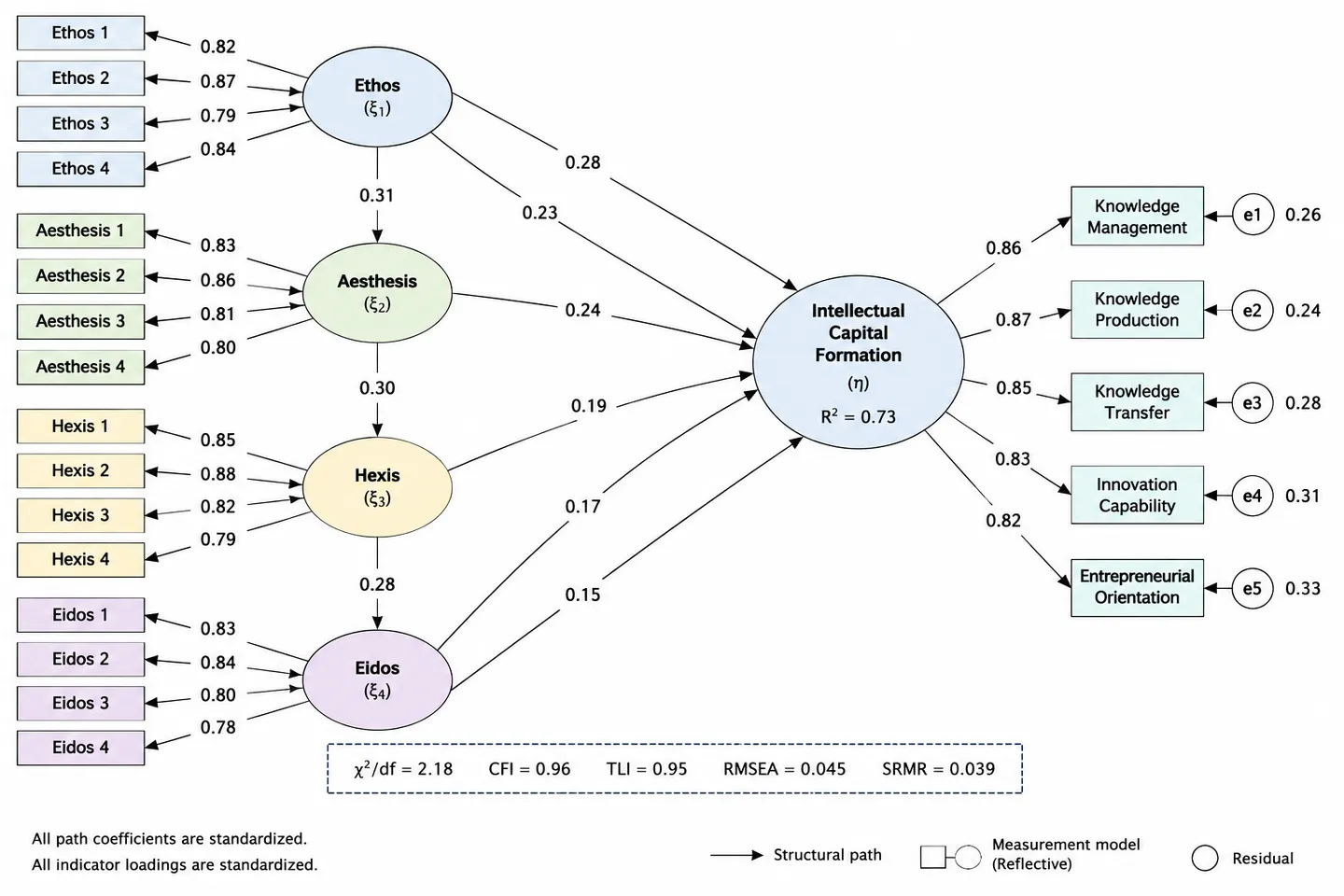
The second latent construct is Aesthesis, which represents the expressive, perceptual, and experiential dimension of formative development. Aesthesis 1, Aesthesis 2, Aesthesis 3, and Aesthesis 4 constitute its observed indicators. Their standardized loadings of 0.83, 0.86, 0.81, and 0.80 indicate that the four indicators substantially reflect the latent dimension. The relatively homogeneous loadings suggest that Aesthesis is conceptualized as a coherent construct in which the capacity to perceive, interpret, express, and integrate experiences contributes to the development of intellectual capital.
The third latent construct is Hexis, representing the practical and embodied dimension of formative habitus. Hexis 1, Hexis 2, Hexis 3, and Hexis 4 reflect the incorporation of knowledge and experience into recurrent practices, competencies, and behavioral dispositions. The standardized loadings of 0.85, 0.88, 0.82, and 0.79 indicate strong relationships between the observed indicators and the latent construct. Hexis 2 presents the highest loading, suggesting that this indicator is particularly representative of the practical dimension of intellectual formation.
The fourth latent construct is Eidos, representing the cognitive and knowledge-oriented dimension of formative habitus. Eidos 1, Eidos 2, Eidos 3, and Eidos 4 reflect the organization, interpretation, and application of acquired knowledge. Their standardized loadings of 0.83, 0.84, 0.80, and 0.78 indicate substantial reflective relationships. The measurement structure therefore assumes that intellectual formation requires not only ethical and experiential dispositions but also a cognitive structure capable of organizing knowledge and transforming it into useful competencies.
The first hypothetical structural trajectory connects Ethos with Aesthesis, with a standardized path coefficient of 0.31. This relationship proposes that ethical dispositions influence the way individuals perceive, interpret, and express academic and professional experiences. A stronger ethical orientation may therefore provide a framework through which experiences acquire meaning and are transformed into legitimate forms of professional and academic expression.
A second trajectory connects Aesthesis with Hexis, with a coefficient of 0.30. This path proposes that perception and expression become incorporated into practical dispositions. Experiences initially interpreted through the expressive dimension can progressively become routines, competencies, and behavioral patterns. Consequently, intellectual capital formation can be understood as a process through which interpreted experiences are transformed into practical capacities.
A third trajectory connects Hexis with Eidos, with a coefficient of 0.28. This relationship proposes that repeated practices and embodied competencies contribute to the consolidation of cognitive structures. Practical experience can therefore reinforce the organization of knowledge by allowing individuals to connect theoretical understanding with concrete situations.
The model also specifies a direct trajectory from Ethos toward Intellectual Capital Formation, with a coefficient of 0.28. This relationship suggests that ethical dispositions may contribute directly to intellectual capital formation beyond their indirect influence through Aesthesis, Hexis, and Eidos. Values, commitments, responsibility, and professional orientation can facilitate the development of knowledge-based capabilities because they influence the way individuals participate in academic, organizational, and professional environments.
A direct trajectory from Aesthesis toward Intellectual Capital Formation is represented by a coefficient of 0.24. This path indicates that perception, interpretation, and expression may independently contribute to intellectual capital formation. The theoretical assumption is that intellectual capital depends partly on the capacity to recognize opportunities, interpret experiences, communicate ideas, and transform individual perceptions into knowledge-producing activities.
The trajectory from Hexis toward Intellectual Capital Formation has a coefficient of 0.19. This relationship emphasizes the contribution of acquired practices and embodied competencies to intellectual capital. The relatively lower coefficient compared with Ethos and Aesthesis suggests, within the hypothetical structure, that practical dispositions contribute meaningfully but do not completely determine intellectual capital formation.
The trajectory from Eidos toward Intellectual Capital Formation is represented by a coefficient of 0.17. This relationship proposes that cognitive organization and knowledge structures directly contribute to intellectual capital formation. The coefficient indicates a positive hypothetical contribution, while also suggesting that intellectual capital formation is not exclusively determined by cognitive knowledge. Instead, it emerges from the interaction of ethical, expressive, practical, and cognitive dimensions.
The central endogenous construct is Intellectual Capital Formation. Its position in the model indicates that it functions as the principal outcome of the formative habitus system. The model assigns an R² value of 0.73 to this construct, meaning that the proposed structural relationships collectively account for a substantial proportion of its variance within the hypothetical model. This value should be interpreted as a model specification rather than as an empirical estimate from the documentary study because the source describes a documentary and exploratory design rather than a conventional respondent-based structural equation analysis.
Intellectual Capital Formation is subsequently associated with Knowledge Management, Knowledge Production, Knowledge Transfer, Innovation Capability, and Entrepreneurial Orientation. Knowledge Management has a standardized loading of 0.86, indicating a strong relationship with the central construct. The trajectory proposes that intellectual capital formation becomes observable through the capacity to organize, manage, and strategically utilize knowledge within academic, professional, and organizational contexts.
Knowledge Production presents a loading of 0.87, the strongest of the five outcome indicators. This relationship suggests that the generation of new knowledge represents one of the most important manifestations of intellectual capital formation. The trajectory is theoretically consistent with the idea that accumulated knowledge, experiences, competencies, and dispositions can be transformed into new concepts, solutions, methods, projects, or organizational practices.
Knowledge Transfer has a loading of 0.85. This relationship indicates that intellectual capital formation is strongly expressed through the capacity to communicate, disseminate, adapt, and apply knowledge across academic, professional, and organizational contexts. Knowledge transfer therefore constitutes a mechanism through which individually acquired competencies can become collective or institutional intellectual resources.
Innovation Capability has a loading of 0.83. This trajectory proposes that intellectual capital formation contributes to the capacity to develop or implement new processes, products, services, strategies, or organizational solutions. The relationship is based on the assumption that innovation depends on the integration of knowledge, experience, competencies, and opportunities within a structured intellectual environment.
Entrepreneurial Orientation has a loading of 0.82. This relationship indicates that intellectual capital formation can also be manifested through opportunity recognition, resource optimization, project development, initiative, and the capacity to transform knowledge into potentially valuable activities. Entrepreneurial orientation therefore represents another possible expression of the conversion of intellectual resources into practical and organizational outcomes.
The measurement model also incorporates residual terms associated with the five observed outcomes. The residual values displayed in the model are 0.26 for Knowledge Management, 0.24 for Knowledge Production, 0.28 for Knowledge Transfer, 0.31 for Innovation Capability, and 0.33 for Entrepreneurial Orientation. These residuals represent the portions of variance not explained by the central Intellectual Capital Formation construct within the proposed measurement structure.
Overall, the hypothetical trajectories describe a progressive formative mechanism in which ethical dispositions influence perception and expression, perception contributes to practical dispositions, practical dispositions reinforce cognitive organization, and the combined dimensions contribute to intellectual capital formation. Intellectual capital formation then becomes observable through knowledge management, knowledge production, knowledge transfer, innovation capability, and entrepreneurial orientation. This structure corresponds to the source’s conceptualization of intellectual capital formation as a process involving knowledge management, production, and transfer, while also incorporating the four dimensions of ethos, aesthesis, hexis, and eidos.
The model therefore represents intellectual capital as the result of a multidimensional developmental process rather than as a single accumulation of knowledge. The proposed relationships imply that academic and professional formation becomes more effective when values, perceptions, practices, and cognitive structures converge. The resulting intellectual capital can subsequently be translated into the management, production, and transfer of knowledge and into innovation and entrepreneurial capacities. The structural model consequently provides a hypothetical representation of how formative habitus may become transformed into individual and organizational intellectual resources.
4. Discussion
The prevalence of the axes alluding to the inter-institutional of intellectual capital is led by strategic alliances (66%) between higher education institutions and local labor market organizations; being the subject of professional practices (51%) the dominant one, as well as the dimension of knowledge management (40%) and the hegemonic category of habitus (51%).
Regarding the contrast of the hypothesis in contingent relationships, institutional coupling [ϰ2 = 13,21 (23 df) p < 0,5], professional practices [ϰ2 = 14,21 (19df) p < ,05], translation of experiences [ϰ2 = 15,32 (18df) p < ,05] and provisions [ϰ2 = 16,21 (17df) p < ,05] were not rejected.
Regarding the proportional relationships of probability, institutional isomorphic was related to professional practices [OR = 23,21 (13,28 to 45,30)] and the translation of knowledge with the provisions [OR = 18,21 (19,21 to 30,28)].
The contribution of the present work to the state of the matter lies in the exploration of the axes, themes, dimensions and categories related to the formation of the intellectual capital, although the research design limited the results to the repositories that house the consulted literature, suggesting the extension of work to other contexts such as training and training.
In relation to the academic training that highlights professional competences, the present work has demonstrated an axis of institutional coupling whose rectory determines the strategies of alliances between universities and organizations. In this sense the isomorphism of the programs and strategies of alliances will allow the observation of the differences and similarities between the educational and labor actors (Melchar and Bosco, 2010).
With respect to labor practices as an area of professional competences, the present study warns that these topics are contingent on the coupling of the university with the labor market. In this way, lines of research related to strategic alliances will allow the unveiling of management competencies rather than production and transfer of knowledge (Meru and Ogbonna, 2013).
This is because the transfer of experiences was related to the dispositions to professional learning. It is a scenario in which strategic alliances and professional practices involve a transfer of knowledge for vicarious learning rather than for the contrast of theories (Riuvera, Punin and Calvo, 2013).
Regarding the systematic reviews and meta-analysis of the formation of intellectual capital that highlights the prevalence of strategic alliances (Sánchez, Cagiano and Hernández, 2011), collaborative practices (Weaver, 2007) and the implementation of new technologies (Wopner, 2012) for a 4.0 training, this study suggests that this technological axis is complemented by a dispositional axis of teaching and learning between the parties involved.
5. Conclusion
The objective of this work was to specify a model for the study of the formation of intellectual capital, emphasizing the dimensions of coupling between institutions and actors, as well as in relation to professional practices, translation of experiences and dispositions to learning.
These contributions are complementary to the literature reviews published from 2000 to 2020, although they disagree regarding the relationships between the axes, themes, dimensions and established categories. Research lines concerning the theoretical and conceptual frameworks that explain such relationships will allow us to test hypotheses related to case observations in management, production and knowledge transfer scenarios.
The present study concludes that intellectual capital formation can be conceptualized as a multidimensional process in which ethical, expressive, practical, and cognitive dispositions interact with the management, production, and transfer of knowledge. The proposed model places Ethos, Aesthesis, Hexis, and Eidos as interconnected dimensions of formative habitus and establishes Intellectual Capital Formation as the central endogenous construct through which these dimensions can be associated with Knowledge Management, Knowledge Production, Knowledge Transfer, Innovation Capability, and Entrepreneurial Orientation. This structure provides a coherent theoretical representation of the transformation of academic and professional dispositions into knowledge-based capabilities.
The proposed trajectories suggest that intellectual capital formation does not depend exclusively on the accumulation of formal knowledge. Ethos represents the value-oriented foundation of the formative process, Aesthesis represents the interpretation and expression of experiences, Hexis represents the incorporation of knowledge into practices and competencies, and Eidos represents the cognitive organization of acquired knowledge. Their interaction provides a theoretical explanation of how formative experiences can become intellectual resources that are subsequently expressed through knowledge management, knowledge production, knowledge transfer, innovation capability, and entrepreneurial orientation.
The scope of the study is primarily theoretical, exploratory, and conceptual. The model provides an analytical structure for examining the relationships among the principal dimensions identified in the literature on intellectual capital formation. It also provides a basis for organizing future empirical research involving universities, professional training environments, knowledge-producing organizations, and labor-market institutions. Its principal contribution is the integration of formative habitus with intellectual capital formation and the specification of hypothetical trajectories that can subsequently be tested through quantitative structural modeling.
The model also has practical scope because its dimensions can be translated into observable indicators for the assessment of intellectual formation. Universities and knowledge-producing organizations may use this framework to examine whether their educational and professional development processes promote ethical dispositions, experiential learning, practical competencies, cognitive development, knowledge management, knowledge production, knowledge transfer, innovation, and entrepreneurial capabilities. The model may therefore serve as a conceptual foundation for designing assessment instruments, institutional development strategies, professional training programs, and strategic alliances between higher education institutions and organizations connected to knowledge production and employment.
The study has important limitations. The research design was documentary, retrospective, and exploratory, and therefore the proposed relationships should not be interpreted as empirically confirmed causal effects. The structural coefficients represented in the conceptual model constitute hypothetical relationships rather than estimates obtained from a respondent-based structural equation model. Consequently, the model requires empirical validation before the proposed trajectories can be interpreted as statistically established relationships.
A second limitation concerns the selection of documentary sources. The study considered sources indexed in selected international repositories and focused on publications from 2019 to 2022. This temporal and documentary delimitation provides consistency for the exploratory analysis but restricts the generalization of the resulting conceptual structure to other periods, databases, institutional environments, and populations. Additional evidence from subsequent years and from broader sources could modify the relative importance of the proposed dimensions and relationships.
A third limitation concerns the complexity of intellectual capital formation itself. The proposed model emphasizes Ethos, Aesthesis, Hexis, and Eidos and their relationship with Intellectual Capital Formation, but other organizational, technological, institutional, socioeconomic, and contextual factors may also influence the development and utilization of intellectual capital. The model should therefore be regarded as a theoretically bounded representation rather than a complete explanation of all mechanisms involved in intellectual capital formation.
A fourth limitation is associated with measurement. Although the model specifies indicators for the principal constructs, the documentary design does not provide sufficient empirical evidence to establish the final psychometric performance of those indicators in a specific population. Future studies must therefore evaluate factor loadings, internal consistency, convergent validity, discriminant validity, and structural relationships using appropriate empirical samples. Measurement equivalence should also be considered when the model is applied across different institutional, professional, cultural, or national contexts.
Future research should first conduct a confirmatory empirical study using a sufficiently large sample of students, professionals, educators, researchers, or organizational participants. The proposed measurement structure should be evaluated through confirmatory factor analysis or partial least squares structural equation modeling to determine whether the indicators adequately represent Ethos, Aesthesis, Hexis, Eidos, and Intellectual Capital Formation. The structural paths should subsequently be tested to determine whether the hypothesized relationships are statistically significant and whether the proposed model explains a meaningful proportion of variance in intellectual capital formation.
Future research should also examine alternative structural configurations. The sequential relationship among Ethos, Aesthesis, Hexis, and Eidos could be compared with parallel, reciprocal, mediating, or hierarchical structures. Such comparisons would determine whether intellectual capital formation is better represented as a sequential developmental process, a multidimensional latent construct, or a combination of interconnected formative and reflective mechanisms.
Longitudinal studies are particularly recommended because intellectual capital formation involves processes of learning, experience, knowledge transfer, and professional development that may change over time. Repeated measurements could determine whether ethical dispositions precede experiential development, whether practical competencies reinforce cognitive structures, and whether these processes subsequently generate measurable increases in knowledge management, knowledge production, knowledge transfer, innovation capability, and entrepreneurial orientation.
Comparative research should also examine differences between universities, organizations, professional sectors, and regional contexts. Such studies could determine whether the proposed model operates similarly across different institutional environments or whether specific contextual variables modify the magnitude and direction of the structural relationships. Cross-national studies could further evaluate the stability and transferability of the measurement and structural models.
Another recommendation is to incorporate institutional and organizational variables into future versions of the model. Strategic alliances, professional practices, institutional coupling, technological resources, organizational climate, leadership, and labor-market conditions may function as antecedents, moderators, or mediators of intellectual capital formation. Their inclusion would permit a more comprehensive explanation of how individual dispositions become collective and institutional intellectual resources.
Finally, future empirical research should establish explicit criteria for evaluating the practical effectiveness of intellectual capital formation programs. The model can be transformed from a conceptual framework into an assessment system capable of identifying strengths and weaknesses in ethical development, experiential learning, practical competence, cognitive development, knowledge management, knowledge production, knowledge transfer, innovation, and entrepreneurial orientation. Such empirical validation would allow the proposed framework to progress from an exploratory theoretical model toward a robust explanatory model with potential applications in higher education, professional development, organizational learning, innovation management, and knowledge-based development.
In conclusion, the study provides a theoretical foundation for understanding intellectual capital formation as an integrated process connecting dispositions, experiences, competencies, knowledge structures, and organizational capabilities. Its principal value lies in specifying a coherent set of hypothetical relationships that can guide subsequent empirical investigation. Its findings should therefore be interpreted as a conceptual and exploratory contribution whose definitive explanatory capacity depends on future measurement validation, structural testing, longitudinal evidence, comparative research, and the incorporation of contextual variables.
Appendices
Appendix A. Operationalization of Variables
Table 3. Operationalization of Formative Habitus Dimensions
| Construct | Conceptual Definition | Dimension | Indicator | Measurement Role | Expected Relationship |
|---|---|---|---|---|---|
| Ethos | Ethical and value-oriented dispositions | Ethical orientation | Ethos 1 | Reflective indicator | Positive |
| Ethos | Ethical and value-oriented dispositions | Ethical orientation | Ethos 2 | Reflective indicator | Positive |
| Ethos | Ethical and value-oriented dispositions | Ethical orientation | Ethos 3 | Reflective indicator | Positive |
| Ethos | Ethical and value-oriented dispositions | Ethical orientation | Ethos 4 | Reflective indicator | Positive |
| Aesthesis | Expressive and experiential dispositions | Experiential orientation | Aesthesis 1 | Reflective indicator | Positive |
| Aesthesis | Expressive and experiential dispositions | Experiential orientation | Aesthesis 2 | Reflective indicator | Positive |
| Aesthesis | Expressive and experiential dispositions | Experiential orientation | Aesthesis 3 | Reflective indicator | Positive |
| Aesthesis | Expressive and experiential dispositions | Experiential orientation | Aesthesis 4 | Reflective indicator | Positive |
| Hexis | Practical and embodied dispositions | Practical orientation | Hexis 1 | Reflective indicator | Positive |
| Hexis | Practical and embodied dispositions | Practical orientation | Hexis 2 | Reflective indicator | Positive |
| Hexis | Practical and embodied dispositions | Practical orientation | Hexis 3 | Reflective indicator | Positive |
| Hexis | Practical and embodied dispositions | Practical orientation | Hexis 4 | Reflective indicator | Positive |
| Eidos | Cognitive and knowledge-oriented dispositions | Cognitive orientation | Eidos 1 | Reflective indicator | Positive |
| Eidos | Cognitive and knowledge-oriented dispositions | Cognitive orientation | Eidos 2 | Reflective indicator | Positive |
| Eidos | Cognitive and knowledge-oriented dispositions | Cognitive orientation | Eidos 3 | Reflective indicator | Positive |
| Eidos | Cognitive and knowledge-oriented dispositions | Cognitive orientation | Eidos 4 | Reflective indicator | Positive |
Table 4. Operationalization of Intellectual Capital Formation
| Construct | Indicator | Measurement Role | Expected Relationship |
|---|---|---|---|
| Intellectual Capital Formation | Knowledge Management | Reflective indicator | Positive |
| Intellectual Capital Formation | Knowledge Production | Reflective indicator | Positive |
| Intellectual Capital Formation | Knowledge Transfer | Reflective indicator | Positive |
| Intellectual Capital Formation | Innovation Capability | Reflective indicator | Positive |
| Intellectual Capital Formation | Entrepreneurial Orientation | Reflective indicator | Positive |
Table 5. Structural Operationalization of the Proposed Model
| Predictor Construct | Outcome Construct | Hypothetical Path | Structural Coefficient |
|---|---|---|---|
| Ethos | Aesthesis | Ethos Aesthesis | 0.31 |
| Aesthesis | Hexis | Aesthesis Hexis | 0.30 |
| Hexis | Eidos | Hexis Eidos | 0.28 |
| Ethos | Intellectual Capital Formation | Ethos Intellectual Capital Formation | 0.28 |
| Aesthesis | Intellectual Capital Formation | Aesthesis Intellectual Capital Formation | 0.24 |
| Hexis | Intellectual Capital Formation | Hexis Intellectual Capital Formation | 0.19 |
| Eidos | Intellectual Capital Formation | Eidos Intellectual Capital Formation | 0.17 |
| Intellectual Capital Formation | Knowledge Management | Intellectual Capital Formation Knowledge Management | 0.86 |
| Intellectual Capital Formation | Knowledge Production | Intellectual Capital Formation Knowledge Production | 0.87 |
| Intellectual Capital Formation | Knowledge Transfer | Intellectual Capital Formation Knowledge Transfer | 0.85 |
| Intellectual Capital Formation | Innovation Capability | Intellectual Capital Formation Innovation Capability | 0.83 |
| Intellectual Capital Formation | Entrepreneurial Orientation | Intellectual Capital Formation Entrepreneurial Orientation | 0.82 |
The model is consistent with the source description of intellectual capital formation as a process involving knowledge management, production, and transfer, together with the four dimensions of ethos, aesthesis, hexis, and eidos.
Appendix B. Measurement Model Specification
Table 6. Indicator Loadings
| Construct | Indicator | Standardized Loading |
|---|---|---|
| Ethos | Ethos 1 | 0.82 |
| Ethos | Ethos 2 | 0.87 |
| Ethos | Ethos 3 | 0.79 |
| Ethos | Ethos 4 | 0.84 |
| Aesthesis | Aesthesis 1 | 0.83 |
| Aesthesis | Aesthesis 2 | 0.86 |
| Aesthesis | Aesthesis 3 | 0.81 |
| Aesthesis | Aesthesis 4 | 0.80 |
| Hexis | Hexis 1 | 0.85 |
| Hexis | Hexis 2 | 0.88 |
| Hexis | Hexis 3 | 0.82 |
| Hexis | Hexis 4 | 0.79 |
| Eidos | Eidos 1 | 0.83 |
| Eidos | Eidos 2 | 0.84 |
| Eidos | Eidos 3 | 0.80 |
| Eidos | Eidos 4 | 0.78 |
| Intellectual Capital Formation | Knowledge Management | 0.86 |
| Intellectual Capital Formation | Knowledge Production | 0.87 |
| Intellectual Capital Formation | Knowledge Transfer | 0.85 |
| Intellectual Capital Formation | Innovation Capability | 0.83 |
| Intellectual Capital Formation | Entrepreneurial Orientation | 0.82 |
Table 7. Residual Variance Associated with Intellectual Capital Formation Indicators
| Indicator | Residual |
|---|---|
| Knowledge Management | 0.26 |
| Knowledge Production | 0.24 |
| Knowledge Transfer | 0.28 |
| Innovation Capability | 0.31 |
| Entrepreneurial Orientation | 0.33 |
The structural model reports an value of 0.73 for Intellectual Capital Formation. Because the original study is documentary and exploratory, these coefficients should be treated as model-specification values rather than as independently estimated empirical coefficients. The source describes the study design as documentary, retrospective, and exploratory.
Appendix C. Expert-Judge Evaluation
Table 8. Expert Evaluation Procedure
| Evaluation Value | Interpretation | Evaluation Criterion |
|---|---|---|
| -1 | Negative effect | The intellectual formative process is detached from the university and labor market |
| 0 | Neutral effect | The training process does not produce significant effects |
| 1 | Positive effect | The training process produces positive effects |
The source specifies that expert judges evaluated selected literature summaries using -1, 0, and 1 according to the relationship between the intellectual formative process, university formation, and labor-market insertion. The ratings were subsequently combined with feedback and reconsideration procedures to establish differences, coincidences, and consensus.
Table 9. Expert-Judge Profile Reported in the Source
| Judge | Sex | Age | Income | Experience |
|---|---|---|---|---|
| Judge 1 | Male | 57 | 47,324.00 | 20 |
| Judge 2 | Female | 68 | 53,902.00 | 30 |
| Judge 3 | Female | 54 | 43,423.00 | 21 |
| Judge 4 | Female | 61 | 38,564.00 | 32 |
| Judge 5 | Male | 48 | 28,546.00 | 20 |
| Judge 6 | Male | 55 | 42,436.00 | 30 |
| Judge 7 | Male | 49 | 51,982.00 | 20 |
The source reports seven judges and provides their sex, age, income, and professional experience.
Table 10. Expert-Judge Assessment Matrix
| Evaluation Criterion | Judge 1 | Judge 2 | Judge 3 | Judge 4 | Judge 5 | Judge 6 | Judge 7 |
|---|---|---|---|---|---|---|---|
| University-to-labor-market formative process | Not reported | Not reported | Not reported | Not reported | Not reported | Not reported | Not reported |
| Training process without significant effects | Not reported | Not reported | Not reported | Not reported | Not reported | Not reported | Not reported |
| Positive formative effects | Not reported | Not reported | Not reported | Not reported | Not reported | Not reported | Not reported |
The individual numerical ratings of the seven judges are not contained in the attached source. Therefore, the cells above are intentionally marked as not reported rather than being assigned artificial values. The source only describes the evaluation procedure and the -1, 0, and 1 coding scheme.
Appendix D. Content-Analysis and Consensus Procedure
Table 11. Expert Evaluation Sequence
| Stage | Procedure | Expected Output |
|---|---|---|
| 1 | Selection of literature summaries | Documentary evidence concerning intellectual capital formation |
| 2 | Initial expert assessment | Individual evaluation using -1, 0, or 1 |
| 3 | Feedback | Identification of disagreements and interpretive differences |
| 4 | Reconsideration | Revision of judgments after feedback |
| 5 | Consensus | Identification of convergent evaluations |
| 6 | Content analysis | Organization of axes, themes, dimensions, and categories |
| 7 | Structural interpretation | Specification of hypothetical relationships among constructs |
The source indicates that the analysis used prevalence distributions together with contingency and proportion statistics to examine the occurrence of axes, themes, dimensions, and categories related to intellectual capital formation.
Appendix E. Construct-to-Indicator Conceptual Map
Table 12. Conceptual Correspondence
| Construct | Core Meaning | Indicators |
|---|---|---|
| Ethos | Values and ethical dispositions | Ethos 1, Ethos 2, Ethos 3, Ethos 4 |
| Aesthesis | Perception, experience, and expression | Aesthesis 1, Aesthesis 2, Aesthesis 3, Aesthesis 4 |
| Hexis | Practice, embodiment, and acquired competencies | Hexis 1, Hexis 2, Hexis 3, Hexis 4 |
| Eidos | Cognitive organization and knowledge | Eidos 1, Eidos 2, Eidos 3, Eidos 4 |
| Intellectual Capital Formation | Consolidation of intellectual resources | Knowledge Management, Knowledge Production, Knowledge Transfer, Innovation Capability, Entrepreneurial Orientation |
The source conceptualizes the four dimensions as components of a formative habitus and describes intellectual capital formation through the management, production, and transfer of knowledge.
Appendix F. Model Evaluation Framework
Table 13. Proposed Empirical Validation Criteria
| Evaluation Area | Recommended Evidence |
|---|---|
| Indicator reliability | Standardized indicator loadings |
| Internal consistency | Reliability coefficients |
| Convergent validity | Average variance extracted |
| Discriminant validity | Construct-level discriminant assessment |
| Collinearity | Variance inflation assessment |
| Structural significance | Path coefficient significance testing |
| Explained variance | for endogenous constructs |
| Predictive relevance | Predictive assessment for endogenous constructs |
| Model adequacy | Appropriate structural model assessment |
These criteria are recommended for future empirical validation and are not reported as results of the documentary study. The source itself describes the analysis as a prevalence, contingency, and proportion analysis rather than as an empirical respondent-based structural equation estimation.