Neural Networks and Rules-based Systems used to Find Rational and Scientific Correlations between being Here and Now with Afterlife Conditions
Neural Networks and Rules-based Systems used to Find Rational and
To: Author
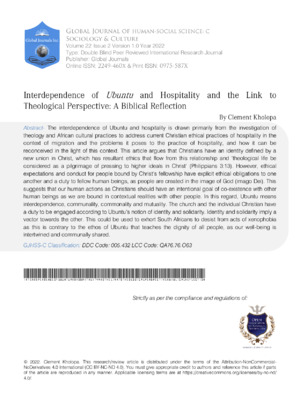
The interdependence of Ubuntu and hospitality is drawn primarily from the investigation of theology and African cultural practices to address current Christian ethical practices of hospitality in the context of migration and the problems it poses to the practice of hospitality, and how it can be reconceived in the light of this context. This article argues that Christians have an identity defined by a new union in Christ, which has resultant ethics that flow from this relationship and ‘theological life be considered as a pilgrimage of pressing to higher ideals in Christ’ (Philippians 3:13). However, ethical expectations and conduct for people bound by Christ’s fellowship have explicit ethical obligations to one another and a duty to fellow human beings, as people are created in the image of God (imago Dei). This suggests that our human actions as Christians should have an intentional goal of co-existence with other human beings as we are bound in contextual realities with other people. In this regard, Ubuntu means interdependence, communality, commonality and mutuality. The church and the individual Christian have a duty to be engaged according to Ubuntu’s notion of identity and solidarity. Identity and solidarity imply a vector towards the other. This could be used to exhort South Africans to desist from acts of xenophobia as this is contrary to the ethos of Ubuntu that teaches the dignity of all people, as our well-being is intertwined and communally shared.
Clement Kholopa. 2026. \u201cInterdependence of Ubuntu and Hospitality and the Link to Theological Perspective: A Biblical Reflection\u201d. Unknown Journal GJHSS-C Volume 22 (GJHSS Volume 22 Issue C2): .
The methods for personal identification and authentication are no exception.
Total Score: 101
Country: South Africa
Subject: Uncategorized
Authors: Clement Kholopa (PhD/Dr. count: 0)
View Count (all-time): 72
Total Views (Real + Logic): 1726

Total Downloads (simulated): 30

Publish Date: 2026 01, Fri
Monthly Totals (Real + Logic):
Neural Networks and Rules-based Systems used to Find Rational and
A Comparative Study of the Effeect of Promotion on Employee
The Problem Managing Bicycling Mobility in Latin American Cities: Ciclovias
Impact of Capillarity-Induced Rising Damp on the Energy Performance of
The interdependence of Ubuntu and hospitality is drawn primarily from the investigation of theology and African cultural practices to address current Christian ethical practices of hospitality in the context of migration and the problems it poses to the practice of hospitality, and how it can be reconceived in the light of this context. This article argues that Christians have an identity defined by a new union in Christ, which has resultant ethics that flow from this relationship and ‘theological life be considered as a pilgrimage of pressing to higher ideals in Christ’ (Philippians 3:13). However, ethical expectations and conduct for people bound by Christ’s fellowship have explicit ethical obligations to one another and a duty to fellow human beings, as people are created in the image of God (imago Dei). This suggests that our human actions as Christians should have an intentional goal of co-existence with other human beings as we are bound in contextual realities with other people. In this regard, Ubuntu means interdependence, communality, commonality and mutuality. The church and the individual Christian have a duty to be engaged according to Ubuntu’s notion of identity and solidarity. Identity and solidarity imply a vector towards the other. This could be used to exhort South Africans to desist from acts of xenophobia as this is contrary to the ethos of Ubuntu that teaches the dignity of all people, as our well-being is intertwined and communally shared.
We are currently updating this article page for a better experience.
Lorem ipsum dolor sit amet, consectetur adipiscing elit. Ut elit tellus, luctus nec ullamcorper mattis, pulvinar dapibus leo.