
I. INTRODUCTION
The most valuable factors for increasing organizational performance is the employee behavior and it also increases their individual performance. For the smooth functioning of financial institution bankers/employees must be more committed and more satisfied with their jobs and it also will help in reducing turnover. Many studies carried out have shown their results that employees with high OCB behaviors are seen to be more satisfied with their jobs and committed to organization (Organ & Ryan, 1995 cited in Huangetal., 2004; Foote & Tang, 2008). Therefore, exciting attachment and staff choice is called OCB. The pioneer Dennis Organ defined the concept "Organizational Citizenship Behavior (OCB)" in the words" an essential condition of organization" that reflects" a willingness of participants to go beyond what is required"(Organascited in Staw & Cummings, 1990, p. 43). Organizational gestures and behaviors belong to OCB and they cannot be applied at the base of formal obligation, or by contractual agreement of reward (Organ, 1990). Coyne and Ong, (2007), examined the relationship of OCB and turnover intention with cross cultural perspective in 162 production workers in the same organization in Malaysia, Germany and England. Their results generally supported that OCB is a strong predictor and significantly related with turnover intention across culture. Therefore OCB not only resulted in less turnover intentions, but also provide a conducive environment for the organization and enhanced organizational performance (Oplatka, 2009).
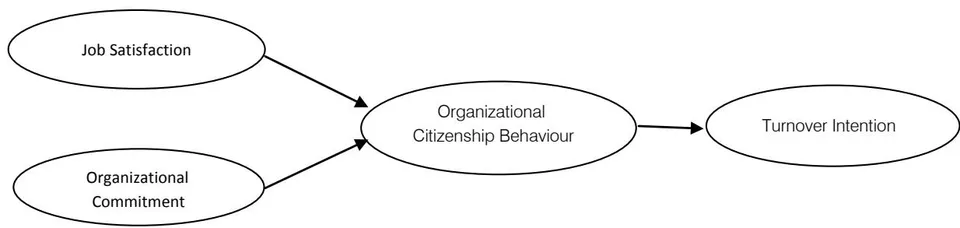
This study was carried out to find out the nature of the relationship between OCB with employees' behavior in the context of public and private sector banks of D.I.Khan, KPK, Pakistan. In the last decade, many of the private banks opened new branches and enhanced many branch facilities in this district, which ultimately raised the competition among banks to attract and retain customers. Such phenomena increased the job demands of employees to cope with route to improve OCB among employees to remain committed and satisfied to maintain their job. The other objective of this study is to find out the impact of job satisfaction and organizational commitment on employees OCB and the impact of OCB on the turnover intention of employees working in the banking sector of Pakistan. Therefore, by attempting to address this specific problem in the banking sector, our study contributes to develop OCB and will eventually reduce the intention to leave their jobs and in turn enhance effectiveness of the banking sector.
II. LITERATURE REVIEW
a) Job Satisfaction, organizational commitment and OCB
Job satisfaction, organizational commitment, fairness and organizational citizenship behaviors (OCB) have been proved by many scholars and researchers as they have a robust correlation among them (Organ & Ryan, 1995; Huangetal, 2004). Social exchange theory that describes when an organization provides benefits to its employees then their employees will certainly increase OCB and come up with a positive response to their organization. Almost every organization wants their employees to give maximum output, which could happen only with maximum satisfaction of employees. The study conducted by Mohammad et. al. (2011) revealed that both intrinsic and extrinsic job satisfaction has an important role in predicting citizenship behavior. They further suggested in the context of social exchange theory to improve employees OCB-O and OCB-I by providing them intrinsic and extrinsic motivational factors. It was observed that if employees are more satisfied they will be more willing to put efforts for the organization (Shaukat., et al, 2012). Many researchers have explained the relationship between OCB and job satisfaction. Foote & Tang (2008), presented a model in which they found out the relationship between OCB and job satisfaction. Research in Pakistani banking sectors found that more satisfied staff showed higher levels of OCB in the organization (Shaukat et al., 2012; Qamar, 2012). Arif & Chohan (2012) carried out a study in Pakistani banks and found a high correlation between both variables. Researchers found a significant relationship of OCB with Job satisfaction and Organizational commitment. Team commitment as a mediator supports the relationship between job satisfaction and OCB. Job satisfaction and OCB are positively and significantly correlated for committed employees in the team. It was also observed that OCB, organizational commitment and job satisfaction have a significant positive relation (Wilke & Lanzetta, 1970; Bolinoetal., 2002).
Job satisfaction was positive and significantly correlated with OCB for committed employees in teams. Jobsatisfaction improves the working relationship among workers that leads to commitment in a team and ultimately results in a higher level of OCBs (Wilke & Lanzetta, 1970; Bolinoetal., 2002). A study was conducted by Park, Yun, and Han, (2009) to see the factors that influenced OCB among nurses. The results revealed that jobsatisfaction and organizational commitment were some factors that positively influenced OCB of nurses which means that there was an appositive relationship between OCB and all selected variables. Good working relationship and interaction between supervisors and subordinates increases the commitment and OCB among employees and reduce their turnover intentions, which ultimately improves organizational effectiveness (Asgari et al., 2008). Some researches on the other hand suggested certain contradictions in the literature about the relationship of job satisfaction and OCB, however, most of the studies supported positive relationship between job satisfaction and OCB (Mohammad et. al., 2011). Furthermore, in the current research employees who report high level of job satisfaction and organizational commitment with their work will be more involved in extra role performance like helping others, care their colleagues who have been absent from their duties etc. Therefore, on the basis of these arguments, the following hypotheses have been constructed.
H1: Job Satisfaction of bank employees will be positively related to OCB.
H2: Organizational Commitment of bank employees will be positively related to OCB.
III. OCB AND TURNOVER INTENTION
The relationship between OCB and turnover intention has begun to get attention in recent times (Chen, Hui and Sego, 1998; Chen, 2005; Mossholder et al., 2005, Paillé, P. (2012). Chen and his colleagues (1998; 2005) designated that behavioral antecedents are important predictors of turnover intention and actual turnover. It is reasonable to use OCB to forecast and predict turnover intention. The relationship of organizational citizenship behavior (OCB) and turnover intention has been observed by other researchers (e.g., Chen et al., 1998; Chen, 2005; Podsakoff et al., 2009). Former literature claimed that intensities of OCB indicate an employees' true willingness and inclination about extant, much they would like to be intricate in their organization, or how much they want to stay away from the organization (Chen et al., 1998). The main argument is that the lower levels of OCB, the stronger the signal of the reluctance of the employee to be part of the organization, and thus the higher probability that the employee would leave the organization.
Given that, some studies have also identified that OCB factors, altruism, sportsmanship, and civic virtue are negatively related to turnover intention (Paillé, 2012). Vein, et. al, (2007) discussed the relational viewpoint to show the OCB and turnover relationship and explored that OCB can reflect the quality of interpersonal relationships between employees in an organization. Therefore, engaging in OCB can satisfy the interactive needs of individuals and will increase the psychological cost if they leave the organization. Hence, we hypothesize that:
IV. METHODOLOGY
a) Population and sampling
The Population of this research comprised of Bank employees serving at various banks in D.I.Khan, Khyber Pakhtunkhwa province of Pakistan. The banks employees sample represented both public and private sectors for collection of data. The size of sample comprises of 140 employees randomly selected from different banks.
The data have been collected by personally meeting with respondents during banking hours. From the public sector banks data were collected from the employees serving in National Bank, State Bank of Pakistan, Khyber Bank of Pakistan, Bank of Punjab, and from private sector banks, Habib Bank Limited, Muslim Commercial Bank, UBL, ABL, Bank Alfalah, Askari Bank, Bank Alfalah Islamic, and Meezan Bank, in D.I.Khan District.
Questionnaires were distributed randomly among the bankers of these banks to collect the data.
V. DATACOLLECTION AND RESPONSE RATE
As this research is primary in nature, so data were collected primarily through questionnaire from the respondents. Around 200 questionnaires were distributed in different branches of public and private sector banks located in D.I.Khan, Khyber Pakhtunkhwa, Pakistan. The Response rate was 70% as 140 usable questionnaires were returned.
VI. INSTRUMENTATION
A survey method is used to collect data through a structured questionnaire consisting Likert scale. It helps to get more responses in a very short time from employees. A Questionnaire was designed, which helps in data analysis. The following scales have been used as an instrument to collect data about the variables.
The scale of OCB was adopted from Organ, (1988), this variable contained ten questions and its Cronbach's alpha = 0.888. Organizational commitment scale was adapted from O'Reilly & Chatman (1986). Seven points Likert scale was used to obtain responses and it contains eight questions and its Cronbach's alpha = 0.868. Scale of turnover intention has adopted from Walsh et al., (1985), and measured by using the 4 item scale and its reliability alpha value was 0.615. Job satisfaction was measured by Gul & Oktay (2009), using a 14 item scale, and its obtained Cronbach's alpha = 0.874. Five points Likert scales was used for both job satisfaction and turnover intention.
VII. DATA ANALYSIS TOOLS
SPSS 17.0 software was used to analyze the data. The Pearson correlation coefficient was used to analyze the strength of correlation and direction of the variables. In addition, simple regression was employed to investigate the variability in OCB and Turnover intention which can be attributed to job satisfaction and organizational commitment. Descriptive analysis was used to report the demographic information of the respondents. Correlation and regression analysis were used to analyze the data and to test the hypothesis.
VIII. FINDINGS AND ANALYSIS
a) Descriptive Analysis
| Age | ||
| Frequency | Percent | |
| 20 to 25 years | 13 | 9.3 |
| 26 to 30 years | 46 | 32.9 |
| 31 to 35 years | 31 | 22.1 |
| 36 to 40 years | 21 | 15.0 |
| 40 & Above | 29 | 20.7 |
| Total | 140 | 100.0 |
In Table1 Demographic information showed that among the sample of 140 respondents, 9.3% of them fell in age category 20-25 years, 32.9% fell into the category of 26-30 years, 22.1% fell in the category of 31-35 years, 15% fell in the category of 36-40 years. While 20.7% respondents in the category of 40 and above.
| Gender | ||
| Frequency | Percent | |
| Male | 125 | 89.3 |
| Female | 15 | 10.7 |
| Total | 140 | 100.0 |
| Public & Private | ||
| Frequency | Percent | |
| Public | 37 | 26.4 |
| Private | 103 | 73.6 |
| Total | 140 | 100.0 |
Table 3 showed the sectors to which employee belongs. Out of 140 respondents, 26.4% were from the public sector, while 73.6 percent employees were from private sector banks. Marital status of respondents which is categorized as single and married, 24.3% of the respondents were single, 75.7% were married. So the majority of the respondents were married.
| Education | ||
| Frequency | Percent | |
| F.A/F.Sc/Diploma | 3 | 2.1 |
| Graduation | 30 | 21.4 |
| Master | 107 | 76.4 |
| Total | 140 | 100.0 |
Table 4 shows qualification of the respondents who were classified as intermediate, Graduation and Masters. Of them2.1%respondents were of intermediate level of education, 21.4% employees were Graduate, and 76.4% employees were Masters degree holders. It means that the majority of respondents were with qualification of Master level.
IX. INFERENTIAL ANALYSIS
A correlation and regression analysis was conducted among job satisfaction, organizational commitment, OCB and turnover intention. Pearson correlation coefficients were calculated for the pair of variables in order to accept or reject the research hypothesis. Table 6 shows the correlation tests of all the independent and dependent variables.
| Mean | SD | Alpha | OCB | JS | OC | TI | |
| OCB | 5.32 | 1.01 | .888 | 1 | |||
| Job Satisfaction | 3.63 | .674 | .874 | .511** | 1 | ||
| Organizational Commitment | 4.77 | 1.085 | .868 | .291** | .812** | 1 | |
| Turnover Intention | 4.68 | 1.297 | .615 | -.178* | .024 | .228** | 1` |
H1: Job Satisfaction of bank employees will be positively related to OCB.
In hypothesis 1 we expect that a positive relation would exist between job satisfaction and OCB. The obtained results of the correlation indicate that there exists a positive significant association between job satisfaction and OCB (r=.511, p<0.01), which means that job satisfaction leads to organizational citizenship behavior. Therefore, hypothesis 1 is accepted.
H2: Organizational Commitment of bank employees will be positively related to OCB.
It was hypothesized in H2that positive relation would exist between organizational commitment and OCB of the bank employees. The pearson correlation results indicate that organizational commitment and OCB is positively correlated with a correlation coefficient of .
Therefore, employees who are committed to their organization, the more positive is their attitude toward OCB. Thus, hypothesis 2 is accepted.
H3: Organizational Citizenship Behavior of bank employees will be negatively related to turnover intention.
Moreover, it is hypothesized that OCB and turnover intention would be negatively related. The obtained results in the correlation analysis indicated that the negative relation exists between OCB and turnover intention of bank employees(r= -.178, P<0.05). Hence, hypothesis 3 is supported.
X. SIMPLE REGRESSION ANALYSIS
In order to get more insight of the research, an attempt has been made to count the significant influence of the independent variables on the dependent variables. For this purpose the following simple regression was applied to explore the significant impact of the variables under study.
| R | Beta | F | P | ||
| JS → OCB | 0.511 | 0.261 | 0.511 | 48.674 | 0.000 |
Table 6 is about the influence of Job satisfaction (JS) on OCB. Simple regression analysis was run to test the cause and effect of independent and dependent variables. Regression coefficient is 0.261 meaning that 26% variation in the DV (OCB) is explained by IV (JS) and the rest of the variance in overall OCB can be attributed to other factors which are held constant. The value of the unstandardized Beta of a theoretical relationship is positive ( , p<.05) meaning that a change of one standard deviation in JS will result in a change of 0.511 standard deviations in the OCB.
| R | Beta | F | P | ||
| OC→OCB | 0.291 | 0.085 | 0.291 | 12.764 | 0.000 |
Table7 shows that regression coefficient is 0.085, which means that only 8.5% variation in the DV is due to IV and the rest of the variance in organizational commitment can be attributed to other factors which are held constant. Unstandardized Beta is 0.291 meaning that a change of one standard deviation in OCB will result in a change of 0.291, standard deviation in organizational commitment.
| R | Beta | F | P | ||
| OCB → TI | 0.178 | 0.032 | -0.178 | 4.505 | 0.036 |
Table 8 shows that regression coefficient is 0.032 which means that 3.2% variation in the turnover intention is due to OCB and other variation is due to other factors which are held constant. The value of unstandardized beta of theoretical relationship is significantly negative ( ) meaning that a change of one standard deviation in OCB will result in a change of 0.17 standard deviation in the turnover intentions.
XI. DISCUSSION AND CONCLUSION
This research is an attempt to explore the relationship of organizational citizenship behavior with employees' job attitude and behavior, i.e. job satisfaction, organizational commitment, and turnover intention of the banking sector employees in Pakistan. The results confirmed that OCB is significantly related to job satisfaction and organizational commitment. These results are in line with the previous studies, for example, see Asgarietal., 2008 and Jain, 2009, KILIÇ, 2013, Ibrahim, Aslinda, and Makassar 2013). Their results revealed that OCB holds a positive significant relationship with job satisfaction and organizational commitment. Those employees who are more satisfied show high commitment and OCB and less turnover intention. So in our study all the three hypothesis are supported. The relationship between OCB and turnover is significantly negative; it means that employees show their organizational citizenship behavior with high job satisfaction and organizational commitment which reduces chances of turnover intention among the banking sector employees in Pakistan. These results also support the previous researches (for example see, Wilke & Lanzetta, 1970; Bolino et al., 2002; Foote & Tang 2008; Park, Yun, and Han, 2009).
In short OCB holds a positive significant relationship with job satisfaction and organizational commitment and negatively related to turnover intentions. Therefore, the policy makers of the banking sector need to revise their human resource policies with respect to their compensation and benefits i.e. revising their pay policies and in addition to financial compensation they must also benefit them other attractive fringe benefits like free medical treatment to their families, children's education, transportation, and house rent etc. Furthermore, the authorities are required to promote good relationship with labor unions and employee in order to solve their organizational and personal problems. This will not only enhance the satisfaction and commitment level of the employees, but also the effectiveness of the banking sector to reap the benefits of low turnover intention and enhance the banks productivity.
XII. RESEARCH IMPLICATIONS
This study investigated the association of work related outcomes, i.e. Jobsatisfaction, organizational commitment, organizational citizenship behavior and turnover intentions. The other part of the results represent cause and effect relationship of the Jobsatisfaction, organizational commitment, organizational citizenship behavior, and turnover intentions of the banking sector employees in Pakistan. This study enhanced our understanding regarding the concepts of OCB, organizational commitment, overall jobsatisfaction and turnover intentions.
The research model of this study helps the researchers for future research to identify and test some mediator and moderator in the same theoretical framework. This study also shows some factors which reduce turnover intentions, i.e. withdrawal behavior of employees, which is very much important for the smooth functioning of every organization, particularly in banks. This study helps to authorities at top levels in the banking sector with guidelines regarding how to enhance positive attitudes like jobsatisfaction, commitment and enhance OCB to decrease negative behaviors like turnover intentions.