Summery-In Colombia, the environmental dimension in the school is circumscribed to the transversal model, however; Teachers, in particular, of basic education do not have adequate, updated and broad conceptual frameworks that allow them to generate necessary actions against the objectives of environmental education and the training of citizens capable of making decisions about the environmental situations of the territories that inhabit. Teachers generally have reduced visions of the environment and environmental education and their actions are activists with little reflection or leading to real transformations. This research advocates giving importance to teacher training so that the teaching of environmental education at school is reflected and new models are promoted. The research is qualitative, transformative and presents the case of 6 natural science teachers from Ibagué Tolima in Colombia.
incular a los profesores en investigaciones donde ellos son actores principales, implica reconocer que hay aspectos de la enseñanza que es posible mejorar, así como darse cuenta de las potencialidades que poseen. Este tipo de investigaciones participativas vinculan de manera directa al profesor y su enseñanza, les permiten actualizarse y transformar sus prácticas de manera real. Al ser una actividad voluntaria, los profesores tienen la posibilidad de explorar un universo de alternativas para la enseñanza y para la investigación de su quehacer, ya que adquieren herramientas conceptuales, metodológicas y procedimentales que les permiten hacer un ejercicio permanente de observación, reflexión y transformación.
De esta manera, importa en esta investigación que los profesores que participan del proceso de reflexión y formación permanente, sean capaces de autoevaluar la manera cómo enseñan la EA o la vinculan a sus procesos de enseñanza y que, de manera autónoma, evidencien sus potencialidades y aspectos por mejorar; así, ellos mismos van fortaleciendo sus modelos de enseñanza al comprender los elementos conceptuales y estructurales que tienen que ver con la enseñanza de la EA.
El docente desde el deber ser de su actuación profesional, como mediador y formador, debe reflexionar sobre su práctica pedagógica para mejorarla y/o fortalecerla y desde esa instancia elaborar nuevos conocimientos, pues en su ejercicio profesional continuará enseñando y construyendo saberes al enfrentarse a situaciones particulares del aula... La reflexión desde la práctica implica la condición de un docente investigador; más real que ideal, pero; no obstante, a pesar de las formalidades declarativas se mantiene una concepción, heredada de la tradición, de formar sólo para enseñar porque se supone que la investigación está reservada a los expertos o son otros profesionales quienes deben investigar los problemas de la educación, lo cual no es verdad", es decir, el docente no solo enseña, sino que desde esta enseñanza deben abrirse los espacios de reflexión e investigación de su propia práctica para transformarla.
En consecuencia, es necesario dar respuesta a esta situación y generar los espacios de participación de los profesores para investigar sobre sus prácticas, ya que, lo contrario se ha identificado como un problema. Así, por ejemplo, Shulman (citado por Vergara & Cofré, 2014) señala en sus investigaciones: "The great gaps that teachers present in the field of educational work, in terms of the way of teaching (communicating scientific knowledge), for which it raises the need to generate strengths both at a conceptual and pedagogical level (later I would call it didactic)," en aras de hacer comprensible de manera efectiva la ciencia a enseñar por parte de los estudiantes. En consecuencia, algunas investigaciones han hecho evidentes problemas relacionados con la enseñanza (y el aprendizaje) de las ciencias, Fenshman (1999, 2004, citado por (Velásquez, Flórez, & Tamayo, 2014) señalan situaciones como: supeditar la enseñanza de la ciencia a repetir hechos científicos, leyes y teorías y la dependencia de los libros de texto por parte de los maestros, de ahí que sea necesaria la formación del profesorado en este campo.
Con relación específica a lo ambiental, teniendo en cuenta los cambios naturales, económicos, sociales, políticos, entre otros; es decir, ambientales, que caracterizan el mundo de la contemporaneidad, se requiere que éstos sean abordados desde la escuela con miras a garantizar la inclusión de la dimensión ambiental y la generación de pensamiento ambiental en los diferentes actores escolares, profesores y estudiantes.
## II. Problema
El problema de la formación de profesores en EA, es común observar las reacciones de los educadores de todos los niveles educativos por afrontar problemas relacionados con la EA debido a su falta o escasa formación en este campo de conocimiento. Según Eschenhagen (2003), en muchas ocasiones los profesores suscitan un activismo inmediatista ciego, sin reflexiones profundas y críticas del cómo, por qué y para qué la EA; este actuar conlleva a posiciones instrumentalistas y tecnologicistas, tanto a lo que se refiere al contenido enseñado, como también los modelos para su enseñanza, sin considerar las objeciones, revisiones y propuestas que se han hecho en esta área.
El problema de la formación de los profesores está relacionado con la naturaleza del campo de conocimiento de la EA. Este tiene un carácter interdisciplinar, sistémico y complejo, que todavía no está resuelto para el hecho de su enseñanza, ya que existe una incomunicación entre las disciplinas que dificulta avanzar en este desarrollo y, más bien, la EA en la escuela se ha convertido en activismo ecológico. Al respecto (García, 2006) plantea que.
La complejidad del proceso de enseñanza de la EA tiene que ver con la heterogeneidad de conceptos que cohabitan en ella, lo que origina diversidad de paradigmas teóricos, estrategias de acción y escenarios de análisis e intervención, y que al predominar concepciones reduccionistas en los profesores, se privilegia la "práctica" obviando el hecho de que para alcanzar los fines de la EA es necesario un marco teórico de referencia y el desarrollo de propuestas didácticas que den sentido a la acción.
En Ussa y Diaz (2014 p. 29) se identifica en relación a la formación docente en Educación Ambiental que aún es poco lo que se ha podido avanzar. Por lo cual, una problemática de las comunidades educativas en el campo ambiental tiene que ver con las deficiencias o incluso carencias de la formación profesional del profesor, que permita desde trabajos reflexivos identificar la integralidad de los diferentes modos de concebir el mundo y las posibilidades de vincular los diferentes tipos de saberes.
Por su parte, Terrón (2004), ubica como un problema de estructura para la enseñanza de la EA, además de la ambigüedad conceptual del campo, el hecho de la precaria formación del profesorado en temas teórico prácticos en la educación inicial y permanente y, como problemas conceptuales, el hecho de que los maestros perciben la EA como asociada o parte de la biología y, por ende, se ubican en una perspectiva naturalista-ecológica del ambiente. También Sauvé, (2005) afirma que la escasa formación de los profesores en el campo de la EA y la multiplicidad de enfoques existentes, dificulta una verdadera transversalización, cayendo en el mencionado activismo ecológico.
## III. ANTECEDENTES
En esta propuesta investigativa, se pone en tensión la llamada EA como eje transversal, ya que sin docentes formados en el área se hace difícil dicha articulación a las demás áreas del conocimiento y se corre el riesgo de transversalizar el saber ambiental de manera inadecuada. Sobre el tema de la EA, desde el modelo transversal, se encuentran mayores desarrollos en el marco referencial; sin embargo, esta no es una categoría de análisis para esta investigación.
Como dice Alba, (1992, citado por Eschenhagen, 2003) en la EA, el argumento de este activismo se centra en la "urgencia de las acciones" y en muchas ocasiones se muestra un franco rechazo a la reflexión y a la construcción teórica. Este tipo de activismo derivado de una escasa o inadecuada formación de los profesores es reduccionista frente a lo que se espera de la EA y se arriesga a que sin claros fundamentos se aumente el distanciamiento entre la teoría y la práctica.
Interpretando a Leff (citado por Eschenhagen, 2003), existe un problema con la vinculación de la EA como adquisición de conocimiento sobre la naturaleza como objeto, sin dar casi importancia a los factores sociales, políticos, económicos, epistemológicos, ni a competencias éticas, críticas y estratégicas y al vincular, explicar o justificar la EA a través de isomorfismos provenientes solamente de la ecología.
La formación de maestros es un elemento central para la enseñanza de la EA; este campo de conocimiento como ya se dijo está caracterizado por su complejidad y una visión reduccionista de él dificulta su comprensión y por tanto su acción. Aunque la proliferación de programas de formación en EA va en aumento en todo el mundo, las tendencias formativas son variadas y no atienden a la totalidad de los maestros en ejercicio y en formación.
Falconi e Hidalgo (2019) citan desde diferentes trabajos de Leff (1986, 1998) que queda claro como la educación no puede estar separada del conocimiento de la vida y el ambiente, y que se requiere una nueva racionalidad social y ambiental para comprender la complejidad del mundo para con ello resignificar las concepciones de crecimiento económico sin límites, desarrollo y progreso y la urgencia por un mejor habitar.
Boada & Escalona (2005) y García (2002, citados por Flórez-Espinosa, Velásquez-Sarria, & Arroyave-Escobar, 2017). Plantean la importancia de generar programas que atiendan esta necesidad desde una visión compleja e integral que respondan a la multi y trans disciplinariedad que la caracterizan. Por su lado, Ferrera 2001, (citado por Flórez-Espinosa, y otros, 2017), hace un llamado para que la formación de maestros orientada a la enseñanza de la EA atienda el tratamiento didáctico de los contenidos a enseñar de forma holística, en vista de las dificultades a las que se ven enfrentados los profesores cuando se trata de la planeación y el desarrollo de sus clases.
Existen propuestas importantes encaminadas a la formación de profesores para desempeñarse en el campo de la EA, tanto en el ámbito local como internacional; tal es el caso de Bonil, y otros, (2012) quienes realizaron, en el contexto español (Catalunya) la investigación "Un modelo formativo para avanzar en la ambientalización curricular" orientada a profesores de primaria, secundaria y asesores en EA. Su modelo tiene como finalidad replantear la distancia que existe entre el planteamiento ideológico de la EA y su concreción práctica en las aulas que a menudo constituye un obstáculo para lo que denominan ambientalización curricular. Para ello, la propuesta formativa se fundamenta en el concepto de idea de alto nivel y su conexión con la práctica que se ha concretado en la determinación de cuatro esferas: conceptual, creativa, didáctica e investigación. Otros documentos hablan de la importancia de la formación docente en este campo, pero no precisan un modelo de actuación claro.
## IV. FUNDaMENTACióN TEÓRIcA
En sus prácticas de enseñanza los docentes recurren a diferentes estrategias, trazan caminos o rutas de acciones cargadas de sentido y significado que generalmente responden a sus procesos de formación, creencias y vivencias; estas se convierten en rutinas de actuación las cuales constituyen sus modelos de enseñanza. Para Porlán (1993, citado por Ruiz, 2012, pág. 29) los modelos de enseñanza se definen como un conjunto de conceptos, principios y esquemas de acción, articulados de manera dinámica y flexible para dar respuesta argumentada a problemas de índole educativo.
Los trabajos de Mayorga & Madrid (2010, citados por Ruiz, 2012), asumen el modelo como una acción reflexionada, donde en primer lugar se representa la tarea a ejecutar y se reflexiona sobre lo planeado con el fin de elegir la representación mental más adecuada para mejorar la práctica y enriquecer el conocimiento didáctico y, en segundo lugar, importa apoyar estas reflexiones y las decisiones a tomar en el aula con elementos científicos, sociales y culturales.
En el caso de la enseñanza de la EA en la escuela, la transversalidad específicamente en Colombia, se lleva a cabo de manera instintiva y bajo las concepciones propias de cada profesor, las cuales son diversas. Digo instintiva porque no están resueltos interrogantes esenciales al respecto, ¿Qué es transversalidad en EA?, ¿Qué es lo que se transversaliza de la EA en las diferentes áreas del conocimiento en la escuela? ¿Cómo asumen los maestros la transversalidad? ¿Cuáles son las apuestas formativas para que los profesores logren transversalizar la EA? En este contexto Los profesores deben atender la directiva ministerial dónde se insta a transversalizar diferentes ejes, entre ellos, la educación ambiental, pero lo hacen sin procesos formativos teóricos y metodológicos que permitan darle sentido a esta práctica.
Para el caso de la educación básica secundaria y media, es el profesor del área de ciencias naturales quien relaciona los estándares básicos de competencia de ciencias naturales y EA establecidos por el Ministerio de Educación Nacional; además en las instituciones educativas se desarrollan los Proyectos Ambientales Escolares (PRAE) como estrategia de la política nacional de educación ambiental, para incorporar la dimensión ambiental en la escuela. (Flórez-Espinosa, y otros, 2017); sin embargo, Rodríguez y García (2009), por ejemplo, plantean como preocupación el hecho de la falta de un debate riguroso sobre el papel excesivo del activismo en la práctica de la EA en las instituciones educativas.
Una de las dificultades para la enseñanza de la EA se establece en la multiplicidad de conceptos de ambiente que coexisten en el pensamiento del profesor y, en sus modelos de enseñanza. Eschenhagen (2010) en su texto 'Los límites de la retórica verde', propone tres maneras de ver el ambiente: el ambiente como objeto, en tanto la naturaleza es "una cosa" que se puede medir, parametrizar, utilizar y, pues permite la interacción de elementos sociales y culturales con la naturaleza y la idea de que hacemos parte de un todo; y, el ambiente como crítica la visión dominante o complejidad, en tanto hay que hacerse preguntas frente a las maneras de pensar, llamadas por la autora, "bases epistemológicas", que están relacionadas con las maneras de actuar y de habitar el mundo; se trata en esta última acepción de confrontar las maneras de vivir, las maneras de gobernar y de someter, no sólo a lo que hemos llamado naturaleza, sino a la humanidad misma. la EA ha estado asociada a la educación ecológica y conservacionista.
Desde una mirada crítica, no se quiere decir que deba alejarse totalmente de esta perspectiva; lo que sucede es que el ambiente se concibe en la actualidad como complejo, interdependiente con otras disciplinas; los problemas ambientales no son sólo de la naturaleza y, en consecuencia, se integran lo social, cultural, político y económico, entre otros aspectos. Sin embargo, prevalecen en la escuela concepciones de ambiente sólo como la naturaleza, lo que nos lleva a un reduccionismo de lo ambiental y, por lo tanto, de su enseñanza. García (2004) afirma en consecuencia que, en la corta historia de la EA hemos centrado su enseñanza en los contenidos ecológicos ("lo verde") y de manera más actual se pasa a aspectos centrados en lo social e ideológico, dejando de lado la ecología.
De igual manera existen visiones reducidas de la educación ambiental por parte de los profesores en ejercicio, generalmente asociadas al reciclaje o la celebración de fechas ambientales; en contraposición se asume en esta investigación una EA comprometida con la sustentabilidad de la vida, y aunque no es la responsable de encontrar alternativas de solución a los problemas que nos aquejan en la actualidad, sí tiene como objetivos la construcción de saber y pensamiento ambiental en el diálogo de saberes, buscando contribuir en el mejoramiento de las relacionas ser humanos, sociedad, naturaleza.
En la carta de Belgrado (1975) se afirma que la EA debe considerar al ambiente natural y al creado por el hombre en sus dimensiones ecológica, económica, tecnológica, social, legislativa, cultural y estética; se entiende así entonces la EA como un proceso continuo y permanente, interdisciplinario, intra y extraescolar, que debe enfatizar en la prevención y mitigación o solución de los problemas ambientales; tener una perspectiva mundial reconociendo las diferencias regionales, basarse en las condiciones ambientales presentes y futuras, examinar críticamente los procesos de desarrollo y crecimiento desde la perspectiva ambiental y promover el valor como la necesidad de la cooperación en la solución de los problemas ambientales y la posibilidad de cambios en las formas de habitar.
## V. Diseño MeTodológico
La investigación opta por el paradigma cualitativo para atender el contexto real y particular en el que se desarrolla la acción investigativa. Por tanto, no se desvincula a los sujetos de sus acciones particulares, ni de los significados que representan en su cotidianidad; más bien se toma conciencia de dichas acciones y significados y, se aportan herramientas para que los profesores vinculados al proceso reflexionen frente a su desempeño y mejoren su enseñanza en una combinación entre lo que generalmente realizan y consideran pertinente, alimentado por los nuevos aportes teóricos y metodológicos.
El diseño de la investigación obedece al resultado del proceso formativo orientado por el investigador principal y apropiado por los profesores participantes desde su interés por mejorar la enseñanza de la EA. En su desarrollo los profesores tuvieron un momento inicial para compartir lo que sabían y pensaban sobre el ambiente, la educación ambiental y otros aspectos relacionados con su enseñanza por medio de un cuestionario en línea, previo al inicio del proceso. Seguidamente, se concretó un cronograma de estudio y se establecieron encuentros quincenales para los debates y la formación entre pares. Se grabó una clase inicial para observar el modelo que se estaba desarrollando; se reflexionó de manera colectiva sobre la clases y modelo iniciales y se procedió a planear, desarrollar y grabar las siguientes clases (6), luego de los cuales siempre hubo reflexión crítica, espacio formativo y nueva planeación. Así durante un año académico los profesores lograron proponer o mejorar sus modelos de enseñanza la educación ambiental. Es de aclarar que hubo 4 momentos de caracterización para ver la evolución de los modelos enseñanza. Este modelo de formación y reflexión, se denominó IPET, cuyas siglas significan: Identificar, Planear, Evaluar para mejorar y Transformar la enseñanza de EA; fue un modelo emergente atendiendo a los rasgos de la investigación acción participativa IAP no preestablecido en su totalidad, si no alimentado por la propia dinámica de los profesores participantes a partir de una propuesta inicial de los investigadores. En la figura # 1 se muestra el diseño investigativo adoptado.
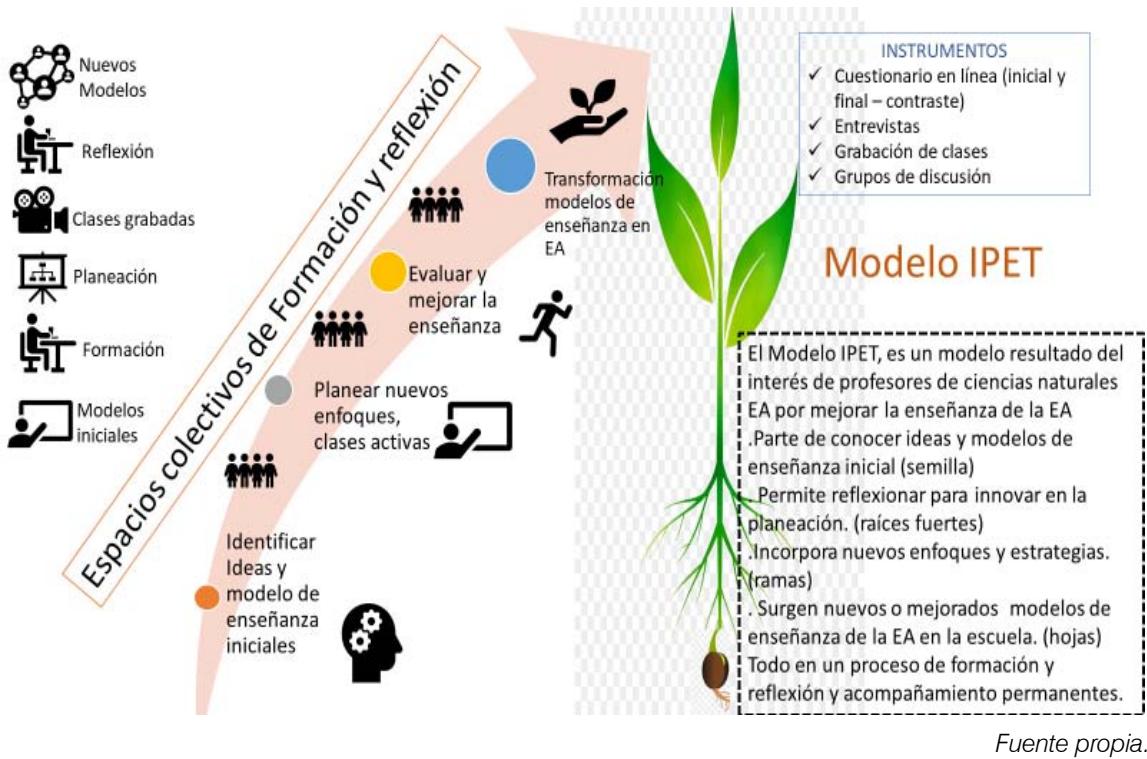
Figura # 1: Diseño de la investigación en el Modelo IPET
## VI. RESultados
Se propone y valida un modelo de formación que tiene como centro la reflexión crítica, compartida y la formación permanente de los profesores que participan en espacios de cooperación y se nutren de tres componentes básicos: la planeación, el compartir del desarrollo de la clase y la experiencia de clase reflexionada, en medio de las cuales se responde las preguntas orientadoras (4) que guían los modelos de enseñanza que se van construyendo: ¿Por qué enseñar EA? ¿Qué enseñar en EA? ¿Cómo enseñar en EA? y ¿Cómo evaluar y mejorar la enseñanza en EA? los cuales permiten reconocer el pensamiento del profesor en relación a su desempeño en el aula y la manera como este evoluciona y mejora. A manera de síntesis general se presenta la gráfica #2
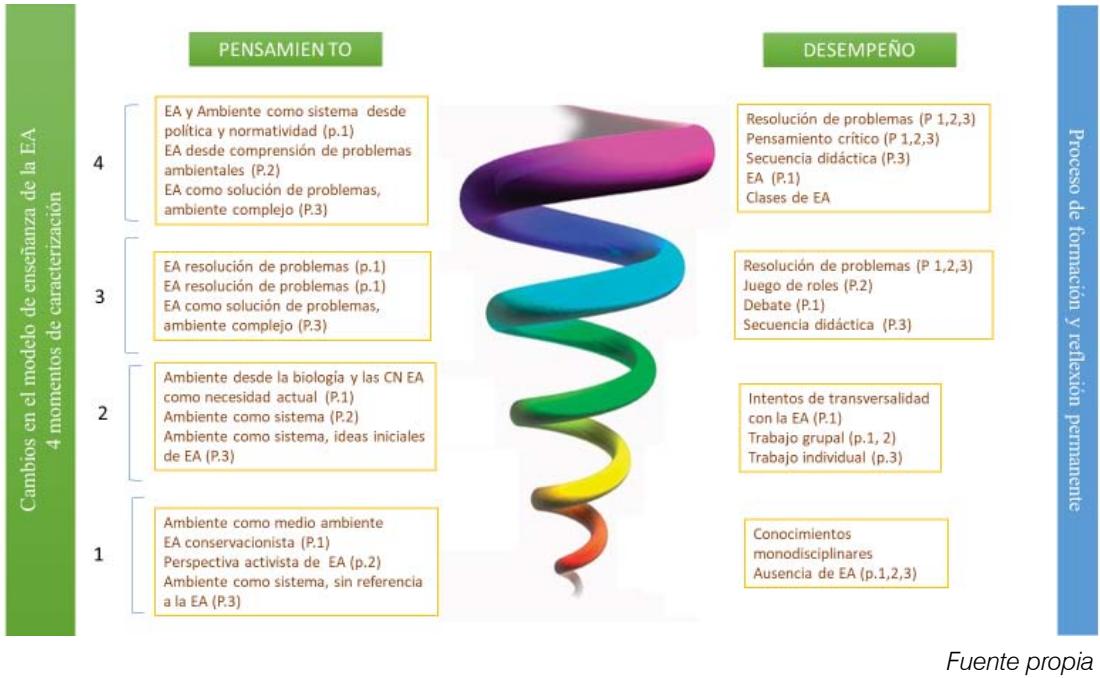
Figura # 2: Resultados generales en el pensamiento y el desempeño de profesores derivado del Modelos de formación reflexiónncadauadeas cuatro caracterizaciones realizadas durante clases enun timpo un año escolar.
En la columna de pensamiento (a la izquierda) se ubican de abajo hacia arriba las respuestas dadas por los profesores en diferentes momentos, en los cuales es posible ver su evolución, cambios en sus ideas, fortalecimiento o replanteamiento de estas. En la primera caracterización (antes de iniciar el proceso formativo crítico) por medio de un cuestionario en línea, se pueden identificar ideas de los profesores sobre ambiente y educación ambiental, en relación a ello hablan de medio ambiente, de la educación ambiental como la conservación, mencionan actividades como recolección de basuras y jornadas de embellecimiento institucional, las cuales se consideran activistas y poco reflexionadas, de igual manera se refieren al ambiente o medio ambiente pero alejado o como algo diferente de la educación ambiental. En la segunda caracterización luego de observar la primera clase dentro del modelo IPET y de responder a una entrevista y participar de la primera sesión de formación y reflexión crítica en grupo de discusión; los profesores hablan de ambiente desde la biología y desde las ciencias naturales, conciben la educación ambiental como una necesidad actual, empiezan a comprender el ambiente como un sistema donde no solo hay naturaleza sino aspectos sociales y culturales que interactúan con ella. En la tercera caracterización luego de desarrollar, grabar y observar las clases 2 y 3, es posible evidenciar avances, al relacionar el ambiente y la educación ambiental no solo con la biología, sino como y desde los problemas ambientales existentes, resultado de la formación inician a incluir en sus posibles ideas para la clase aspectos del enfoque de solución de problemas en el marco de la comprensión del ambiente como complejidad. En la cuarta caracterización luego de haber desarrollado las clases 4, 5 y 6, de haber participado de los encuentros de formación y reflexión crítica y de responder a una nueva entrevista y al cuestionario inicial en una segunda aplicación a manera a contraste, es posible evidenciar como los profesores piensan en la educación ambiental y el ambiente como un sistema complejo que involucra aspectos políticos y normatividad, además logran pensar la educación ambiental desde problemas y conflictos ambientales, y potencialidades.
En la columna de desempeño (a la derecha), es posible también observar, cambios, o evolución de los modelos de enseñanza propuestos por los profesores bajo el modelo formativo IPET; de abajo hacia arriba, igual que en la columna del pensamiento, aparecen los 4 momentos de caracterización, con las mismas fuentes de información (cuestionario, clases grabadas, entrevistas, espacios de formación y reflexión crítica, grupos de discusión). Se observa en la primera caracterización como sus clases son mono disciplinares y dogmáticas desde las ciencias naturales, sin articulación con la educación ambiental ni problematización de los contenidos; en la segunda caracterización aparecen los primeros intentos de transversalidad de la educación ambiental en sus clases de ciencias naturales (escuela primaria) o de bilogía (escuela secundaria), de igual manera inician la transformación de estrategias de enseñanza, pasando de clases magistrales al trabajo en equipo y al fortalecimiento del trabajo individual. Para la tercera caracterización sus modelos de enseñanza adquieren un fuerte componente del enfoque de solución de problemas, se da importancia al juego de roles (por ejemplo, representando los actores de un conflicto ambiental, o representando el rol de investigadores o científicos) los debates, la construcción de secuencias didácticas. En la cuarta caracterización, los profesores incluyen estrategias para el desarrollo de pensamiento crítico, estudios de caso, análisis de causa - consecuencia, conclusiones, argumentación y toma de decisiones; algunos profesores optan por dar espacio para desarrollar clases auténticas de educación ambiental, sin la dependencia de temas de las ciencias naturales, pero problematizando los contenidos con diferentes campos del saber.
De manera particular, a continuación, se presenta la tabla #1 con los cambios y mejoras en la construcción del modelo de enseñanza de la profesora del grado primero elemental en educación básica.
Tabla # 1: Cambios en el modelo de la enseñanza de la EA de la profesora de grado primero derivados de la participación en el modelo formativo1 reflexivo IPET
<table><tr><td>COMPONENTES DEL MODELO</td><td>CLASE # 1</td><td>CLASE # 2</td><td>CLASE # 3</td><td>CLASE # 4</td><td>CLASE # 5</td><td>CLASE #6</td></tr><tr><td>¿POR QUE ENSEÑAR EA?</td><td>No se tuvo en cuenta la EA</td><td>Desarrollo Sensibilización</td><td>Desarrollo Reflexiónística. Relaciones con el entorno</td><td>Desarrollo Pensamentoístico. Soluciones problemas ambientales</td><td>Promoverolestres Aprendizajes y el Pensamento ambiental</td><td>Desarrollo Concisióna ambiental entorno al cuidado de la vida en todas sus formas. Fortalecimiento de valores Trabajo collaborativo</td></tr><tr><td>¿QUÉ ENSEÑAR DE LA EA?</td><td>No se tuvo en cuanta la EA</td><td>Cuidado de las plantas</td><td>Los estudiantes como investigadores en la huerta escolar</td><td>Problemáticas ambientales reales</td><td>La importancia de la buena nutrición y la relacion directa de la comida empaquetada con la contaminación por residuos solidos</td><td>Articular la EA con elprojecto de planlector desde el airedecastellano y enotros espacioscurriculas</td></tr><tr><td>¿COMO ENSEÑAR ASPECTOS DE LA EA?</td><td>Gúias Ideas previas de los estudiantes conceptos</td><td>Preguntas problema. Comparación deestructuras Sensibilización. Ideas previas</td><td>plantea y desarrolla una vez basada en una experiencia practicia alrededor de la germinación de las plantas Juego de roles Materiales especializados como luples libretas para la observación directa Practica fueera del aula</td><td>Por medio del video foro de dibujos animados sobre la depredación del hombre sobre toda forma de vida en el planeta Guía de trabajo. Resolución de problemas Socialización de ideas para la solución de problemas presentados en la guía</td><td>Estudio de casos de contaminación por residuos solidos, confrontación directa con lo que trae en la lonchera de comida empacadarente al hecha en casa. Sensibilización ante a los azucarres y las grasas presentes en empaquetados.</td><td>El trabajo collaborativo con roles definidos de acuerdo a sus habilidades. El como herramipta de aprendizaje ambiental. Guía de sopa de letras con manos claves del. Producción de canción o poesía además de mensaje para el conejo ambientalista y critico, protagonist del. Evaluación de la clase y sus activités con un ticket de salute.</td></tr><tr><td>¿COMO EVALUAR Y MEJORAR LA ENSEÑANZA DE EA?</td><td>Fortalecer la conceptualización de la profesora para avanzar en el Modelo. Integrar la EA a la clase de ciencias naturales.</td><td>Proponer en las Classes tareas vivencias y, desde la articulación de temas Ambientales. Para poderar el conocimiento ambiental y sensibilizar a los estudiantes.</td><td>Se avanza el proponer que los estudiantes Socialisten y reflexionen. Realizar salidas al Campo con los estudiantes dejan la puerta abierta a un sin número de posibilidades de los temas que se pueda hacer con los estudiantes en relacion a las ciencias naturales y la educatingía ambiental, es possible reflexionar sobre todos los aspectos que se observan y no estaban planeados.</td><td>El cambio de rol del profesor. Una mejor planeación, El uso deas estrategias El enfoque critic y los materiales educativos.</td><td>Preparar unacke con una articulación conceptual con un tema de ciencias naturales como la nutrición. Plantear niñosestudios de casos acorde a las realidades ambientales de los niños. El confrontar situaciones cotidianas como la comida empacquetada con la comida hecha en casa y su afectacion en la salute de los niños y al ambiente.</td><td>Para La transversalidad de laenseñanza de la EA es tener una visión más amplia en la articulación de los temas" y para "poteciar" suenseñanza. Desarrollar estrategias y evaluar las malmas en cuando a suefectividad. Fomentar el trabajo collaborativo dese las edades iniciales para que desarrollen competencias y habilidades sociales Implementar el auto y co evaluación de las activités. Hacer los ajustés necessarios en la preparación y desarrollo de las classes, incluir la resolución de problemas y promoverolestoresDSPersonalmenteado conceptual lo mejor todo.</td></tr></table>
La tabla presenta la reflexión crítica y propuestas de mejora clase a clase elaborados por la propia profesora de grado primero quien construyó un modelo enseñanza de la educación ambiental basado en el juego de roles y la solución de problemas, poniendo a prueba los aprendizajes y reflexiones obtenidos entre pares., teniendo en cuenta las preguntas orientadoras propuestas como base para la construcción o mejoramiento de su modelo.
Finalmente, después del proceso formativo bajo el modelo IPET, la profesora del grado primero logra construir un modelo dinámico que ajusta a sus

necesidades de clase para la enseñanza de la educación ambiental en articulación con la enseñanza de las ciencias naturales siguiendo las orientaciones para el proceso, concebidas como elementos conceptuales y estructurales de su propuesta didáctica, como puede verse en la siguiente figura:
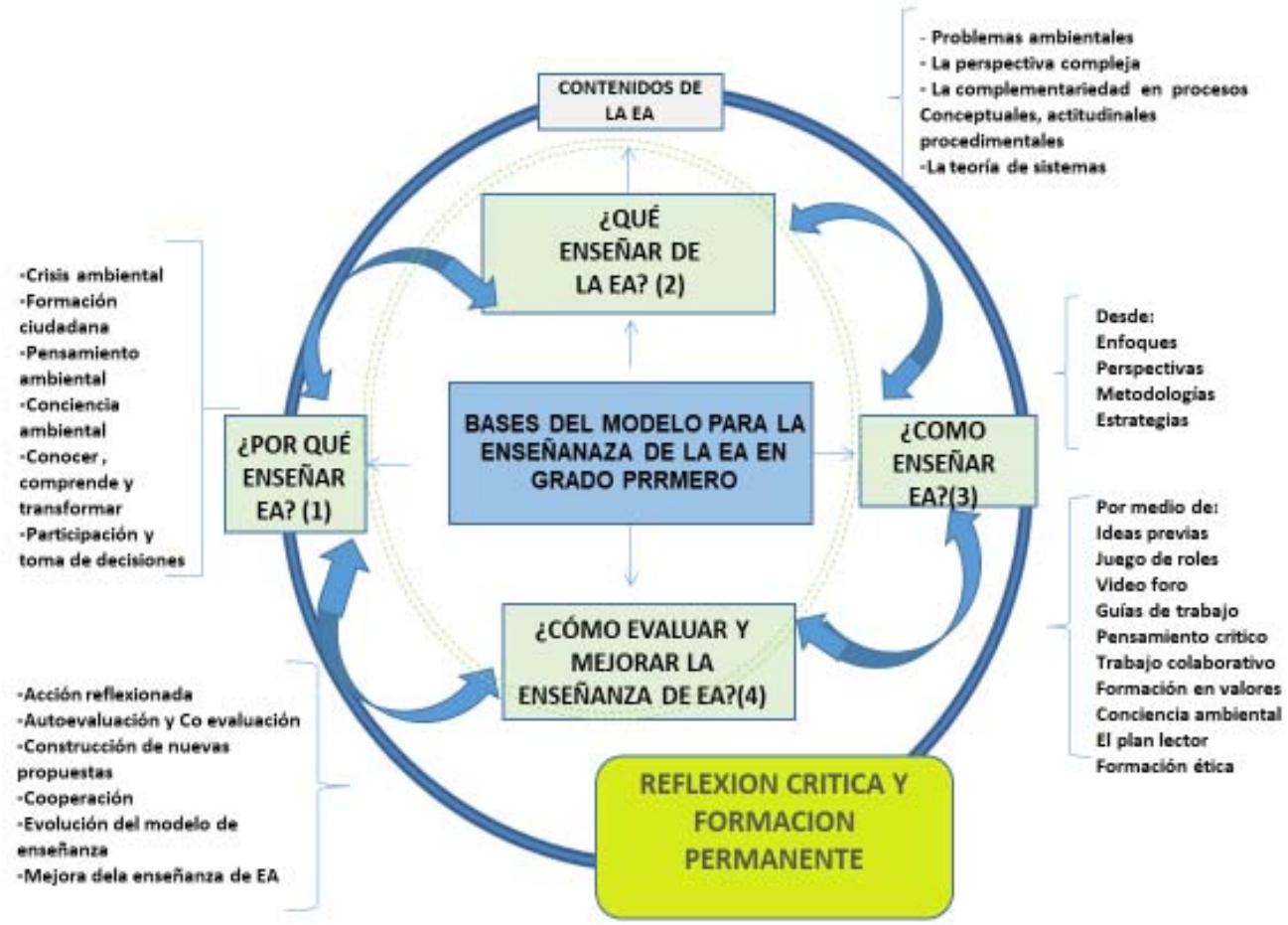
Figura #3: Modelo de enseñanza de la educación ambiental construido por la profesora del grado primero de educación básica bajo el modelo IPET
Fuente: Elaboración propia: Flórez y Lopera, (2022)
## VII. CONclusiONES
Los profesores de educación básica requieren de procesos formativos, investigativos, situados, permanentes y acompañamiento para mejorar sus modelos de enseñanza de la educación ambiental.
La formación logró que los profesores avanzaran de sus ideas reducidas de ambiente y la educación ambiental, lo cual deriva en planeaciones y procesos de enseñanza pertinentes y contextualizados.
El modelo de formación y reflexión IPET permitió diferentes estrategias de comprensión y mejora de las prácticas en el aula de educación ambiental en la educación básica.
La formación y reflexión crítica centrales en el modelo IPET permitió mejorar los modelos de enseñanza de la educación ambiental en la educación básica de los profesores que hicieron parte de la investigación.
## AGRaDECIMIENTOS
A las Universidades de Caldas y Tolima en Colombia
A, Erika María Lopera, Felipe Molano Bermúdez, Ángela Navarro, Clara Elena Beltrán, Luz Piedad Ramírez, Luis Ávila, Diego Fernando Agudelo, Diego Gálvez e Ivonne, profesores de instituciones educativas de Ibagué -Colombia que aceptan el reto de participar en esta investigación para transformar el aula de EA en la escuela.
A, Andrea del Pilar Puentes Barreto por toda su ayuda en este proceso investigativo, por su compañía y cariño.
1.Bonil, J., Calafell, G., Granados, J., Junyent, M., & Tarín, R. M. (2012). Un modelo formativo para avanzar en la ambientalización curricular.
- Profesorado. Revista de currículum y formación del profesorado, 16(2), 145-163.
2. Díaz, V.(2006). Formación docente, práctica pedagógica y saber pedagógico. Laurus, 12 (Ext.), 88-103.
3. Eschenhagen, L.(2003). The state of the art of environmental education and the problems it is facing. Toluca, México: Il Encuentro Metropolitano de Educación Ambiental.
4. Eschenhagen, M. L.(2010). The limits of green rhetoric or why, after more than 30 years of effort, no substantial improvements are observed? Revista Gestión y Ambiente, 13(1), 111-118.
5. Flórez-Espinosa, G.-M., Velásquez-Sarria, J.-A., & Arroyave-Escobar, M.-C.(2017). Formación ambiental y reconocimiento de la realidad: Dos aspectos esenciales para la inclusión de la educación ambiental en la escuela. Revista Luna Azul(45), 377-399.
6. Falconí, F., & Hidalgo, E.(2019). Educación ambiental y formación docente en el Ecuador. En Cuederno de política educativa N° 7. Recuperado de http://201.159.222.12:8080/bitstream/56000/1210/1/Falconi%20e%20Hidalgo%2C%20EDUCACION%20AMBIENTAL.pdf 7. Flórez-Espinosa, G.M., Lopera-Calderón, E-M. Modelo de enseñanza para la educación ambiental en el grado primero de la escuela primaria. En 10 International Congress Educational Sciences And Development. Octubre 19-21, 2022 8. García, J. E.(2006). Los problemas de la educación ambiental ¿es posible una educación ambiental integradora? Reflexiones sobre educación ambiental II: artículos publicados en la carpeta informativa del CENEAM 2000-2006, 123-142.
9. Rodríguez, F., & García, J. E.(2009). El activismo que no cesa. Obstáculos para incorporar la metodología didáctica basada en la investigación del alumno a la práctica de la Educación Ambiental. Investigación en la Escuela(67), 26-36.
10. Ruiz, F. J.(2012). Caracterización y evolución de los modelos de enseñanza de la argumentación en clase de ciencias en la educación primaria. Barcelona, España: Universidad Autónoma de Barcelona.
11. Sauvé, L.(2005). Una cartografía de corrientes en educación ambiental. En M. Sato, & I. Carvalho, Educación ambiental - Pesquisa e desafios(págs. 17-46). Porto Alegre: Artmed.
12. Terrón, E.(2004). La educación ambiental en la educación básica, un proyecto inconcluso. Revista Latinoamericana de Estudios Educativos, XXXIV(4), 107-164.
13. Ussa, É. O. V., & Díaz, J. J. D.(2014). Referentes de la formación de profesores en educación ambiental. Revisión de antecedentes 2000-2012. Uni-pluriversidad, 14(2), 27-36. Recuperado de file:///C:/Users/UT/Downloads/Dialnet-ReferentesDeLaFormacionDeProfesoresEnEducacionAmbi-7580426.pdf 14. Velásquez, J. A., Flórez, G. M., & Tamayo, Ó. E.(marzo de 2014). Conocimientos necesarios para la enseñanza: una categoría fundamental en la formación de maestros. Ibagué: Universidad del Tolima.
- pluriversidad, 14(2), 27-36. Recuperado de file:/// C:/Users/UT/Downloads/Dialnet-ReferentesDeLa Fo rmacionDeProfesoresEnEducacionAmbi-7580426% 20(1).pdf
14. Velásquez, J. A., Flórez, G. M., & Tamayo, Ó. E. (marzohttp://elizabethguerreroramirez.blogspot.com de 2014). Conocimientos necesarios para la enseñanza: una categoría fundamental en la formación de maestros. Ibagué: Universidad del Tolima. Obtenido de http://elizabethguerrerorami rez.blogspot.com/2015/03/y-que-es-eso-de-la-educ acion-ambiental.html
15. Vergara, C., & Cofré, H. (2014). Conocimiento Pedagógico del Contenido: ¿el paradigma perdido en la formación inicial y continua de profesores en Chile? Estudios Pedagógicos, XL(Número Especial 1), 323-338.
Generating HTML Viewer...
Funding
No external funding was declared for this work.
Conflict of Interest
The authors declare no conflict of interest.
Ethical Approval
No ethics committee approval was required for this article type.
Data Availability
Not applicable for this article.
How to Cite This Article
Gloria Marcela Flórez Espinosa. 2026. \u201cIpet A Training Model for The Teaching of Education Environmental In Basic Education\u201d. Global Journal of Human-Social Science - G: Linguistics & Education GJHSS-G Volume 23 (GJHSS Volume 23 Issue G8): .
Explore published articles in an immersive Augmented Reality environment. Our platform converts research papers into interactive 3D books, allowing readers to view and interact with content using AR and VR compatible devices.
Your published article is automatically converted into a realistic 3D book. Flip through pages and read research papers in a more engaging and interactive format.
Summery-In Colombia, the environmental dimension in the school is circumscribed to the transversal model, however; Teachers, in particular, of basic education do not have adequate, updated and broad conceptual frameworks that allow them to generate necessary actions against the objectives of environmental education and the training of citizens capable of making decisions about the environmental situations of the territories that inhabit. Teachers generally have reduced visions of the environment and environmental education and their actions are activists with little reflection or leading to real transformations. This research advocates giving importance to teacher training so that the teaching of environmental education at school is reflected and new models are promoted. The research is qualitative, transformative and presents the case of 6 natural science teachers from Ibagué Tolima in Colombia.
Our website is actively being updated, and changes may occur frequently. Please clear your browser cache if needed. For feedback or error reporting, please email [email protected]
Thank you for connecting with us. We will respond to you shortly.