As the tensions between the People’s Republic of China (PRC) and the United States of America (USA) mount about the desires of the PRC to incorporate Taiwan into its political and economic structure, is there no alternatives to war between the PRC and USA over the issue other than the forceful political takeover of Taiwan by the PRC? Is the USA caught like the British and French in 1938 with no choice other than appeasement or war? The author believes there is a feasible alternative, namely, the encouragement of the PRC and Taiwan to form a Greater Chinese Common Market similar the original European Common Market, where each country retains its political sovereignty, but with a joint set of economic, trade and investment policies. This approach has clearly worked in Europe with Germany no longer being a war threat, but instead playing a key leadership role in the European Common Market (ECM) and the subsequent European Union (EU). It is not clear whether this economic “Greater China” is enough to satisfy the desires of the PRC government for a cultural “Greater China” and political “Greater China” that would result from the forcible takeover of Taiwan by the PRC, but the formation of the GCCM would be possible without a war in the Taiwan Straits and could eventually lead to the political integration of Taiwan into the PRC.
## I. EARLY DISCUSSIONS ABOUT THE FORMATION OF A GREATER CHINESE COMMON MARKET
The idea of the formation of a Greater Chinese Common Market is not a new one. According to Harry Harding in a 1993 paper, The Concept of "Greater China": Themes, Variations and Reservations, in the China Quarterly:
"The first such reference can be found in the June 1979 issue of a Taiwanese journal, Changqiao (Long Bridge), which advocated the creation of a "Chinese Common Market" that would link Taiwan, Hong Kong, Macao, Singapore and the Chinese mainland. In Hong Kong, one of the first to use a similar concept was the futurologist Huang Zhilian who, in 1980, devised the terms Zhongguoren gongtongti (Chinese community) and Zhongguoren jingji jituan (Chinese economic grouping) to refer to economic cooperation among Hong Kong, Taiwan and the mainland."
In the next year, 1994, the Chinese Economic Studies devoted an entire issue to the concept of a Greater Chinese Common Market. The most notable article was written by Chu-Yuan Cheng, Concept and Practice of a "Greater Chinese Common Market", in which he further explored how such a market might work. The possibility of including Singapore is raised in the issue, which would have further emphasized that the GCCM was an organization of sovereign states.
The question of whether Taiwan could maintain its sovereignty in a Greater Chinese Common Market appears to have been the major obstacle to its formation in the last years of the twentieth century.
In 2005, the Refugee Survey Quarterly published a particularly interesting article by Wei-Wei Zhang, Overseas Chinese and the Concept of "Greater China" in which the author concluded that:
"While the idea of 'Greater China' originates from the early time of China and Outer China, its more recent meaning reflects the increased interaction between China, Hong Kong, Taiwan and other Chinese communities. The evolution of the idea of 'Greater China has apparently revealed some characteristics:
- (a) "Greater China" in its economic and political sense, refers essentially to the integration of Hong Kong, Taiwan, Macao and the Chinese mainland, and in its cultural sense, it is borderless, covering virtually all of the cultural contact between Chinese communities around the world;
- (b) The three levels of "Greater China" are in fact interrelated: Economic "Greater China" serves as a basis on which cultural "Greater China" has evolved and political "Greater China may eventually take shape. In turn, cultural "Greater China" has enriched the idea of the Chinese-based economic integration and an eventual political unification."
### He added:
"As the integration of Hong Kong, Taiwan, Macao and Chinese economies have acquired its own logic, and these economies are so complementary and the potential gains from their cooperation so huge, an eventual institutionalized economic "Greater China" is a likely long-term scenario.
A political "Greater China" is far more difficult to achieve due to the prolonged animosity between Beijing and Taipei and various international factors. It is however feasible that with the evolution of economic integration and deepening of cultural contact, Beijing and Taipei may eventually embrace some kind of modus vivendi, if not an all-out political arrangement, in order to stabilize their relations, or at least prevent such relations from deteriorating into uncontrollable regional or international crises. In this sense, economic, cultural and political "Greater Chinas" may well move in a direction of facilitating greater peace and prosperity.


The author wants to echo the views presented above, namely, that a successful economic "Greater China" could eventually lead to political unification of the PRC and Taiwan in a peaceful fashion.
## II. ECONOMIC COOPERATION FRAMEWORK AGREEMENT OF 2010 BETWEEN THE PRC AND TAIWAN
In 2010, the PRC and Taiwan signed an Economic Cooperation Framework Agreement (ECFA), a free trade agreement designed to:
- Reduce tariffs and trade barriers between the two countries and
- Improve relations between them.
Siddarth Rai in a recent article from the Institute of Chinese Studies in Delhi concluded the following in May 2023 about the impact of the ECFA:
"The formal opening up of Taiwan's economy to China by signing ECFA had helped Taipei to weather the 2008 global financial crisis, but it also accelerated the migration of the Taiwanese industries to mainland China. The ECFA was signed at a time when China was on the cusp of becoming the world's second-largest economy and was already rapidly expanding its presence in the global value chain. China's economic position has upgraded from a secondary to a primary role in cross-strait economic relations. China's complete industrial chain, strong international class companies, and deep capital strength have made Chinese companies more competitive than the traditional Taiwanese industries. President Tsai Ing-wen brought in several economic policy changes to reduce Taiwan's overdependence on the Chinese economy and to boost its high-tech sector companies. However, unlike Chinese enterprises, which are guided by state industrial policies, the profit-driven Taiwanese hi-tech companies continued trading and investing in the Chinese market until the US-China trade war broke out in 2018. President Tsai also unrolled New Southbound Policy to expand and diversify its trading relations with other countries in the region but with limited success as China is using its geo-economic influence in the region to isolate Taiwan."
Despite the political tensions between the PRC and Taiwan during the period following the signing of the ECFA in 2010, there has been a significant growth in the cross-strait trade between them as a result, as can be seen by the following data from the Taiwan Customs Administration in the Ministry of Finance:
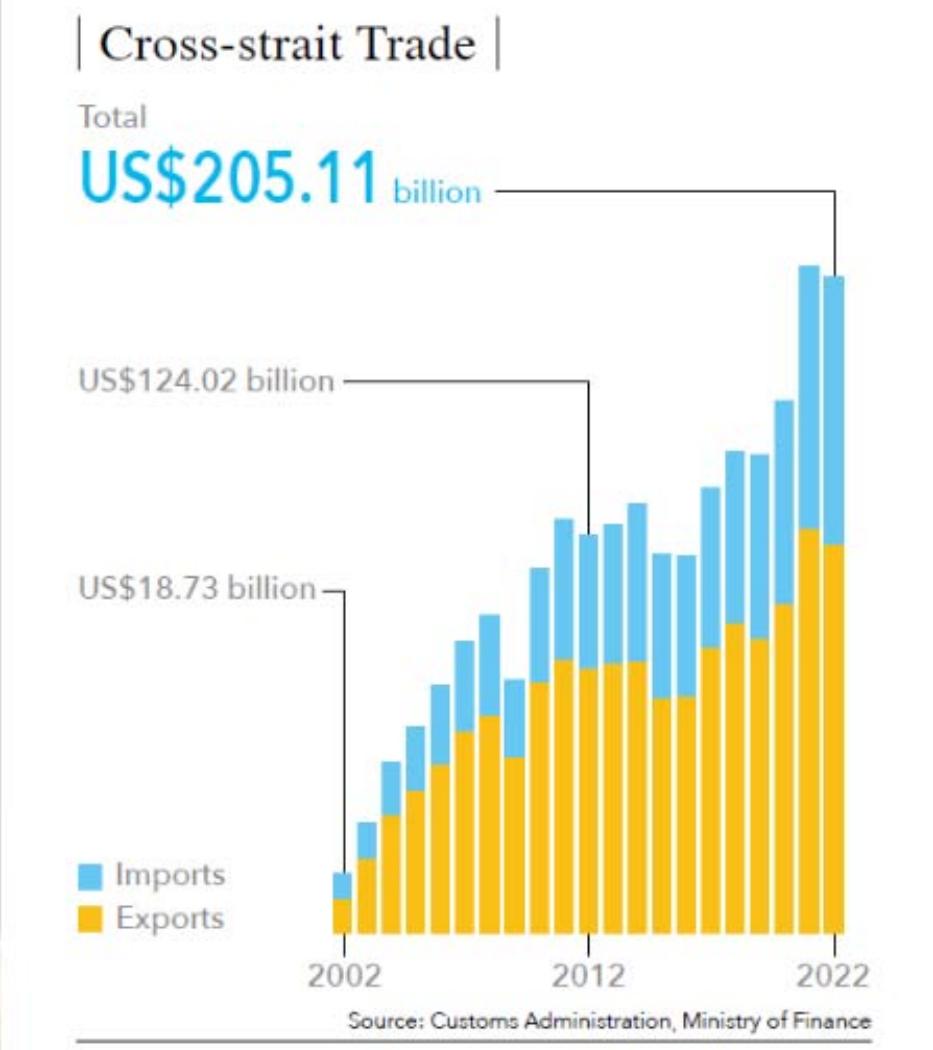
By 2019, the CIA World Factbook estimated the total volume of this trade amounting to US\(165.8 billion. Exports by Taiwan to the PRC amounted to US\) 101.0 billion and imports from the PRC to Taiwan of US\)64.8 billion. The PRC had become the largest trading partner of Taiwan as follows:
- Exports: China $26\%$, United States $14\%$, Hong Kong $12\%$, Japan $7\%$, Singapore $7\%$, South Korea $5\%$.
- Imports: China $21\%$, Japan $16\%$, United States $11\%$, South Korea $6\%$.
The CIA World Factbook also reported that the commodities involved in the 2019 international trading by Taiwan were as follows:
- Exports: Integrated circuits, office machinery/parts, computers, refined petroleum, liquid crystal displays.
- Imports: Integrated circuits, crude petroleum, photography equipment, natural gas, refined petroleum.
When we examine the direct investments by the PRC and Taiwan in each other, we find that most of the money has come from Taiwan into the PRC. According to Taiwanese government sources, between 1991 and the end of December 2022, approved investment in
China averaged about US $10 billion per year, whereas Chinese direct investment in Taiwan averaged only US$ 24 million per year.
The author feels that this shows that economic cooperation between the PRC and Taiwan has been possible even in a hostile political environment and that both parties could benefit from further economic cooperation. The transformation of the ECFA into a Common Market structure with more coordination of economic and trade policies may be the easiest way to create this Common Market.
## III. ECONOMIC IMPLICATIONS OF THE GREATER CHINESE COMMON MARKET
Let us examine two major economic implications of the formation of the Greater Chinese Common Market:
- The resulting size and economic power of the PRC through the GCCM in comparison with the USA and European Union
- Access to advanced semiconductor chips to the PRC and its resulting dominance of the worldwide market for such chips
Resulting Size and Economic Power of the PRC through the GCCM in Comparison with the USA and European Union
<table><tr><td></td><td>PRC</td><td>GCCM</td><td>USA</td><td>European Union</td></tr><tr><td>Size in thousands of sq km</td><td>9,597.0</td><td>9,633.0</td><td>9,833.5</td><td>4,236.4</td></tr><tr><td>Population in millions (2019 estimated)</td><td>1,433.8</td><td>1,457.6</td><td>329.1</td><td>513.5</td></tr><tr><td>Real GDP (Purchasing Power Parity) 2019 in trillions of US $</td><td>22.5</td><td>23.6</td><td>20.5</td><td>19.9</td></tr><tr><td>Real GDP per capita 2019 in US $</td><td>15,693</td><td>16,191</td><td>62,298</td><td>38,724</td></tr><tr><td>Exports (Billions of 2019 US $)</td><td>2,631</td><td>2,853.7</td><td>2,519.7</td><td>2,387.8</td></tr><tr><td>Source: CIA World Factbook</td><td></td><td></td><td></td><td>1 Euro = $1.12</td></tr></table>
You are invited to focus on the impact of the Greater Chinese Common Market on the Real GDP
(Purchasing Power Parity) lead over the USA and the EU in 2019 as follows:
% Lead in Real GDP (Purchasing Power Parity) 2019
<table><tr><td>Over</td><td>Of PRC</td><td>Of GCCM</td></tr><tr><td>USA</td><td>8.9%</td><td>13.1%</td></tr><tr><td>EU</td><td>11.6%</td><td>15.7%</td></tr></table>
If the Greater Chinese Common Market had been in existence in 2019, it would have added about 4 percentage points to the lead of the PRC over each of the USA and the EU in Real GDP (Purchasing Power Parity), a not insignificant impact.
The Real GDP (Purchasing Power Parity) is the measure generally used to compare the economic productivity and standards of living of countries or economic blocs. It adjusts the Real Gross Domestic Products of a country or economic bloc for the differences in internal purchasing power, that is, the exchange rate at which one country's currency would be converted into another to purchase the same "market basket" of products.
Potential Dominance of the GCCM in the Manufacture of Semiconductor Chips In 2023, Taiwan produced over $60\%$ of the world's semiconductor chips and over $90\%$ of the most advanced ones. Most were manufactured by a single company, Taiwan Semiconductor Manufacturing Corporation (TSMC). TSMC is one of the top three semiconductor manufacturers in the world (the other two being Samsung and Intel).
Semiconductor chips are used in increasing amounts in four of the fastest growing markets in the world, namely, consumer electronics, electric vehicles, medical equipment and military electronics. This growth is largely dependent on the following characteristics of the chips:
- Their becoming smaller and thinner in size
- Their capability to perform more computations in less time and
- Their production of less heat in their operation
This, in turn, requires less line width in the semiconductor circuitry. Line width is already measured in nanometers (nm) – a billionth of a meter. Apple is using bionic chips with 5 nm line width. By comparison, a human hair is 100,000 nm in width. To achieve such precision in manufacture requires special lithographic systems to print these circuits on the chips. And these lithographic systems are all manufactured by a single Dutch company, ASML, in whom TSMC, Samsung and Intel invested US$6.5 billion in 2012. The PRC is currently blocked from purchasing these special lithographic systems by an economic blockade by the USA and its Western allies, including the Dutch government.
The GCCM would not only make these advanced chips available to the PRC, but immediately make them the dominant force in the world for such chips. If this happened, the USA and EU would have to make multi-billion-dollar investments in their own semiconductor chip manufacturing plants to replace the TSMC output. The Biden administration has already started the process in 2021.
## IV. CONCLUSIONS
The formation of a Greater Chinese Common Market would immediately accomplish two major goals for the PRC:
- Significantly increase its lead over the USA and EU economies in terms of GDP (Purchasing Power Parity)
- Give the PRC access to the manufacture of the most advanced semiconductor chips, including those with military application – a significant plus for Chinese involvement in the GCCM and negative for USA and Western support for such a move.
This leaves the following most significant political and economic questions:
- Would this be enough to convince the PRC government to proceed with the formation of the Greater Chinese Common Market, even with Taiwan retaining its political sovereignty with the hope that political integration might someday follow?
- Should the USA and its allies stimulate the formation of the GCCM, even if it makes available the most advanced semiconductor chips to the PRC increasing the strength of its military forces?
- Would the protection of a GCCM treaty satisfy the concerns of Taiwan about its forcible takeover by the PRC in the future?
- Should a common currency be implemented for the partner states in the GCCM? At what point in the development of the GCCM should a common currency be adopted?
- Will the formation of the GCCM help avoid warfare in the Taiwan Straits, but not replicate the kind of appeasement policies that didn't work for Chamberlain with Nazi Germany in the 1930s?
Generating HTML Viewer...
References
7 Cites in Article
Chu-Yuan Cheng Concept and Practice of a "Greater Chinese Common Market.
Evelyn Cheng (2022). CHINA ECONOMY: China needs Taiwan's biggest chipmaker -more than the other way around.
Cia (2019). Unknown Title.
(2024). Cross-strait Relations.
Harry Harding (1993). The Concept of “Greater China”: Themes, Variations and Reservations.
Siddarth Rai (2023). Economic Cooperation Framework Agreement -A Study of Cross-Straits Economic Integration.
Wei-Wei Zhang (2005). Overseas Chinese and the Concept of "Greater China.
No ethics committee approval was required for this article type.
Data Availability
Not applicable for this article.
How to Cite This Article
Dr. Stanley I. Buchin. 2026. \u201cIs there a Peaceful Economic Solution to the Tensions between the People’s Republic of China and the United States of America about Taiwan?\u201d. Global Journal of Human-Social Science - F: Political Science GJHSS-F Volume 24 (GJHSS Volume 24 Issue F3): .
Explore published articles in an immersive Augmented Reality environment. Our platform converts research papers into interactive 3D books, allowing readers to view and interact with content using AR and VR compatible devices.
Your published article is automatically converted into a realistic 3D book. Flip through pages and read research papers in a more engaging and interactive format.
As the tensions between the People’s Republic of China (PRC) and the United States of America (USA) mount about the desires of the PRC to incorporate Taiwan into its political and economic structure, is there no alternatives to war between the PRC and USA over the issue other than the forceful political takeover of Taiwan by the PRC? Is the USA caught like the British and French in 1938 with no choice other than appeasement or war? The author believes there is a feasible alternative, namely, the encouragement of the PRC and Taiwan to form a Greater Chinese Common Market similar the original European Common Market, where each country retains its political sovereignty, but with a joint set of economic, trade and investment policies. This approach has clearly worked in Europe with Germany no longer being a war threat, but instead playing a key leadership role in the European Common Market (ECM) and the subsequent European Union (EU). It is not clear whether this economic “Greater China” is enough to satisfy the desires of the PRC government for a cultural “Greater China” and political “Greater China” that would result from the forcible takeover of Taiwan by the PRC, but the formation of the GCCM would be possible without a war in the Taiwan Straits and could eventually lead to the political integration of Taiwan into the PRC.
Our website is actively being updated, and changes may occur frequently. Please clear your browser cache if needed. For feedback or error reporting, please email [email protected]
Thank you for connecting with us. We will respond to you shortly.