
In a study across several countries, including Brazil, with a total of 7226 women (400-500 women from each country) aged 15-49, it has been reported a higher frequency of physical symptoms, as assessed by severity and number of menstrual cycles affected[6]. In this global study, Brazil was characterized by the second-largest values of severity and duration of symptoms, staying only behind the UK. The high prevalence of severe symptoms observed in our study corroborates these findings. However, when evaluating the global population, among the 5 most prevalent symptoms, 4 were physical[6]. In our study, psychoemotional symptoms were a higher prevalence and severity. It is important to highlight that these data were collected before the pandemic of COVID-19, so these results were not influenced by the psychological effects seen during the pandemic. We continue to collect data during the pandemic, and it will be interesting to compare this issue.
The lower severity of overeating in the northeast region may be related to the lower severity of anxiety and tension during the premenstrual period.
Previously studies showed that among Brazilian women, stated that physicians prescribed hormones as a strategy for dealing with premenstrual syndrome, [10] and PMS symptoms severity was inversely associated with oral contraceptive use (emotional symptoms) and better-perceived health (physical symptoms)[19]. In our investigation, among respondents who met the diagnostic criteria for PMS , would take oral hormonal contraceptives as a treatment option for PMS. This is an important finding since the combined oral contraception for women of reproductive age is one of the effective options used for the treatment of PMS, mainly for women who seek contraception counseling.[20]
The strength of this study includes the use of a questionnaire validated in Brazil that is commonly used for population studies, the large number of women included, and the national scope of the study. In addition, the participating women included in our study were selected in a private healthcare system to minimize bias-related the socioeconomic status of participants. A limitation of this study is that data such as education and family income of the participants were not collected.
V. CONCLUSION
Psychoemotional symptoms are more frequent and severe than somatic symptoms. There were a lot of similarities in women's experiences of these symptoms across Brazilian regions. Symptoms had a frequency and intensity regardless of the region, which makes many women states that would be willing to take a contraceptive that reduces TPM symptoms. It is important for healthcare professionals, to make screening symptoms associated with SPM during contraception counseling to choose the most proper option.
List of abbreviations
Premenstrual syndrome; MRP: Market Research Programs; PSST: Premenstrual Symptoms Screening Tool
Acknowledgments
The authors would like to thank all participants in this research.
Adriana O. Pedro contributed to the design, writing and revision of the manuscript; Samantha B. O. Silva contributed to the design, data analysis and wrote the manuscript; Maura G. Lapa contributed to data analysis; Juliana D. P. Brandao contributed to data analysis and wrote the manuscript and Vivienne C. Castilho contributed to the design and revision of the manuscript.
All authors discussed the results and contributed to the final manuscript.
Funding
This research was supported by Libbs Farmacêutica Ltd a (Brazil) provided funding and material support for this research (protocol number LB1105).
Availability of data and materials
Declarations
All procedures performed in this research were in accordance with the ethical standards and approved by Research Ethics Committee in all participating sites and was conducted following the ethical standards outlined in the Helsinki Declaration (1983).
Competing interests
Adriana O. Pedro has served on advisory boards or has been a consultant for Libbs Farmacêutica, Abott, Achè, Amgen, EMS, Eurofarma, Grumenthal, Mantecorp-Farmasa, and Sanofi. She has also served on the speaker's bureau for Libbs Farmacêutica, Abott, Achè, Amgen, EMS, Eurofarma, Grumenthal, Mantecorp-Farmasa, and Sanofi-Aventis.
Samantha B. de Oliveira, Maura G. Lapa, Juliana D. P. Brandao and Vivienne C. Castilho are employed at Libbs Farmacêutica, Medical Affairs Division.
Lanza di Scalea T, Pearlstein T: Premenstrual Dysphoric Disorder. Med Clin North Am 2019, 103(4): 613-628.
ACOG Practice Bulletin: No 15: Premenstrual syndrome. Obstet Gynecol 2000, 95(4): suppl 1-9.
International Classification of Diseases 11th Revision. [online] Available at: https://icd.who.int/en [Accessed 18 March 2022].
O'Brien PM, Backström T, Brown C, Dennerstein L, Endicott J, Epperson CN, Eriksson E, Freeman E, Halbreich U, Ismail KM et al: Towards a consensus on diagnostic criteria, measurement and trial design of the premenstrual disorders: the ISPMD Montreal consensus. Arch Womens Ment Health 2011, 14(1): 13-21.
Dennerstein L, Lehert P, Backström TC, Heinemann K: Premenstrual symptoms -- severity, duration and typology: an international cross-sectional study. Menopause Int 2009, 15(3): 120-126.
Dennerstein L, Lehert P, Heinemann K: Global study of women's experiences of premenstrual symptoms and their effects on daily life. Menopause Int 2011, 17(3): 88-95.
Ashraf D-M, Kourosh S, Ali D, Sattar K: Epidemiology of Premenstrual Syndrome (PMS)-A Systematic Review and Meta-Analysis Study. J Clin Diagn Res 2014, 8(2): 106-109.
Bahamondes L, Córdova-Egüez S, Pons JE, Shulman L: Perspectives on Premenstrual Syndrome/Premenstrual Dysphoric Disorder. Disease Management & Health Outcomes 2007, 15(5): 263-277.
Silva CM, Gigante DP, Carret ML, Fassa AG: [Population study of premenstrual syndrome]. Rev Saude Publica 2006, 40(1): 47-56.
Petta CA, Osis MJ, de Pádua KS, Bahamondes L, Makuch MY: Premenstrual syndrome as reported by Brazilian women. Int J Gynaecol Obstet 2010, 108(1): 40-43.
Victor FF, Souza AI, Barreiros CDT, Barros JLN, Silva F, Ferreira A: Quality of Life among University Students with Premenstrual Syndrome. Rev Bras Ginecol Obstet 2019, 41(5):312-317.
Rezende APR, Alvarenga FR, Ramos M, Franken DL, Dias da Costa JS, Pattussi MP, Paniz VMV: Prevalence of Premenstrual Syndrome and Associated Factors Among Academics of a University in Midwest Brazil. Rev Bras Ginecol Obstet 2022, 44(2):133-141.
Câmara RA, Köhler CA, Frey BN, Hyphantis TN, Carvalho AF: Validation of the Brazilian Portuguese version of the Premenstrual Symptoms Screening Tool (PSST) and association of PSST scores with health-related quality of life. Braz J Psychiatry 2017, 39(2):140-146.
Henz A, Ferreira CF, Oderich CL, Gallon CW, Castro JRS, Conzatti M, Fleck MPA, Wender MCO: Premenstrual Syndrome Diagnosis: A Comparative Study between the Daily Record of Severity of Problems (DRSP) and the Premenstrual Symptoms Screening Tool (PSST). Rev Bras Ginecol Obstet 2018, 40(1): 20-25.
IBGE | censo 2010 | resultados. [online] Available at: https://censo2010.ibge.gov.br/resultsados.html [Accessed 18 March 2022].
Cohen J: Statistical Power Analysis for the Behavioral Sciences. New York: Routledge;
Fonseca JS, Martins GA. Cu rso de Estatistica. 5th edition. Sao Paulo: Atlas;
Hulley S, Cummings S, Browner W, Grady D, Newman T. Designing Clinical Research. In: Designing Clinical Research. 3rd ed. Philadelphia: Lippincott, Williams & Wilkins;
Sternfeld B, Swindle R, Chawla A, Long S, Kennedy S: Severity of premenstrual symptoms in a health maintenance organization population. Obstet Gynecol 2002, 99(6):1014-1024.
Freeman EW: Therapeutic management of premenstrual syndrome. Expert Opin Pharmacother 2010, 11(17):2879-2889.
| Region | State | Target Population | Random selection | ||
| Midwest | Distrito Federal | 91 | (35.3%) | 79 | (35.7%) |
| Goiás | 94 | (36.4%) | 79 | (35.7%) | |
| Mato Grosso | 54 | (20.9%) | 46 | (20.8%) | |
| Mato Grosso do Sul | 19 | (7.4%) | 17 | (7.7%) | |
| Total | 258 | (100%) | 221 | (100%) | |
| North | Amazonas | 114 | (57.6%) | 108 | (56.8%) |
| Pará | 41 | (20.7%) | 40 | (21.1%) | |
| Tocantins | 43 | (21.7%) | 42 | (22.1%) | |
| Total | 198 | (100%) | 190 | (100%) | |
| Northeast | Alagoas | 7 | (1.1%) | 7 | (1.1%) |
| Bahia | 98 | (14.7%) | 98 | (14.7%) | |
| Ceará | 124 | (18.6%) | 124 | (18.6%) | |
| Maranhão | 38 | (5.7%) | 38 | (5.7%) | |
| Paraíba | 31 | (4.7%) | 31 | (4.7%) | |
| Pernambuco | 218 | (32.7%) | 218 | (32.7%) | |
| Piauí | 124 | (18.6%) | 124 | (18.6%) | |
| Rio Grande do Norte | 20 | (3.0%) | 20 | (3.0%) | |
| Sergipe | 6 | (0.9%) | 6 | (0.9%) | |
| Total | 666 | (100%) | 666 | (100%) | |
| South | Paraná | 191 | (38.1%) | 133 | (38.2%) |
| Rio Grande do Sul | 196 | (39.1%) | 135 | (38.8%) | |
| Santa Catarina | 114 | (22.8%) | 80 | (23%) | |
| Total | 501 | (100%) | 348 | (100%) | |
| Southeast | Espírito Santo | 154 | (4.4%) | 46 | (4,4%) |
| Minas Gerais | 651 | (18.6%) | 196 | (18.7%) | |
| Rio de Janeiro | 805 | (23%) | 242 | (23%) | |
| São Paulo | 1888 | (54%) | 566 | (53.9%) | |
| Total | 3498 | (100%) | 1050 | (100%) | |
| Total | 5121 | 2475 | |||
| Region of Brazil | Midwest (n=221) | North (n=190) | Northeast (n=666) | South (n=348) | Southeast (n=1050) | TOTAL (n=2475) | ||||||
| Profile - n (%) | ||||||||||||
| 20 to 29 years | 107 | (48.4) | 106 | (55.8) | 341 | (51.2) | 168 | (48.3) | 462 | (44.0)* | 1184 | (47.8) |
| 30 to 39 years | 80 | (36.2) | 63 | (33.2) | 247 | (37.1) | 128 | (36.8) | 417 | (39.7) | 935 | (37.8) |
| 40 to 49 years | 34 | (15.4) | 21 | (11.1) | 78 | (11.7) | 52 | (14.9) | 171 | (16.3) | 356 | (14.4) |
| Total of participants | 221 | (100%) | 190 | (100%) | 666 | (100%) | 348 | (100%) | 1050 | (100%) | 2475 | (100%) |
| Mean (S.D.) | 30.7 | (7.4) | 29.8 | (7.2) | 30.2 | (7.3) | 30.5 | (7.5) | 31.4 | (7.4) | 30.8 | (7.4) |
| Median (Min - Max) | 30 | (20 - 49) | 28 | (20 - 49) | 29 | (20 - 49) | 30 | (20 - 49) | 31 | (20 - 49) | 30 | (20 - 49) |
| p (Anova Region * Age) = 0.0043 | p = 0.9641 | p = 0.0645 | p = 0.0222 | p = 0.4165 | p = 0.0003 | |||||||
| Region of Brazil | Midwest (n=221) | North (n=190) | Northeast (n=666) | South (n=348) | Southeast (n=1050) | TOTAL (n = 2475) | p-value | |
| Physical symptoms (%) | ||||||||
| Headache | Prevalence | 86.8 | 86.3 | 85.7 | 87.6 | 85.9 | 86.2 | p = 0,9253 |
| Severe intensity | 43.2 | 39.6 | 41.3 | 41.0 | 40.6 | 41.0 | p = 0.9615 | |
| Acne and oily skin | Prevalence | 85.1 | 84.2 | 86.2 | 85.1 | 86.3 | 85.8 | p = 0.9209 |
| Severe intensity | 33.0 | 33.7 | 33.3 | 33.4 | 30.9 | 32.3 | p = 0.8343 | |
| Edema | Prevalence | 84.2 | 88.9 | 84.4 | 86.5 | 84.4 | 85.0 | p = 0,4676 |
| Severe intensity | 23.1 | 29.6 | 22.2 | 24.3 | 27.7 | 25.5 | p = 0.1077 | |
| Weight gain * | Prevalence | 84.6 | 81.6 | 79.7* | 85.3 | 85.3 | 83.5 | p = 0.0267* |
| Severe intensity | 32.6 | 36.1 | 31.5 | 30.0 | 36.7 | 34.0 | p = 0.1298 | |
| Breast tenderness | Prevalence | 84.6 | 84.2 | 81.2 | 82.8 | 82.1 | 82.3 | p = 0.7556 |
| Severe intensity | 30.8 | 25.9 | 24.8 | 22.0 | 25.1 | 25.1 | p = 0.3888 | |
| Exacerbation of immunoallergic conditions | Prevalence | 79.6 | 82.1 | 77.4 | 79.6 | 78.6 | 78.8 | p = 0,6934 |
| Severe intensity | 19.9 | 10.3 | 15.5 | 14.8 | 15.5 | 15.4 | p = 0.2006 | |
| Region of Brazil | Midwest (n=221) | North (n=190) | Northeast (n=666) | South (n=348) | Southeast (n=1050) | TOTAL (n=2475) | p-value | |
| Psycho-emotional symptoms (%) | ||||||||
| Irritability | Prevalence | 98.6 | 97.7 | 97.6 | 99.4 | 99.0 | 98.5 | p = 0.0975 |
| Severe intensity | 64.7 | 64.5 | 58.9 | 58.7 | 63.3 | 61.7 | p = 0.1935 | |
| Anxiety and tension* | Prevalence | 97.7 | 96.3 | 98.0 | 99.4 | 98.8 | 98.4 | p = 0.0501 |
| Severe intensity | 58.3 | 50.8 | 50.4 | 50.0 | 57.66 * | 54.2 | p = 0.0085 * | |
| Decreased interest in routine | Prevalence | 95.5 | 93.2 | 94.9 | 94.0 | 94.6 | 94.5 | p = 0.8327 |
| Severe intensity | 39.8 | 35.6 | 39.6 | 38.5 | 39.2 | 39.0 | p = 0.9027 | |
| Depression and sadness | Prevalence | 96.4 | 92.6 | 93.7 | 95.1 | 94.6 | 94.4 | p = 0.4339 |
| Severe intensity | 45.5 | 38.1 | 41.5 | 44.7 | 45.6 | 43.8 | p = 0.2495 | |
| Overeating * | Prevalence | 91.0 | 89.5 | 89,2* | 94.3 * | 92.5 | 91.5 | p = 0.0347 * |
| Severe intensity | 47.8 | 37.6 * | 42.5 * | 52.7 * | 50.6 * | 47.5 | p < 0.001 * | |
| Concentration difficulties | Prevalence | 91.4 | 92.1 | 92.9 | 91.4 | 89.9 | 91.2 | p = 0.2926 |
| Severe intensity | 21.8 | 23.4 | 26.5 | 23.6 | 23.3 | 24.1 | p = 0.5664 | |
| Emotional instability | Prevalence | 93.2 | 93.2 | 90.4 | 90.8 | 90.7 | 91.0 | p = 0.5801 |
| Severe intensity | 30.6 | 32.2 | 30.1 | 30.1 | 33.6 | 31.8 | p = 0.5795 | |
| Region of Brazil | Midwest | North | Northeast | South | Southeast | TOTAL | ||||||
| Willing to take the contraceptive - n (%) | ||||||||||||
| No | 57 | (25,8%) | 41 | (21,6%) | 159 | (23,9%) | 99 | (28,4%) | 280 | (26,7%) | 636 | (25,7%) |
| Yes | 164 | (74,2%) | 149 | (78,4%) | 507 | (76,1%) | 249 | (71,6%) | 770 | (73,3%) | 1839 | (74,3%) |
| Total responders | 221 | (100%) | 190 | (100%) | 666 | (100%) | 348 | (100%) | 1050 | (100%) | 2475 | (100%) |
This page is intentionally left blank
Existe uma Diferença Regional na Percepção de Sintomas Associados à Síndrome Pré-Menstrual? Resultados de um Estudo Nacional com Mulheres em Idade Reproduvitiva do Brasil
By Adriana Orcesi Pedro, Samantha Belamarques de Oliveira Silva, Maura Gonzaga Lapa, Juliana Dineia Perez Brandao & Vivienne Carduz Castilho
Contexto: Avaliar a prevalência, intensidade e distribuição regional dos sintomas da sindromepre-menstrual (SPM) relatados por brasileiras em idade reprodutiva.
GJMR-E Classification: NLM Code: WP 570, UDC: 618.177.31(81)

Strictly as per the compliance and regulations of:
Adriana Orcesi Pedro , Samantha Belamarques de Oliveira Silva , Maura Gonzaga Lapa , Juliana Dineia Perez Brandao & Vivienne Carduz Castilho ¥
Contexto: Avaliar a prevalência, intensidade e distribuição regional dos sintomas da sindromepré-menstrual (SPM) relatados por brasileiras em idade reprodutiva.
Autor σρ ω: Libbs Farmacêutica Ltda, Departamento de Assuntos Médicos, São Paulo, Brasil.
I. INTRODUÇÃO
Síndrome pré-menstrual (SPM) é uma disfunção muito comum de mulheres em idade reproduziva. Aproximamente 20% a 25% das mulheres aparecem sintomas pré-menstruais moderados a graves, eURTCA de 85% das mulheres aparecem pelo menos um sintoma pré-menstrual leve[1]. No entanto, algunos estudos exibiram o impacto dos sintomas da SPM sobre a qualida de vida do trabalho, a familia e os relacionamentos sociais.
Existem differentes sintomas somáticos e psicoemocionais associados à SPM, como depressão, surtos de raiva, irritabilité, ansiedade, confusão, retraimento social, sensibilitadé mamária, distensão abdominal, cefaleia e inchaço das extremidades[2]. Esses sintomas são tíclicos e recorrentes, PODendo variar em duração e intensidade durante os ciclos menstruels[2]. Segundo a Organização Mundial da Saúde, a "Síndrome de Tensão Pré-Menstrual" é caracterizada por sintomas ambientais, metabólicos ou comportamentais que ocorreve durante a fase lutea do ciclo menstrual, resultando em sintomas emoçionais, somáticos ou comportamentais tíclicos que interferem com o estilo de vida de uma pessoa[3]. Os criterios do Colégio Americano de Ginecologia e Obstétricia (ACOG) e do Royal College de Obstetras e Ginecologists descrevem a SPM como a presence de comprometimento funcional e qualquer número de sintomas psicoemocionais ou somáticos[4].
Por ser um problema global, a SPM é estudada em todo odomundo com o intuito deNDER-seus efeitos na vida cotidiana[5, 6]. Na primary meta-análise global, a prevalência agrupada de SPM oscilou em torno de , embora a maior das estudos incluidos fossem heterogêneos, envolvendo diversos fatores de confusão intra e inter-estudos, algo de um tamanho amostral limitado[7]. Um estudo sugere que a prevalência da SPM é mais elevada em paises latino-americanos, quando comparado à Europa[8].
No Brasil, há poucos estudos pubbados que abordam a prevalência, as carateristicas dos sintomas e informações detalhadas da sindrome pré-menstrual de mulheres em idade reproduvitiva. Além disso, a correção com as condições sociodemétricas, socoestrômicas e sociocultrais das mulheres afetadas não é estabelecida[9-12]. Contudo, um estudo realizado na população brasilária mostrou uma prevalência da sindrome inferior àquela autorrelataa quando foram realizados os criterios de diagnóstico da SPM [9].
Portanto, estudos de abrangência nacional que analisam as disparidades regionais e com um tamanho amostral relevante de mulheres afetadas pela SPM são escassos. Novos dados contribuirão para desmistficar a SPM eaabdar os professionais de saude no auxilio de mulheres acometidas por esta sindrome.
Este estudo teve por objetivo avaliar a prevalência, a intensidade e a distribuição regional dos sintomas da SPM relatados pela população feminina Brasileira. Os resultados inéditos podem colarunar na revisão dos mecanismos usados para melhorar a Saúde e a vida das pessoas afetadas pela SPM, bem como oferecer ferramentas de tomada de decisão para o tratamento precoce e eficaz da SPM.
II. METHODOS
a) Delineamento do estudo e seleção da amostra
Este foi um estudo observacional e retrospectivo. Todos os dados foram obtidos a partir de um banco de dados contendo informações armazenadas por Programas de Pesquisa de Mercado (MRP), que são anonymizadas para garantir a confidencialidade dos dados das participantes e a segurar e confidencialidade do estudo.
Um questionário autoaplicável foirespondido entre fevereiro de 2019 e März de 2020 por mulheres de 20 a 49 anos de idade de todas as regões brasiliras: sul, sudeste, norte, nordeste e centro-oeste. O convite de participação foi realizado por um dispositivo eletrônico (cellular ou tablet). Após a solicitação de acesso à rede sem fio da clínea, a mulherrecebia o convite e informações sobre o conteudo e a finalidade da pesquisa. Este estudo não incluiu um formulário de consentimento. O tempo do autopreenchimento do questionário foi de cinco a dez minutos.
Em seguida, as participantes foram classificadas de acordo com a presence ou ausência de SPM, seguido os criterios diagnósticos do ACOG[2]. Para avaliar o comprometimento funcional, foi perguntado às participantes o quanto os sintomas da SPM afetavam o seu dia a dia(nem um peuco, um peuco ou muito). Sendo assim, as que responderam "muito" foram consideradas como tendo comprometimento funcional.
As mulheres que aceitaram participar voluntariamente do estudo receberam a versão validada no Brasil do PSST - Instrumento de Rastreamento de Sintomas Pré-Menstruais (Anexo 1)[13]. Este é um questionário retrospectivo bem estabelecido para os sintomas da SPM e que pode ser respondido durante a consulta clínica. O PSST demonstrou alta sensibilitadé (79%) para o diagnóstico de SPM, àslem de identificar muiteres gravamente afetadas pela SPM[14].
Uma escalade Likert de 4 pontos foi usada para medir a intensidade dos sintomas psicoemocionais (irritabilitad, ansiedade/tensao, reduzido interesse nas atividades diarias, depressao e tristeza, ingestao excessiva de alimentos, dificuldade de concentracao e instabilitademoecional) e somaticos (cefaleia, acne e pele oleosa, edema, ganho de peso, sensibilidade mamaria e exacerbaço de doencas imunoalergicas) de acordo com a intensidade nenhum; leve; moderado; grave). Além disso, dados demograficos foram coletados e as participantes foram questionadas se usariam contraceptivos orais combinados como opcao de tratamento para a SPM.
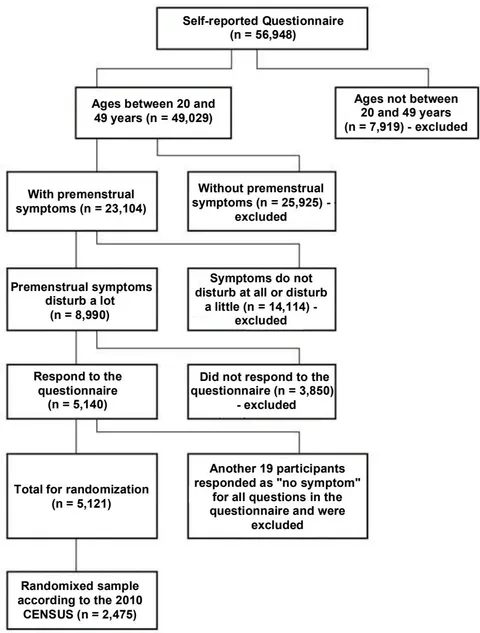
Emleys a representatividade regional, as participantes foram selecionadas aleatoriamente de acordo com as proporções populacionais por regiao, com base noultimate censo demografico (2010)[15].O fluxograma do estado está representado na Figura 1.
O protocolo do estudo foi enviado ao Comité de Ética em Pesquisa, sob o registrar 33794520.1.0000. 8098.
b) Cálculo amostral
Para calcular o tamanho da amostra, foi usada uma formula de estimação para a analise descritiva de variaveis qualitativas[16-18]. Neste caso, a estimativa da sindrome pré-menstrual (SPM)uí obtida da literatura[10]. O[nível de significência alfa, ouerro tipo I,uí definido em (ou intervalo de confiança de ),e oerro de amostragem em .De acordo com os resultados, uma amostra minima de uí obtida. O programa uso foi o SAS (Statistical Analysis System), versão 9.4 (SAS Institute Inc, 2002-2012, Cary, NC, EUA).
De acordo com os dados do Censo Demógrafico Brasileiro de 2010, a população feminina Brasileira de 20 a 49 anos de idade está distribuária de segunte forma: na região sudeste, na região nordeste, na região sul, na região centro-oeste e na região norte. Com o programa estatístico SAS, foi Solicitada mistura aleatoria para cada região Brasileira.
c) Métosos estatisticos
De acordo com as variaveis analisas, as caracteristicas da amostra foram exibidas como tabelas de frequencia para variaveis categoricas com values de frequencia absoluta (n) e relativa (%).
Considerando-se a resposta de cada pergunta, aanalise comparativa das regioes FOi realizada por meio do teste qui-quadrado de Pearson ou da Analise de Variência (ANOVA). Sempre que umaDIFFERÊÇA significativa era encontrar em no primeiro teste, multiplasanalisescomparativaseram realizadas para que cada região fosse comparada. O teste de Bonferroni foi uso para multiplas comparações.
O valor de p foi considero estatisticamente significativo a , resultado do nivel de significencia de dividido por 6. Utilizamos a Regressao de Poisson, um teste estatistico apropriadopara dados numéricos, para comparar regioes quando ao numero de sintomas moderados ou graves. Todas asanalises foram realizadas com o software SAS versao 9.4 e Microsoft Excel.
III. RÉSULTADOS
Um total de 56.948 mulheres respondeu ao questionário inicial, sentido que 8.990 tinkham entre 20 e 49 anos de idade e preencheram os criterios diagnósticos para SPM (qualquer número de sintomas psicoemocionais ou somáticos com comprometimentofucional). Dentre estas mulheres, 5.121 concordaram em responder a uma anamnese detalhada acerca de seuis sintomas, caracterizando aagemal do estudo.
Em seguida, 2.475 participantes foram randomizadas, respeitando a proporcionalidade da populacao feminina de cada estado, com base no censo de 2010 (Tabela 1).
A idade média das participantes foi de anos. Mulheres de 20 a 29 anos de idade representaram da amostra, SIMBINIZANDO a faixa etária mais prevalente. Mulheres de 40 a 49 anos de idade representaram a menor proporcão das participantes (14,4%). A idade média foi mais elevada na região sudeste (31,4, p=0,0003). Entre asos brasiliras, a proporcão de participantes em cada faixa etária foi uniforme (Tabela 2).
O/perfil das participantes que não aceitaram responder ao questionário foi similar ao das que aceitaram em relação as regões brasiléiras e a faixa etária. Metade das participantes de cada perfil concordou em responder ao questionário.
Ao analisar a prevalência total dos sintomas e a distribuição dos sintomas somáticos graves, não foram observadas diferências significativas entre as regões Brasileiras, exceto a menor prevalência de ganho de peso na região nordeste (Tabela 3).
Em média, cefaleia foi o sintoma somático mais prevalente(86,2%)no Brasil, especialmente nas regiões sul e centro-oeste, e 41% das mulheres com cefaleia apareceram o sintoma com intensidade grave. O segundo sintoma mais relevante no Brasil foi acne e pele oleosa(85,8%), com 32,3% de intensidade grave, seguido pelo edema(prevalência de 85%, 25,5% com intensidade grave). Acne e pele oleosa também foram os sintomas mais prevalentes nas regiões sudeste e nordeste. Na região norte, edema foi o sintoma somático mais prevalente(Tabela 3).
Ganho de peso foi o único sintoma somático com uma prevalência estatisticamente significativa inferior na região nordeste, comparado a outras regiões do País(Tabela 3).
O sintoma menos prevalente e grave foi a exerçabaço de doengas imunoalergicas (78,8% e 15,4%, respectively) (Tabela 3).
Com relação aos sintomas psicoemocionais, o mais prevalente no País foi irritabilidade(98,5%), com 61,7% das mulheres apresentando o sintoma em intensidade grave. Ansiedade/tensão foi o segundo sintoma psicoemocional mais prevalente na população brasileira(98,4%), com intensidade grave em 54,2% das participantes (média). A maior prevalência deste sintoma foi observada na região sul. Quanto à intensidade, foi estatisticamente significante nas regiões nordeste e sudeste. Na região sul, eles os sintomas (irritabilidade e ansiedade/tensão) mostraram a mesma prevalência elevada(99,4%). O terceiro sintoma mais prevalente no País foi o reduzido interesse nas atividades diárias(94,5%), tendo sido considerado de intensidade grave por 39% das mulheres(Tabela 4).
Ingestão excessiva de alimentos foi o único sintoma que mostrou uma diferença estatisticamente significativa entre as regiões tanto para prevalência quanto em intensidade.
Em média, das mulheres com SPM declararam que usariam contraceptivos ais combinados como opção de tratamento dos sintomas da SPM (Tabela 5).
IV. DISCUSSAO
Nossa subpoena mostrou uma alta prevalência de sintomas somáticos e psicoemocionais em todas as regíoes brasiléiras, com prevalência média de 83,6% e 94,2%, respectivamente.
Um estudo realizado na região sul do Brasil, com 1.395Mulheres de 15 a 49 anos de idade, demonstrou que os principais sintomas somáticos pré-menstruais foram desconforto abdominal, cefaleia e dornas mamas. Os sintomas psicoemocionais mais prevalentes foram irritabilitadade, nervosismo e fatIDA. [9]Em meuisto estudo, os sintomas somáticos mais prevalentes foram cefaleia , acne e pele oleosa e edema , quando os sintomas psicoemocionais mais prevalentes foram irritabilitadde , ansiedade/tensao e reduzido interesse nas atividades diarias .
Em um estudo brasiliero multicêntrico que teve por objectivo redescrever as perspectivas e atitudes das mulheres brasiliras em�� à SPM, foram revestadas 1.053 mulheres de 18 a 40 anos de idade que viviam em 6 cidades masculas, cada uma em uma regione geografica, do Distrito Federal [10]. Os resultados nostraram que a maioria das mulheres (78.1%) declarou que a SPM está relacionada a sintomas emulatoriais, e 24.3% disseram que está relacionada a sintomas somáticos[10]. Os sintomas emulatoriais mentionados pelas participantes com maior frequência foram nervosismo/ansiedade, irritabilité/raiva/agressividade e alterações de humor/choro, quando os sintomas somáticos mais comuns foram cefaleia, célicas e dor nas mamas, inchaço e sensibilitadé [10]. Por,[11] observamos em)nossa poucoisa que irritabilité e ansiedade/tensão foram os sintomas psicoemocionais mais prevalentes.
Ao avaliar a prevalência dos sintomas com intensidade grave,/DDo estudo mostrou que os sintomas psicoemocionais predominaram sobre os somáticos,com para irritabilitadedeversus para cefaleia,que foi o sintoma somático mais grave.
A avaliação da gravidade e do número de cicloiros menstruais afetados, realizada por um estudo conducindo emes paises, incluindo o Brasil, com 7.226 mulheres (400-500 mulheres de cadayard) de 15 a 49 anos de idade, demonstrou uma frequência mais elevada de sintomas somáticos[6]. Nesse estudo global, o Brasil ficou em segundo lugar com relação à gravidade e duração dos sintomas, ficando atrás semente do Reino Unido. A alta prevalência de sintomas graves observados em meuisto estudo correbora com esses achados. No entanto, ao avaliar a popULAÇÃO global, 4 dos 5 sintomas mais prevalentes eram somáticos[6]. Em meuisto estudo, a maior prevalência e gravidade foram de sintomas psicoemocionais.
É importante enfatizar que os dados foram coletados antes da pandemia da COVID-19, portanto os resultados não foram influenciados pelos efeitos psicológicos desencadeados durante a pandemia. Continuamos a coletar dados durante a pandemia, éa comparação interessante.
A menor gravidade da ingestão excessiva de alimentos na região nordeste pode estar relacionada à menor gravidade da ansiedade e tensão durante o periodo pré-menstrual.
Estudos anteriores indicaram que foram prescritos homônios para das mulheres brasiliras como estrategia para lidar com a sindrome pré-menstrual,[10]e que a gravidade dos sintomas da SPM está invversamente associada ao uso de contraceptive oral (sintomas emulatorais) emelhor percepção de Saúde (sintomas somáticos)[19].Em)nossa subpoena, das participantes que preencheram os criterios diagnósticos para SPM usariam contraceptivos orais combinados como opçao de tratamento para a SPM. Esse é um achado importante, poised a contraceptionção oral combinada para mulheres em idade reprodutiva é uma das opções eficazes para tratamento da SPM, principalmente para mulheres que buscam aconselhoamento em。[20]
A robustez deste estudo inclui o uso de um questionário validado no Brasil comumente utilizao para estudos populacionais, o grande numero deMulheres incluidas, e a abrangencia nacional do estudo. E importante dessaltar que asMulheres incluidas em no estudo foram selecionadas em umsystema de saude privado para minimizar possiveis vises relacionados a condicao socioeconomica das participantes. Como limitacaoo estudo destacamos a ausencia de coleta de dados referentes a escolaridade e renda familiar das participantes.
V. CONCLUSÃO
Sintomas psicoemocionais são mais freqentes e graves que sintomas somáticos nocontexto da sindrome pré-menstrual. Houve muitas similaridades na apareção desses sintomas entre as regõesbrasileiras, uma vez que os sintomas tinkham uma frequência e intensidade independente da região, o que levou muitasMulheres a affirmarem que estariam dispostas a usar um contraceativo para reduzir os sintomas da SPM. Para escolher a opçao mais apropriad, é importante que os professionis de saude fazer o rastreamento de sintomas associados à SPM durante o aconselhoamento de métodos contraceptivos.
Lista de abrevições
SPM: Síndrome pré-menstrual; MRP: Programas de Pesquisa de Mercado; PSST: Instrumento de Rastreamento de Sintomas Pré-Menstruais
Agradecimientos
Os autores agradecem a todas as participantes esta subpoena.
Contribuição dos autores
Adriana O. Pedro contribuiu com o delineamento do estudo, redação e revisão do manuscrito; Maura G. Lapa contribuiu com a análise de dados; Juliana D. P. Brandãocontribuiu com a análise de dadosse escreveu o manuscrito; e Vivienne C. Castilho contribuiu com o delineamento do estudo e revisão do manuscrito.
Todo os autores discutiram o resulto e contribuíram com o manuscrito final.
Finanziamento
Esta pesquisa foi patrocinada pela Libbs Farmacêutica Ltda (Brasil), que forneceu suporte financeiro e material (número de protocolo LB1105).
Disponibilitadedeados emateriais
Os dados gerados e/ou analisados durante o presente estudo podem ser disponibilizados pelo autor correspondente mediante pedido razoável.
Declaracoes
Todos os procedimentos envolvidos no teste da queixa foram realizados em conformidade com os padrões éticos e aprovados pelo comitê de Ética em Pesquisa em todos os locais participantes, e foram conduzidos seguindo os padrões éticos delineados na Declaração de Helsinki(1983).
Conflito de Interesses
Adriana O. Pedro atuou em comités consultivos ou fou consultora da Libbs Farmacêutica, Abott, Aché, Amgen, EMS, Eurofarma, Grumenthal, Mantecorp-Farmasa, e Sanofi. Ela también atuou no setor de palestras da Libbs Farmacêutica, Abott, Aché, Amgen, EMS, Eurofarma, Grumenthal, Mantecorp-Farmasa e Sanofi-Aventis.
Samantha B. de Oliveira, Maura G. Lapa, Juliana D. P. Brandãoe Vivienne C. Castilho travahamno Departamento de Assuntos Médicos na Libbs Farmacêutica.
I. BACKGROUND
85% of women experience at least one mild premenstrual symptom[1]. However, few studies reveal the impact of PMS symptoms on quality-of-lifework, family, and social relationships.
There are several different psycho-emotional and physical symptoms associated with PMS as depression, angry outbursts, irritability, anxiety, confusion, social withdrawal, breast tenderness, abdominal bloating, headache and swelling of extremities[2]. These symptoms are cyclic and recurrent and can change in extent and intensity during different menstrual cycles[2]. According to the World Health Organization, "Premenstrual Tension Syndrome" is characterized by certain environmental, metabolic, or behavioral symptoms that occur during the luteal phase of the menstrual cycle, and lead to cyclic emotional, physical, or behavioral symptoms that interfere with an individual's lifestyle[3]. The American College of Obstetrics and Gynecology and the Royal College of Obstetricians and Gynecologists' criteria describe PMS as any number of psychoemotional or physical symptoms and functional impairment is required[4].
Since PMS is a global problem, it has been studied worldwide to understand its effects on daily life[5, 6]. The first global meta-analysis reported the pooled prevalence of PMS at values around worldwide, although most of the included studies were heterogeneous, involving several confounding factors within and between studies, and a limited sample size[7]. Some studies suggested that the prevalence of PMS is higher in Latin-American countries when compared to Europe[8].
In Brazil, there are few published studies on the prevalence, symptoms characteristics, and detailed information about the premenstrual syndrome in women of reproductive age. In addition, the correlation with socio-demographic, socioeconomic, and sociocultural conditions of the affected women is not established [9-12]. However, a study in the Brazilian population showed that when using criteria for the diagnosis of PMS, the prevalence of the syndrome was lower than the self-reported [9].
Therefore, nationwide studies looking at regional differences involving a large sample size among sufferers of PMS are scarce, and new data will contribute to demystifying PMS and help health professionals to assist affected women.
This study aimed to evaluate the prevalence, intensity and regional distribution of PMS symptoms reported by the Brazilian female population and the information generated may help to rethink mechanisms to improve the health and quality of life of PMS suffering women and offer decision-making tools related to the need for early and effective treatment of PMS.
II. METHODS
a) Study design and sample selection
It was an observational and retrospective study. All data were collected from a database with information stored by the Market Research Programs (MRP) and anonymized to ensure the data subjects' confidentiality and the study's security and confidentiality.
A self-reported questionnaire was answered by women aged 20 to 49 years from all Brazilian regions: South, Southeast, North, Northeast, and Midwest, between February 2019 and March 2020. The invitation to participate was made through an electronic device (cell phone or tablet). As soon as the woman requested access to the clinic's wireless network, she was invited to participate in the research and received information about the content and purpose of the research. This study was free from a consent form. The duration of the questionnaire filling out was around five to ten minutes.
Next, the participants were categorized as having PMS or not, according to the ACOG diagnostic criteria[2]. To evaluate functional impairment, the participants were asked how much the PMS symptoms disturbed their daily life (not at all, a little, or a lot) and those who answered "a lot" were considered as having a functional impairment.
Those who accepted to participate voluntarily were directed to the questionnaire adapted from the PSST - Premenstrual Symptoms Screening Tool -version validated in Brazil (Annex 1)[13].PSST is a retrospective questionnaire that can be completed during clinical consultation which is well established for PMS symptoms. It has demonstrated high sensitivity for PMS diagnosis and, in addition, identified women who suffer from severe PMS[14].
A 4-point Likert scale was used to measure the intensity of psychoemotional (irritability, anxiety and tension, decreased interest in routine activities, depression and sadness, overeating, concentration difficulties, emotional instability) and physical(headache, acne and oily skin, edema, weight gain, breast tenderness, exacerbation of immunoallergic conditions) symptoms according to intensity ; ; ; ). Also, demographic data of To have representativeness according to regional population, the respondent women were randomly selected according to the population proportions by region, based on the latest published demographic Census (2010)[15]. The study flow chart is represented in Figure 1.
b) Sample Calculation
According to the 2010 Demographic Census data, [15] the Brazilian female population aged 20 to 49 years was distributed as follows: in the Southeast, in the Northeast, in the South, in the Midwest and in the North region. A specific procedure was used for this selection that randomly shuffles and chooses lines among those available in each region, using the SAS statistical software.
c) Statistical methods
According to the variables under study, the sample characteristics are shown as frequency tables of categorical variables with absolute (n) and percentage (%) frequency values.
Comparisons among regions concerning the response of each question were analyzed using Pearson's Chi-Square test or Analysis of Variance (ANOVA). If a significant difference was found at in the first test, multiple comparisons were performed so that each region was compared. Bonferroni's correction test was used for multiple comparisons.
The p-value was considered significant at , resulting from the significance level of divided by 6. We used Poisson Regression to compare regions regarding the number of moderate or severe symptoms, an appropriate statistical test for numerical data. All analyzes were performed using SAS software version 9.4 and Excel.
III. RESULTS
A total of 56,948 women responded to the initial questionnaire. Of these, 8,990 were aged between 20 and 49 years and met the diagnostic criteria for PMS (any number of psycho-emotional or physical symptoms with functional impairment). Among them, 5,121 participants agreed to answer a detailed anamnesis about their symptoms, characterizing the target population of the study.
The mean age of participants was years. Women between 20 and 29 years represented of the sample, corresponding to the larger age group. The participants aged between 40 to 49 years represented the lowest proportion of respondents . The mean age was higher in the southeast region . Among the different Brazilian regions, the proportion of respondents in each age group was uniform (Table 2).
The profile of the participants who did not accept to respond to the questionnaire was similar to participants who accepted to respond, regarding the Brazilian regions and age group. Half of the participants in each profile agreed to answer the questionnaire.
By analyzing the total prevalence of symptoms and the distribution of severe physical symptoms, it was observed no significant differences between the regions of Brazil, except for the lower prevalence of weight gain in the northeast region (Table 3).
Headache was the most prevalent physical symptom (86.2%) in the Brazil average, as well as in the South and Midwest regions, and 41% of the women with headaches presented the symptom with severe intensity. The second most prevalent symptom in the Brazil average was acne and oily skin (85.8%), with 32.3% of severe intensity, followed by edema (85% prevalence, 25.5% with severe intensity). Acne and oily skin were also the most prevalent symptom in the Southeast and Northeast regions. In the North region, edema was the most prevalent physical symptom (Table 3).
Weight gain was the only physical symptom with a statistically significantly lower prevalence in the northeast region compared to other regions of the country (Table 3).
When focusing on the psychoemotional symptoms, the most prevalent symptom in the country was irritability (98.5%) with 61.7% of women presenting the symptom in severe intensity. Anxiety and tension were the second most prevalent psychoemotional symptom in the Brazilian population (98.4%) and 54.2% of the participants presented it in severe intensity (average). The most prevalence of this symptom was observed in the south region. Regarding intensity, it was statistically significant in the northeast and southeast regions. In the South region, both symptoms (irritability/Anxiety and tension) showed the same higher prevalence . The third most prevalent symptom in the country was decreased interest in routine activities and of women considered it to be of severe intensity (Table 4).
IV. DISCUSSION
Our investigation showed a high prevalence of physical and psychoemotional symptoms in all Brazilian regions, with the average prevalence of these symptoms in Brazil being and , respectively.
In a study in southern Brazil 1395 women aged 15 to 49 years were evaluated. The main premenstrual physical symptoms found in this study were abdominal discomfort, headache and breast pain. Among the psychoemotional symptoms, the most prevalent were irritability, nervousness and fatigue.[9] In our study the most prevalent physical symptoms were headache , acne and oily skin , and edema and the psychoemotional symptoms were irritability , anxiety and tension and decreased interest in routine activities .
In a multicenter Brazilian study that aimed to describe the perspectives and attitudes of Brazilian women toward premenstrual syndrome,1053 women, separated by regions, between 18 and 40 years, lived in 6 Brazilian cities, 1 in each geographic region of the country and the Federal District were interviewed [10]. Results showed that most women (78.1%) stated that PMS is related to emotional symptoms, and said that it is related to physical symptoms [10]. The emotional symptoms most frequently mentioned by the participants were nervousness/anxiety, irritability/anger/aggressiveness and mood swings/crying, whereas the most common physical symptoms were headache, cramps and breast pain, swelling, and tenderness[10]. On the other hand, in our investigation we observed that irritability and anxiety/tension were the most prevalent psychoemotional symptoms.
When evaluating the prevalence of symptoms with severe intensity, our study showed a higher prevalence of psychoemotional symptoms over physical symptoms, reaching for irritability versus for headache, which was the most severe physical symptom.

Palavras-chave: sindrome pré-menstrual, mulheresbrasileiras, estudo regional, gravidade dos sintomas pré-menstruais, prevalencia dos sintomas pré-menstruais.
Palavras-chave: sindrome pré-menstrual, mulheres brasiliras, estudo regional, gravidade dos sintomas pré-menstruais, prevalência dos sintomas pré-menstruais.