I. EULER'S NUMBERS AND GOLDEN RATIO
Euler's numbers are e: 2,718281828459045...[1]
The starting point of this study was found as follows. When the first fifteen digits of the number "e" after the comma are subtracted from a quadrillion, the first three digits of the numbers obtained at the result are "618". Also, the golden ratio numbers include "618", too.(Remember, it is approximately 1,618) (For more information about "618" and biochemistry [6]) In fact, in the digits after "618" in the result, Euler's numbers are the same as the digits after the first three digits after the comma (281828459045).
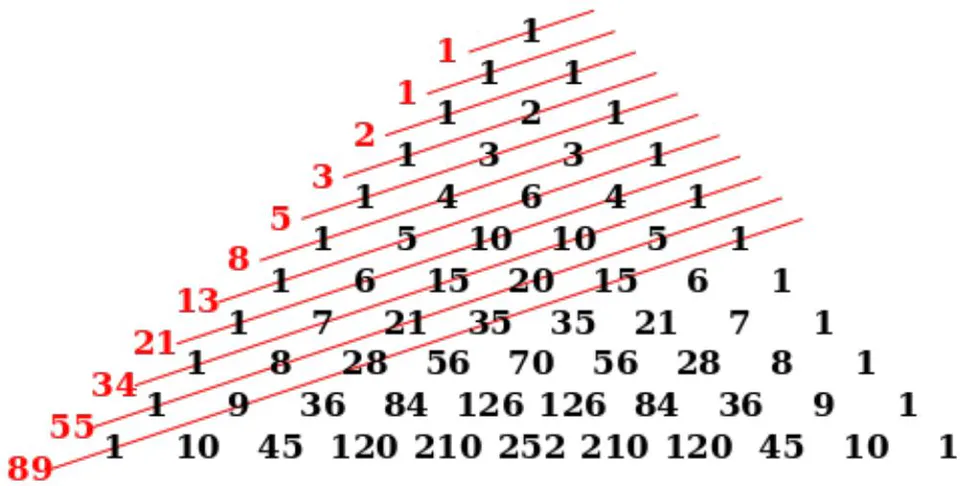
Fibonacci series:.0,1,1,2,3,5,8,13,21,34,55... [7]
The golden ratio has the continued fractions (1/1, 2/1, 3/2, 5/3, 8/5, 13/8, 21/13, 34/21, 55/34...etc) are ratios of successive Fibonacci numbers. [7]
The starting point of the numbers in the Fibonacci series is the Pascal triangle, which is also formed by the exponents of the eleven "11" digit. Namely, From Fibonacci series, the number of "55" is the eleventh(11) number. Another mysterious point is that if you calculate the diagonals of this triangle. the sum of the numbers in the diagonals will give you the Fibonacci sequence [1]. (1,1,2,3,5,8,13,21,34,55) [7]. Namely, the value of a row is a power of 11. [3]
DECIMAL BINARY 101 210 311 4100 5101 6110 7111 81000 91001 101010 DECIMAL BINARY 111011 121100 131101 141110 151111 1610000 1710001 18 19 20 DECIMAL BINARY 2110101 22 23 2411000 25 26 2711011 28 29 3011110 DECIMAL BINARY 31 32 33 34 35100011 36100100 37 38100110 39 40 DECIMAL BINARY 41 42101010 43 44 45101101 46101110 47101111 48 49 50 DECIMAL BINARY 51110011 52110100 53 54 55 56 57 58 59111011 60 DECIMAL BINARY 61 62111110 63 64 65 661000010 67100011 68 691000101 70 DECIMAL BINARY 711000111 721001000 73 741001010 751001011 76 771001101 781001110 79 80 DECIMAL BINARY 811010001 821010010 83 841010100 85 86 871010111 88 89 90 DECIMAL BINARY 91 92 93 94 951011111 961100000 971100001 98 991100011 100
The first hundred of Euler's numbers are here:
e:2,71828182845904523536028747135266249775724709369995957496696762772407663035354759457138217852516642742746
At first, Euler's numbers of both digits after the comma was taken each time. For example, 71,82,81,82,84...and so on. Then these numbers are found in the binary number system in Table-1. (For instance, "71", 1000111 and so on). Secondly, convert these binary numbers to decimal number base (For instance, "71" 1000111; 1000=8 and
111=7). Finally, all decimal numbers are subjected to the addition process, respectively. . The result of the addition is "55".
{"code_caption":[],"code_content":[{"type":"text","content":"Euler's numbers: 71 82 81 82 84\nEuler's numbers: 1000 111 10 100 10 10 10001 10 100 10 101 0\nEuler's numbers: 8 + 7 +2+4+2 +2 +17 +2+4+2 +5\nEMPTY=55\n\nEuler's numbers: 84(more) 59 04 52 35 36 02 87\nEuler's numbers: 100 111 01 11 1001 10 100 1000 11 100 100 10 10 101\nEuler's numbers: 4 +3 +2+3 +9 +2 +4 +8 +3 +4 +4 +2 +2 +5=55\n\nEuler's numbers: 87(more) 47 13 52 66 24\nEuler's numbers: 11 1011 11 11 01 1 10 100 10000 10 1 1000\nEuler's numbers: 3 +11 +3 +3+1+1+2+4 +16 +2 +1+8 =55\n\nEuler's numbers: 97 75 72 47 09 36\nEuler's numbers: 1 10000 1 100 10 11 100 1000 10 1 111 10 01 10 01 00\nEuler's numbers: 1+16+ 1 +4 +2 +3 +4 +8 +2 +1+7 +2+1 +2+1\nEMPTY=55\n\nEuler's numbers: 99 95 95 74 96\nEuler's numbers: 1 1000 11 1 01 1111 1 01 1111 100 10 10 1\nEuler's numbers: 1 +8 +3 +1+1+15 +1+1+15 +4 +2 +2 +1=55\n\nEuler's numbers: 96(more) 69 67\nEuler's numbers: 100000 100 00 101 10000\nEuler's numbers: 32 +2 +EMPTY+5 +16 =55\n\nEuler's numbers: 67(more) 62 77 24 07 66\nEuler's numbers: 11 111 110 10 01 101 1 1000 1 11 10000\nEuler's numbers: 3 +7 +6 +2+1 +7 +1 +8 +1+3+16=55\n\nEuler's numbers: 66(more) 30 35 35 47 59\nEuler's numbers: 10 111 10 1000 11 1000 11 1011 11 111 01\nEuler's numbers: 2 +7 +2 +8 +3 +8 +3 +11 +3 +7 +1 =55\n\nEuler's numbers: 59(more) 45 71 38 21 78 52\nEuler's numbers: 1 101 101 1000 111 100 110 101 01 100 11 10 11 01\nEuler's numbers: 1 +5 +5 +8 +7 +4 +6 +5 +1 +4 +3 +2 +3\n+1 =55"}],"code_language":"txt"}
Euler's numbers: 52(more) 51 66 42 74 27 46 Euler's numbers:00 1 100 11 10000 10 10 10 10 100 10 10 110 11 10 11 10 Euler's numbers:EMPTY +1+4+3 +16 +2 +2 +2+2 +4 +2 +2 +6 +3 +1+3 +2=55
| Euler's numbers: 52(more) | 51 | 66 | 42 | 74 | 27 | 46 |
| Euler's numbers:00 | 1 100 11 | 10000 10 | 10 10 10 | 100 10 10 | 110 11 10 | 11 10 |
| Euler's numbers:EMPTY +1+4+3 +16 +2 +2 +2+2 +4 +2 +2 +6 +3 +1+3 +2=55 | ||||||
IV. CONCLUSION
The most widely used number digit system today is decimal. But in this work, Euler's numbers have been converted from decimal base system to binary number base system. Interestingly, the first number of Euler's numbers is "2". Binary numbers have only two digits (0 or 1) too [5].
According to Quantum Perspective Model[4], after calculating the first hundred digits of Euler numbers after the comma, the number" 55 " (ten times) was found, especially in the Fibonacci series (0,1,1,2,3,5,8,13,21,34,55...)[7].The 11th digit in the Fibonacci series is also "55". The numbers of the this series can be reached through The Pascal Triangle with the exponents of this number 11.As a result, after calculating the first hundred of Euler's numbers after the comma, the number" 55 " has been obtained (ten times).It is the sign of the relationship between Euler's numbers and Fibonacci series.During the calculation, the "EMPTY" numbers "00' are disregarded. According to the number-based system, the number" 00 " has no value, neither in the decimal nor in the binary-based system. According to binary encoding base system, on the case of current not passing, this means 0 (zero). [8] That's why, it can be the reason of disregardence of "EMPTY" "00' numbers.
As described in the reviews by Mäkelä, and Annila, the Fibonacci sequence is for other mathematical model functions which have useful results. (Mäkelä and Annila, 2010): If Fibonacci numbers are found in Nature, Why not include them in Euler's numbers? Or is it the difference how it discovers parameters in science in terms of the quantum perspective model, especially when the relevant unit of analysis is invariant numbers?