ISLAMIC BANKING: SELECTION CRITERIA AND IMPLICATIONS

ยง Tunku Abdul Rahman University

Send Message

To: Author

ISLAMIC BANKING:  SELECTION CRITERIA AND IMPLICATIONS

Article Fingerprint

ReserarchID

3U3B3

ISLAMIC BANKING:  SELECTION CRITERIA AND IMPLICATIONS Banner

AI TAKEAWAY

Connecting with the Eternal Ground
  • English
  • Afrikaans
  • Albanian
  • Amharic
  • Arabic
  • Armenian
  • Azerbaijani
  • Basque
  • Belarusian
  • Bengali
  • Bosnian
  • Bulgarian
  • Catalan
  • Cebuano
  • Chichewa
  • Chinese (Simplified)
  • Chinese (Traditional)
  • Corsican
  • Croatian
  • Czech
  • Danish
  • Dutch
  • Esperanto
  • Estonian
  • Filipino
  • Finnish
  • French
  • Frisian
  • Galician
  • Georgian
  • German
  • Greek
  • Gujarati
  • Haitian Creole
  • Hausa
  • Hawaiian
  • Hebrew
  • Hindi
  • Hmong
  • Hungarian
  • Icelandic
  • Igbo
  • Indonesian
  • Irish
  • Italian
  • Japanese
  • Javanese
  • Kannada
  • Kazakh
  • Khmer
  • Korean
  • Kurdish (Kurmanji)
  • Kyrgyz
  • Lao
  • Latin
  • Latvian
  • Lithuanian
  • Luxembourgish
  • Macedonian
  • Malagasy
  • Malay
  • Malayalam
  • Maltese
  • Maori
  • Marathi
  • Mongolian
  • Myanmar (Burmese)
  • Nepali
  • Norwegian
  • Pashto
  • Persian
  • Polish
  • Portuguese
  • Punjabi
  • Romanian
  • Russian
  • Samoan
  • Scots Gaelic
  • Serbian
  • Sesotho
  • Shona
  • Sindhi
  • Sinhala
  • Slovak
  • Slovenian
  • Somali
  • Spanish
  • Sundanese
  • Swahili
  • Swedish
  • Tajik
  • Tamil
  • Telugu
  • Thai
  • Turkish
  • Ukrainian
  • Urdu
  • Uzbek
  • Vietnamese
  • Welsh
  • Xhosa
  • Yiddish
  • Yoruba
  • Zulu
Font Type
Font Size
Font Size
Bedground

Abstract

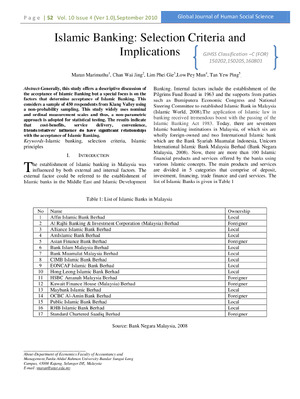
Generally, this study offers a descriptive discussion of the acceptance of Islamic Banking but a special focus is on the factors that determine acceptance of Islamic Banking. This considers a sample of 450 respondents from Klang Valley using a non-probability sampling. This study widely uses nominal and ordinal measurement scales and thus, a non-parametric approach is adopted for statistical testing. The results indicate that cost-benefits, service delivery, convenience, friends/relativesโ€™ influence do have significant relationships with the acceptance of Islamic Banking.

References

74 Cites in Article
  1. N Ahmad,S Haron (2002). Perception of Malaysian Corporate Customers towards Islamic Banking Products.
  2. N Ahmad,S Haron (2000). The effects of conventional interest rate and rate of profits on funds deposited with Islamic Banking system in Malaysia.
  3. Ulfah Zainudin,Ahmad Othman (2003). Leasing and Factoring Companies Offering Shariah-Based Financing Products in Malaysia: Reference to the Financial Services Act 2013 (FSA) and the Islamic Financial Services Act 2013 (IFSA).
  4. L Algaoud,M Lewis (2001). Islamic Banking.
  5. W Anderson,Eli Cox,David Fulcher (1976). Bank Selection Decisions and Market Segmentation.
  6. R A Arreola (1995). Developing a Comprehensive Faculty Evaluation Syatem : A handbook for College Faculty and Administration on Designing and Operating Comprehensive Faculty Evaluation System.
  7. S Awang (1997). Bank Selection Decision: Factors Influencing The Selection of Bank and Banking Services.
  8. K H Azam Ahamed (2008). Benefits of Islamic Banking.
  9. C Chaoprasert,B Elsey (2004). Service quality improvement in Thai retail banking and its management implications.
  10. D Choi,L Valikangas (2001). Six Sigma and TQM cannot create sustainable value unless coupled with a more innovative strategy.
  11. D Cooper,P Schindler (2008). Business Research Methods.
  12. Dato Seri,Mohd Najib Bin,Tun Haji,Abdul Razak (2008). Islamic Finance. KL: Prime Minister Office 16.
  13. G Duncan,T Smeeding,W Rodgers (1992). The incredible shrinking middle class.
  14. A Dusuki,N Abdullah (2006). Why do Malaysian customers patronize Islamic banks.
  15. M Ebrahim,K Tan (2001). Islamic Banking in Brunei Darussalam.
  16. T Edris,M Almahmeed (1997). Services considered important to business customers and determinants of bank selection in Kuwait: a segmentation analysis.
  17. F Edwards (1973). Advertising and Competition in Banking.
  18. Cengiz Erol,Radi Elโ€bdour (1989). Attitudes, Behaviour, and Patronage Factors of Bank Customers towards Islamic Banks.
  19. Cengiz Erol,Erdener Kaynak,Elโ€bdour Radi (1990). Conventional and Islamic Banks: Patronage Behaviour of Jordanian Customers.
  20. O Evren (2003). Commercial paper.
  21. D Fullwiley (2007). Race and Genetics: Attempt to Define the Relationship.
  22. A Gait,A Worthington (2007). An Empirical Survey of Individual Consumer, Business Firm and Financial Institution Attitudes towards Islamic Methods of Finance.
  23. P Gerrad,J Cunningham (1997). Islamic Banking: a Study in Singapore.
  24. Michelle Schneweis (1977). University Faculty and Administrative Attitudes Toward Students with Disabilities.
  25. Sudin Haron,Norafifah Ahmad,Sandra Planisek (1994). Bank Patronage Factors of Muslim and Nonโ€Muslim Customers.
  26. S Haron,W Azmi (2008). Determinants of Islamic and conventional deposits in the Malaysian banking system.
  27. I Hegazy (1995). An Empirical Comparative Study between Islamic and Commercial Banks' Selection Criteria in Egypt.
  28. J Hussain (2003). Islam: its law and society.
  29. M Iqbal,P Molyneux (2005). Thirty Years of Islamic Banking: History, Performance, and Prospects.
  30. Z Iqbal (1997). Islamic Financial System.
  31. Lingga Erlambang Agusty,Aminullah Achmad Muttaqin (2009). ANALISIS PENGARUH LABEL HALAL, KESADARAN HALAL, DAN PERSEPSI ATAS PRODUK HALAL DALAM PEMBELIAN KOSMETIK HALAL.
  32. R Javalgi,R Armaco,J Hosseini (1986). Using the Analytical Hierarchy Process for Bank Management:Analysis of Consumer Bank Selection Decisions.
  33. L Johnson,M Dotson,B Dunlap (1988). Service quality determinants and effectiveness in the real estate brokerage industry.
  34. Robert Johnston (1995). The determinants of service quality: satisfiers and dissatisfiers.
  35. E Kaynak,A Whiteley (1999). Retail bank marketing in Western Australia.
  36. Karsten Ingo (1982). Islam and Financial Intermediation.
  37. Carolyn Kennington,Jeanne Hill,Anna Rakowska (1996). Consumer selection criteria for banks in Poland.
  38. M Khan (1986). Islamic interest-free banking.
  39. M Khan,A Mirakhor (1989). Islamic banking: Experiences in the Islamic Republic of Iran and Pakistan.
  40. K Khazeh,W Decker (1992). How customers choose banks.
  41. Ahmad Koraini,Zainey Konjing,Marahizal Malihan (2008). Tertiary palynomorph assemblage from eastern Chenor, Pahang.
  42. L Kirkpatrick (2005). Attachment, Evolution, and the Psychology of Religion.
  43. T Kohers,W Simpson (1981). Concentration and Advertising in the United States Savings and Loan Industry.
  44. R Kugyte,L Sliburyte (2005). A Standardized Model of Service Provider Selection Criteria for Different Service Types: a Consumer-oriented Approach.
  45. D Kurtz,L Boone (2005). Principle of Marketing.
  46. H Lamsali,R Razak,H Lazim,H Ismail,D Arslhad,K Adnan (2005). Service Quality and Customer Preference Towards Islamic Banking in Malaysia: A Study Using CARTER Model.
  47. S Metawa,M Almossawi (1998). Banking Behaviour of Islamic Bank Customers: Perspectives and Implications.
  48. M Metwally (2006). Economic Consequences of Applying Islamic Principles in Muslim Societies.
  49. M Metwally (2002). The Impact of Demographic Factors on Consumers' Selection of a Particular Bank within a Dual Banking System: A Case Study.
  50. S Mokhlis,N Hazimah,S Salleh,H (2008). Commercial Bank Selection: The Case of Undergraduate Students in Malaysia.
  51. W Norton,Company (2001). Primary Source Evidence versus Secondary Source Material.
  52. H Okumus (2005). Interest free Banking in Turkey : A study of customer satisfaction and bank selection criteria.
  53. O Omar,E Orakwue (2006). Genderbased Choice of Retail Banking in Nigeria.
  54. H Omer (1992). The Implication of Islamic Beliefs and Practice on Islamic Financial Institutions in the UK.
  55. A Othman,L Owen (2001). Adopting and measuring customers service quality (SQ) in Islamic banks: a case study in Kuwait finance house.
  56. M Pass (2006). Western US college students: banking preferences and marketplace performance.
  57. P Philp,Paula Haynes,Marilyn Helms (1992). Financial Service Strategies: Neglected Niches.
  58. S Qadri (2008). Islamic Banking: An Introduction.
  59. N Razzouk (2004). What's important in choosing a primary care physician: an analysis of consumer response.
  60. J Riggall (1980). A New Study: How Newcomers Select Banks.
  61. A Saboko (2009). The growth of Islamic banking.
  62. A Samad,M Hassan,(n.D The performance of Malaysian Islamic bank during 1984 until 1997:An exploratory study.
  63. D Schaik (2001). Islamic Banking.
  64. M Shariff (1920). Salient Features of Islamic Banking Act, 1983 and Banking and Financial Institutions Act.
  65. C Tan,C Chua (1986). Intention, attitude and social influence in bank selection: a study in an Oriental culture.
  66. W Trochim (2000). The ResearchMethods Knowledge Base.
  67. Peter Turnbull (1983). Corporate Attitudes Towards Bank Services.
  68. K Tyler,E Stanley (1999). UK Bank-Corporate Relationships: Large Corporates' Expectations of Service.
  69. Ust Hj,Zaharuddin Hj,Abd Rahman (2007). Differences Between Islamic Banks and Conventional.
  70. S Wakhid,S Efrita (2007). Adapting Islamic Banks' CARTER model: an empirical study in Riau's Syariah Banks.
  71. F Wangenheim (2004). The effect of word of mouth on services switching: Measurement and moderating variables.
  72. K Weigelt,C Camerer (1988). Reputation and corporate strategy: A review of recent theory and applications.
  73. B Whitson,M Phillips (1998). Library Research Using Primary Sources.
  74. Y Zainuddin,N Jahyd,T Ramayah (2004). Perception of Islamic Banking: Does It Differ among Users and Non Users.

Funding

No external funding was declared for this work.

Conflict of Interest

The authors declare no conflict of interest.

Ethical Approval

No ethics committee approval was required for this article type.

Data Availability

Not applicable for this article.

How to Cite This Article

Dr Marimuthu. 1970. "ISLAMIC BANKING: SELECTION CRITERIA AND IMPLICATIONS". Global Journal of Human-Social Science GJHSS Volume 10 (GJHSS Volume 10 Issue 4).

More Citation Formats

Download Citation

Journal Specifications

Crossref Journal DOI 10.17406/GJHSS

Print ISSN 0975-587X

e-ISSN 2249-460X

Keywords
Version of record

v1.2

Issue date
September 10, 2010

Language
English
Experiance in AR

Explore published articles in an immersive Augmented Reality environment. Our platform converts research papers into interactive 3D books, allowing readers to view and interact with content using AR and VR compatible devices.

Read in 3D

Your published article is automatically converted into a realistic 3D book. Flip through pages and read research papers in a more engaging and interactive format.

Article Matrices
Total Views: 8.6K
Total Downloads: 548
All Trends

Request Access

Please fill out the form below to request access to this research paper. Your request will be reviewed by the editorial or author team.
X

This is the heading

Lorem ipsum dolor sit amet, consectetur adipiscing elit. Ut elit tellus, luctus nec ullamcorper mattis, pulvinar dapibus leo.


High-quality academic research articles on global topics and journals.

ISLAMIC BANKING: SELECTION CRITERIA AND IMPLICATIONS

Dr Marimuthu
Dr Marimuthu Tunku Abdul Rahman University