I. WORKING METHODOLOGY
a) General Requirements
The organization must establish and maintain an environmental management system whose requirements are described as follows:
i. Environmental Policy
Management at the highest level must define their organization's environmental policy.
ii. Panning
Environmental Aspects:
The organization must maintain procedures for identifying the environmental aspects of the various activities
General Requirements and other:
The organization must maintain a procedure for identifying the legal and other requirements applied to the environmental aspects of the activities.
Objectives and Targets:
The organization must establish and maintain environmental objectives and targets.
Environmental Management Program:
To achieve these objectives, the organization must establish and maintain one or more programs.
b) Implementation and Operation
i. Structure and Responsibility
The environmental management system requirements are established, implemented and maintained in accordance with this international standard.
ii. Training, Awareness and Competency
The staff should be made aware of:
- The importance of compliance with environmental policy and environmental management system requirements;
- With significant environmental impacts;
- Their roles and responsibilities to achieve compliance with environmental policy and requirements;
- Potential consequences of deviations from specified operating procedures.
iii. Communication
The organization shall establish and maintain procedures for:
- Ensure internal communication between the different levels and functions of the organization;
- Receive, document and respond to relevant requests from external stakeholders.
iv. Environmental Management System Documentation
The organization must establish and maintain paper or electronic information and maintain procedures to control all documents required by the standard:
Operational Proficiency
The organization must identify those of its operations and activities that are associated with significant environmental aspects
Emergency Prevention and Responsiveness
The organization must identify potential accidents and emergency situations and be able to react to reduce the associated environmental impacts.
v. Control and Corrective Action
Monitoring and Measurement
The organization must regularly monitor and measure activities that may have a significant environmental impact.
Non-compliance, corrective action and preventive action
The organization must define the responsibilities for the analysis of non-conformities, the taking of measures to reduce potential impacts, as well as to commit and carry out corrective and preventive and corrective actions.
Recordings
The organization must establish and maintain one or more programs and procedures for periodic audits of the environmental management system
vi. Management Review
The organization's management must review the environmental management system to ensure that it is still appropriate, sufficient and effective, as well as any changes to elements of the environmental management system.
II. PERFORM SELF-DIAGNOSIS
a) Identification of the Most Significant Environmental Aspects and Impacts of the Various Activities:
Environmental aspect: An element of an organization's activities, products or services that may interact with the environment. An aspect is therefore synonymous with impact factor, the aspect is the source of impacts [10].
Environmental impact: Any change in the environment, negative or beneficial, resulting wholly or partially from the activities, products or services of an organization [11].
From the identified activities, products and services, it is still necessary to identify environmental aspects and the impacts associated with them: It is a question of breaking down the activity to identify any operation that may generate nuisances (processes, equipment that has been part of, raw materials, outgoing products, waste or waste generated, resources, fluids and energy used, maintenance and cleaning work of equipment applied to process equipment, etc.).
The decomposition can be done on different levels, from the most general to the most detailed (workshop, manufacturing process, particular equipment) depending on the need to access or not very precise information. For to be more exhaustive, we can, for each activity, study each environment/ area or each nuisance.
The identification of environmental aspects and impacts is made taking into account the situation of the mode of operation (Table 1): Normal (N) as the situation of transitional operation (T) or the Incident operation (I)
| Note | Normal Operation(N) | Transitional March(T) | Incident Operation(I) |
| 1 | The event takes place continuously | The event takes place several times a day | The event takes place several times on the site |
| 2 | The event takes place at least 50% of the time | The event takes place at least once a week | The event has already happened once on the site |
| 3 | The event takes place between 25 and 50% of the time | The event takes place at least once a month | The event has already occurred on similar sites |
| 4 | Event takes place at least 25% of the time | The event takes place at least once a month | The event has no known history |
The identification of environmental aspects and impacts allows us to see environmental indicators and propose approaches for each indicator that will help us better understand environmental problems, material flows, personal perception and other environmental data.
b) Assessment of Environmental Aspects and Impacts
The process approach and the identification of Environmental Aspects and Impacts allows us to identify:
- Any operation which may generate nuisances (processes, equipment forming part of them, liquid, solid or gaseous discharges, etc.);
- Sensitive points;
- Type of action to be implemented;
- Skills and information required to master processes.
i. Assessment of Significant Environmental Impacts
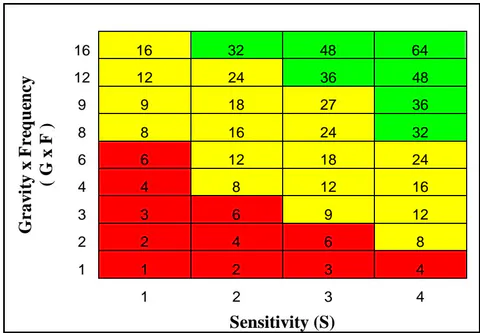
The assessment of environmental impacts is carried out by taking into account three factors (Table 2): «Gravity», «Frequency of occurrence» and «Sensitivity of the receiving environment» and it has 4 stages:
1. Intrinsic gravity assessment (G): This involves determining the severity of the environmental
impact. For this, it is important to define beforehand the criteria that will be taken into account in order to carry out this evaluation. Criteria such as: toxicity of products, amount of water or energy consumed... what helps to determine the order of magnitude of impacts, either critical, major, limited or minor;
Frequency of occurrence assessment (F): this involves determining the frequency of occurrence of the Environmental Impact;
The evaluation of the Sensitivity (S): the sensitivity of the receiving medium is also determined by characterizing the receiving medium (floor tightness for example);
Table 2: Environmental Impact Assessment
| Score/Criterion | Gravity (G) | Frequency (F) | Sensitivity (S) |
| 1 | Irreversible damage to living beings (humans, fauna and flora) whether they are internal or external to the organism (critical) | Permanent | Critical |
| 2 | Irreversible damage to the environment (major) | Frequent | Important |
| 3 | Reversible harm to environment (limited) | occasional | Limited |
| 4 | Gene for staff (minor) | Rare | Low |
- Determining the criticality of the environmental impact: Taking into account the previous criteria. This score is obtained by multiplying the elementary scores for each criterion:
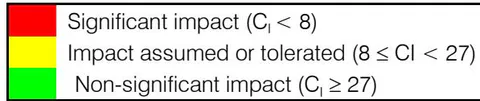
The Table 3 below represents the criticality matrix and determines the significance of the environmental impact:
ii. Assessment of Significant Environmental Aspects:
This part consists of 3 steps, this is to identify 2 other criteria related to the identified environmental aspects:
- Study of regulatory compliance (C): any aspect not satisfying regulatory constraints and necessarily significant
| 0 | Non-compliant |
| 1 | Compliant or non-regulatory |
- Environmental Control Level Assessment (M): Control level is technical, human and organizational. The evaluation must take in to account the principles of prevention
| 1 | Non-existent |
| 2 | Low |
| 3 | Good |
| 4 | maximum |
3. Determination of the criticality of the environmental aspect:
| C_A = C_1 × C × M |
The Table 4 represents the criticality matrix and determines the significance of the environmental aspect:
| Gravity x Frequency x Sensitivity (G x F x S) | 64 | 0 | 64 | 128 | 192 | 256 |
| 48 | 0 | 48 | 96 | 144 | 192 | |
| 36 | 0 | 36 | 72 | 108 | 144 | |
| 32 | 0 | 32 | 64 | 96 | 128 | |
| 27 | 0 | 27 | 54 | 81 | 108 | |
| 18 | 0 | 18 | 36 | 54 | 72 | |
| 16 | 0 | 16 | 32 | 48 | 64 | |
| 12 | 0 | 12 | 24 | 36 | 48 | |
| 9 | 0 | 9 | 18 | 27 | 36 | |
| 8 | 0 | 8 | 16 | 24 | 32 | |
| 4 | 0 | 4 | 8 | 12 | 16 | |
| 3 | 0 | 3 | 6 | 9 | 12 | |
| 2 | 0 | 2 | 4 | 6 | 8 | |
| 1 | 0 | 1 | 2 | 3 | 4 | |
| 0 | 1 | 2 | 3 | 4 | ||
| Conformity x Proficiency (C x P) | ||||||
| Significant Aspect (CA<16) |
| Assumed or tolerated aspect (16≤CI<81) |
| Non-Significant Aspect (CA≥81) |
III. CONCLUSION
The ISO 14001 standard is the most suitable and appropriate environmental management system for its application, given its commitments and its proactive aspect that does not require an environmental declaration.
In practice, there is a wide variety of methodologies that make it possible to achieve the environmental objective, some of which are limited to a purely formal approach, while others integrate consultation or worker participation.
The methodology proposed in this work allows an improvement of environmental performance in order to achieve a clearly defined goal, the management and protection of the environment in which the activities take place.