Issues, Challenges and Prospects of Female Education in Nigeria: Implications for Sports Administration in Schools

§ Department of Human Kinetics & Health Education Facu...
‡ Department of Educational Management & Policy Facult...

Send Message

To: Author

Issues, Challenges and Prospects of Female Education in Nigeria: Implications for Sports Administration in Schools

Article Fingerprint

ReserarchID

107J1

Issues, Challenges and Prospects of Female Education in Nigeria: Implications for Sports Administration in Schools Banner

Key Research Insights

Synthesized scholarly intelligence & interactive research assistant
  • English
  • Afrikaans
  • Albanian
  • Amharic
  • Arabic
  • Armenian
  • Azerbaijani
  • Basque
  • Belarusian
  • Bengali
  • Bosnian
  • Bulgarian
  • Catalan
  • Cebuano
  • Chichewa
  • Chinese (Simplified)
  • Chinese (Traditional)
  • Corsican
  • Croatian
  • Czech
  • Danish
  • Dutch
  • Esperanto
  • Estonian
  • Filipino
  • Finnish
  • French
  • Frisian
  • Galician
  • Georgian
  • German
  • Greek
  • Gujarati
  • Haitian Creole
  • Hausa
  • Hawaiian
  • Hebrew
  • Hindi
  • Hmong
  • Hungarian
  • Icelandic
  • Igbo
  • Indonesian
  • Irish
  • Italian
  • Japanese
  • Javanese
  • Kannada
  • Kazakh
  • Khmer
  • Korean
  • Kurdish (Kurmanji)
  • Kyrgyz
  • Lao
  • Latin
  • Latvian
  • Lithuanian
  • Luxembourgish
  • Macedonian
  • Malagasy
  • Malay
  • Malayalam
  • Maltese
  • Maori
  • Marathi
  • Mongolian
  • Myanmar (Burmese)
  • Nepali
  • Norwegian
  • Pashto
  • Persian
  • Polish
  • Portuguese
  • Punjabi
  • Romanian
  • Russian
  • Samoan
  • Scots Gaelic
  • Serbian
  • Sesotho
  • Shona
  • Sindhi
  • Sinhala
  • Slovak
  • Slovenian
  • Somali
  • Spanish
  • Sundanese
  • Swahili
  • Swedish
  • Tajik
  • Tamil
  • Telugu
  • Thai
  • Turkish
  • Ukrainian
  • Urdu
  • Uzbek
  • Vietnamese
  • Welsh
  • Xhosa
  • Yiddish
  • Yoruba
  • Zulu
Reading Preferences
Font Size
Line Spacing
Background
This converted HTML version may contain rendering inconsistencies. Please refer to the PDF for the authoritative version, or click here to provide feedback.

Abstract

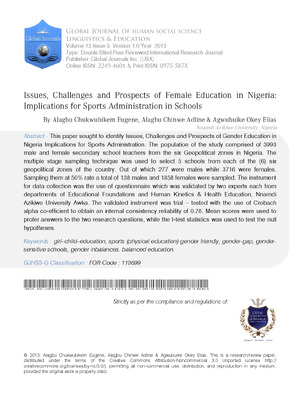
This paper sought to identify Issues, Challenges and Prospects of Gender Education in Nigeria Implications for Sports Administration. The population of the study comprised of 3993 male and female secondary school teachers from the six Geopolitical zones in Nigeria. The multiple stage sampling technique was used to select 5 schools from each of the (6) six geopolitical zones of the country. Out of which 277 were males while 3716 were females. Sampling them at 50% rate a total of 138 males and 1858 females were sampled. The instrument for data collection was the use of questionnaire which was validated by two experts each from departments of Educational Foundations and Human Kinetics & Health Education, Nnamdi Azikiwe University Awka. The validated instrument was trial – tested with the use of Crobach alpha co-efficient to obtain an internal consistency reliability of 0.78. Mean scores were used to profer answers to the two research questions, while the t-test statistics was used to test the null hypotheses. The research findings revealed that the educated women are more aware of the value of sports (physical education) in gender education. Furthermore the study revealed absence of gender sports sensitive schools environment; persistent gender discrimination at the home and community levels. Recommendations were made.

References

18 Cites in Article
  1. 1. F. Adeyeye (2008). Sports Development in Nigeria: The place and Role of Sports psychology. Journal of Sports psychology Association of Nigeria, 15-18.
  2. 2. C. Alagbu (1999). Factors Affecting Perception and Attitude of Parents Towards their female offsprings participation in competitive Sports in selected federal Government Girls Colleges in Nigeria (Ph.D Thesis Unpublished) University of Ibadan Nigeria.
  3. 3. C. Alagbu (2010). Connecting Tertiary Education Sports Programme to Society. Proceedings of the conference of Nigeria. Association of physical, 134.
  4. 4. J. Awoyinfa (2005). Leadership effectiveness and job performance of personnel in both public and private orientated sports organization in Lagos.
  5. 5. M. Bello,B. OI; Ogunsanwo,F. Okoro (2011). Bello, M.OI; Ogunsanwo, B.A. 7 Okoro, F.I. sports as a tool for controlling HIV/AIDS among students of tertiary institutions in IJEBU Area of Ogun State Nigeria. Journal of Nigerian University Games Association (JNUGA, 3(1)
  6. 6. B. Ezegbe (2001). Universal Basic Education (UBE).
  7. 7. Programmes in Nigeria: Implications on Women Education for National Development Studies in Gender Discrimination in the 21st Century.
  8. 8. Federal Nigeria (2000). National Policy on Education (4th Edition.
  9. 9. Federal Nigeria (2005). Millenium Development Goals Abuja: The National Planning Commission Abuja.
  10. 10. Federal Nigeria (2006). Millenium Development Goals, Abuja. The National Planning Commission Abuja
  11. 11. P. Ikulago (2009). Understanding Sports Psychology.
  12. 12. S. Ikwumelu (1991). National Development in Nigeria: A Humano-centric Approach. A journal of Social Issues, 1(1), 91.
  13. 13. C. Nwagwu (1995). A comparative Analysis of Women.
  14. 14. Participation in formal Education in Anglophone and francophone West African Countries. The Nigerian Academy of Nigeria, 65-76.
  15. 15. F. Ozigboh (1998). Women’s Education in Nigeria: Issues and Problems. International Journal in the humanities (IJOSH, 1, 66-73.
  16. 16. J. Semidara (2008). The use of mental Imagery: A Psychological construct for preparing Athletes for Performance Enhancement in Major National and International Competitions. Journal of Sports, 19-26.
  17. 17. M. Synder (1990). Women: The key to Ending Hunger: The Global Hunger Project. Hunger
  18. 18. UNESCO (2002). Education for all (EFA) Monitoring Report. Education for all (EFA) Monitoring Report

Funding

No external funding was declared for this work.

Conflict of Interest

The authors declare no conflict of interest.

Ethical Approval

No ethics committee approval was required for this article type.

Data Availability

Not applicable for this article.

How to Cite This Article

Chukwubikem Alagbu, Chinwe Adline Alagbu, Okey Elias Agwubuike. . "Issues, Challenges and Prospects of Female Education in Nigeria: Implications for Sports Administration in Schools". Global Journal of Human-Social Science - G: Linguistics & Education GJHSS-G Volume 13 (GJHSS Volume 13 Issue 14 (G5)).

More Citation Formats

Download Citation

Journal Specifications

Crossref Journal DOI 10.17406/GJHSS

Print ISSN 0975-587X

e-ISSN 2249-460X

Keywords
Classification
GJHSS-G Classification FOR Code: 110699
Version of record

v1.2

Issue date
April 5, 2013

Language
English
Order Article Reprint
Experience in AR

Explore published articles in an immersive Augmented Reality environment. Our platform converts research papers into interactive 3D books, allowing readers to view and interact with content using AR and VR compatible devices.

Read in 3D

Your published article is automatically converted into a realistic 3D book. Flip through pages and read research papers in a more engaging and interactive format.

Article Matrices
Total Views: 4.1K
Total Downloads: 172
All Trends

Request Access

Please fill out the form below to request access to this research paper. Your request will be reviewed by the editorial or author team.
X

This is the heading

Lorem ipsum dolor sit amet, consectetur adipiscing elit. Ut elit tellus, luctus nec ullamcorper mattis, pulvinar dapibus leo.


High-quality academic research articles on global topics and journals.

Issues, Challenges and Prospects of Female Education in Nigeria: Implications for Sports Administration in Schools

Chukwubikem Alagbu
Chukwubikem Alagbu
Chinwe Alagbu
Chinwe Alagbu
Okey Agwubuike
Okey Agwubuike