This study explores how Jammu and Kashmir’s terrain has changed since Article 370 was repealed and provides a thorough comparative analysis of the socio-political and economic aspects of the area. The goal of the study is to offer important insights into the ramifications of this historic event by examining the complex developments that have occurred since the constitutional amendment. A thorough analysis of the pre-and post-Article 370 abrogation periods is included in the comparative overview. Using a multidisciplinary approach, the study incorporates information from a range of sources, including government documents and scholarly literature. By utilizing a variety of research approaches, the study aims to provide a comprehensive picture of the changes in Jammu and Kashmir.
## I. INTRODUCTION
The Jammu and Kashmir is location in the northern part of India. The union territory Jammu and Kashmir becomes disputes between the two nations India and Pakistan from the partition of the two nations in year 1947. Jammu and Kashmir, formerly one of the largest princely states of India, us bounded to the east by UT of ladakh, to the south by Indian states of Himachal Pradesh and Punjab, to the southwest by Pakistan, and to the southwest by PAK (Pakistan administrated Kashmir). The total area of J&K 101,387 square km. population is 12,367,013.
The long-running and intricate dispute over Kashmir involves both India and Pakistan competing for control of the area and India's struggles with the Jammu and Kashmiri population living there. With its complex effects on millions of people, this protracted struggle has political, social, economic, and cultural facets (Bhat, 2019).
The union territory Jammu and Kashmir was a state of India till $05^{\text{th}}$ august 2019. On $05^{\text{th}}$ august 2019 Jammu and Kashmir was declared union territory of India. The article 370 and 35A in Jammu and Kashmir was abolished by Supreme Court of India, which was giving special status to the people of Jammu and Kashmir. Soon after the abrogation of article 370 in J&K, people start protesting against the decision by the court which results curfews and strikes in the UT. All the communication and internet services were snapped in whole Jammu and Kashmir. All the business and educational institution remains closed for long months, which impacts badly on the economy of Jammu and Kashmir (Nadaf, 2023; Imtiyaz, Sumira, 2021).
A provision known as Article 370 of the Indian Constitution gave the state of Jammu and Kashmir temporary special autonomy. It gave Jammu and Kashmir a special standing inside the Indian Union when it was added to the Constitution in 1949. The princely state of Jammu and Kashmir's 1947 admission to India is the foundation of Article 370's history. The princely state of Jammu and Kashmir became a part of India when its ruler, Maharaja Hari Singh, signed the Instrument of Accession in October 1947. This made it possible for the Indian government to support Pakistan-backed tribal forces in their attempt to repel an invasion. The state would maintain autonomy in all areas with the exception of defense, foreign policy, finance, and communications, according to the Instrument of Accession (Schofield, 2021; Noorani, 2014).
In 1949, the Indian Constitution was amended to include Article 370, which established unique protections for Jammu and Kashmir. The state was given a great deal of autonomy and permission to adopt its own constitution. Jammu and Kashmir's unique identity was cemented in 1957 when it ratified its own constitution. The state held exclusive rights over land and property, its own flag, and sovereignty over a number of issues. It could also designate who was a permanent resident. Several presidential decrees have been issued over the years to include Jammu and Kashmir in the ambit of Indian law. Nonetheless, the state maintained its unique status and its citizens were subject to different laws (Schofield, 2021; Noorani, 2014).
Despite the special status, there were amendments and modifications to Article 370 over the years. The autonomy enjoyed by Jammu and Kashmir was gradually eroded, and the state's relationship with the Indian Union became less distinct. On August 5, 2019, the Indian government, led by Prime Minister Narendra Modi, abrogated Article 370 and revoked the special status of Jammu and Kashmir.
Jammu and Kashmir is famous for its tourist destinations. It has both summer and winter tourist destinations. Tourism is great source of income for the J&K. People from all over the world come in Jammu and
Kashmir for snow skiing and other winter sports. Unfortunately the curfews and strikes become barriers for tourists to visit and the number of tourists arriving was very low. The total number of tourists arriving in Kashmir for tourism declines very low soon after the abrogation of article 370, but after the two of years the numbers of tourists increases at very high rate which was highest from last seventy years. This accelerates the income for Jammu and Kashmir.
This comparative study examines the significant changes that have occurred in Jammu and Kashmir since Article 370 of the Indian Constitution was revoked. The revocation of the state's special status has resulted in significant changes to the political landscape, socioeconomic structures, and governance. The study explores the newly amended legislation, the division of the area into union territories, and the effects of these changes on the quality of life for the local population. The goal of the study is to shed light on the complex consequences of this significant constitutional amendment, including both the intended and unintended effects, by comparing the circumstances before to and following the amendment.
## II. BEFORE ABROGATION OF ARTICLE 370
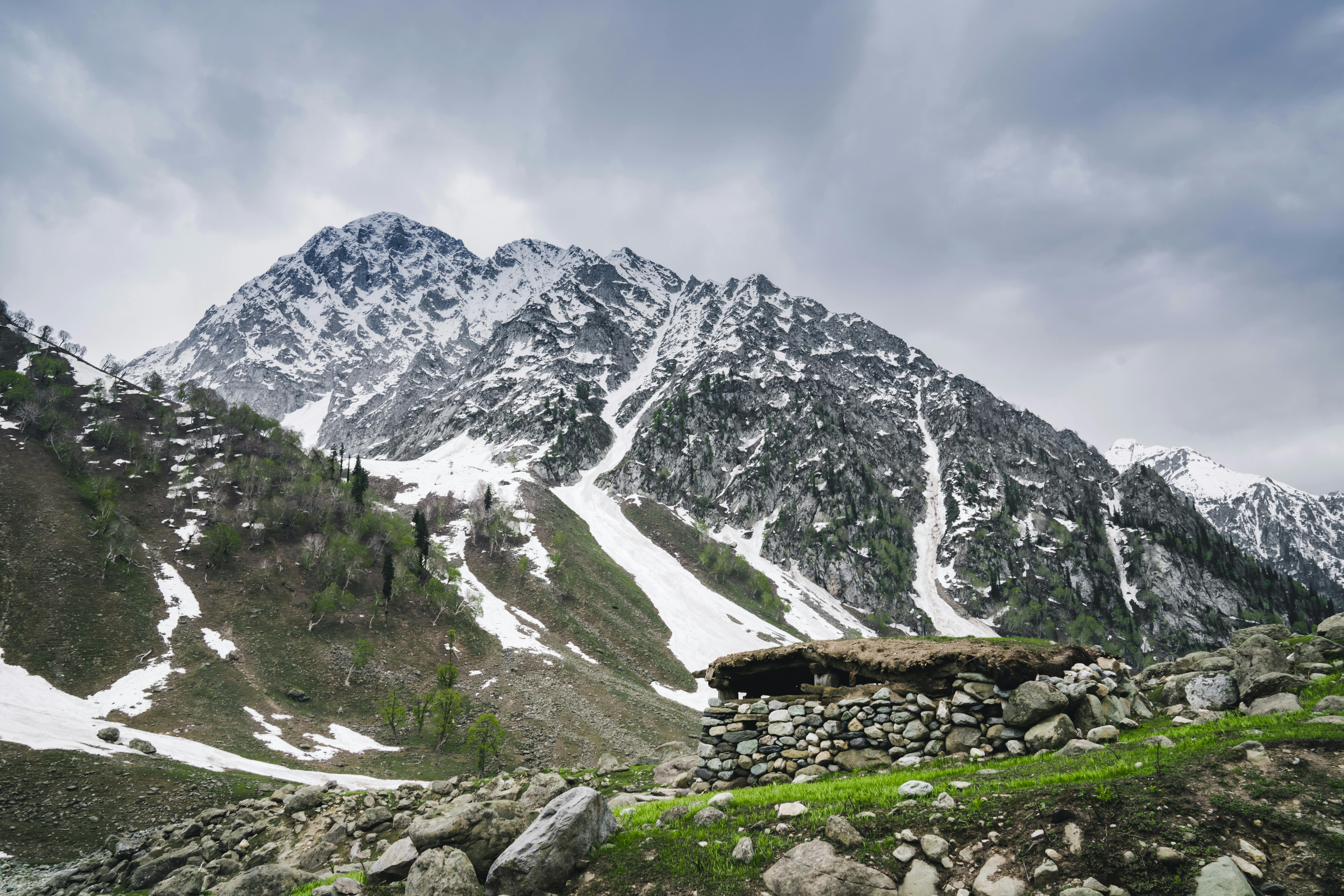
The UT of Jammu and Kashmir is famous for various tourist destinations. Jammu and Kashmir is located in northern India, covered with huge mountains which make it more beautiful and attractive. People from all India and other parts of world comes here as a tourists to enjoy its natural beauty and winter sports.
Other from its huge mountains and scenic beauty. Jammu and Kashmir witnesses hundreds of shutdowns from 2012 to 2019. One of the major causes of increasing these shutdowns and strikes were increases the militancy in Jammu and Kashmir. Burhan wani one of the famous militant known as poster of boy of Kashmir uses internet as a medium to boost militancy in Jammu and Kashmir. He was using social media as a medium to upload images and videos of militants with weapons roaming in Kashmir valley. When India army neutralized these militants in encounters people start protesting against army in order to make escape for militants which results huge conflicts in Jammu and Kashmir (Qadir and Dar, 2021). These encounters and strikes become common for many years till government neutralized maximum number of militants in Kashmir. The government of Jammu and Kashmir imposes curfews then soon after the encounter starts in order to stop people for protesting against the armed forces. This type of situation remains same till 2019. During this period of time from 2012 to 2019, stone pelting, encounters, curfews, internet shutdowns was common in Kashmir valley. The internet had suspended for hundreds of times and hundreds of young youth had lost their life by these stone pelting and encounters.
The various things in Jammu and Kashmir before abrogation of article 370 are as:
1. Curfews and lockdown
2. Internet suspension
3. Stone pelting and encounters
4. Economical losses
### Curfews and lockdown
Jammu and Kashmir witnesses the highest number curfews and lockdowns in India. The main behind these lockdowns and curfews was political unsuitability. The local political parties on Jammu and Kashmir were issuing calendars of curfews to be imposed in J&K. On the other side Hurriyat party (banned now) was issuing calendars for lockdowns for the people in order to make protests against the government. From the above both sides' common people are facing various problems in their day to day life. In these curfews and lockdowns the market, transportation, businesses, educational institutions remains closed which directly impacts on the social and economical situations of common people living in Jammu and Kashmir.
#### Internet suspension
Internet is one of the most and efficient technology of modern technologies. Today internet is used in every field. Internet inter-connects millions of people around the world. Today suspension of internet means disconnects from world. In the present where internet is essential for everything like business, education, communication, entertainment, research and development, on the other side Jammu and Kashmir witnesses hundreds of internet shutdowns from past 10 years. A total of 427 internet shutdowns are recorded in Jammu and Kashmir from year 2012 to 2023, in which the longest internet shutdown was for 552 days imposed on $5^{\text{th}}$ August 2019 soon after the abrogation of article 370 there. During this long internet suspension period only 2G had restored after 06 months in some areas and complete restoration was after 552 days. This was one the longest internet shutdown in the world (Mukhopadhyay et al., 2020).
In the year 2012 a total of 03 (2012-03) internet shutdowns recorded in Jammu and Kashmir, 2013-05, 2014-05, 2015-05, 2016-10, 2017-32, 2018-65, 2019-55, 2020-116, 2021-79, 2022-43, 2023-09 recorded. Shutdown of internet impacts badly on business and education. During the COVID19 when all educational institution and business remains closed for long months, internet was the only source for students to learn and various companies starts work from home (WFH. But unfortunate internet was suspended in Jammu and Kashmir in that crucial time, which impacts badly on the education of the students and make thousands jobless because of these internet shutdowns by the government (Qadir and Jaggarwal, 2021).
#### Stone pelting and encounters
Jammu and Kashmir was always in news in India from past thirty years regarding encounters. These encounters broke out between militants and armed force for the cause to separate J&K from India. From year 2012 to 2019 these encounters becomes on regular basics due to rise of militancy in Jammu and Kashmir. When the news regarding these encounters comes on social media, people from various areas trying to come near encounter site and start stone pelting on army in order to brake encounter make escape for militants. These encounters and stone pelting takes the lives of hundreds of young people and injured thousands of people during this tough period in Kashmir. Hundreds of youth are still behind bars because of these incidents happened in Jammu and Kashmir. In year 2016 when poster boy burhan wani along with two associates was killed on $08^{\text{th}}$ July which lead stone pelting and strikes continues for 6 month and takes the lives of 90 youth in Kashmir region. This was one of the worst times in modern era which ruined life and carrier of thousands of young youth in Jammu and Kashmir.
#### Economical losses
Jammu and Kashmir is less developing UT of India. The main reason of this least development is local political instability and less industrial development. The main economy of J&K in dependent on tourism and agriculture. Due to continue strikes and lockdown from past ten years tourists are facing difficulties and feeling insecurity in visiting there which impacts badly on the economy of Jammu and Kashmir. On the other side continue strikes and curfews makes problems for farmers to send their products like apples, saffron, almonds etc to outside the UT. As per the different estimates used in the study, the total duration of shutdowns in India between 2012 and 2017 remains 16,315 hours (680 days), which has generated an economic loss of approximately $3.04 million (Rydzak, 2019).
## III. AFTER ABROGATION OF ARTICLE 370
It's essential to consider that the changes have sparked diverse reactions and opinions, both within India and on the international stage. While some see these developments as positive steps towards integration and development, others express concerns about the impact on regional autonomy, identity, and human rights. The situation continues to evolve, and the long-term effects of these changes in Jammu and Kashmir remain a subject of ongoing debate and scrutiny.
The various changes in Jammu and Kashmir after abrogation of article 370 are as:
1. Economical development
2. No more curfews and lockdowns
3. No internet shutdowns
4. Infrastructure development
5. Boosts tourism in Jammu and Kashmir
### Economical development
Economic development is the process by which low income; simple national economics are changed into sophisticated, industrialized economics. While the term is occasionally used interchangeably with economic growth, its primary meaning is a shift in a nation's economy that encompasses both qualitative and quantitative advancements.
After the abrogation of article 370 in Jammu and Kashmir, various changes are witnesses and Economic development is one of most important for the people. Arun Kumar Mehta, the chief secretary for J&K, states that the government's top priority is the UT's industrial development, which is predicted to provide a large amount of jobs over the next five years. "Jammu and Kashmir's goal is to achieve long-term industrial development and economic growth, and the government is steadfast in its commitment to helping business owners who wish to invest in the region and further\R its development,"
Prominent companies from all over the nation and overseas are eager to invest in the UT as J&K is already establishing itself as the most dynamic, rapidly expanding, and alluring investment destination. The Burj Khalif a builders ceremoniously broke ground on the first foreign direct investment in the UT, a shopping center and multipurpose tower on the outskirts of Srinagar, earlier this year in March, marking their official arrival into J&K.
It is imperative to acknowledge that the process of economic growth in Jammu and Kashmir is intricate and continuous. The area's social dynamics, political climate, and historical background all add to the difficulty of putting development plans into action and keeping them going. Analysis and criticism of these policies' efficacy as well as their implications for Jammu and Kashmir's long-term economic growth are certain to continue. Examine Figure 1, indicating a rise in the growth rate post the abrogation of Article 370, as per the Jammu and Kashmir Economic Survey of 2023. Initially, there is a decline in the growth rate coinciding with the commencement of Article 370's abrogation, a period marked by heightened tension and numerous lockdowns in the Jammu and Kashmir region.
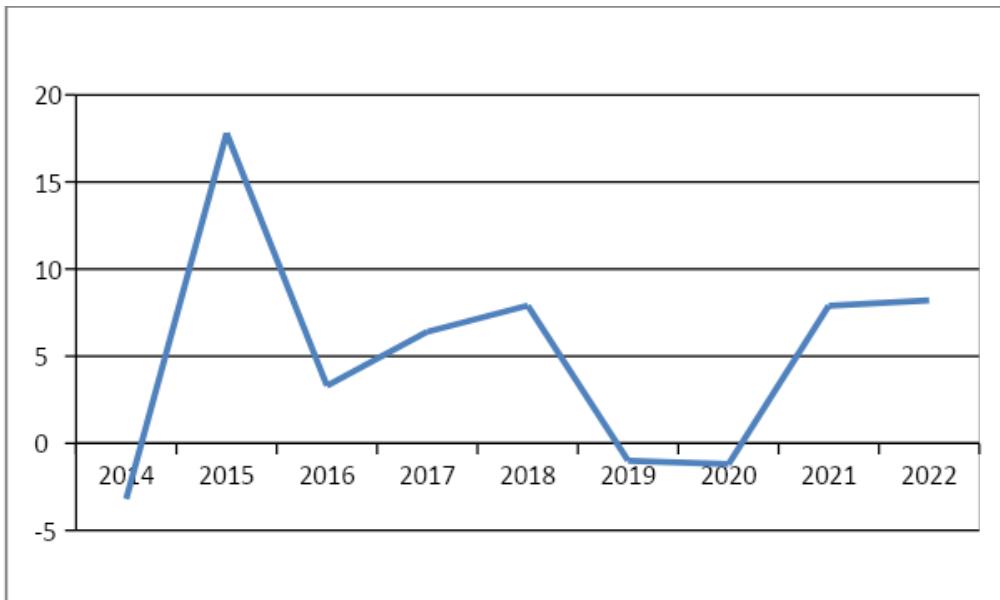
Figure 1: Economic Growth
Source: J&K Economic survey 2023. Created with datawrapper
#### No more curfews and lockdowns
Jammu and Kashmir was very known by its situations like curfews and lockdowns from last decades. Jammu and Kashmir is the only region in India with highest number of lockdowns. These lockdowns and curfews ends with the abrogation of article 370 in year 2019. Before the abrogation of article 370 almost every month the market remains closed multiple times, which impacts common people living in the region. Almost $0\%$ lockdowns are recorded from past two years in the Jammu and Kashmir. Abrogation of article 370 brings a major change in the situations of Kashmir.
#### No internet shutdowns
Internet is one of most modern and efficient technology in the present world. Internet is associated
with every aspect of human life. Weather its business, education, R&D or entertainment, internet shows it presence. The suspension of internet services was common in Jammu and Kashmir. Every year internet was snapped for hundreds times in there. Jammu and Kashmir witnesses the longest internet shutdown in the world which remains for 552 days. From last two years a major change has been seen in Jammu and Kashmir related to internet services. No major internet shutdown has been recorded there from past couple of years as shown in Table 1. In some incidents still minor internet shutdowns are recorded there but not effects so much as earlier was recorded.
Table 1: Total number of internet shutdowns in Jammu and Kashmir and India.
<table><tr><td>Year</td><td>Total number of internet shutdowns in India</td><td>Total number of internet shutdowns in Jammu and Kashmir</td></tr><tr><td>2012</td><td>03</td><td>03</td></tr><tr><td>2013</td><td>05</td><td>05</td></tr><tr><td>2014</td><td>06</td><td>05</td></tr><tr><td>2015</td><td>14</td><td>05</td></tr><tr><td>2016</td><td>31</td><td>10</td></tr><tr><td>2017</td><td>79</td><td>32</td></tr><tr><td>2018</td><td>134</td><td>65</td></tr><tr><td>2019</td><td>106</td><td>55</td></tr><tr><td>2020</td><td>129</td><td>116</td></tr><tr><td>2021</td><td>100</td><td>79</td></tr><tr><td>2022</td><td>40</td><td>27</td></tr><tr><td>Total</td><td>647</td><td>402</td></tr></table>
#### Infrastructure development
In order to encourage economic growth and draw in international investment for productivity and
sustainable production, infrastructure development is seen as essential (Osei-Hwedie et al., 2017). The fundamental components of social and economic
transformation that support the economy's production operations are referred to as infrastructure. Among these components are the following:
1. Highways
2. Railways
3. The system of education, which comprises colleges and schools
4. The hospital and health system
5. Sanitary system with provisions for clean drinking water
6. The financial system, which consists of banks, insurers, and other businesses
After the abrogation of article 370 in Jammu and Kashmir, a major change is witnessed regarding infrastructure. The smart city project in Srinagar is one of major changes in heart of Srinagar Lal chowk, it attracts tourists and foreign investors. Education system and health are one of major components of a country. From
past couples of years these segments have witness's major changes towards growth and development. Apart from these departments are other are leading towards growth development which is beneficial for the welfare of people living in Jammu and Kashmir.
## IV. BOOSTS TOURISM IN JAMMU AND KASHMIR
Jammu and Kashmir is famous for its tourist destinations. Tourism is contributing a major portion in the economy of UT. After the abrogation of article 370 a major change has been visible in the tourism of Jammu and Kashmir. In the past the tourism department has been seen decline due to continue strikes and lockdowns in the UT. Soon after the normalcy post article 370 tourism in Jammu and Kashmir have shown good signs of improvement as shown below:
Table 2: Tourist visit during 2010 to 2014 are given below:
<table><tr><td>Former State of Jammu & Kashmir</td><td></td></tr><tr><td>Year</td><td>DTVs</td></tr><tr><td>2010</td><td>9973189</td></tr><tr><td>2011</td><td>13071531</td></tr><tr><td>2012</td><td>12427122</td></tr><tr><td>2013</td><td>10891424</td></tr><tr><td>2014</td><td>9438544</td></tr></table>
Table 3: Tourist visit during 2019 to 2022 are given below:
<table><tr><td>Union Territory of Jammu & Kashmir</td><td></td></tr><tr><td>Year</td><td>DTVs</td></tr><tr><td>2019</td><td>16163330</td></tr><tr><td>2020</td><td>2519524</td></tr><tr><td>2021</td><td>11314920</td></tr><tr><td>2022</td><td>18617740</td></tr></table>
It has been shown in Table 2 and Table 3, that the domestic tourists visit (DTV) in Jammu and Kashmir after abrogation of article 370 increases.
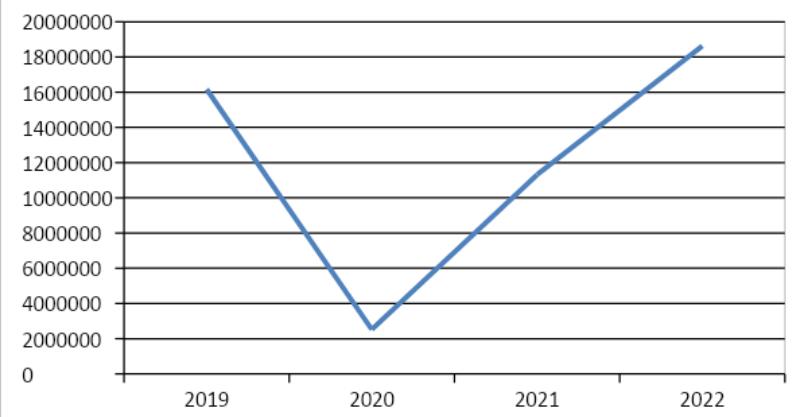
Figure 2: Domestic tourist visit
Until August 5, 2019, Jammu and Kashmir was a state in India, but it was then reorganized into a union territory. The Supreme Court of India abolished Article 370 and 35A in Jammu and Kashmir, which granted special status to its residents. Following the court's decision, there were widespread protests, leading to curfews and strikes in the newly formed union territory. However, after a year, the situation in the valley improved, and tourism resumed, as depicted in Figure 2.
## V. CONCLUSION
Jammu and Kashmir was a northern state of India till $04^{\text{th}}$ August 2019 and later declared UT (union territory). The state witnesses' huge number of lockdowns, curfews, internet shutdown and encounters due to local political instability till it was state of India. On $04^{\text{th}}$ august 2019 the government of India has declared Jammu and Kashmir as UT and article 370 has been abolished which was giving special status to the people of Jammu and Kashmir. Soon after the abrogation of article 370 a complete curfew was imposed by the government there in order to stop people from protesting against the major decision by the government. All the educational institution, transportation, industries, market remains closed for couples of months. The communication and internet services are also suspended there.
After a long period of time, the government controls the situation there and lifts curfews and lockdowns. After two years, major changes are witnessed in Jammu and Kashmir. No curfews or lockdowns are witnessed there, no major internet suspensions recorded. The major boost is witnessed in tourism of Jammu and Kashmir; a large number of tourists from India and other parts of the world are coming there to enjoy the natural beauty of Jammu and Kashmir, which boosts the economy of J&K. The government is taking possible steps towards growth and development which is beneficial for the common people. Jammu and Kashmir witnesses normal situations after decades.
Generating HTML Viewer...
References
10 Cites in Article
Sabzar Bhat (2019). The Kashmir conflict and human rights.
Arif Nadaf (2023). Discursive representation of the Article 370 abrogation: A comparative CDA of the headlines of two major Indian online news publications.
Victoria Schofield (2021). Kashmir in Conflict.
A Noorani (2014). Kashmir–Union Negotiations on Article 370.
S Imtiyaz (2021). Progress Made So Far: A Situation Analysis of Jammu and Kashmir Pre and Post Removal of Article 370.
S Qadir,A Dar (2021). How Internet Shutdowns Affects the Entrepreneurs in Jammu and Kashmir.
D Mukhopadhyay,A Gupta (2020). Jammu & Kashmir Internet Restrictions Cases: A Missed Opportunity to Redefine Fundamental Rights in the Digital Age.
Dr. Mehta,Garima Mukhija,Halak Mehta (2021). DETERMINANTS OF NUTRITION CONSCIOUSNESS OF YOUNG ADULTS ON FOOD DELIVERY APPS: A ANALYTICAL STUDY.
J Rydzak (2019). Of Blackouts and Bandhs: The Strategy and Structure of Disconnected Protest in India.
B Osei-Hwedie,N Kurantin (2017). The Impact of Infrastructure on Growth and Development: The Case of Ghana, 1986-2016.
No ethics committee approval was required for this article type.
Data Availability
Not applicable for this article.
How to Cite This Article
Shahid Qadir. 2026. \u201cJammu and Kashmir Post Article 370: A Comparative Overview of the Shifts\u201d. Global Journal of Human-Social Science - F: Political Science GJHSS-F Volume 24 (GJHSS Volume 24 Issue F2): .
Explore published articles in an immersive Augmented Reality environment. Our platform converts research papers into interactive 3D books, allowing readers to view and interact with content using AR and VR compatible devices.
Your published article is automatically converted into a realistic 3D book. Flip through pages and read research papers in a more engaging and interactive format.
This study explores how Jammu and Kashmir’s terrain has changed since Article 370 was repealed and provides a thorough comparative analysis of the socio-political and economic aspects of the area. The goal of the study is to offer important insights into the ramifications of this historic event by examining the complex developments that have occurred since the constitutional amendment. A thorough analysis of the pre-and post-Article 370 abrogation periods is included in the comparative overview. Using a multidisciplinary approach, the study incorporates information from a range of sources, including government documents and scholarly literature. By utilizing a variety of research approaches, the study aims to provide a comprehensive picture of the changes in Jammu and Kashmir.
Our website is actively being updated, and changes may occur frequently. Please clear your browser cache if needed. For feedback or error reporting, please email [email protected]
Thank you for connecting with us. We will respond to you shortly.