
I. INTRODUCTION
As the service economy grows exponentially, business employers and feeder organizations such as higher education have focused on employability. Analyzing the employers' employability assessment is critical to higher productivity and lower organizational turnover. Furthermore, the cost of high turnover and training new hires is significant in the service industry, particularly in the hospitality sector (Agovino, 2019). Shifting demographics, changing consumer expectations, and adopting new technologies will make many traditional approaches less effective and relevant in the future.
The turnover rate in the leisure and hospitality industries was as high as . The rate was in 2021 and in 2022. Compared to the average industry turnover rate of , it is considerably high (Hansen, (2023)), which also indicates that high turnover has negative consequences, such as lower team morale and damaged brand image. In addition, loss of organizational knowledge and cohesive culture negatively affect a firm's business performance (Robinson et al., 2014; Morrow & Mcelroy, 2007; Shen & Cannella, 2002). High employee turnover in the hospitality industry stems from a need to understand hospitality job strains better and the incongruence between job demand and employees' expectations (Park & Min, 2020). In particular, the reason behind such high employee turnover is related to proactive career behavior that can predict the employees' adaptability to careers and resilience against difficulties in the workplace (Nguyen et al., 2016; Hameed et al., 2020). In the hospitality industry, one of the critical challenges in recruiting is the job market competitiveness in recruiting highly skilled talents and retaining them (Ghani et al., 2022).
Employability is a set of skills and qualifications of a job applicant suitable for organizational job roles from a hiring decision-makers' perspective (Bollerot, 2001; Fugate et al., 2004). On the other hand, perceived employability is the perceived ability of a potential employee to obtain sustainable employment appropriate to one's qualifications (Rothwell et al., 2008; Wang et al., 2022). Thus, a clear understanding of employability is critical for employers, job seekers, and higher education institutions that educate and produce potential employees. Numerous studies have identified the antecedents of employability, which involve career motivation and proactive career behavior (Kuijpers et al., 2006; Vanhercke et al., 2014; Kim et al., 2015). However, the role of career motivation and proactive career behavior regarding employability should be clarified. Studies related to employability were mainly focused on perceived employability or a person's self-confidence about their future employment (Vanhercke et al., 2014). The criteria and the antecedents of perceived employability were tested mostly on potential job applicants (Caballero et al., 2021; Donald et al., 2019; Ho et al., 2022).
Therefore, more research needs to be reported on how perceived employability is related to 'actual' employability by hiring managers' decision-making. This study examines how perceived employability relates to actual employability in the hospitality industry. In particular, this study focuses on the relationship between perceived employability and actual employability concerning career motivation and proactive career behavior. Specific research questions for the study are:
How is perceived employability related to actual employability in the hospitality industry?
Can perceived employability be predicted by career motivation and proactive career behavior?
What is the relationship between career motivation and proactive career behavior?
Firstly, the study examines career insight, career identity, and career resilience as the components of career motivation that influence proactive career behavior. Secondly, we look into the impact of career motivation on perceived employability. Thirdly, the relationship between proactive career behavior and perceived employability is analyzed. Fourthly, the mediation effect of proactive career behavior on the relationship between career motivation and perceived employability is tested. Finally, following the quantitative analysis, a qualitative study based on in-depth interviews with the hiring managers examines the relationship between perceived employability and actual employability.
The following table shows the abbreviations used in the paper.
| Abbreviation | Variable Name |
| CM | Career Motivation |
| CID | Career Identity |
| CIN | Career Insight |
| CRE | Career Resilience |
| PCB | Proactive Career Behavior |
| PE | Perceived Employability |
| E | Employability |
II. LITERATURE REVIEW
a) Career Motivation
Career motivation is an individual's traits of career identity, insight, and resilience toward career decisions (London, 1983; London & Noe, 1997; Opsata, 2020). Career identity is the degree to which people perceive their career as their identity. Career insight is the recognized motivation that makes people set up career goals and plans based on practical career-related information. Career resilience is an adaptation to various career situations regardless of obstacles.
Specifically, career identity is how individuals identify with their main career field. People with high career identity have a strong sense of the job associated with career development. Career insight is the ability to view current and future career opportunities and set career goals while having self-knowledge of one's strengths and weaknesses. Individuals with high career insight are willing to gather career-related information, explore opportunities, and develop obtainable career goals and plans to follow through. Career resilience refers to adapting to changing employment and business circumstances, even in unfavorable or obstructive situations (Kodama, 2017). Individuals with career resilience are self-confident to challenge new tasks or jobs and adapt to new work environments. They tend to develop their careers through acquiring new knowledge and skills (Mishra & McDonald, 2017). Career resilience can alleviate job adversity in changing work circumstances (Howard, 2008; Youssef & Luthans, 2007; Goethals, 2005). Career motivation influences an organization's affective commitment and job satisfaction (Alniacik et al., 2012; Wang et al., 2020).
b) Proactive Career Behavior
Proactive career behavior is an individual's approach to career management, such as career design and career-planning strategies (Verbruggen et al., 2007; Abele & Wiese, 2008). Proactive career behavior involves planning and executing career activities based on career goals (Broeck et al., 2016). It includes self-driven career development, such as practical activities to improve work competencies to uphold possible employment (Sturges et al., 2002). Proactive career behavior includes career management, skill development, and networking (Parker & Liao, 2016). Career management involves an insight into building up career goals and planning how to accomplish them. Skill development refers to the efforts to acquire knowledge and skills for career management. Networking is getting information and feedback for up-to-date information and planning strategies to accomplish career goals.
Organizational members with proactive career behavior show high job satisfaction (Hall et al., 2004). The individuals who developed their careers through networking show high performance, such as promotion and compensation, and higher subjective career success (Van Emmerik et al., 2006; Forret & Dougherty, 2004). Proactive career behavior is a significant aspect of the hospitality industry job since it can predict employees' adaptability to careers (Hameed et al., 2020) and resilience toward difficulties in the workplace (Nguyen et al., 2016). It also can lower turnover and increase career satisfaction (Chan & Mai, 2015).
c) Perceived Employability
Perceived employability indicates a person's perceived possibility of future employment by identifying career opportunities (Vanhercke et al., 2014).
Furthermore, it includes accepting transitioning to a new career if career circumstances change (Berntson & Marklund, 2007). Job seekers perceive employability based on the subjective appraisal of compatibility between employment conditions, knowledge, and skills (Ngo et al., 2017). Perceived employability is developed by confidence in their knowledge and skills, job opportunities, and adaptation capabilities toward their work environment. For college students, perceived employability is their belief of how likely they will be successful in the job market (Pitan & Muller, 2020). Students' perceived employability typically increases through classroom learning and utilizing the campus career development center (Tomlinson, 2017; Bridgstock et al., 2019). In addition, human capital can also help students enhance perceived employability (Caballero et al., 2021; Donald et al., 2019; Ho et al., 2022). Human capital consists of academic knowledge and skills for career, social networking for occupation, and cultural understanding.
III. MEDICATION EFFECT AND HYPOTHESIS DEVELOPMENT
a) Career Motivation and Proactive Career Behavior
Proactive behavior is an individual trait like proactive personality, personal initiative, and self-efficacy (Crant, 2000). Career motivation includes self-confidence, career goals, and positive affect, significantly influencing proactive career behavior (Hirschi et al., 2013). Career motivation includes self-confidence, career goals, and positive affect and significantly influences proactive career behavior (Hirschi et al., 2013). Creed et al. (2017) reported that goal-oriented individuals experience less stress because they encourage themselves to confront discrepancies between their current situation and career goals. Career insight is relevant to career goal setting and will likely precede the subjects' proactive career behavior (Clements & Kamau, 2018). Hu et al. (2016) reported that subjects with high career resilience are likely to have consistent, proactive career attitudes, although they may experience career-related adversity. Their fundamental principles guiding their career aspirations bolster their resilience amidst adversity and obstacles. According to Creed et al. (2017), subjects with high career goal commitment maintain their goals even if they experience challenges in employment, which is related to career resilience. In addition, proactive career behavior can be enhanced by a clear self-image of future work, (Strauss et al., 2012; Taber & Blankemeyer, 2015).
Based on the above arguments, the following hypotheses are developed:
Hypothesis 1: Career motivation significantly impacts proactive career behavior.
- H1-1: Career identity makes a significantly positive impact on proactive career behavior.
- H1-2: Career insight makes a significantly positive impact on proactive career behavior.
- H1-3: Career resilience makes a significantly positive impact on proactive career behavior.
b) Career Motivation and Perceived Employability
According to Ngoma & Ntale (2016), career identity is a positive antecedent of perceived employability: The subjects with higher career identity encounter more opportunities and challenges for job competency. These experiences make them feel more confident about future employment. Career Insight, which facilitates planning how to accomplish individuals' career goals, involves career development learning, and this helps them improve employability (Bridgstock et al., 2019; Ho et al., 2022). Career insight consists of career activity planning for goal accomplishment and career development efforts like learning new skills (Bridgstock et al., 2019; Ho et al., 2022). Career insight facilitates individuals' initiatives to take internships, attend career fairs, and build career networks. It also helps them understand employment trends, which can increase their confidence about future employment. Career resilience helps individuals accept career-related difficulties (Abukhait et al., 2020). They will not quickly abandon their career goals even if they confront adversities in the job market and are likely to continue to develop job competencies that could lead to employability. Based on these arguments, the following hypotheses are developed:
Hypothesis 2: Career motivation makes a significantly positive impact on perceived employability.
- H2-1: Career insight makes a significantly positive impact on perceived employability.
- H2-2: Career identity makes a significantly positive impact on perceived employability.
- H2-3: Career resilience makes a significantly positive impact on perceived employability.
c) Proactive Career Behavior and Perceived Employability
Perceived employability is enhanced by individual readiness for employment based on one's qualifications. For example, university students' skill development and network building for careers significantly impact their perceived future employability (Clements & Kamau, 2018). Furthermore, university students' proactive learning, career development, and communication skills significantly impacted perceived employability (Park et al., 2020). It shows that individuals proactively preparing for their careers have positive confidence in their future employability. A hypothesis for the relationship between proactive career behavior and perceived employability is developed as follows:
Hypothesis 3: Proactive career behavior significantly and positively impacts perceived employability.
d) Mediation Effects of Proactive Career Behavior
According to Crant (2000), proactive individuals can create a positive environment for their career performance. Job seekers' motivations, such as self-confidence, career goals, and positive affect, influence proactive career behavior (Hirschi et al., 2013). Creed et al. (2017) state that goal-oriented individuals encourage themselves to engage in proactive behavior and experience less distress when confronting the discrepancy between their current situation and career.
Barnett and Bradley (2007) report that proactive career behavior mediates the relationship between organizational support and career success. Ling et al. (2017) show that proactive career behavior mediates the relationship between work-life quality and subjective career success. In addition, proactive career behavior mediates the relationship between career management and career satisfaction (Ismail et al., 2016).
Previous studies show that proactive career behavior enhances the impact of positive perception on internal and external circumstances of an individual's career outcome. Therefore, proactive career behavior will likely mediate the relationship between career motivation and perceived employability. Based on this argument, the following hypotheses are developed:
Hypothesis 4: Proactive career behavior mediates the relationship between career motivation and perceived employability.
H4-1: Proactive career behavior mediates the relationship between career identity and perceived employability.
H4-2: Proactive career behavior mediates the relationship between career insight and perceived employability.
H4-3: Proactive career behavior mediates the relationship between career resilience and perceived employability.
e) Qualitative Data Analysis
The following hypothesis intends to explore any potential gap in the career motivation of perceived employability mediated through proactive career behavior. We examine the relationship between perceived employability and actual employability. We conducted in-depth interviews to analyze the relationship between the perceived employability of the job candidates reviewed in the above quantitative hypotheses and employers' hiring decision-making. The hypothesis is developed as follows:
Hypothesis 5: There is no difference between perceived employability and employability.
IV. RESEARCH METHODOLOGY
a) Model
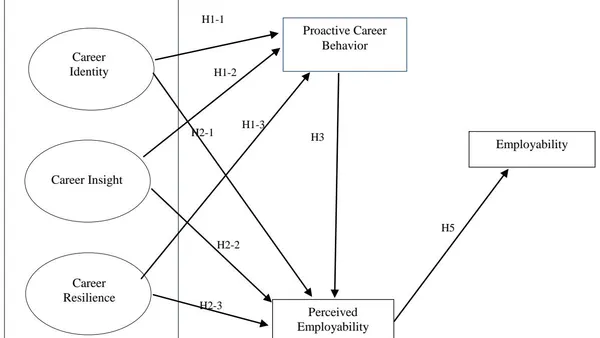
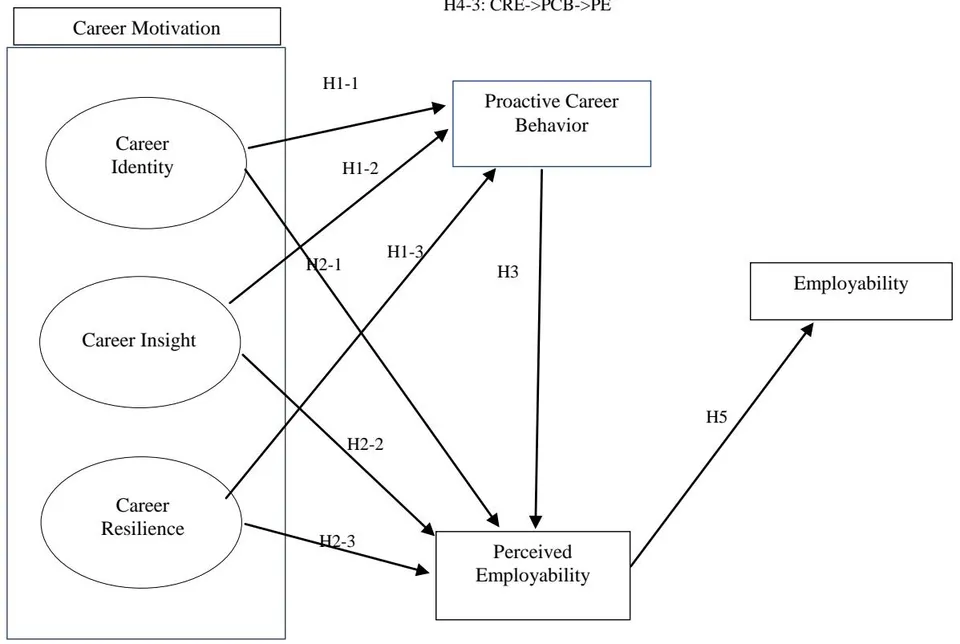
Based on the propositions, we developed a conceptual model to describe the impact of career identity, career insight, and career resilience on perceived employability mediated through proactive career behavior, as shown in Figure 1.
Mediation Effect
H4-1: CID->PCB->PE
H4-2: CIN->PCB->PE
H4-3: CRE->PCB->PE
b) Instruments
Career motivation is an individual's motivation toward their career and consists of career identity, career insight, and career resilience (Noe et al., 1990; Bedeian, 1994; Carson & Bedeian, 1994; Opsata, 2020). Career identity includes items like 'my major career field is an important part of who I am.' Career insight includes items like 'I have a clear career goal.' A career resilience example is 'the costs associated with my career field seem too much.' The responses were given on a scale from 1 (totally disagree) to 7 (totally agree).
Proactive career behavior is a consistent engagement in career development to maintain one's employability based on individual career goals. It includes the acquisition of active information, knowledge, and skills development. The variables are measured using the five items in Smale et al. (2019). For example, 'I have discussed my career prospects with someone with more experience in the department or college.' The items are measured on a 7-point scale.
Perceived employability is an individual's confidence in future employment. Its measures are adapted from Kirves et al. (2014). A sample survey question is, 'Given my qualifications and experience, getting a job would not be hard.' The same Likert scale was used.
For a qualitative analysis, we conducted in-depth interviews to compare the relationship between job applicants' perceived employability and employers' hiring decision-making.
In the in-depth interviews, we asked hiring managers how they made hiring decisions.
c) Data Collection
The study surveyed university students majoring in hospitality management at six universities located in three major cities in Korea. With a bachelor's degree in hospitality management, the subjects will work on a career in hotel management, food and beverage services, travel and tourism, event management, sports, wellness, and leisure-related jobs. Each respondent was informed of the confidentiality of the survey. A total of 251 responses were collected, and the cases with missing and ineligible values were eliminated. As a result, a total of 228 cases were used. SPSS Statistics 20.0 and AMOS 20.0 were applied to analyze the data. Frequency, reliability, confirmatory factor analysis, and correlation analysis were conducted to verify the study's validity and reliability. Finally, we used structural equation modeling to determine the relationship among the variables.
After the quantitative analysis, we conducted in-depth interviews with hospitality organization managers for a qualitative study. We interviewed seven senior managers about their perspectives on hiring decisions to examine the practical relationship between perceived employability and employability.
Following the interview sessions, we applied the interpretive analysis to draw inferences from their responses to determine the hiring managers' deep reasoning processes. We used what the hiring managers said and did to make statements about the process and knowledge structures, both explicit and tacit, they have used to make hiring decisions.
V. RESULTS
a) Demographic Information
As presented in Table 1, out of the 228 respondents, are males (107 persons) and are females (121 persons). The age distribution is 17 to 19, consisting of (34 persons), 20 to 24 ( with 121 persons), 25 to 29 ( with 70 persons; and above 30 ( with three persons).
| Respondents' Characteristics | Items | Frequencies (%) | Respondents' Characteristics | Items | Frequencies (%) |
| Gender | Male | 107 (46.9) | Grade | Sophomore | 47 (20.6) |
| Female | 121 (53.1) | Major/Department | Junior | 67(29.4) | |
| Age | 17~19 | 34(14.9) | Senior | 89(39.0) | |
| 20~24 | 121(53.1) | ||||
| 25~29 | 70(30.7) | ||||
| 30 ~ | 3 (1.3) | ||||
| Total | 228 (100) | The Total | 228 (100) |
b) Validity and Reliability
Cronbach's alpha coefficient was used to determine the measurement's reliability. As indicated in Table 3, Cronbach's alpha for each construct in the measurement model ranges from 0.735 to 0.799 and, thus, fulfills the cutoff; this value is adequate at (Lee, 2006). Convergent validity is confirmed when the construct reliability value exceeds 0.7 (Kim, 2007).
Also, convergent validity is obtained as long as the standardized factor loading of all measures and the average variance extracted (AVE) is recommended to be above 0.5 (Fornell & Larcker, 1981).
Regarding construct reliability, the values of the five constructs range from 0.804 to 0.875, as seen in Table 3. A couple of items in each variable were eliminated since the standardized factor loading was not fit to satisfy the cutoff value of 0.5. Then, the standardized factor loading of all measures was moderate, ranging in value from 0.516 to 0.818. In addition, the AVE of each construct is above 0.528 and meets the condition.
These show that relevant measurement items adequately explained the designated underlying construct because it exceeds the cutoff of above 0.5, explaining construct validity (Kim, 2007). Further, each average variance extracted (AVE) reaches from 0.528 to 0.643. The confirmatory factor analysis (CFA) procedures can confirm whether the scales of psychometric properties are reasonably fit to extend beyond exploratory analytic technique (Noar, 2003). Further, CFA can add further information about the scale's dimensionality by testing various models against one another (Noar, 2003). CFA was completed with the maximum likelihood estimation. CFA was applied to all items, and a chi-square of 345.665, degree of freedom (df) of 145, and p-value of 0.000 (p<0.001). Further, the value in chi-square/df should be less than 3 to have overall goodness of fit (Kim, 2007). The value of chi-square/df shows 2.391, so the overall goodness of fit index (GFI) is accepted. In assessing the model fit, the following indices need to be fulfilled (Hooper et al., 2008): GFI (desirable at ), Adjusted goodness of fit index (AGFI, desirable at ), Root Mean Squar (RMR, desirable at , acceptable at ), Normed fit index (NFI, desirable at ), Comparative fit index (CFI, desirable at ), chi-square (desirable at ), Tucker-Lewis Index (TLI, desirable at ), Root mean square of approximation (RMSEA) (very desirable at and moderately desirable at ). Table 3 summarizes the outcome: NFI (0.837), AGFI (0.817), RMR (0.056), GFI (0.874), CFI (0.896), TLI (0.863), and RMSEA (0.078). While the relatively small sample sizes may limit the possibility of reaching the 0.9 cutoff value for some fit indices, it is acceptable (Marsh et al., 2004). As a result, the relationship among the suggested variables is considered a reasonable fit.
| Factor | Item | Estimate | S.C. | T-value | P-value | Cronbach's α | CCR | AVE |
| Career Identity | CID1 | 1 | 0.654 | 0.780 | 0.870 | 0.643 | ||
| CID2 | 1.048 | 0.777 | 9.330 | *** | ||||
| CID3 | 1.022 | 0.715 | 8.397 | *** | ||||
| Career Insight | CIN1 | 1 | 0.698 | 0.763 | 0.846 | 0.528 | ||
| CIN2 | 1.092 | 0.681 | 9.220 | *** | ||||
| CIN3 | 0.867 | 0.598 | 7.942 | *** | ||||
| CIN4 | 1.042 | 0.657 | 8.904 | *** | ||||
| CIN5 | 0.860 | 0.537 | 7.230 | *** | ||||
| Career Resilience | CRE1 | 1 | 0.516 | 0.773 | 0.875 | 0.640 | ||
| CRE2 | 1.457 | 0.773 | 7.468 | *** | ||||
| CRE3 | 1.151 | 0.671 | 7.001 | *** | ||||
| CRE4 | 1.318 | 0.749 | 7.330 | *** | ||||
| Proactive Career Behavior | PCB1 | 1 | 0.685 | 0.799 | 0.843 | 0.543 | ||
| PCB2 | 0.792 | 0.579 | 9.616 | *** | ||||
| PCB3 | 0.810 | 0.710 | 9.238 | *** | ||||
| PCB4 | 0.817 | 0.559 | 7.547 | *** | ||||
| PCB5 | 0.870 | 0.668 | 8.048 | *** | ||||
| Perceived Employability | PE1 | 1 | 0.562 | 0.735 | 0.804 | 0.583 | ||
| PE2 | 1.052 | 0.731 | 7.643 | *** | ||||
| PE3 | 1.096 | 0.818 | 7.908 | *** | ||||
| ***: 0.000 (r): reversed score, CCR: Composite construct reliability AVE: Average variance extracted x2 (df = 145) = 345.665 (p = 0.000), CMIN/df= 2.391, GFI = 0.874, AGFI = 0.817, RMR = 0.056, NFI = 0.837, CFI=0.896, TLI=0.863, RMSEA=0.078 | ||||||||
c) Correlation Matrix
The correlation coefficients presented in Table 4 vary from 0.367 to 0.769. Discriminant validity is secured when the squared correlation exceeds AVE (Lee, 2006). The results of each squared correlation are below AVE, ensuring discriminant validity.
| Variable | Means | S.D. | 1 | 2 | 3 | 4 | 5 |
| CID | 4.017 | 0.591 | 1 | ||||
| CIN | 3.741 | 0.557 | 0.537* | 1 | |||
| CRE | 4.098 | 0.550 | 0.769** | 0.537* | 1 | ||
| PCB | 3.571 | 0.615 | 0.606* | 0.718* | 0.402* | 0.730* | |
| PE | 3.615 | 0.673 | 0.468* | 0.527* | 0.367* | 1 | 1 |
| *Significant at *p<0.05, **significant at *p<0.01 S.D.: Standard Deviation | |||||||
d) Hypotheses Testing
Results of Overall Measurement Model Testing: Table 5 summarizes the strength of the relationships among the constructs with path coefficients and overall goodness of model fit indices. The model presents an acceptable fit: Chi-square (df: 143) =323.981 (p = 0.000), CMIN/df = 2.266, GFI = 0.879, AGFI = 0.822, RMR = 0.056, NFI = 0.848, TLI = 0.876, CFI = 0.865, RMSEA = 0.075.
Results of Hypothesis Testing: The path coefficients of each direct effect were computed to analyze the proposed hypotheses.
Hypothesis 1: Hypothesis 1-1, the impact of CID on PCB, has been supported with a path coefficient of . Hypothesis 1-2, the impact of CIN on PCB, has been accepted; the test result shows a path coefficient of . Hypothesis 1-3, the impact of CRE on PCB, has been accepted; the test result shows a path coefficient of .
Hypothesis 2: Hypothesis 2-1, Explaining the impact of CID on PE, a path coefficient is . Hypotheses 2-1, 2-2, and 2-3 have rejected the impacts of CID, CIN, and CRE on PE.
Hypothesis 3: Hypothesis 3, the impact of PCB on PE has been supported with a path coefficient of .
| Hypotheses | Path | S. C. | S. E. | T-value | P-value | Result |
| H1-1 | CID->PCB | 0.548 | 0.249 | 2.513 | * | Supported |
| H1-2 | CIN->PCB | 0.707 | 0.143 | 5.980 | *** | Supported |
| H1-3 | CRE->PCB | 0.450 | 0.305 | 2.303 | * | Supported |
| H2-1 | CID->PE | 0.612 | 0.612 | 1.525 | 0.127 | Rejected |
| H2-2 | CIIN->PE | 0.409 | 0.409 | 1.509 | 0.131 | Rejected |
| H2-3 | CRE>PE | 0.689 | 0.689 | 1.935 | 0.053 | Rejected |
| H3 | PCB->PE | 0.874 | 0.318 | 3.177 | ** | Supported |
| Fit Indices | x2 (df:143) =323.981, p=0.000, CMIN/df=2.266, GFI=0.879, AGFI=0.822, RMR=0.056, NFI=0.848, CFI=0.906, TLI=0.876, RMSEA=0.075 | |||||
| Significant at *** p<0.001, ** p<0.01 *p<0.05. S.C.: Standardized coefficient. S.E.: Standard Errors. | ||||||
Table 6 presents the mediation effect of proactive career behavior on the relationship between career motivation and perceived employability. For example, X and Y represent the independent variable and the dependent measure, respectively. The significance of X's direct effect on Y and the indirect effect through the mediation variable should be examined to examine the mediation effect (Rucker et al., 2011). If the indirect effect through the mediation variable is significantly supported regardless of the insignificant direct effect of X on Y, the mediation variable fully mediates the relationship between X and Y (Rucker et al., 2011). In contrast, if the direct effect of X on Y remains significant when the indirect effect is supported, the mediating variable makes a partial mediation effect for the relationship between X and Y (Rucker et al., 2011). Bootstrapping was employed to analyze the direct impact. The results indicate that all direct effects of CID, CIN, and CRE on perceived employability have been rejected.
Hypothesis 4: H4-1, the mediation effect of PCB for the relationship between CID and PE was supported (path coefficient: 0.625 . H4-2, the mediation effect of PCB for the relationship between CIN and PE was supported (path coefficient: . H4-3, the mediation effect of PCB for the relationship between CRE and PE was supported (path coefficient: 0.513 . As a result, PCB has a full mediation effect on the relationship between each sub-variable of career motivation and perceived employability. Career motivation can significantly influence perceived employability when job seekers' proactive career behavior intervenes.
| Hypothesis | Direct (x->y) | Indirect | Result |
| H4-1:CID->PCB->PE | 0.612 | 0.625* | Full Mediation |
| H4-2:CIN->PCB->PE | 0.409 | 0.807* | Full Mediation |
| H4-3:CRE->PCB->PE | 0.689 | 0.513* | Full Mediation |
| significant at *p<0.05 | |||
| Hypothesis | Direct (x->y) | Indirect | Result |
| H4-1:CID->PCB->PE | 0.612 | 0.625* | Full Mediation |
| H4-2:CIN->PCB->PE | 0.409 | 0.807* | Full Mediation |
| H4-3:CRE->PCB->PE | 0.689 | 0.513* | Full Mediation |
| significant at *p<0.05 | |||
e) Qualitative Analysis
Numerous studies report the criteria and antecedents of perceived employability. They stated what could predict the potential job applicants' perception of future employability (e.g., Caballero et al., 2021; Donald et al., 2019; Ho et al., 2022). They also described the roles of current employees' perceived employability in organizational attitudes and behaviors (e.g., Silla et al., 2009; Acikgoz et al., 2016). However, few examined whether the job applicants' perceived employability and antecedent variables will predict employability. To this end, this research conducted the qualitative study through in-depth interviews with the hiring managers who have rich hospitality work experiences as follows:
Following the quantitative study, in-depth interviews were conducted with hotel human resources managers. The interviewees have worked in the hotel industry for at least ten years. The summary of the interview is presented in Table 7. The list below is the summary of the interview questions.
Do you care to what extent the job applicants are proactively engaged in networking for information seeking, knowledge, and skill development when hiring hospitality significant students?
If yes, what activities do you consider the most important? Prioritize the level of importance, and please explain why.
What effective program have you discovered or would like to recommend to enhance employability?
When the job applicants are confident about employment, would you like to hire them?
If yes or no, why?
Do you see any discrepancy in the performance of applicants/employees with high and low career motivations?
The summary of an interpretive analysis in Tables 8 and 9 presents the key themes of hiring managers' decision-making. These key themes include job seekers' career motivation, proactive career behavior, and perceived employability, which were reported in the prior literature and the results of the above quantitative analysis.
On the other hand, an interpretive analysis reveals the relative importance of work experience over language and computer skills. Moreover, it emphasizes communication skills, human relationship skills, upbeat personality, modesty, fast learning, and organizational adaptation on top of perceived employability, networking, and information seeking. They emphasized an organizational fit of new hires.
Such findings discovered through an interpretive analysis enrich the quantitative studies and help expand the scope of career motivation, proactive career behavior, and perceived employability.
| Hotels in Major Cities | Job Title | Career Duration involving hiring |
| LUXURY HOTEL | Director of Room Division | About 20 years |
| LUXURY HOTEL | Training Manager | About 12 years |
| LUXURY HOTEL | General Manager | About 35 years |
| LUXURY HOTEL | Director of Sales and Marketing | About 15 years |
| LUXURY HOTEL | HR Director | About 20 years |
| LUXURY HOTEL | Director of Sales & Marketing, | About 28 years |
| LUXURY HOTEL | Manager of Purchasing Department | About ten years |
| Interviewee | Consistent Line with the Quantitative Study Results | Unclear Aspects |
| 1stInterviewee | Applicants should make efforts to seek information about the jobs and careers they apply for. Knowledge and skill development are considered to be very important. It is very important to understand what hoteliers do. These indicate that information gathering through networking and skill development in proactive career behavior are integral elements for employment and support the study result. | Job applicants' perceived employability is not enough to be willingly hired in the hotel industry. We need to see whether PE is engaged with a positive learning attitude toward various hotel job positions and confidence in managing their careers in multiple departments in the hotel business. This means perceived employability could be the antecedent of real employability; however, the essence of confidence needs to be examined. |
| Employees with high career motivation perform well, such as in customer satisfaction, low turnover, and sales records. Therefore, career motivation is considered a matter of interest when hiring employees. This supports this study's finding of the significant role of career motivation. | ||
| 2ndInterviewee | The job applicants need to understand their roles in the hotel industry and have the knowledge and | Perceived employability does not always mean employability. We try to verify whether such PE comes from a |
skills needed for employment. For example, they need to actively find out what the hotel industry is and what is needed to be a qualified hotelier. Further, various hotel internships and hospitality job experiences are recommended. This supports this study's result of the positively significant impact of proactive career behaviors on perceived employability.
| skills needed for employment. For example, they need to actively find out what the hotel industry is and what is needed to be a qualified hotelier. Further, various hotel internships and hospitality job experiences are recommended. This supports this study's result of the positively significant impact of proactive career behaviors on perceived employability. | confident learning attitude. For example, applicants need to present whether they can accept learning new skills they do not apply for. That is, if the applicants are willing to work in any department in the hotel organization with a positive learning attitude, we consider hiring. | |
| Career motivation conditionally influences employability because it does not always mean the antecedent of performance. We consider performance to be communication skills, relationships with others, and a positive learning attitude. Therefore, applicants with career motivation are welcomed. However, their career motivation should be congruent with our career development process, and their career goal needs to be balanced with organizational goals. It says career motivation is an essential concept for employability, but such career motivation should be interlinked with organizational perspectives. Therefore, the applicants' career motivation would be compelling when the hotel's career development process and organizational goals are congruent with it. | ||
| 3rdInterviewee | Job applicants' proactive career behaviors tell us whether they are qualified. Specifically, they need to prove they understand the jobs they applied for and have certificates of job skills like sommelier, chef, language, etc. It supports this study's result of the significant impact of proactive career behaviors on PE. Specifically, information-seeking and skill development of proactive career behaviors are integral parts of employability. | Perceived employability is essential; however, we try to verify whether it is superiority or a balance of confidence and modesty. Their perceived employability should not stem from superior qualifications but from the utmost efforts to fit hotel positions. Otherwise, the employment results in high turnover or conflict with others. This indicates that the impact of proactive career behaviors on PE should be fulfilled based on the integration of confidence and modesty. |
| Career motivation is considered important because applicants with high motivation show a good level of ownership, responsibility, and passion for job skill acquisition. This supports this study's conclusion that career motivation plays a significant role in PE. | ||
| Applicants with high PE are preferred. This means that those with a high PE level are more positively considered for employment decisions than those with low perceived employability. | ||
| 4thInterviewee | Work experiences in the hospitality industry, including internships and part-time jobs, are important factors | Certificates to prove knowledge and skills are not a priority because they cannot prove their adaptation to the |
| when deciding employment. When considering turnover, it is important to know whether the candidates are aware of job traits and the low salary of entry-level positions. | working environment. Networking and information-seeking are not critical factors. | |
| If they are qualified enough, we hire them. | We do not hire if the reasons for perceived employability are unmet with the required qualifications. | |
| We see a passion for learning all the skills needed in the hotel industry. When they have such motivation, they learn fast. We look for personnel who are willing to accept and challenge new skills and knowledge with motivation. | ||
| 5thInterviewee | We find out whether they have any working experience in the hospitality industry. This tells us whether they have had proactive career behaviors. We also seek soft skills like a service-oriented attitude and an upbeat personality. | Networking, information seeking, and knowledge and skills without practical work experience are not priorities. |
| We see their passion for a career in the hospitality industry. | We do not need to see their confidence in their employment. | |
| Motivation for a hospitality career is very important for hiring decisions. Specifically, we try to figure out their belief about their job fit in the hospitality industry (career identity) and clear goal approach (career insight). Highly motivated employees have shown low turnover and a hospitality-oriented attitude. | ||
| 6thInterviewee | Those activities could be better than non-proactive behaviors. However, the critical proactive behaviors for hospitality employment should be defined as understanding hospitality jobs and job fit based on practical work experiences. Language and communication skills development are essential. | |
| We consider turnover rate one of the performance perspectives. Motivated employees show more responsibility when quitting jobs. We like to have passionate employees, but we like to prove whether their passion is interrelated with a warm heart for people. In addition, motivation can be figured out through their interview answers about the job position they applied for and their readiness to learn exact skills with the fewest mistakes. | ||
| We care about the knowledge and skill development needed for the job positions they applied for. For example, if they apply for a position in the purchasing department, they must have computer and communication skills. | ||
| 7thInterviewee | As long as perceived employability comes from real quail-fications that fit the jobs they applied for, we consider it positively. | |
| Performance means fast learning and adaptation to organizations. Highly motivated employees mostly show high performance. |
| Themes | Frequency | Remarks |
| Proactive career behavior | 11 | Essential activities for career and employment |
| Knowledge and skills Foreign language skill Computer skill | 9 | Needed but practical working experiences are more important |
| Career motivation | 18 | Very important for employment, but individual job fit and readiness to adapt to the organizational atmosphere should be accompanied |
| Perceived employability along with confidence | 6 | Efforts for employment like various certificates are reasonable, but demonstrating a continuous learning attitude is more important |
| Perceived employability along with a positive learning attitude in various job demands | 4 | Learning attitude is sometimes more important than knowledge and skills for employment |
| Job performance measures include communication skills, human relationship skills, positive personality, modesty, fast learning and adaptation to the organization | 6 | These are the indicators of job performance. Looking for fast learners who are quick at adapting to an organizational atmosphere Check if hotel employees need to work a variety of job roles |
| Turnover | 3 | Important to predict low turnover intention |
| Practical work experience | 6 | Work experience is more important than knowledge, skills, and other certificates. This is the most crucial factor to be hired. |
| Networking, information seeking | 8 | Need networking to understand the hospitality industry and jobs How proactively an applicant tries to understand the hospitality industry and jobs. |
| Job ownership, responsibility, passion | 1 | Essential factors for organizational performance |
VI. DISCUSSION
In the quantitative survey, we examined
Career motivation has a positive relationship with proactive career behavior,
Career motivation has a positive relationship with perceived employability,
Proactive career behavior has a positive relationship with perceived employability.
We investigated whether proactive career behavior mediates the relationship between career motivation and perceived employability.
First, the results confirm the relationship between the components of career motivation (i.e., career identity, career insight, and career resilience) and proactive career behavior. In particular, the impact of career insight is the most significant among the components of career motivation. As Hirschi et al. (2013) and Opsata (2020) mentioned, self-efficacy and control over their careers encourage such attitudes.
Career insight is one of the essential antecedents of proactive career behavior. Career identity and career resilience also contribute to enhancing competencies and thus boost job seekers' chances of employment. Such results are in line with the prior literature.
However, the results show no significant relationship between career motivation (i.e., career identity, career insight, and career resilience) and perceived employability. Career motivation does not directly impact job seekers' perceived employability, which is different from previous studies. This means that to enhance job seekers' confidence in employment, more than their career motivation is needed; other factors must also be investigated. Second, the subjects' proactive career behavior influences their career motivation. When job seekers proactively explore career opportunities through networking and develop job competencies, they gain confidence consistent with the prior studies. Third, proactive career behavior mediates the relationship between the components of career motivation, specifically career identity, career insight, and career resilience.
The quantitative study results summarize that career motivation positively influences proactive career behavior, and proactive career behavior mediates the relationship between career motivation and perceived employability. It is consistent with prior findings. However, there is no direct relationship between career motivation and perceived employability.
In the qualitative study, the roles of career motivation and proactive career behavior for employment are highly relevant. The job applicants' knowledge and skill development, as well as their understanding of job requirements, are, in fact, significant interests for hiring managers.
The qualitative analysis shows that employability considers job fit and adaptability to organizational needs. Job experience is critical for hiring decisions. Hiring managers pay particular attention to job applicants' motivation, learning attitude, and willingness to learn and accept a variety of job roles. In proactive career behavior, the significance of knowledge and skill development is in line with the quantitative study, but hiring managers emphasize practical experience.
Career motivation should also include a positive learning attitude toward acquiring new skills and a willingness to adapt to various job requirements. In addition, the applicant's career goals must fit organizational needs and expectations. On the other hand, overconfidence in an individual can be undesirable since it may result in high turnover or conflict with others. Finally, it is essential to align their career motivation with organizational viewpoints. While high career motivation is viewed as a positive factor in employment decisions, it is crucial for career goals and plans to fit into the organizational culture.
VII. CONCLUSION
This study investigated the relationships between career motivation, proactive career behavior, and perceived employability and their effects on hiring decisions in the hospitality industry.
The findings in the quantitative analysis present that career identity, career insight, and career resilience positively influence perceived career behavior and that perceived employability can be positively affected by proactive career behavior as well. However, career identity, career insight, and career resilience can enhance hospitality job applicants' perceived employability when proactive career behavior mediates the relationships. The results shed light on how to enhance subjects' job competencies.
However, in the qualitative part, employability would be affected by the learning attitude and the willingness to accept various job roles. The qualitative analysis shows that career motivation, a positive learning attitude, and acceptance and adaptability in various job roles significantly correlate with employability.
The study has several theoretical contributions. First, it confirms the positive effects of critical dimensions of career motivation (i.e., career identity, career insight, and career resilience) as the antecedents of job applicants' proactive career behavior. Second, it proved a positive relationship between proactive career behavior and perceived employability. Third, career motivation (i.e., career identity, career insight, and career resilience) are the antecedents of perceived employability when proactive career behavior intervenes. Finally, the study leads us to understand better how behavioral factor positively affects job seekers and their proactive career behavior.
The mediation effect of proactive career behaviors suggests that proactive career behaviors explain the relationship between career motivation and perceived employability. It implies that highly motivated individuals engage in proactive behaviors, enhancing their perceived employability.
Practically, the study's findings suggest that career motivation should be enhanced to encourage job seekers to be proactive about their careers. For example, individual characteristics, work experiences, self-efficacy, and goal-setting can enhance career motivation (Stringer & Kerpelman, 2010; Mishra & McDonald, 2017; Clements & Camau, 2018). Proactive career behavior is a significant mechanism that makes career motivation effective for perceived employability. Self-efficacy can enhance career exploration behavior (Sheu, 2023), and career goal commitment boosts job seekers' proactive career behavior (Clements & Camau, 2018). Higher education may need to help students develop an attitude toward new knowledge, skill development, and dynamic and fast changes in the service business.
The study's limitations include only interviewing seven hiring managers in the hotel industry, which may be further extended to involve more hiring managers. Future studies need to confirm and discuss whether perceived employment and a positive learning attitude significantly influence employability. Moreover, artificial intelligence could assist hiring by screening resumes and pre-assessing candidates (Spa executive, 2023). Future studies can explore that artificial intelligence significantly increases the likelihood of hiring matched employees with desirable attitudes and job fit.
APPENDIX
| 1 | 2 | 3 | 4 | 5 | 6 | |
| Interviewee | Yes.Many employees request trans-ferring to another department or quit their jobs because they say the hotel jobs are different from what they thought.Therefore, proactive career behaviors indicate whether they understand that hotel jobs are essential for employment decisions. | Knowledge andSkills because they make them trained faster. | Practical training, field trip of sites. | Yes | Not applicable(N/A) | Yes. The ones with high motivation show high sales reports, communication skills, customer service, satisfaction, and low turnover. |
| Interviewee | Yes.What applicants have done to be employed in the hospitality industry is very important.This mean means they understand their business and jobs. | We think Work experience and attitude to accept any job are the most important factors.This is not included in your activities. | Training of communication skills, service manner, and organizational culture of the hospitality industry | Yes,but the confidence should include humility, flexibility, and a positive learning attitude. | N/A | Yes, but they should have a good relationship with people, a positive learning attitude, and pace control of career motivation with the career development stage within the organization. |
| Interviewee | Yes, proactive career behaviors indicate qualifications to work. | Knowledge and skills like language and various certificates, and job understanding. | Communication skills, service manner, and opportunity to experience overseas countries.s | Yes,but we examine whether PE comes from readiness to work or the superiority of their over-qualification. If it comes from the latter, we don't hire | N/A | Yes, they have a responsibility, passion for learning, high sales performance, guest satisfaction, and adaptation to work. |
| Interviewee | Yes.Work experiences in the hospitality industry, including internships and part-time jobs, are important factors when deciding employment. When considering turnover, it is important to know whether they are aware of job traits and the low salary of entry-level positions.Certificates to prove knowledge and skills are not a priority because they cannot prove their adaptation to the working environmentNetworking and information-seeking are not critical factors. | We check whether they have any working experience in the hospitality industry. We can predict their adaptability to their jobs through their work experiences. | Basic knowledge and theories in the hospitality industry.After hiring, we have to teach them from A to Z because most of them do not have sufficient basic concepts about hospitality jobs. | Yes.If they are qualified enough, we hire them. However, we do not if such confidence is not met with the needed qualifications. | N/A | We see a passion for learning all the skills needed in the hotel industry. When they have such motivation, they learn fast. We look for personnel who are willing to accept and challenge new skills and knowledge with motivation. |
| 5thInterviewee | Yes, we do. | We find out whether they have any working experience in the hospitality industry. This tells us whether they had proactive career behaviors. We also seek high soft skills like a service-oriented attitude and positive personality. | Universities need to make their students understand hospitality jobs and career stages in depth. | N/A | No. We need to see their confidence. We see their passion for a career in the hospitality industry. | Motivation for a hospitality career is very important for hiring decisions. Specifically, we try to figure out their belief about their job fit in the hospitality industry (career identity) and clear goal approach (career insight). Highly motivated employees have shown low turnover and a hospitality-oriented attitude. |
| 6thInterviewee | Those activities could be better than non-proactive behaviors. | Understanding of hospitality jobs and job fit based on practical work experiences. Further, fluent foreign language skills and other qualifications like computer skills. | More opportunities to be enrolled in practical training. | N/A | No. We need to see their confidence. We see their passion for a career in the hospitality industry. | We consider turnover rate one of the performance perspectives. Motivated employees show more responsibility when quitting jobs. We like to have passionate employees, but we like to prove whether their passion is interrelated with a warm heart for people. In addition, motivation can be figured out through their interview answers about the job position they applied for and their readiness to learn exact skills with the fewest mistakes. |
| 7thInterviewee | Yes | Wee specially care about the knowledge and skill development needed for the positions they applied. | Any program can improve basic manners and attitudes. | It is okay as long as the confidence comes from real qualifications that fit the jobs they applied for. | N/A | Performance means fast learning and adaptation to organizations. Highly motivated employees mostly show high performance. |