

Julian Amery: Navigating Britain’s Shift from Imperialism to European Integration, 1950-1970

1
Glenn Wasson
Glenn Wasson
1 Belfast

Send Message

To: Author

GJHSS Volume 24 Issue F2

Article Fingerprint

ReserarchID

98CQ6

Julian Amery: Navigating Britain’s Shift from Imperialism to European Integration,  1950-1970 Banner
  • English
  • Afrikaans
  • Albanian
  • Amharic
  • Arabic
  • Armenian
  • Azerbaijani
  • Basque
  • Belarusian
  • Bengali
  • Bosnian
  • Bulgarian
  • Catalan
  • Cebuano
  • Chichewa
  • Chinese (Simplified)
  • Chinese (Traditional)
  • Corsican
  • Croatian
  • Czech
  • Danish
  • Dutch
  • Esperanto
  • Estonian
  • Filipino
  • Finnish
  • French
  • Frisian
  • Galician
  • Georgian
  • German
  • Greek
  • Gujarati
  • Haitian Creole
  • Hausa
  • Hawaiian
  • Hebrew
  • Hindi
  • Hmong
  • Hungarian
  • Icelandic
  • Igbo
  • Indonesian
  • Irish
  • Italian
  • Japanese
  • Javanese
  • Kannada
  • Kazakh
  • Khmer
  • Korean
  • Kurdish (Kurmanji)
  • Kyrgyz
  • Lao
  • Latin
  • Latvian
  • Lithuanian
  • Luxembourgish
  • Macedonian
  • Malagasy
  • Malay
  • Malayalam
  • Maltese
  • Maori
  • Marathi
  • Mongolian
  • Myanmar (Burmese)
  • Nepali
  • Norwegian
  • Pashto
  • Persian
  • Polish
  • Portuguese
  • Punjabi
  • Romanian
  • Russian
  • Samoan
  • Scots Gaelic
  • Serbian
  • Sesotho
  • Shona
  • Sindhi
  • Sinhala
  • Slovak
  • Slovenian
  • Somali
  • Spanish
  • Sundanese
  • Swahili
  • Swedish
  • Tajik
  • Tamil
  • Telugu
  • Thai
  • Turkish
  • Ukrainian
  • Urdu
  • Uzbek
  • Vietnamese
  • Welsh
  • Xhosa
  • Yiddish
  • Yoruba
  • Zulu

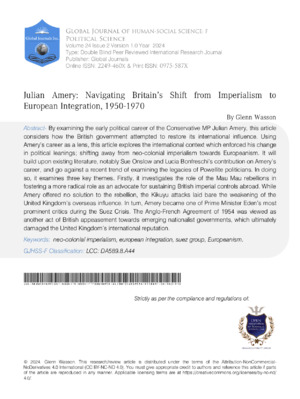
By examining the early political career of the Conservative MP Julian Amery, this article considers how the British government attempted to restore its international influence. Using Amery’s career as a lens, this article explores the international context which enforced his change in political leanings; shifting away from neo-colonial imperialism towards Europeanism. It will build upon existing literature, notably Sue Onslow and Lucia Bonfreschi’s contribution on Amery’s career, and go against a recent trend of examining the legacies of Powellite politicians. In doing so, it examines three key themes. Firstly, it investigates the role of the Mau Mau rebellions in fostering a more radical role as an advocate for sustaining British imperial controls abroad. While Amery offered no solution to the rebellion, the Kikuyu attacks laid bare the weakening of the United Kingdom’s overseas influence. In turn, Amery became one of Prime Minister Eden’s most prominent critics during the Suez Crisis. The Anglo-French Agreement of 1954 was viewed as another act of British appeasement towards emerging nationalist governments, which ultimately damaged the United Kingdom’s international reputation.

Funding

No external funding was declared for this work.

Conflict of Interest

The authors declare no conflict of interest.

Ethical Approval

No ethics committee approval was required for this article type.

Data Availability

Not applicable for this article.

Glenn Wasson. 2026. \u201cJulian Amery: Navigating Britain’s Shift from Imperialism to European Integration, 1950-1970\u201d. Global Journal of Human-Social Science - F: Political Science GJHSS-F Volume 24 (GJHSS Volume 24 Issue F2): .

Download Citation

Alt text: Academic article discussing Britain's shift from imperialism to European integration, 1950-1970.
Issue Cover
GJHSS Volume 24 Issue F2
Pg. 11- 25
Journal Specifications

Crossref Journal DOI 10.17406/GJHSS

Print ISSN 0975-587X

e-ISSN 2249-460X

Keywords
Classification
Not Found
Version of record

v1.2

Issue date

March 18, 2024

Language

English

Experiance in AR

The methods for personal identification and authentication are no exception.

Read in 3D

The methods for personal identification and authentication are no exception.

Article Matrices
Total Views: 1159
Total Downloads: 39
2026 Trends
Research Identity (RIN)
Related Research

Published Article

By examining the early political career of the Conservative MP Julian Amery, this article considers how the British government attempted to restore its international influence. Using Amery’s career as a lens, this article explores the international context which enforced his change in political leanings; shifting away from neo-colonial imperialism towards Europeanism. It will build upon existing literature, notably Sue Onslow and Lucia Bonfreschi’s contribution on Amery’s career, and go against a recent trend of examining the legacies of Powellite politicians. In doing so, it examines three key themes. Firstly, it investigates the role of the Mau Mau rebellions in fostering a more radical role as an advocate for sustaining British imperial controls abroad. While Amery offered no solution to the rebellion, the Kikuyu attacks laid bare the weakening of the United Kingdom’s overseas influence. In turn, Amery became one of Prime Minister Eden’s most prominent critics during the Suez Crisis. The Anglo-French Agreement of 1954 was viewed as another act of British appeasement towards emerging nationalist governments, which ultimately damaged the United Kingdom’s international reputation.

Our website is actively being updated, and changes may occur frequently. Please clear your browser cache if needed. For feedback or error reporting, please email [email protected]
×

This Page is Under Development

We are currently updating this article page for a better experience.

Request Access

Please fill out the form below to request access to this research paper. Your request will be reviewed by the editorial or author team.
X

Quote and Order Details

Contact Person

Invoice Address

Notes or Comments

This is the heading

Lorem ipsum dolor sit amet, consectetur adipiscing elit. Ut elit tellus, luctus nec ullamcorper mattis, pulvinar dapibus leo.


High-quality academic research articles on global topics and journals.

Julian Amery: Navigating Britain’s Shift from Imperialism to European Integration, 1950-1970

Glenn Wasson
Glenn Wasson Belfast

Research Journals




























































