Kelvin's Secret Dropper
I. INTRODUCTION
Drops of rain from a thundercloud bring negative charges to the earth's surface; it still does not have a generally accepted theory of this phenomenon [1]. First of all, it should be noted that thunderstorm clouds consist of several thunderstorm cells closely adjacent to each other, the development of processes in which is identical, but shifted in time. By a thunderstorm cell is meant a region that has a certain horizontal extent in which all the basic physical processes take place.
In Fig. 1 in an idealized form presents a thunderstorm cell at an early stage of development [1].
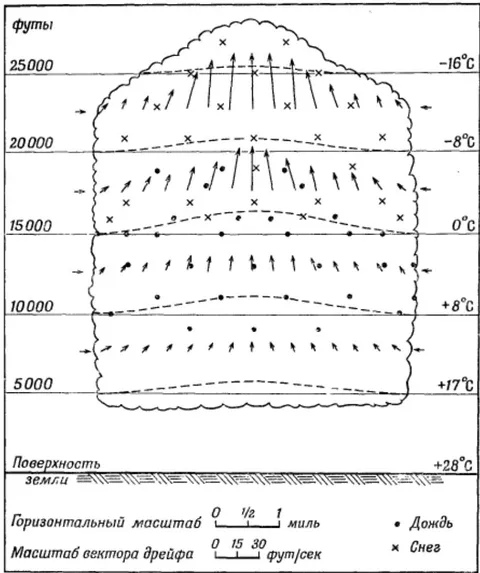
Streams of warm air rush up and cool down as they rise. If the temperature at the bottom of the cell, located at an altitude of 5,000 feet, is about +17 degrees Celsius, then at an altitude of 25,000 feet it is -
16 degrees, and in this area water vapor begins to turn into snow. Further development of the thunderstorm cell is shown in Fig. 2 [1].
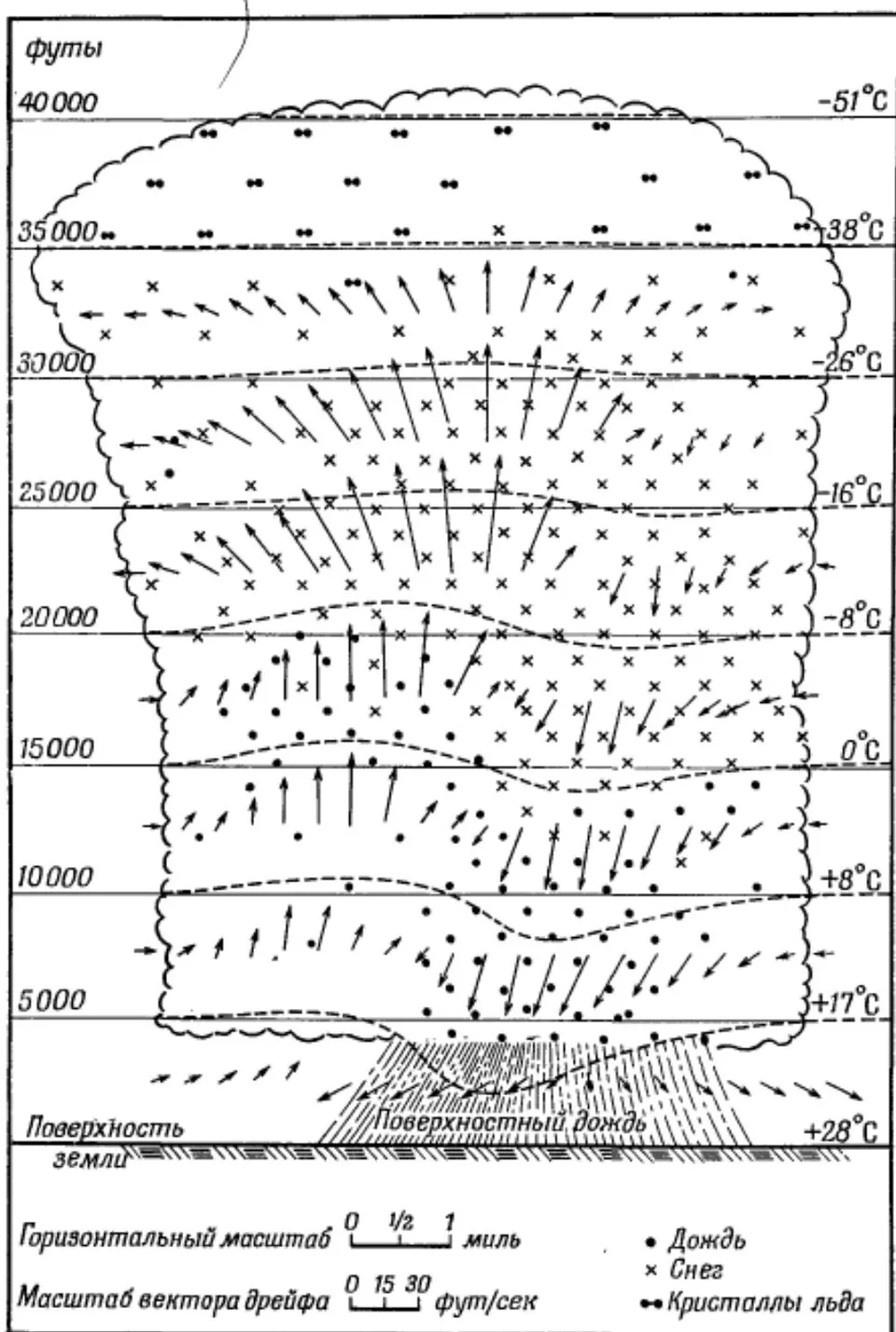
In this state, the cell is considered ripe and it begins to rain from its lower part, while ice crystals form in its upper part. Ice crystals formed in the upper part of the cell and snow formed in its middle part, falling down, begin to melt in the streams of warm rising air, turning into drops. It is at this stage that lightnings are formed, indicating that this process is accompanied by charge transfer from the upper part of the cell to its lower part. But the mechanism for such a transfer is not yet clear.
II. FRICTION ELECTRIFICATION
It is known that the friction of amber on wool leads to its electrification. This is due to the fact that the dielectric constant of amber (the relative dielectric constant of amber is 2.6 - 2.8) is greater than that of wool, and electrons transfer from a dielectric with a lower dielectric constant to a dielectric with a higher dielectric constant. A similar phenomenon is easily observed during friction of dielectric films (for example, from fluoroplastic), with dielectrics whose dielectric constant is less. For some types of fluoroplastic, the relative permittivity reaches 10. Such films are so electrified that they literally adhere to neutral conductors, or to other dielectrics with a lower dielectric constant. In water and ice, the relative permittivity is also high and for static fields reaches 3.25 and 80 for ice and water, respectively.
Between the upper and lower parts of the thunderstorm cell there is a very large potential difference. Therefore, raindrops falling through a thundercloud are strongly polarized. Water is a polar dielectric, its molecule has an electric moment, and its polarization is associated with the rotation of electric dipoles in an electric field. Polarized drop of water is shown in Fig. 3.
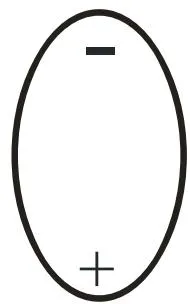
Its lower part is positively charged, and the upper one is negative. Therefore, flying through ionized air containing free electrons, its lower part collects them. When a drop leaves a thunderstorm cell, where there is no large potential gradient, the polarization of the drop disappears, but the electrons, due to the fact that water has a high dielectric constant, cannot leave the drop, and together with it fall on the earth's surface.
III. Kelvin's Dropper and its Principle of Action
The implied model of Kelvin's dropper is shown in Fig. 4
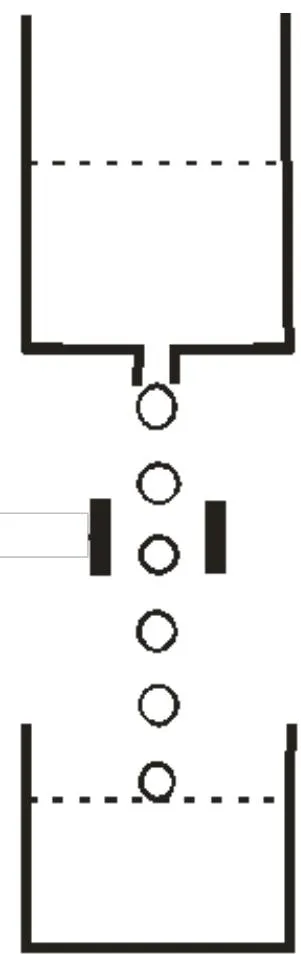
From the upper vessel, neutral drops of water flying past the middle ring electrode, which is called the inductor, fall into the lower isolated vessel. In this case, the lower vessel acquires a negative or positive charge. Therefore, droplets carry unitary charges that accumulate in the water of the lower vessel. But why they were brought there by drops of water that enter electrically neutral from the upper vessel, it is not clear. A prerequisite for charge transfer by water droplets is a large potential difference between the inductor and the lower vessel, and, consequently, their high polarization, as noted in . In this work, it is also reported that the performance of the Kelvin dropper according to the scheme shown in Fig. 4, was confirmed using a Van de Graaff generator as a high-voltage voltage source. But the processes of polarization of water droplets cannot lead to the appearance of unitary charges in them.
A modified design of such a dropper was proposed by Kelvin, it is presented in Fig. 5 [3].
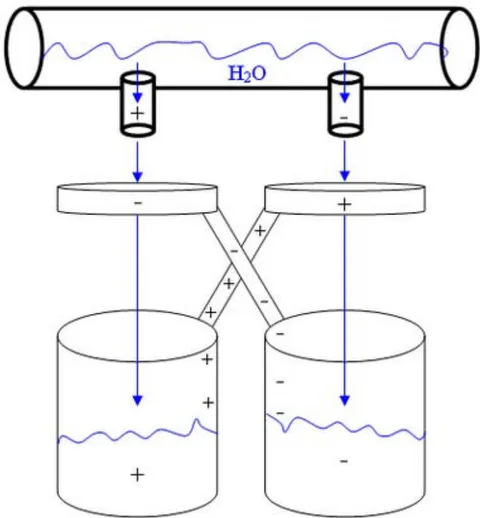
Some fundamental differences in the principle of operation, compared with the option presented in Fig. 4, this dropper does not. Kelvin's dropper differs only in that there are two simplified droppers and two cross-connected inductors connected to the lower containers. Judging by the picture, it is clear that it is assumed in advance that water droplets come out of the holes in the upper vessel already charged, and the signs of the charges of these drops are opposite. But how can this be if the water in the upper vessel is electrically neutral.
To clarify the principle of operation of Kelvin's dropper, her experimental layout was shown, shown in Fig. 6.
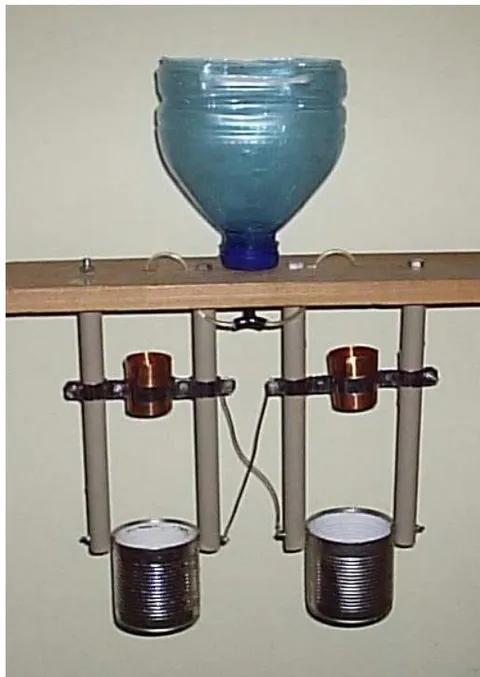
Experimental studies conducted on this layout showed the following features that were not noted in well-known publications. It can be seen that above the inductor, the jets are solid. But after the water jets, flying through the inductors, fall into the area between the inductors and the lower vessels, they are split into small droplets scattering in different directions. This process is clearly visible in Fig. 7.
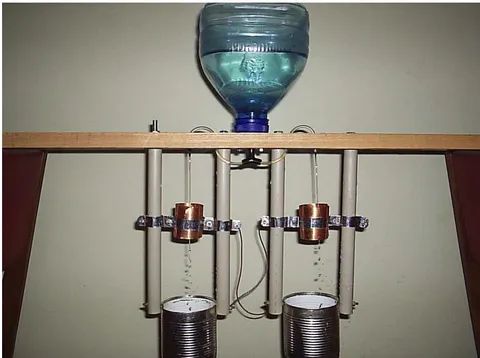
Such fragmentation is due to the fact that unidirectional electric dipoles formed during the polarization process repel each other. The water molecule is polar. In the process of polarization, the electric dipoles of all molecules rotate in the same direction, which leads to their repulsion. This repulsion leads to crushing of the jets into droplets. It should be noted that the lower vessel is negatively charged in the case when the lower part of the polarized drop falling into it is positively charged. With the reverse polarization of the droplet falling in the lower vessel, the vessel acquires a positive charge. With the reverse polarization of the droplet falling in the lower vessel, the vessel acquires a positive charge. Which of these conclusions can be drawn. Drops acquire additional unitary charges during the passage, between the inductors and the lower vessel, in the case when there is a large potential difference between the inductors and the lower vessel. This may be due to the following circumstance. In the space surrounding us, there is always a radiation background caused by both natural and artificial processes. This background leads, although weak, to ionization of the atmosphere, in which free electrons and ions are present in it. They are then collected by the lower part of the polarized droplet when flying through an albeit weakly but still ionized atmosphere. In the case when the lower part of the polarized drop is positively charged, it collects electrons on this part, and when the lower part is negatively charged, it collects positively charged ions. This explains the fact that the lower vessels of the dropper have different potentials.
Similar processes, as already mentioned, occur during the transfer of charges by raindrops. The polarization of these drops is such that their lower part is positively charged, and this is an additional factor in the collection of such a drop of electrons. Therefore, the processes of charge transfer by raindrops are similar to the processes in Kelvin's dropper. Significant drawback of the Kelvin dropper as a high-voltage generator is that such a generator cannot operate continuously, since the discharge of water from the lower tank during continuous operation of the generator has not yet been resolved. Such a generator so far can only work in cyclic mode, when after the discharge of water from the lower tanks, the next start of the generator occurs.
IV. CONCLUSION
The physics of Kelvin's dropper is still not completely understood, since it is unclear how neutral drops of water, even when polarized, can acquire a unitary charge. The article made the assumption that the process of acquiring a charge by droplets in a Kelvin dropper is due to the fact that the surrounding atmosphere is ionized due to the existing radiation background.