INTRODUCTION
Keratitis-ichthyosis-deafness (KID) syndrome is an orphan genetic multisystem disease with autosomal recessive (AP) and dominant types (DT) of inheritance, which manifests in the neonatal period.
With AR-type of inheritance, the disease is initiated by a homozygous or compound heterozygous mutation in the AP1B1 gene on chromosome 22q12, with AD inheritance by a heterozygous mutation in the connexin-26 gene (GJB2) on chromosome 13q12. The GJB2 gene encodes the structural protein connexin 26, which forms gap contacts connecting neighboring cells and allowing the exchange of small molecules and ions. Violation of this connection and exchange can affect intercellular communication in the skin and other tissues [1-3].
Burns first described a disorder with these symptoms in 1915, and Skinner et al. proposed KID as the term for this syndrome in 1981. Worldwide, only 100 cases have been described [4].
The main triad of symptoms is the following:
Skin changes (hyperkeratosis, ectodermal dysplasia, tendency to secondary infections of various etiologies) usually on the palms, soles, and scalp;
Eye diseases (vascularizing keratitis, corneal opacity, dry eyes, blepharitis, conjunctivitis, photophobia);
Pathology of the hearing organs (sensorineural hearing loss, impaired conduction due to external or otitis media)[5-7].
Patients with KID syndrome are believed to be at an increased risk (12%) of developing squamous cell carcinoma of the skin, tongue, and buccal mucosa in childhood. The literature describes cases of squamous cell carcinoma of the cornea.
Patients with KID syndrome are susceptible to secondary infections because the skin barrier function is impaired, thus leading to the formation of erosions and penetration of bacterial or fungal infections. Excessive keratinization of the cellular epithelium (hyperkeratosis) causes blockages of the openings of the sweat and sebaceous glands [8], resulting in the development of purulent-inflammatory processes. Other features of KID syndrome may include:
Sparse hair, or alopecia;
The absence of nails or their unusual shape;
Abnormal structure or shape of the teeth;
Reduced sweating.
There is no specific treatment for this disease at the moment. All therapies are symptomatic and aimed at preventing and treating complications. Treatment of skin lesions is mainly conservative, including emollients and keratolytic. Due to ichthyosis, infection is highly likely, making the treatment of such wounds more difficult .
Existing literature suggests treating the secondary infection with hydrosurgery, which supports antibacterial and antifungal therapy, silver-containing dressings, and a cream containing Gentianapurpurea [11]. Several sources suggest balneotherapy, the mechanism of which is designed to stimulate increased skin permeability and accelerate the passage of minerals and keratolysis [8]. The technique is reported to show good results [9].
The literature describes rare cases of surgical treatment of complications of skin manifestations, mainly in squamous cell carcinoma of the skin. The article presents a case of secondary skin infection in a girl with KID syndrome.
I. CASE REPORT
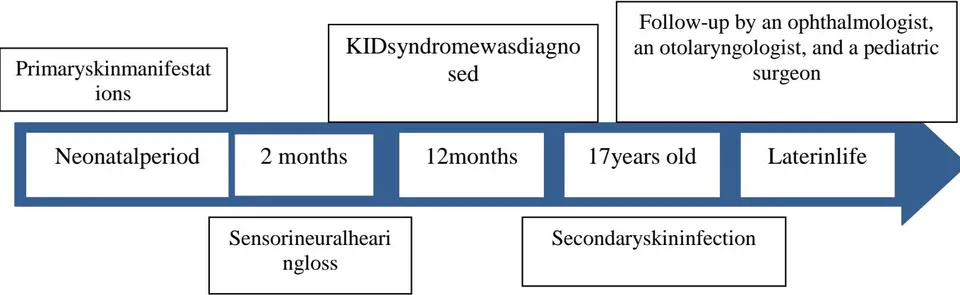
A 17-year-old girl diagnosed with KID syndrome presented to the department of purulent and emergency surgery of the N. F. Filatov State Clinical Hospital with complaints of painful infiltrates in the parietal area. A month before the admission, the patient had a single painful 2x2-cm hyperemicin duration in the parietal area, and therefore received conservative treatment (bandages with "Levomekol") with no positive effect. Within a week, there appeared multiple infiltrates, gradually merging and being painful on palpation. Two days before the admission the patient had a fever of up to 38°C.
Medical history indicates that the patient is from the second pregnancy (without complications), the second birth, and full-term. In the neonatal period, the patient had lamellar peeling of the skin, dryness, thickening of the skin in the areas of the shins, neck, face, elbows, and popliteal folds. Over time, yellowish-brown almost black scales joined together, mainly in the head area. At 2 months, sensorineural hearing loss was detected. She was observed by an ophthalmologist for keratitis and photophobia. The patient was diagnosed with KID syndrome at 12 months.
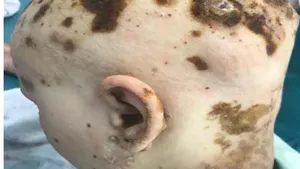
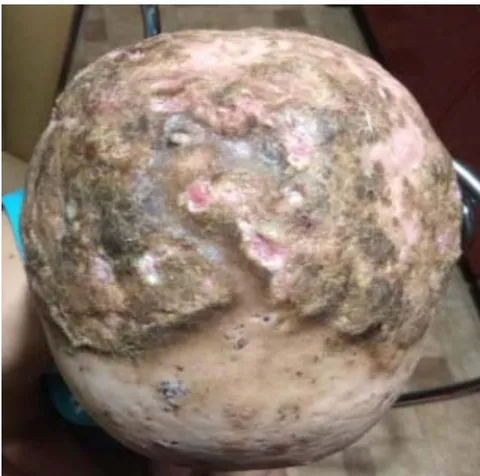
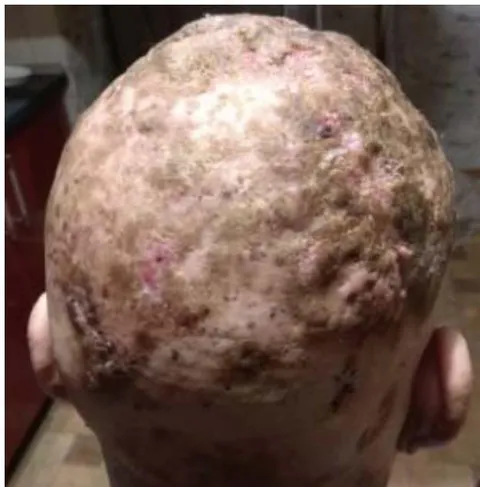
On examination, the patient was feverish (37.8°C). The skin was dry and with follicular keratosis. There was no growth of eyebrows and eyelashes. In the areas of the extensor surfaces of the elbow, knee joints, and the gluteal fold, the skin was thickened and pigmented. The skin of the parietal area was with multiple yellow-brown scaly overlays. Palpation revealed several painful and edematous infiltrates, some being with fluctuation. The clinical blood test showed the number of white blood cells to bear 10,2x10⁹ cl/l. Urinalysis and blood biochemistry were normal.
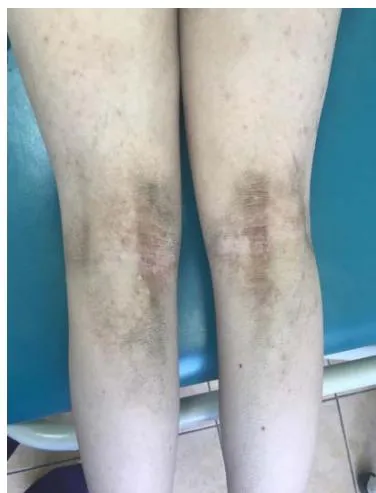
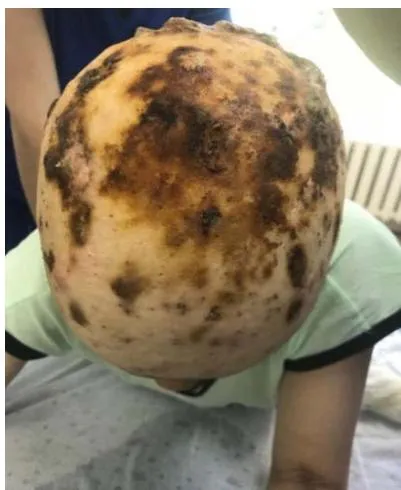
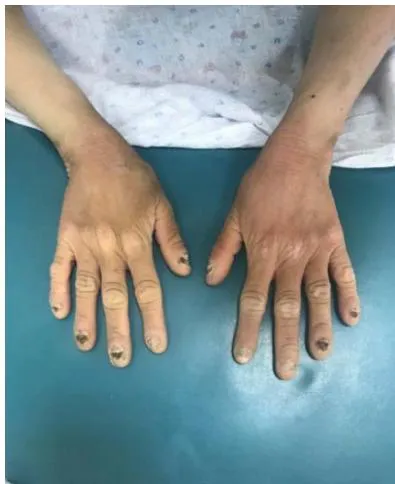
The preliminary diagnosis was KID syndrome with multiple abscesses of the skin of the parietal region.
The patient being under facemask general anesthesia, we opened multiple abscesses and obtained many of purulent contents (from 3 to 15 ml), which then sent for microbiological examination. It demonstrated the growth of Staphylococcus epidermidis. The wounds were not drained, as there was no need for this.
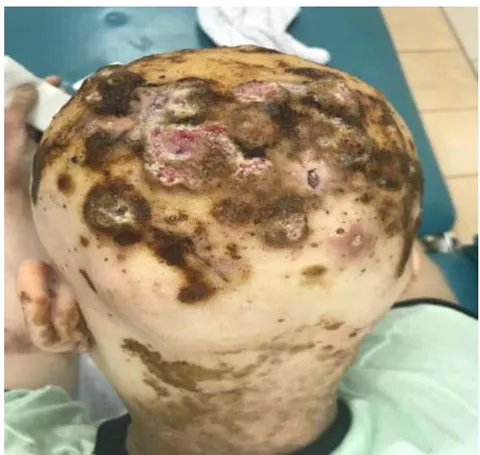
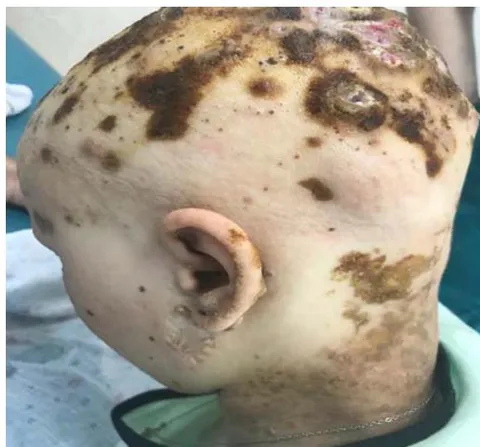
In the postoperative period, the patient received antibacterial (Cefazolin 1gh3 p, IV) and antihistamine (Suprastin 1,0x2 p,IV) therapy, local silver-containing dressings, and physiotherapy (UHF). During daily dressings, elements of keratosis were removed with a Volkmann spoon, non-viable skin areas were excised, and abscess cavities were flushed with an antiseptic solution (Chlorhexidine 0.05%). The pus-like discharge from the wounds persisted for 7 days; the pain on palpation disappeared within 2–3 days; and no new foci of inflammation were noted. On day12, the patient was discharged in a moderate condition.
The prognosis is relatively favorable. KID syndrome predisposes patients to squamous cell carcinoma and an increased incidence of bacterial, viral, and fungal infections. Due to sensorineural deafness, speech development is usually delayed. Corneal vascularization, bilateral, but asymmetric, is very common (in more than 80% of cases). Repeated corneal erosions, corneal leukomas, meibomitis, and severe dry eye syndrome are often observed [6].
II. Discussion
KID syndrome is a rare congenital disease. Patients with KID syndrome are liable to squamous cell carcinoma and an increased incidence of bacterial, viral, and fungal infections. These were the complications with which the patient presented to hospital. The treatment was carried out by with the principles of purulent surgical infection.
The surgical approach, which includes the opening and drainage of abscesses, is validated, since the abscesses can be complicated by their rupture and spread of pus into adjacent tissues and the formation of deep phlegmons of the head, including the subcutaneous ones. This can lead to the spread of the purulent process to the face and neck and thus increase the risk of cavernous sinus thrombosis and sepsis . A microbiological examination of the purulent contents should be carried out to select antibacterial therapy. For local treatment, it is recommended to open and drain abscesses, remove keratin layers, and use silver-containing dressings with antibacterial properties made of polyamide mesh .
In surgical practice, patients with KID syndrome are rare. Therefore, such patients require special approach to the treatment of secondary infection.
The treatment of this pathology is based on the prevention of secondary surgical, ophthalmic, and otolaryngological complications. In case of secondary skin infection, only a comprehensive approach, which included local wound care, symptomatic and antibacterial therapy, gives a good income of treatment.
III. CONCLUSION
Today, there is no standard therapy and opinion on how to treat patients with KID syndrome. The treatment of this pathology is based on the prevention of secondary surgical, ophthalmological, and otolaryngological complications.
Informed Consent
The consent of the patient's parents to the publication of the clinical case was not received. The information presented in this article was depersonalized, identifying information was deleted.
No
Expression of Appreciation
Source of Funding
Absent
Conflict of Interest
The authors declare no conflict of interest.
Madina A. Chundokova https://orcid.org/0000-0001-5562-8397