I. INTRODUCTION
The basic concepts and laws used in the theory of electrical circuits are given in the course of physics and, mainly, when considering electrical fields. Therefore, it is sometimes difficult to use them for electrical circuits because the field is represented as though by space, and the electrical circuit is a combination of different elements. When considering various issues, one has to rely and refer to well-known laws and fundamental provisions. One of the basic laws of an electrical circuit is the second Kirchhoff law, which was established experimentally and applies exclusively to the closed circuit of an electrical circuit. In the electrical circuit, the concept of the word contour itself implies topographical closure. The closure of the circuit in the definition of the second law of Kirchhoff gives rise to the false assumption that the voltage on the elements of the closed section (contour of circuit) is caused by the electromotive force (EMF) of the sources of only this closed section of the circuit. Why "the algebraic sum of voltages on the elements of a closed (precisely closed?) section of a circuit is equal to the algebraic sum of the electromotive forces of this section", classically written as [1,p.50]
This is obvious: As a property of any separately taken system, the algebraic sum of the potentials "n" points along a closed section of the chain is zero, i.e.
, but for an open part of the chain this condition does not hold.
We believe that the restriction of the application of the second Kirchhoff law only to a closed section of the chain and the resulting false assumptions can be eliminated by the statement given below as a theorem.
The theorem about voltages between any two points of an electrical circuit. The voltage (potential difference) between any two points of the electric circuit is equal to the algebraic sum of voltages at the circuit elements connecting these two points.
Proof logical-analytical. The energy state of an electrical circuit or its separately taken part, likened to a point, relative to another system or relative to the system itself, is usually characterized by the notion of potential. In the steady state of the system, the point potential is constant. This means that the potential difference between any two points in an electrical circuit (voltage) consists of an algebraic sum of potential differences (voltages) on the elements connecting these two points and does not depend on the path of the charge, just like the "geographical location of Ankara does not depend on how you got to him from Paris via of Berlin or of Rome."
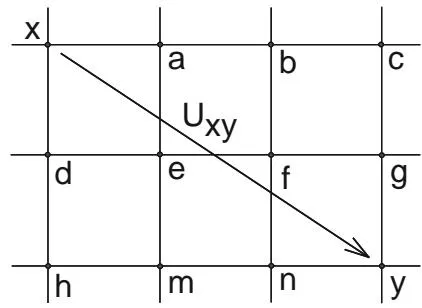
Let the points "x" and "y" of some electrical circuit are interconnected as shown topographically in Fig.1.
By definition voltage
The algebraic sum of potential differences on the circuit elements connecting the points "x" and "y" along the path "xaefny", along the path "xdhmny" along the path "xabfgy", etc.
If we open the brackets in equality (3), then the algebraic sum of the potential differences on the circuit elements connecting the points "x" and "y":
It follows from the equality of the right-hand sides of equalities (2) and (4) that
where - is the difference; - potential difference; - is the algebraic sum of potential differences on elements from the point "x" to the point "y" along any path.
Considering the voltage between the points "x" and "y" along other paths, we get the same.
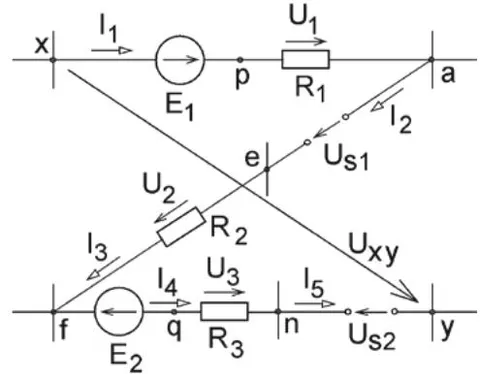
Proof based on the second Kirchhoff law.
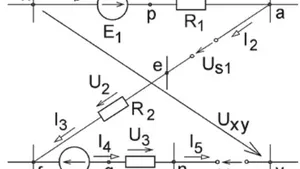
Assume that the "xaefnyx" contour (Fig. 1) is filled with the elements shown in Fig.
Since, in practice, we mainly deal with voltages than with EMF, we must assume in the circuit that there
If we consider the voltage between the points "x" and "y" as the voltage of the voltage source, then according to the second Kirchhoff law
From this equality, the voltage between the points "x" and "y"
If the voltage and EMF are expressed by their definition of potential differences, then
The right-hand side of this equality is the algebraic sum of potential differences on the circuit elements connecting the points "x" and "y", i.e.
but the left side is the voltage between the points "x" and
From the equality of the left-hand sides of equalities (8) and (9) it follows
which proves the statement of the theorem.
The proof is experimental. Measurements and verification of data carried out in the laboratory and in practice confirm the statement of the theorem.
From the theorem under consideration, the second Kirchhoff law follows for any part of the chain [2,3,4 overall].
Summarizing (dividing and grouping similar terms of equalities (3) and (8)), and bearing in mind that for the remaining sections connecting the points "x" and "y", one can write the same equalities, differing only in the number of elements, write in general terms like
where - is the voltage of the voltage source on the branches connecting the points "x" and "y"; - voltage drop on the passive elements of the branches connecting the points "x" and "y"; E - EMF of the branches connecting the points "x" and "y" along the chosen path.
If we consider a closed loop, the concept of voltage loses its meaning, i.e. since the points "x" and "y" merge into one point, and formula (12) is written as
If there is no voltage source in the circuit or in the considered section, then formula (12) takes the form
If there is no current in the considered section, then in the left part of the formula (12) will be , remains as the no-load voltage generated by the EMF sources:
If in the considered section of the circuit there are no sources of EMF, then equation (12) is written as
All this shows that equation (12) is more universal and rigorous than equation (1), a common equality expressing Kirchhoff's second law. On this basis, it will be correct to write the formula of the second Kirchhoff law in the form (12) and formulate "the algebraic sum of the voltage between any two points of the electrical circuit and the voltages of the branch elements connecting these points is equal to the algebraic sum of the electromotive force of the considered section" [5, p.24].
II. FINDINGS
The definition of the theorem is one of the fundamental concepts for the analysis of electrical circuits.
The above theorem is more general than the second Kirchhoff law, since the second Kirchhoff law is derived from this theorem, i.e. the theorem is the basis for the second Kirchhoff law.
The theorem, in contrast to the second Kirchhoff law, is applicable to both closed and topographically linear sections of an electric circuit.
The mathematical formula of the theorem is more semantic and universal than the generally accepted record of the second law of Kirchhoff.
The definition of the second law of Kirchhoff admits the possibility of complementing the definition of this theorem.