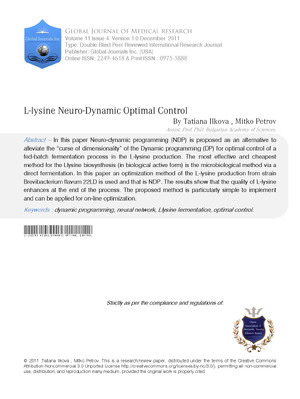
L-lysine Neuro-Dynamic Optimal Control

§ Institute of Biophysics and Biomedical Engineering, ...

Send Message

To: Author

L-lysine Neuro-Dynamic Optimal Control

Article Fingerprint

ReserarchID

MR5X74P

L-lysine Neuro-Dynamic Optimal Control Banner

Key Research Insights

Synthesized scholarly intelligence & interactive research assistant
  • English
  • Afrikaans
  • Albanian
  • Amharic
  • Arabic
  • Armenian
  • Azerbaijani
  • Basque
  • Belarusian
  • Bengali
  • Bosnian
  • Bulgarian
  • Catalan
  • Cebuano
  • Chichewa
  • Chinese (Simplified)
  • Chinese (Traditional)
  • Corsican
  • Croatian
  • Czech
  • Danish
  • Dutch
  • Esperanto
  • Estonian
  • Filipino
  • Finnish
  • French
  • Frisian
  • Galician
  • Georgian
  • German
  • Greek
  • Gujarati
  • Haitian Creole
  • Hausa
  • Hawaiian
  • Hebrew
  • Hindi
  • Hmong
  • Hungarian
  • Icelandic
  • Igbo
  • Indonesian
  • Irish
  • Italian
  • Japanese
  • Javanese
  • Kannada
  • Kazakh
  • Khmer
  • Korean
  • Kurdish (Kurmanji)
  • Kyrgyz
  • Lao
  • Latin
  • Latvian
  • Lithuanian
  • Luxembourgish
  • Macedonian
  • Malagasy
  • Malay
  • Malayalam
  • Maltese
  • Maori
  • Marathi
  • Mongolian
  • Myanmar (Burmese)
  • Nepali
  • Norwegian
  • Pashto
  • Persian
  • Polish
  • Portuguese
  • Punjabi
  • Romanian
  • Russian
  • Samoan
  • Scots Gaelic
  • Serbian
  • Sesotho
  • Shona
  • Sindhi
  • Sinhala
  • Slovak
  • Slovenian
  • Somali
  • Spanish
  • Sundanese
  • Swahili
  • Swedish
  • Tajik
  • Tamil
  • Telugu
  • Thai
  • Turkish
  • Ukrainian
  • Urdu
  • Uzbek
  • Vietnamese
  • Welsh
  • Xhosa
  • Yiddish
  • Yoruba
  • Zulu
Reading Preferences
Font Size
Line Spacing
Background
This converted HTML version may contain rendering inconsistencies. Please refer to the PDF for the authoritative version, or click here to provide feedback.

Abstract

In this paper Neuro-dynamic programming (NDP) is proposed as an alternative to alleviate the “curse of dimensionality” of the Dynamic programming (DP) for optimal control of a fed-batch fermentation process in the L-lysine production. The most effective and cheapest method for the Llysine biosynthesis (in biological active form) is the microbiological method via a direct fermentation. In this paper an optimization method of the L-lysine production from strain Brevibacterium flavum 22LD is used and that is NDP. The results show that the quality of L-lysine enhances at the end of the process. The proposed method is particularly simple to implement and can be applied for on-line optimization.

References

11 Cites in Article
  1. 1. D Bertsekas,J Tsitsiklis (1996). Neuro-dynamic programming: an overview. Proceedings of 1995 34th IEEE Conference on Decision and Control, 1, 560-564.
  2. 2. Kurt Driessens,Sašo Džeroski (2004). Integrating Guidance into Relational Reinforcement Learning. Machine Learning, 57(3), 271-304.
  3. 3. Andrew Barto,Steven Bradtke,Satinder Singh (1995). Learning to act using real-time dynamic programming. Artificial Intelligence, 72(1-2), 81-138.
  4. 4. R Sutton (1988). Learning to predict by the methods of temporal differences. Machine Learning, 3, 9-44.
  5. 5. N Kaisare,J Lee,J Lee (2003). Simulation based strategy for nonlinear optimal control: application to a microbial cell reactor. International Journal of Robust and Nonlinear Control, 13, 347-363.
  6. 6. T Ilkova,M Petrov (2008). Dynamic and neurodynamic optimization of a fed-batch fermentation process. Lecture Notes in Artifical Intelligence, 5253, 365-369.
  7. 7. Savas Anastassiadis (2007). L-Lysine Fermentation. Recent Patents on Biotechnology, 1(1), 11-24.
  8. 8. A Soni,R Parker (2002). Fed-batch bioreactor control using a multi-scale model. Proceedings of the 2003 American Control Conference, 2003., 3, 2371-2376.
  9. 9. D Vlachos,A Mhadeshwar,N Kaisare (2006). Hierarchical multiscale model-based design of experiments, catalysts, and reactors for fuel processing. Computers & Chemical Engineering, 30(10-12), 1712-1724.
  10. 10. J Lee,N Kaisare,J Lee (2006). Choice of approximator and design of penalty function for an approximate dynamic programming based control approach. Journal of Process Control, 16, 135-156.
  11. 11. Zh Xiong,J Zhang (2005). Neural Network model-based on-line re-optimisation control of fedbatch processes using a modified iterative dynamic programming algorithm. Chemical Engineering and Processing, 44, 477-484.

Funding

No external funding was declared for this work.

Conflict of Interest

The authors declare no conflict of interest.

Ethical Approval

No ethics committee approval was required for this article type.

Data Availability

Not applicable for this article.

How to Cite This Article

Dr. Dr. Tatiana Ilkova, Dr. Mitko Petrov. . "L-lysine Neuro-Dynamic Optimal Control". Global Journal of Medical Research GJMR Volume 11 (GJMR Volume 11 Issue 4).

More Citation Formats

Download Citation

Journal Specifications

Crossref Journal DOI 10.17406/gjmr

Print ISSN 0975-5888

e-ISSN 2249-4618

Keywords
Version of record

v1.2

Issue date
December 23, 2011

Language
English
Order Article Reprint
Experience in AR

Explore published articles in an immersive Augmented Reality environment. Our platform converts research papers into interactive 3D books, allowing readers to view and interact with content using AR and VR compatible devices.

Read in 3D

Your published article is automatically converted into a realistic 3D book. Flip through pages and read research papers in a more engaging and interactive format.

Article Matrices
Total Views: 5.7K
Total Downloads: 451
All Trends

Request Access

Please fill out the form below to request access to this research paper. Your request will be reviewed by the editorial or author team.
X

This is the heading

Lorem ipsum dolor sit amet, consectetur adipiscing elit. Ut elit tellus, luctus nec ullamcorper mattis, pulvinar dapibus leo.


High-quality academic research articles on global topics and journals.

L-lysine Neuro-Dynamic Optimal Control

Dr. Ilkova
Dr. Ilkova Institute of Biophysics and Biomedical Engineering, Bulgarian Academy of Sciences
Dr. Petrov
Dr. Petrov <p>Institute of Biophysics and Biomedical Engineering, Bulgarian Academy of Sciences</p>