Annotation- Crop production is one of the dynamically developing branches of agriculture. The main directions of the industry's development are not only to increase crop yields but also to obtain environmentally friendly products. The work presents the rationale for the use of laser light to activate the growth of plants. The example of Savoy cabbage shows the positive effect of using a semiconductor laser with a wavelength of 650 nm, radiation power of 150 MW, and a radiation duration of 30 seconds. It shows not only the increase of leaf area by 67% and the head weight by more than 15% but also the accumulation of proteins and carbohydrates by an average of 15% in the plant samples of the experimental group. All this indicates an increase in the energy of plant growth. The proposed technology makes it possible to increase the yield of crop production with minimal usage of fertilizers and chemical protection products.
I. INTRODUCTION
The development of crop production, as a branch of agriculture, determines the socio-economic development of regions not only in Russia but also in the world. Every year in our country, there is an increase in acreage by 6.5%. This indicator is provided due to the expansion of the area of industrial and grain crops while reducing potatoes and vegetables.
However, the data on the yield of these crops indicate its growth, which is the result of several factors, including the active application of fertilizers (organic and mineral) by agricultural producers and the use of various chemicals to stimulate growth and increase the resistance of crops to diseases and control them. Every year, the production of pesticides and herbicides in our country rises by 6-8%, which negatively affects the ecological state of the environment and the quality of produced products (according to the Russian Union of Manufacturers of Chemical Plant Protection Products). The negative impact of chemicals affects the entire biosphere, shifting the balance towards the resistance of pathogens to pesticides themselves and reducing the immune response of plant organisms. High toxicity also affects the genetic apparatus of cells, leading to the development of irreversible negative consequences. Also xenobiotics are accumulated in the body, which leads to the poisoning of animals and humans. Over the past eight years, the total consumption of pesticides in Russia has increased more than 208 times and amounted to 156.6 thousand tons. That is why, since 2017, our country has been implementing a scientific and technical program for the development of agriculture, which involves the transition to the production of environmentally friendly agricultural products by 2025 through the development and introduction of new highly efficient and safe technologies.
In practice, physical methods of exposure, which differ from chemical ones in environmental friendliness, safety, and low energy consumption, have shown high efficiency. There has been proven high efficiency of coherent radiation, which has a stimulating effect on plants, activating the genetic potential through switching photosynthetic systems without changing the DNA structure [1].
Light has a regulatory effect on photosynthetic plants, being a source of energy. The method of laser stimulation affect son photosynthesis, that is, the formation of organic matter under the influence of light. If in the dark phase (at night) vegetative plants are illuminated with red light (that is, light energy) of a given wavelength, this will enable the inclusion of FS-II (photosystem-II), which triggers the cascade mechanism of energy synthesis in the form of ATP macromolecules and the hydrogen donor in anabolic reactions - the NADP H2 coenzyme. After removing the light exposure, FS-II will turn off. Then FS-I (photosystem I) activates enzymatic systems through a higher action potential of phytochrome and phytohormonewith the help of additionally generated energy of ATP and the reducing agent NADP H2. This accelerates the synthesis of protein and carbohydrates, increasing yield.
If we talk about the influence of light on various stages of plant development, then the effectiveness of coherent radiation in pre-sowing seed treatment has been proven. If we expose the light of the red spectrum, the seed germination rate, vigor, stress resistance, health status, and survival rate of plants, as well as the yield and quality of the crop, increase. All of these made it possible to introduce laser technologies in agriculture, which allow achieving high results by activating the genetic potential of the plant organism and reducing the use of chemical stimulants and pesticides.
It is worth noting that the laser systems developed and used in agriculture are far from perfect due to low productivity and large overall dimensions .
II. EXPERIMENTAL PART
Devices with helium-neon lasers are the most common laser installations in agriculture. In the Krasnodar Territory of Russia, Kazakhstan, and Ukraine, were usedinstallations thatwere mounted on self-propelled agricultural machinery for processing vegetative plants or installed in storage facilities for presowing seed treatment. Devices had a significant weight, about16 kg. The operator chose power and duration of processing for each crop, and controlled it from the vehicle cab. Because the treatment was carried out in the dark, there were often plants traumatization and dark pauses for those areas that were at a great distance from the device.
Since the beginning of the 2000s, Danilovskikh M G conducted the research on the effect of laser radiation on the growth and development of plants. He tested the optomechanical on various crops. Thepeculiarityof the device was a semiconductor laser, which differs from its analogs in its small size and energy consumption. Long-term experiments allowed us to choose the optimal radiation dose for crops and start field tests.
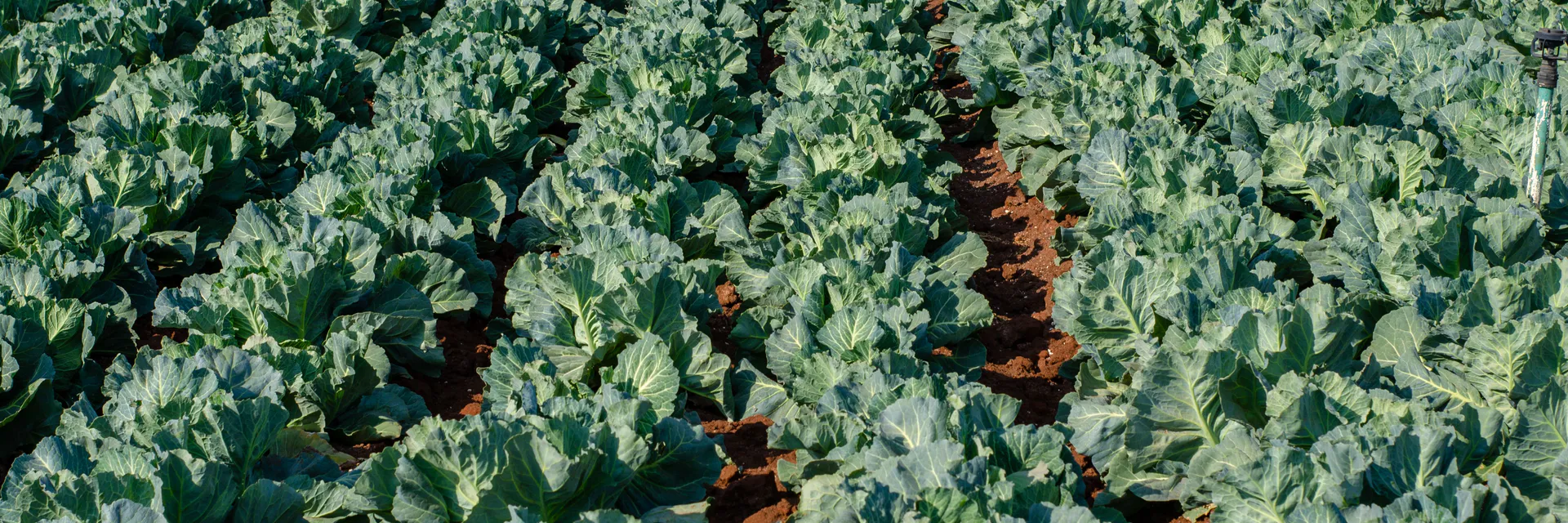
For the research, we selected a vegetable crop – planted seedlings of Savoy cabbage of the "Salima F1" variety of early maturation. This variety of cabbage has a raised rosette of leaves. The leaf is transversely-broadly elliptical, strongly bubbly, medium-sized, covered with a waxy coating. The color varies from green to dark green. The head is oval or round, yellowish on the cut. The outer and inner stumps are short. The weight of the head is 1.8-2 kg.
Workers of KFKH D. P. Pavlyuk (village Ermolino, Novgorod region, North-West of Russia) conducted the planting in early June. The average daily temperature at the time of planting was in the range of +17...+19C, at night + 11C. This temperature regime is optimal since cabbage is hard to tolerate hot, dry air.
The treatment was carried out by an optomechanical laser beam control device twice -one day after planting the seedlings in the open ground and 12 days later (June 5 and 17, 2019). The treatment was carried out with a red-band semiconductor laser with a radiation wavelength of and radiation power of 150 MW for 30 seconds.
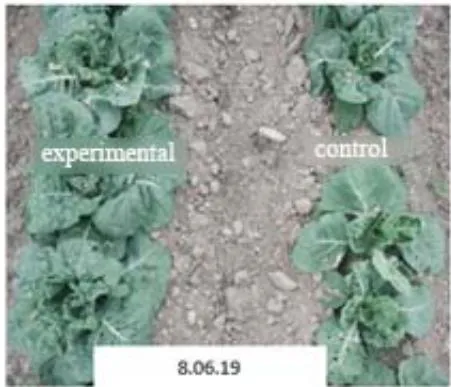
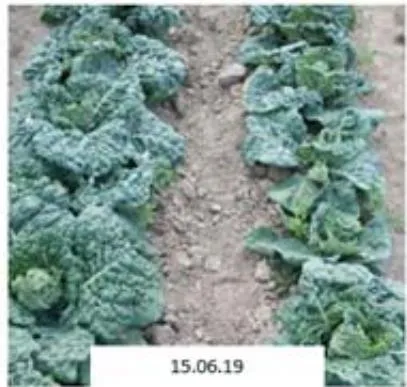
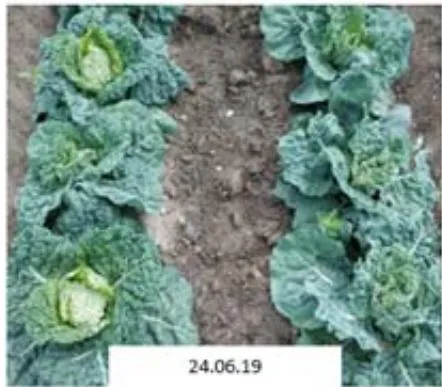
The growth energy of Savoy cabbage was calculated from the growth rate and the area of the leaf plate since the leaf plate displays photosynthetic activity. On June 8, 15 and 24, 2019, the leaf plate was measured, and the cabbage samples were photofixed (Picture 1).
After treatments, the leaf surface area was measured according to the standard method:
where a is the length of the leaf, cm;
b – width at the widest part of the leaf, cm.
The leaf plate, being the main assimilating organ of plants, accumulates synthesized organic substances that serve as structural and energy material for the entire plant organism. The area of a single leaf and the total leaf surface of the plant allow us to assess the photosynthetic potential and intensity of its work.
The workers carried out harvesting on 07.07.2019 while we measured and recorded the weight, size of the heads, and their biochemical composition.
III. RESULTS AND DISCUSSIONS
The assessment of the growth energy of Savoy cabbage by the change in the area of the leaf plate (Table 1) has shown that, on average, the leaf surface area of Savoy cabbage in the control group is 220.7 cm larger than the leaf area of the control samples (we carried out measurementson June 8). As a rule, the first leaves unfold slowly, but already at the first measurement, there is a significant difference. Further, the growth accelerates, facilitated by optimal climatic conditions - the air temperature was 18-26 C. On June 15, we also noted the trend of more active development of irradiated plants. Namely, the area of cabbage leaves in the experimental group was 723.4 cm more than the area of leaves in the control samples. At the time of photofixation of the plantings, we noted the earlier formation of heads in the plants of the experimental group (see Picture 1, photo is on the right). Measurements from June 24 showed us an increase in the area of the leaf plateby 937.9 cm2 in the experimental group. The acceleration of the leaves' growthcomposing the head affects the size of the head, increasing it in size.
| Average leaf area of one plant, cm2 | |||||
| June 8 | June 15 | June 24 | |||
| control group | experimental group | control group | experimental group | control group | experimental group |
We connect such a high growth rate of the leaf plate with the activation of biochemical processes after laser stimulation. The intracellular components absorb light, which leads to a change in the thermodynamic equilibrium. Short-term heating leads to a change in the physical and chemical properties of chromophores and their surrounding areas, which activates the adenylatecyclase signal transmission system inside the cell. An increase in the number of protein macromolecules leads to the activation of biochemical processes, as a result of which the redox potential of mitochondria grows. Then activation of ATP synthesis starts, which is also spent on protein synthesis, increasing the growth energy .
After harvesting, we selected groups of heads of the control and experimental groups to assess the size and weight of the heads. A cabbage head is a group of twisted leaves that grow from an apical bud. The yield of cabbage and the heads' size directly depend on the number of healthy leaves in the rosette and their size.
The studies have shown that on average the girth of a cabbage head is 7.4 cm larger, and the weight is 1.1 kg heavier in the experimental group samples compared to the control ones. (Table 2).
| No | Measurement parameter | Measurement object | |
| Control group | Experimental group | ||
| 1 | Average girth of a cabbage head, cm | 41,9±0,11 | 49,3±0,12 |
| 2 | Average wight of a cabbage head, kg | 1,9±0,27 | 3,0±0,30 |
We carried out biochemical analysis on June 9, stored the crop in a refrigerated room at a temperature of +3 C and air humidity of 85-90%. Then, we extracted the selected samples, determined the content of free sugars (glucose) and proteins in the solutions by a photo-electrocolorimeter, determined the quantitative fat content by the extraction-weight method. (Table 3).
The average glucose content was 0.4 g/100g higher in the samples of the experimental group. Even at low concentrations, glucose has a significant protective effect, lowering the freezing point. We noted a rising glucose content by 15.19% in the experimental group, which indicates an increase in the frost resistance of cabbage, and its energy value.
Most of the organic nitrogenous substances of plants are proteins. In plants, there are quantitatively fewer protein substances than carbohydrates, but they play asignificant role in the construction of living matter and the implementation of life processes. All processes of plant growth and development are connected with them. When using laser radiation, plants accumulate 15.14% more protein, which is an indicator of the activation of several growth, shaping, physiological and biochemical processes. It reflects the active growth of the leaf area and the weight of the head.
Fats (lipids) are an essential component of living cells, providing selective permeability and liquid-crystal properties, although most plants accumulate relatively few lipids (about 2%). Also, lipids are protective substances that help a plant tolerate adverse effects of the external environment. The fat content in the experimental group was increased by 14.66% and amounted to 0.13 g/100 g. Cabbage has a low-fat content, which does not affect organoleptic parameters, but affects the resistance of plants to low temperatures.
| No | Measurement criterion, g/100 g | Measurement object | |
| Control group | Experimental group | ||
| 1 | Glucose content | 2,85±0,06 | 3,29±0,04 |
| 2 | Protein content | 1,14±0,02 | 1,32±0,02 |
| 3 | Fat content | 0,11±0,005 | 0,13±0,002 |
IV. CONCLUSIONS
In vivo treatment of Savoy cabbage of Salima F1 variety with short-term exposure to coherent radiation rises the functional activity of plant organisms, activating cell division. We can see it in an increase of leaf area, earlier maturation, and accumulation of alarger amount of dry matter. The use of stimulating plant growth on non-polluted with chemicals land allows us to obtain higher-quality, environmentally safe agricultural products.
ACKNOWLEDGMENTS
The work was supported by the Ministry of Education and Science of the Russian Federation in the framework of the State Task of the Novgorod Research Institute of Agricultural Sciences (topic No. 0681-2019-0001, reg. No. research, NIOKTR AAAA-A19-119082290041-7).