Latin America is a sending region of talents, or brain drain, which can be reverted if governments apply some policies to make these talents return such as the network formation and the emergence of virtual scientific communities which can open new opportunities for the strengthening of scientific communities in the sending countries and the possibilities of an academic career. This research analyzes the phenomenon of brain drain in Latin America through the Migration Systems and Networks theory or Social Network theory and presents a case study which consists in the analysis made of the data obtained from a survey done to Latin American high skilled people living in different countries than their countries of origin. The professionals surveyed and the author do some recommendations to may revert this phenomenon in the region.
## I. INTRODUCTION
The intense global demand for talent has contributed to increase migration of specialized human resources, in response to new opportunities, incentives and resources. The most developed economies, extensive users of science and technology, operate like huge magnets that attract large flows of specialists capable of generating ideas or products and applying knowledge in complex production and innovation processes.
It is estimated, for example, that in OECD countries (Organization for Economic Co-operation and Development), where it occurs about $70\%$ of world trade in goods and services, the number of immigrants with at least 13 years of schooling increased in the past decade from 12 to 20 million people, mostly from developing countries, who moved in search of higher wages and better job opportunities or professional development (Didou & Gérard, 2009).
Indeed, unlike the term "mobility", which has benefited over the years of evaluative neutrality, the "brain drain" favored, from the first moment when intense ideological debates were enunciated in the sixties, especially addressed to the strategies of the national governments, in the sense of developing public policies to promote science, technology and innovation and, equally, growth and competitiveness. Thus, if emigration is, in general, a phenomenon that implies political interest at first hand, the emigration of qualified professionals attracts renewed interest. This is because the departure of these professionals may signal the incapacity of national political systems, or the domination of other countries that exercise great attractiveness over young people (with or without higher education) with high goals of professional self - realization.
The magnitude and importance of Latin American skilled emigration in international flows, according to data from the United States - the main destination - were increasing in the numbers of skilled emigrants and a decrease in their relative participation in the set of flows.
### a) Research Questions
- How are the Latin American countries facing the brain drain?
- What has been the incidence of the brain drain in the region?
b) Hypothesis
Latin America does not have the necessary conditions to house and employ high-skill workers according to their professional training and that is why they decide to emigrate to more developed countries to search an accurate scientific network where the professional is able to produce more.
## II. RESEARCH METHODOLOGY
The research methodology is mixed. For one side there is the theoretical part which will give the analysis based on the Migration Systems and Networks theory or Social Network theory and the empirical part which consists in the analysis of the answers obtained from a survey done to people who are considered as brain drain of Latin American countries.
### a) Migration Systems and Networks Theory or Social Networks Theory
The theory of social networks, of which origins date back to 1930 and 1940, has received, until its current configuration, various influences basically coming from anthropology, psychology, sociology and mathematics. It is a good example to highlight that the theory, conceptual apparatus, methods and techniques can be mutually linked. This theory provides an innovative perspective: the relational one, which focuses its analysis in the relations of the units that act as theory, models, methods and applications are expressible in relational terms. In this sense, the individual is not the unit of analysis but the set formed by individuals and the ties between them, as Henao (2012) points out.
What is a social network? Social networks can be defined as a well-defined set of actors-individuals, groups, organizations, communities, global societies, etc. such as universities, diaspora organizations, government and nongovernmental organizations, private employment agencies, corporations, religious and cultural organizations, and so on, linked ones with others through a relationship or set of social relationships, according to Henao (2012) and Poros (2011).
To complement the definition of social network, it is noteworthy to mention some fundamental concepts to understand and analyze the phenomenon of social networks: social actor, relational ties, dyad, triad, subgroup and group. Conceptualizing each one, first, social actors are social entities subject to social network links. They can be individuals, companies, collective social units, departments in a company, public service agencies in the city, states, etc. Relational ties are the links between pairs of actors, a unit of analysis in social networks. They are of various types such as personal-friendship, transfers of resources, goods, money, information, etc.; associations, mental behavioral interactions; geographic or social mobility; physical connections; formal relationships or organizations; etc. The dyads and triads refer to the possible link between two or three actors, respectively. The subgroup can be defined as any subset in addition to the ties between them. Finally, social networks have the ability to model relationships among systems of actors that are named groups as a set of actors on which ties are measured, as Henao argues.
Moreover, the central idea of social networks is based on the fact that people think, feel and do. These originate and are expressed in the patterns of situational relationships that occur between the actors, thus opposing to the idea that the characteristics of the individual actors are at the base or are the cause of the behavior patterns, therefore of the social structure. In this measure, what matters most in network theory are the links that exist between the different actors in the various situations in which they are observed. In other words, the social actors and their actions are seen as interdependent and not as autonomous units, and the relational ties between the actors may indicate transfers of resources, both material and non-material. Furthermore, network theory models view relationship structures as environments that either provide opportunities or restrict individual action. Similarly, network models identify the social, economic, political structure, etc. as constant patterns of relationships among actors, as Henao claims.
According to Poros (2011) the most distinguishing characteristic of migrant networks is that they can be in two or more nations, but they also lean to be fairly restricted and precise in terms of the bonds that comprise them. Besides, such linkages bond possible migrants in home countries with others in destination countries, or attempt to link highly skilled migrants with institutions or organizations in the nation or receiving nation that are regarding to recruit them.
Therefore, if this theory is applied to the migration of talents issue, this is a network decision model, where the nodes or vertices represent people with a high level of education who are researching in their field of knowledge, and the links reflect the academic, scientific or investigative productions that they carry out with their peers, in order to achieve greater development or a greater quantity of investigative products. The researcher who wishes to emigrate takes into account for making the decision the following criteria: the average degree of the network, since the productivity of scientists depends on the degree of scientific collaboration they develop; the utility generated by the different types of links; the effect that neighbors have on individual productivity; the assessments of the different locations and the technology available for scientists. In the model, the researcher who wishes to emigrate makes the decision to have scientists from the same local network as neighbors or to have as neighbors the scientists from the developed country, once the neighborhood substitution process has been carried out, the neighbors s/he chooses generate positive and complementary effects on their productivity, as Del Rio (2009) states.
Scientists who decide to emigrate do so because they are seeking to increase their productivity. As the productivity of each researcher depends on the scientific collaboration that they can develop with their peers, scientists will choose those places where there is a greater probability of raising the degree of each one, that is, the measure of the network, approximated by its average degree, will be the variable that the researcher will use to decide in which network it is located. Those networks with a higher average degree represent networks with greater scientific collaboration. Scientific collaboration generates increasing returns, which in the model will be named the agglomeration function; this depicts the positive effects that researcher's productivity has to account other scientists to strengthen their work. In addition to scientific collaboration, the productivity of researchers depends on the infrastructure, technological resources and investment capital available to them. In developed economies, the agglomeration function and technological infrastructure are greater, if there is a greater agglomeration of scientists this requires a greater technological infrastructure, generally these two arguments have a positive relationship in their behavior, the model proposed below works with these two arguments, according to Del Rio.
When researchers from the developing country move to the developed country, their geographic network change may be temporary or permanent. If the figure of links developed by the researcher is greater than the average degree of the scientific collaboration network, her/his drain will be permanent, while if the number of links between the scientist with the network of the developed country is less than the average degree of the network, the outflow will be transitory, as soon as the research process that led her/him to leave the country will return, since there is a greater affinity with the scientists located in the country of origin, with them he carries out most of his scientific work.
The brain drain, as Del Río and Henao point out, occurs because the search for greater scientific collaboration often requires geographical connection, since the research work carried out together must be supported by logistical components such as technology and capital available for the research, which are located in certain places in developed countries. This reveals that there are spaces determined by unequal exchanges between hegemonic and non-hegemonic centers of knowledge production. The professionals who most tend to emigrate are those who work in cutting-edge research in high technology or areas whose development is just incipient in their country of origin, such as electronic or biomedical engineering, biomedicine, neurology, or applied mathematics. These actors are forced to change their geographic network, if they want to leverage of all the benefits provided by the scientific collaboration of developed countries.
Furthermore, schools and universities are a principal reference of high educated migrant networks, particularly among individuals who have accomplished degrees abroad. According to Vertovec (2002), the experience of studying out of the home country, meaningfully rises the probability of being a skilled migrant in the host country. The links that migrant students create can also aid consequently to provide opportunities for them.
According to Del Río, geographic location acts as a barrier to global scientific collaboration. Although paths with short geodetic distances can be formed between researchers from developing countries and researchers from developed countries, highly trained professionals decide to emigrate to economies with a significant level of research and scientific collaboration.
The latter can be explained since the geographic networks of developed countries have greater scientific collaboration among themselves, due to there are favorable factors for this, such as technological infrastructure and a number of scientists in the same geographical area (Henao, 2012).
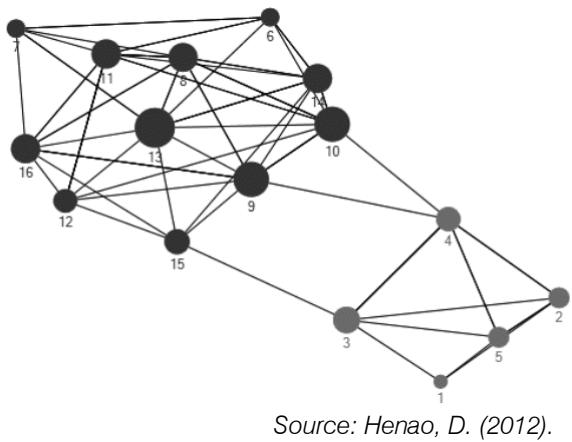 Fig. 1: "La teoría de redes: aspectos claves para el análisis de la "fuga de cerebros".
The figure 1 shows the connectivity of two geographic networks of scientific collaboration. To the extent the nodes and their connections are presented, both networks reveal the bridges that allow interconnection: (4-10), (4-9) and (3-15) and the points from which it can occur emigration processes. The black nodes represent the developed country network, and the gray nodes (1, 2, 3, 4 and 5) are those of the developing country network. Likewise, the presented interconnection among the nods in the gray network (developing country) is weaker than the black network (developed country), since it shows less interconnection than the developed network, therefore it confirms that the researcher from the developing nation needs to move to the developed one in order to be completely benefited.
### b) Empirical Methodology: Case Study
The Case Study in Qualitative Research is an inquiry process focused on the description and detailed, comprehensive, systematic, in-depth examination of a defined case, of a particular fact, phenomenon, event or situation. The analysis incorporates the context (temporal-spatial, economic, political, legal), which allows a greater understanding of its complexity and, therefore, the greater learning of the particular case (Duran, 2012).
According to Duran, the Case Study can be used in four different situations: a) when the axis of the study revolves around answers to "how" and "why"; b) when the conduct involved in the study cannot be manipulated; c) when it is considered necessary to analyze contextual conditions because are relevant to the phenomenon under study; or d) when there is no clear delineation between the phenomenon and the context.
The case study is a phenomenon of some kind that occurred in a limited context. It can be a person, couple, object, system, a particular event or a historical event, community, organization department, a program; the only requirement is that it must have some physical, social or temporal limit that confers identity on it, as Duran argues.
## III. QUALIFIED MIGRANTS FROM LATIN AMERICA
According to Luchilo (2018), undoubtedly, some conditions in the evolution of Latin American countries facilitated convergence with US demand. Starting in the 1950s, with different rhythms, Latin American countries experienced modernization processes, which included government initiatives to promote scientific activities and improve the quality of their universities. Likewise, the bottlenecks that substitute industrialization faced in the relatively more developed countries of the region, led to the creation of different institutions aimed at improving the productivity of the agricultural and industrial sectors and creating capacities in areas considered strategic, such as nuclear energy. Simultaneously, there were changes in the social structure and cultural habits, especially in urban sectors, one of which salient manifestations was the expansion of university education.
For instance, research skilled migration from Argentina focused on engineers. Based on the survey of the admissions records of the US Immigration and Naturalization Service, a series with the income of Argentinean professionals and technicians admitted as immigrants to the United States between 1950 and 1966 was drawn up. During that period, 6,545 people entered in that condition, among them 1,131 engineers, 1,180 doctors and 1,323 teachers and professors, as Luchilo states.
Colombia was another Latin American country that experienced significant emigration, both in absolute terms and in relation to its pool of qualified personnel. Unlike Argentina –which in the 1970s, 1980s and 1990s decreased its emigrant flows with respect to the one of 1960–, the growth of Colombian emigration from the 1960s was the beginning of a tendency to the expansion of flows to the United States. In the case of professionals, the estimates are 6,470 professionals and technicians for the period 1961-1970. The scholars also estimated the percentage of skilled emigrants who entered the United States between 1961 and 1966 in relation to the total number of university graduates in Colombia in the same period at about $17\%$, with a peak of $23\%$ in health sciences, as Luchilo claims.
Furthermore, according to an estimation of Ermólieva (2010) about the minimum cost of a university education for a student at the graduate level (4 years) in the region is 25 thousand dollars, the professional migrations of the last four decades have cost of more than 30,000 million dollars for the Latin American and Caribbean countries, then the exodus of the 24 thousand Latin American professionals registered in 2006 represented a loss of one billion dollars for the region since their training, including postgraduate courses, ranges from 40 thousand to 80 thousand dollars according to the undergraduate and the country of origin.
As Luchilo (2018) and Espinoza (2013) argue, regarding the magnitude of qualified migrations, the estimates vary depending on whether the years of schooling - more than 13 years - or the highest level of education attained - complete superior - are taken into account. According to estimates, the Latin Americans with more than 13 years of schooling residing in OECD countries by 2007 numbered around 4.9 million, which represented just under $20\%$ of the total number of qualified migrants in OECD countries. The growth in the proportion of Latin American skilled migrants far exceeded the average for the same period: while skilled migrants in OECD countries increased by $111\%$, the ones from Latin American countries did so by $155\%$ between 1990 and 2007 (Guevara, 2019). Unlike other regions in which flows are more diversified, those of qualified Latin Americans have a very strong orientation towards the United States, which receives more than $88\%$ nationals from this region with more than 13 years of schooling.
Furthermore, countries like Mexico represents about $28\%$ of all skilled migrants and is the country of which number of skilled migrants grew the most between 1990 and 2007. The Caribbean countries represent the most important regional subset, with around a third of skilled migrants. Within this group, Cuba is the nation with the highest number of qualified migrants, followed by Jamaica, Haiti and the Dominican Republic, as Luchilo claims.
According to information from the UNAM Economic Research Institute (Mexico), around 5,000 scientists leave the country searching of better job opportunities. The head of this office added that currently about 200,000 Mexican researchers work in countries such as Canada, France, Argentina, Chile and Spain. Just in the US there are no less than 550,000 Mexicans who have bachelor's, master's or doctorate's studies. Likewise, it must be taken into account that for each year of undergraduate studies that each of these Mexicans carried out, their country of origin (Mexico) invested around USD2, 270, and the 11.5 thousand Mexicans residing in the United States with a doctorate degree are approximately equivalent to the Mexican production of such highly qualified personnel during the last 6 years, as Ermolieva (2010) and Espinoza (2013) argue.
Within the sub-region of the Andean countries, Peru and, above all, Venezuela experienced higher than average growth. In the countries of the Southern Cone, the most prominent phenomenon is the growth in the number of Brazilian skilled migrants –Brazil has the second growth rate during the period, after Mexico-, but the number of skilled migrants is very small in all countries compared with the pool of qualified people in Brazil, as Luchilo argues.
Professionals in science and engineering represent around $16\%$ of all Latin Americans with university studies residing in the United States, in this case, the differences between the countries of the region are not so important. While for Mexico the proportion of professionals in science and engineering over the total number of professionals was $14.8\%$, for Venezuela it was $21\%$ and for Argentina it was $22\%$, as Luchilo affirms.
Moreover, in 2005, a study made by the National science foundation (USA) registered 53,000 Argentines, 36,000 Colombians, 33,000 Peruvians, and 20,000 Brazilians among immigrants who made up the US science and technology system. South America as a whole provided nearly 180,000 scientists and engineers. The Caribbean did the same with 170 thousand people, the majority from Cuba, Jamaica and the Dominican Republic (Ermólieva, 2010).
On the other hand, according to Didou (2008), another possible way to address this asymmetric movement of scientists and professionals towards developed countries, it is the "brain exchange". It was about compensating losses due to emigration via the promotion of mobility and the exchange of highly qualified resources between countries of origin and developed countries. Hand in hand with changes in the conditions for the production of knowledge and after the revolution in information technology, in the 1990s, the design of policies that would achieve a "brain gain" through creation and strengthening of networks of scientists and professionals. These networks seek to act as links between local and global networks of scientific and technological development. This allows those who live in other countries to have the possibility of providing help and collaboration to their colleagues and scientific communities in their countries of origin through technical reports, consultancy or other forms of academic ties.
### a) How Latin America is Facing the Brain Drain
At the same time of the changes in conditions of knowledge production and after the revolution in computer technologies, in the 1990s began to explore the design of policies to achieve a "brain gain" through creation and strengthening of networks of scientists and professionals. These networks seek to act as links between networks local and global scientific development and technological. The network allows those who have established in other countries to have the possibility to help and collaborate with colleagues and scientific communities based in their countries of origin from technical reports, consulting or other forms of academic bond, as Garcia (2008) explains.
One way to generate gain is to try to introduce new units of account in the profit and loss balance of qualified personnel. In other words, the negative balance in the qualified emigration account can be offset by a positive balance in the "remittances" or "knowledge transfer" account. From this perspective, emigrants - often grouped under the name of "diaspora" - can become a factor in the development of their countries of origin. In this field, the "diaspora option" has been very successful, especially in international organizations (Luchilo, 2018).
On the other side, in recent years, several countries in the region have tried policies to promote return and link with qualified emigrants, aimed above all at researchers and, to a lesser extent, at entrepreneurs. Some of these policies - such as the RAICES program of the Argentinian Ministry of Science and Technology which emphasizes the return or, rather, the repatriation of scientists. Along the same lines, an interesting project is the Return Plan, launched by the Ecuadorian government to recruit teachers among Ecuadorians living abroad. Others, on the other hand, are inscribed in the diaspora option, and focus mainly on the promotion of linkages. It is interesting to note that these initiatives are not necessarily promoted by the countries of origin. The launch in 2001 of the International Diaspora Engagement Alliance was an initiative of the US State Department, in which companies and other organizations converged - including the Inter-American Development Bank -. Multilateral credit organizations, and also those of the United Nations system, are active supporters of this second approach, as evidenced in a large series of publications, projects and international meetings, as Luchilo states.
### b) Incidence of the Brain Drain in the Region
According to Espinoza (2013), it has been accounted that approximately 180 million people, $3.5\%$ of the world's population, are inhabiting in different nations than the ones they were born. Expats are generally high-skilled: from whom $67\%$ are in the United States and $88\%$ in OECD nations have a secondary or higher education. They are usually better lettered than the rest of the inhabitants in their nations of origin. Usually less educated migration generates lots of gains for expats, families, and home nations. Conversely, well-educated emigration is generally attributed for divesting developing nations of human capital, this hampers economic development. On one hand, the economic approach proposes that brain drain provides high skilled human resources as it places well-educated to their best use; and on the other hand there is the approach that brain drain hinders to a nation's economic, social, and professional development. However, according to the author, the consequences of the brain drain are now becoming a concern for developed nations where labors are feeling endangered by a huge amount of well-educated force arriving to their nations.
Well-educated exodus benefits the migrants themselves, the network of scientist or professionals, and in general, the economy. Ran accurately it may also benefit many developing nations. Approximately $37\%$ of the legal migration living in OECD nations correspond to the well-educated one. According to IMF and World Bank studies have found a strong connection between education and legal migration, it does not consequently affect home nations adversely: expectations of exodus encourage the aspiration for more education, mainly when the recompenses are higher than prospects in source countries. This at the same time, can also direct to larger investment in education and skills. This migration may also foster cognizance go through from receiving to home nations, as Espinoza points out.
In receiving nations, family organizations and investments from migrants have arisen towards sending nations that has generated a solid community sentiment around a nationality and professions in common. This may rouse trade and encourage exports in home nations as expats regularly keep predilection for those goods they raised with and are expected to import items they know. Likewise, migrants may give rise to positive impact on productivity and technology transfer, as Espinoza explains.
On the other hand, with the migration of engineers, doctors, scientists and others, the brain drain not only contributes to the technological and scientific backwardness of a nation, but also suffers from a process of human decapitalization, which, at the same time, economic growth slows in short and long term.
Hence, this situation benefits to the developed countries keep growing technologically, scientifically and economically and become more appealing to experts. For instance, according to World Bank data, in the period of time between 1976 and 1996, the share of international trade corresponding to the cutting-edge technology items folded, was from $11\%$ to $22\%$ (Guevara, 2019).
## IV. CASE STUDY: LATIN AMERICAN
## PROFESSIONALS DECIDE TO EMIGRATE TO MORE DEVELOPED COUNTRIES TO SEARCH AN ACCURATE SCIENTIFIC OR
### PROFESSIONAL NETWORK WHERE THEY ARE ABLE TO PRODUCE MORE
A questionnaire (appendix 1) was made and shared with 29 Latin American professionals who answered all the questions. Their nationalities are: 1 Argentinian, 1 is from Belize, 1 Brazilian, 1 Chilean, 7 Colombians, 1 is from Ecuador, 4 are from El Salvador, 3 Guatemalaans, 3 are from Honduras, 3 Mexicans, 2 are from Nicaragua, 1 Paraguayan and 1 Peruvian.
According to the answers given by the professionals, the following analysis was made:
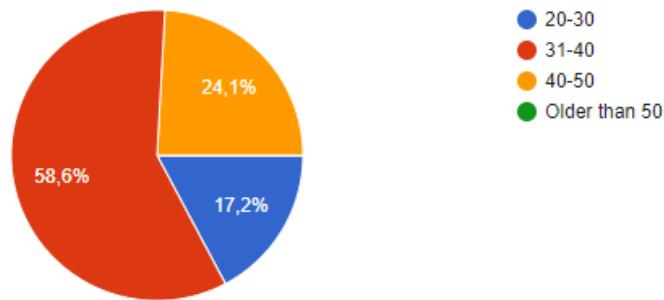
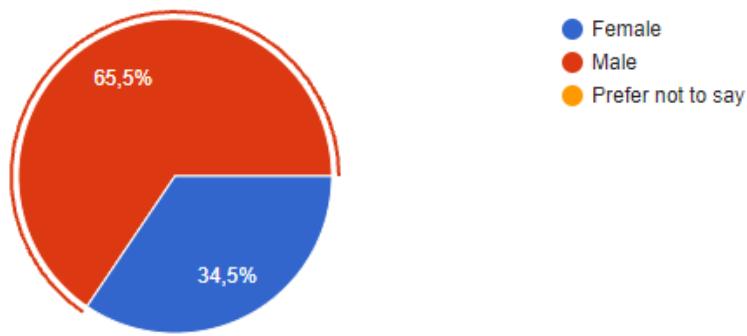 Fig. 2: Age Range. Almost of the
$60\%$ of the Surveyed are in the Age Range of 31-40, no one is older than 50 and $17\%$ of them belong to the Age Range of 20-30.
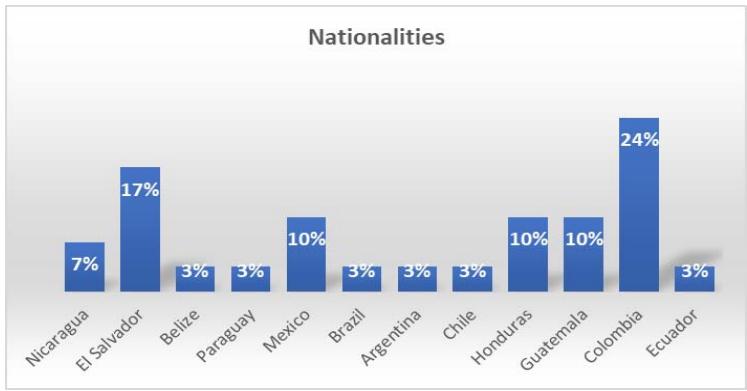 Fig. 3: Gender. Most of the Professionals Surveyed are Male,
$65.5\%$. $34.5\%$ of them are Female.
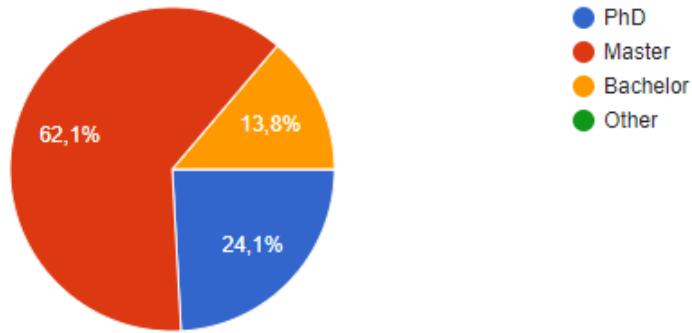 Fig. 4: Nationality.
$24\%$ of the Professionals Surveyed are Colombians, the following are Salvadorans $(17\%)$ and from 6 Latin American countries $3\%$ of the Professionals were Surveyed. Fig. 5: Highest level of education completed. Most of them have a master as the highest level of education, $62\%$. The second highest level of education is PhD, corresponding to $24\%$ of the professionals surveyed.
Table 1: Professionals per Nationality, Highest Degree Completed, Country they Studied and they Live. Any of the 29 Professionals Surveyed live in their Country of Origin. All of them, Studied their Highest-Level Degree (Bachelor, Master or Doctorate) in other Country Different than theirs, 14 of them (48%) Moved to other Country Different than the one they Studied. 52%, Live in the Same Country they Studied.
<table><tr><td>No°</td><td>Nationality</td><td>Highest Degree Completed</td><td>Country they Studied</td><td>Country they Live</td></tr><tr><td>1</td><td>Nicaraguan</td><td>Master</td><td>Taiwan</td><td>United States</td></tr><tr><td>2</td><td>Nicaraguan</td><td>Phd</td><td>Taiwan</td><td>Taiwan</td></tr><tr><td>3</td><td>Salvadoran</td><td>Phd</td><td>France</td><td>United States</td></tr><tr><td>4</td><td>Salvadoran</td><td>Bachelor</td><td>Taiwan</td><td>South Korea</td></tr><tr><td>5</td><td>Salvadoran</td><td>Master</td><td>Taiwan</td><td>Taiwan</td></tr><tr><td>6</td><td>Salvadoran</td><td>Master</td><td>Taiwan</td><td>Taiwan</td></tr><tr><td>7</td><td>Belizean</td><td>Master</td><td>Taiwan</td><td>Taiwan</td></tr><tr><td>8</td><td>Peruvian</td><td>Master</td><td>Taiwan</td><td>Taiwan</td></tr><tr><td>9</td><td>Paraguayan</td><td>Master</td><td>South Korea</td><td>Saudi Arabia</td></tr><tr><td>10</td><td>Mexican</td><td>Master</td><td>South Korea</td><td>South Korea</td></tr><tr><td>11</td><td>Mexican</td><td>Master</td><td>South Korea</td><td>Spain</td></tr><tr><td rowspan="2">12</td><td rowspan="2">Mexican</td><td>Master</td><td>South Korea</td><td rowspan="2">Germany</td></tr><tr><td>Master</td><td>Spain</td></tr><tr><td>13</td><td>Brazilian</td><td>Phd</td><td>Japan</td><td>Japan</td></tr><tr><td>14</td><td>Argentinian</td><td>Phd</td><td>Taiwan</td><td>United States</td></tr><tr><td>15</td><td>Chilean</td><td>Master</td><td>South Korea</td><td>South Korea</td></tr><tr><td>16</td><td>Honduran</td><td>Bachelor</td><td>Taiwan</td><td>France</td></tr><tr><td>17</td><td>Honduran</td><td>Master</td><td>Taiwan</td><td>Taiwan</td></tr><tr><td>18</td><td>Honduran</td><td>Master</td><td>Taiwan</td><td>Germany</td></tr><tr><td>19</td><td>Guatemala</td><td>Master</td><td>South Korea</td><td>Mexico</td></tr><tr><td>20</td><td>Guatemala</td><td>Master</td><td>South Korea</td><td>Mexico</td></tr><tr><td>21</td><td>Guatemala</td><td>Master</td><td>South Korea</td><td>South Korea</td></tr><tr><td>22</td><td>Colombian</td><td>Master</td><td>South Korea</td><td>Italy</td></tr><tr><td>23</td><td>Colombian</td><td>Bachelor</td><td>Austria</td><td>Austria</td></tr><tr><td>24</td><td>Colombian</td><td>Master</td><td>Turkey</td><td>Turkey</td></tr><tr><td>25</td><td>Colombian</td><td>Master</td><td>France</td><td>France</td></tr><tr><td>26</td><td>Colombian</td><td>Phd</td><td>United States</td><td>United States</td></tr><tr><td>27</td><td>Colombian</td><td>Phd</td><td>Puerto Rico</td><td>Mexico</td></tr><tr><td>28</td><td>Colombian</td><td>Bachelor</td><td>United States</td><td>China</td></tr><tr><td>29</td><td>Ecuadorian</td><td>Phd</td><td>United States</td><td>United States</td></tr></table>
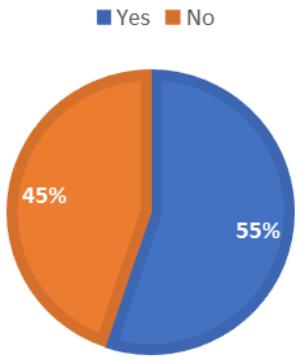 Fig. 6: Associated with a Network of Scientists or Professionals (it can be the Place where they Work). More than the half of the Professionals Surveyed,
$55\%$, are Associated or Work with a Network of Scientist or Professionals. Table 2: General Functions in the Network According the Nationality and Highest Degree Completed. As the Table Above Shows, Only one of the Professionals Associated to a Network of Scientist or Professionals his Highest Level is a Bachelor Degree, 15 are Postgraduates (11 Master/4 Doctorate) and the Networks of 11 of them, have more than 21 Members.
<table><tr><td>N°</td><td>Country</td><td>Highest degree completed</td><td>General functions in the network</td><td>N° scientist or professionals</td></tr><tr><td>1</td><td>Nicaraguan</td><td>Master</td><td>Nonprofit organization coordinator</td><td>21 or more</td></tr><tr><td>2</td><td>Salvadoran</td><td>Doctorate</td><td>Network of Central American scientists ("Red de Investigadores de Ciencias Naturales de América Central"), and currently exploring it, trying to see how I can contribute.</td><td>21 or more</td></tr><tr><td>3</td><td>Salvadoran</td><td>Master</td><td>Senior Technical Support Engineer</td><td>21 or more</td></tr><tr><td>4</td><td>Argentinian</td><td>Doctorate</td><td>I work at a major financial institution and I teach at different universities.</td><td>21 or more</td></tr><tr><td>5</td><td>Salvadoran</td><td>Master</td><td>New Product Introduction for Automotive Industry</td><td>21 or more</td></tr><tr><td>6</td><td>Mexican</td><td>Master</td><td>I am part of Mexican professionals group in Korea</td><td>21 or more</td></tr><tr><td>7</td><td>Chilean</td><td>Master</td><td>Phd research</td><td>N/A</td></tr><tr><td>8</td><td>Guatemalaan</td><td>Master</td><td>Networking (job connections, adapt to life in foreing country counseling)</td><td>N/A</td></tr><tr><td>9</td><td>Colombian</td><td>Master</td><td>Phd research</td><td>N/A</td></tr><tr><td>10</td><td>Colombian</td><td>Bachelor</td><td>N/A</td><td>N/A</td></tr><tr><td>11</td><td>Colombian</td><td>Master</td><td>A study about the acceptability of Technologies (genome editing) in animal Breeding.</td><td>21 or more</td></tr><tr><td>12</td><td>Colombian</td><td>Doctorate</td><td>Tec de Monterrey</td><td>21 or more</td></tr><tr><td>13</td><td>Guatemalaan</td><td>Master</td><td>R&D of shock absorber components for the automotive industry</td><td>N/A</td></tr><tr><td>14</td><td>Honduran</td><td>Master</td><td>Support as professionals in the insurance industry</td><td>21 or more</td></tr><tr><td>15</td><td>Ecuadorian</td><td>Doctorate</td><td>Research</td><td>21 or more</td></tr><tr><td>16</td><td>Guatemalaan</td><td>Master</td><td>General Manager</td><td>21 or more</td></tr></table>
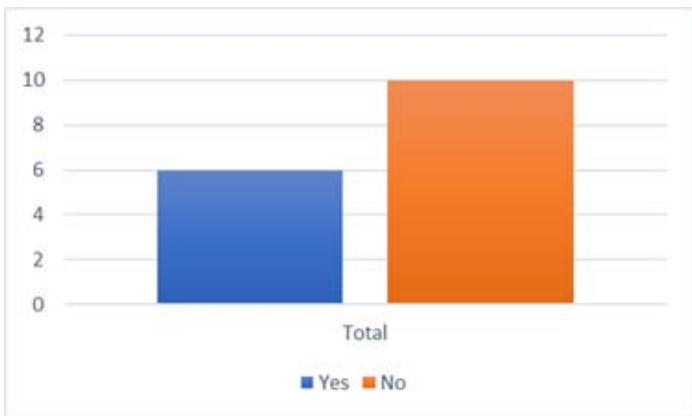 Fig. 7: Question: Is your country a part of this network where you are a member of? Among the 16 professionals who are members of a network, only 6 of them answered that their country of origin is a part of their network.
Table 3: Question: In which way does the network include your country? Answers can be more than one. The Nationalities of the Professionals who are Member of a Network of Scientists or Professionals that Includes their Country of Origin are: One Argentinian, One Mexican, Two Colombians, One Ecuadorian and One Guatemalan, which are Representations of all the Sub-Regions of the American Continent: North, Central and South. Three of them Answer that the Company/Institution where they Work has a Branch in their Country of Origin. Two of them are doing a Project that Benefits their Home Country. Two of them are doing a Research Related to their Country of Origin.
<table><tr><td>No°</td><td>Country of Origin</td><td>Highest Degree Completed</td><td>Way your Country is Included in the Network</td></tr><tr><td>1</td><td>Argentinian</td><td>Doctorate</td><td>The company/institution where you work has a branch in your country /You are doing a research related to your country</td></tr><tr><td>2</td><td>Mexican</td><td>Master</td><td>You are doing a project that benefits your country</td></tr><tr><td>3</td><td>Colombian</td><td>Bachelor</td><td>The company/institution where you work has a branch in your country</td></tr><tr><td>4</td><td>Colombian</td><td>Doctorate</td><td>You are doing a research related to your country</td></tr><tr><td>5</td><td>Ecuadorian</td><td>Doctorate</td><td>You are doing a project that benefits your country/ You are doing a research related to your country</td></tr><tr><td>6</td><td>Guatemala</td><td>Master</td><td>The company/institution where you work has a branch in your country.</td></tr></table>
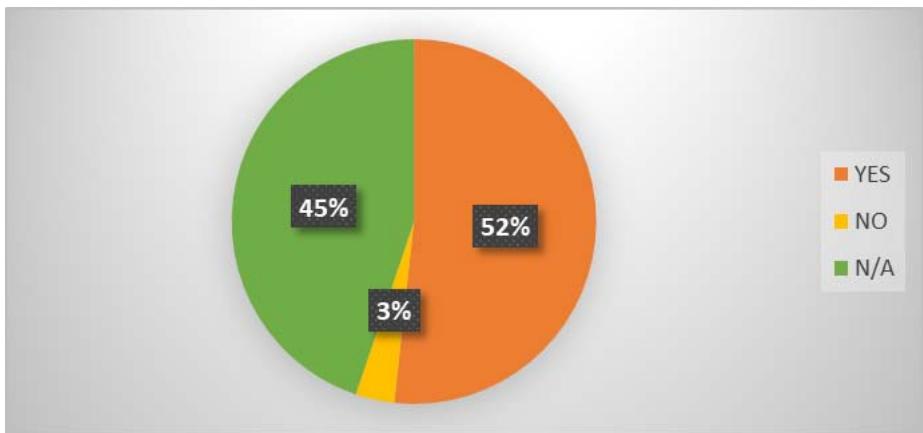
Fig. 8: Question: If Your Home Country Had The Exact Same Network Opportunities As You Have In The Country Where You Live Currently, Would You Still Stay In Your Host Country? If This Question Does Not Apply To Your Case, Choose N/A. Most Of The Half Of Professionals Surveyed, $52\%$, Answered That Even If They Have The Exact Network Opportunity As They Have In Their Host Country, They Would Not Go Back To Their Home Country. Only The $3\%$ Answered That They Would Go Back To Their Country Of Origin.
Table 4: Question: Why would you Stay in your Host Country? Continuing with the Previous Question, 15 Professionals of a Group of 16 who Answered that Even if They would have the Same Network Opportunities in their Country of Origin, They Prefer to Stay in their Host Country, 4 of them Said that because they have Family in the Host Country and there is a Better Quality of Life there. In General, what their Answers have in Common is that the Host Country Brings them a Better Quality of Life and Better Opportunities. One of them Expressed that her Country of Origin doesn't have the Accurate Political and Social Conditions to Live.
<table><tr><td>Answers</td><td>No.</td></tr><tr><td>Home country doesn't have accurate political and social conditions to live</td><td>1</td></tr><tr><td>Host country has better conditions and capacity than country of origin</td><td>3</td></tr><tr><td>Has a family in the host country</td><td>3</td></tr><tr><td>It is very unlikely that the opportunities would be exactly the same.</td><td>1</td></tr><tr><td>Has a family in the host country, and in the host country has a better quality of life</td><td>4</td></tr><tr><td>Better opportunities</td><td>1</td></tr><tr><td>I will be interested in developing and study something that is quite new in agricultural studies.</td><td>1</td></tr><tr><td>Host country has better universities than in Latin America</td><td>1</td></tr></table>
Table 5: Question: What can you Recommend to the Government of your Country to Improve its Capacity to Leverage of its High-Skilled Workers Abroad Like you? All these Recommendations Written by the Professionals Show not only their Discontent Regarding to the Acting of the Government of their Countries, but also their Desire to be Listened to what they Consider Necessary to be Changed in their Countries in Order to Leverage their Local high Qualified human Resource.
All the answers provided by the professionals were included in this chart. Of the 29 respondents, only two people did not answer this question: one from Belize and one from El Salvador.
<table><tr><td>All the answers provided by the professionals were included in this chart. Of the 29 respondents, only two people did not answer this question: one from Belize and one from El Salvador.</td></tr><tr><td>2 People from Nicaragua: a) Invest in education (create education curriculums with standards that are closer to the ones in the region or in the continent, so that Nicaraguans can have more access to higher education)</td></tr><tr><td>b) Allow citizens to work for the government and feel free to share ideas and projects that will benefit everyone (currently, only citizens affiliated to the political party of the government are able to occupy certain job positions regardless of the level of education)</td></tr><tr><td>c) Allow police and military to be autonomous entities that work in benefit of the Nicaraguan people</td></tr><tr><td>d) Invest in internal security of the country, to fight burglary, violence against women, child and women trafficking, drug trafficking and others.</td></tr><tr><td>e) Invest in medicine and create programs that can facilitate access to medical care to those who live in the country area.</td></tr><tr><td>f) Design and implement agricultural programs to help the small farmers</td></tr><tr><td>g) Invest in clean energy and projects to help the environment</td></tr><tr><td>h) Invest in special education, access to transportation, medical care and programs that will allow the special needs community to have access to a dignified life</td></tr><tr><td>i) Search high skilled professionals</td></tr><tr><td>3 People from El Salvador: a) A first step is networking: if all Salvadoran scientists abroad could partner together, we would create enough momentum to draft solid scientific proposals for the country. That's why the current network I'm partnering with seems a good starting point for me.</td></tr><tr><td>b) Incentives for research: money should be invested for young talented investigators to come home and do their research there.</td></tr><tr><td>(c) Creating a culture where the scientific profession is respected. If the government dismisses expert scientific opinion for mere political reasons, it removes incentives for young researchers to do their work in El Salvador. The government should trust on the scientific community. Data should speak by itself.</td></tr><tr><td>d) Improve security, persecute corruption and organized crime, create jobs, respect democracy and rule of law, attract foreign investment, improve education</td></tr><tr><td>e) Open to industries which are in a path to expansion in other countries to leverage language skills, overseas sales skills and technical studies.</td></tr><tr><td>1 from Peru.:a) To govern well to create job opportunities.</td></tr><tr><td>1 from Paraguay: a) Freedom, less taxes, mostly for entrepreneurs who are starting.</td></tr><tr><td>b) Less bureaucracy for business.</td></tr><tr><td>3 people from Mexico: a) Better salaries and fight corruption</td></tr><tr><td>b) To offer more benefits and opportunities to continue with studies to grow professionally</td></tr></table>
c) To foster innovation, educate in knowledge work and IT sectors, e-commerce, advanced technologies.
- 1 from Brazil: a) My country needs to invest more in science and research to attract the high-skilled workers back to the country.
- 1 from Argentina: a) The government of my country (regardless of whatever party happens to be in power) does not seem to be interested in retaining high-skilled workers. Thus, I would not make any recommendations to it.
- 1 from Chile: a) I applied for the Chilean government scholarship for graduate studies. I didn't get it. But I got first a Korean Studies scholarship from UCLA and then the KGSP program. It seems to me that foreign institutions valued me more.
b) I also think Chilean government is too focused in Europe and the US when it comes to define what fields of study are "useful" or "practical". Just because you are applying from an Asian country, it is already harder to get support. This is a big strategic mistake, in my opinion.
- 3 People from Honduras: a) Provide more opportunities to travel and study abroad.
b) Not to be dishonest with money or power, and to have a vision to understand what problems are really facing the country's people.
c) To build an economy that can be trusted.
- 3 People from Guatemala: a) Ease to certify degrees, access to colleges (need to register as professional to be validated as a member of that profession to have access to job opportunities on public sector).
b) Work and invest in research and development facilities.
c) To create better conditions for big and foreign companies to establish in my country so that we could help to foster development with our work.
- 7 People from Colombia: a) Create a credible and sustainable policy to reverse the so called "brain drain". Offer competitive compensation packages to promote the return to home country and/or promote and increase exchange of knowledge between host and home country.
b) A responsible salary and giving better opportunities to study.
c) I would recommend the government to encourage university- industry cooperation and to focus on the third mission of universities
d) First, I recommend to the government to recognize the several challenges the country has on environmental and agricultural fields.
e) To make scientists to stay in the nation it can be interesting to show them the potential biodiversity of the country. The fact that they are not going to work on something already done, but that there's a lot of to do and that's a value for high-skilled workers. It is a challenge but is worth for.
f) Well paid jobs and real opportunities.
g) Research opportunities. Also improve the country's infrastructure
h) Safety
- 1 from Equator: a) Create spaces of collaboration. That is all we ask for!
## V. RECOMMENDATIONS
Recommendations of the Final Declaration of the CRES (Regional Conference on Higher Education) regarding "Talent drain": to prevent and avoid the drain of talents carried out through the emigration of people with academic and professional qualifications, it is necessary to implement measures and public policies that generate incentives for qualified personnel to remain or return to their country of origin and integrate national development projects. Therefore, it is essential to create better working conditions and establish institutional alliances that allow the generation of favorable conditions for permanence and use of talents. Likewise, official agreements for training abroad must include dimensions such as reciprocity and service obligations in their country for graduates, as Didou and Gérard (2009), Ermolieva (2010) and Espinoza (2013) claim.
Likewise, it is required to increase and consolidate the academic association between postgraduate programs, reinforcing training activities, encouraging the mutual recognition of credits and stimulating co-directorships and cooperative postgraduate courses, particularly in strategic areas. In addition, to promote the training of qualified human resources in the management of regional integration and international solidarity cooperation, seeking continuity and increasing the quality of the actions that are developed.
Moreover, the development of migrant networks can generate FDI and trade connections which aid to fortify the gains from trade and the diffusion of knowledge, which at last stimulus the development in the sending nation. Networks or diaspora externalities arise as a repercussion of a decrease in transaction and other information costs related to the commitment problem that is innate in agency relationships, according to Groizard and Llull (2007).
So that Latin American countries can reduce the costs and leverage of the potential benefits derived from mobility, it is necessary to develop - among other tasks - multifaceted policies that go beyond the classic invoice programs aimed at preventing the definitive exodus of specialized personnel, encouraging their return and guaranteeing their reintegration to the country of origin.
To be successful in this task, it is essential to consolidate the framework institutional and human capital training programs. For this, it is necessary to enter into strategic alliances with the countries of the region and continue advancing, among other tasks, in the implementation of collaborative research and training projects, aimed at the mutual recognition of credits, the recognition of qualifications, the strengthening of the offer of postgraduate courses with double degrees, the design of short mobility stays and quality assurance.
Furthermore, it is recommended to establish lasting ties with the communities of professionals and talents abroad to promote networks and exchange schemes. Various home countries have benefited from their human capital based abroad.
Finally, it is worth highlighting and including the recommendations given by the professionals surveyed in this research since they represent a small group of the Latin American brain drain and they have expressed the reasons why they prefer to live abroad which most of them are related to better job opportunities.
## VI. CONCLUSION
Network theory is an important element for the analysis of the "brain drain" phenomenon, since it allows demonstrating that scientific collaboration produces greater benefits and, therefore, promotes the transfer of researchers from developing countries to developed ones which have larger networks and greater scientific collaboration. In the same way, it offers the possibility of analyzing how scientific collaboration may be limited by geographical location, since the developed country has greater technology and greater investment capital, generating clusters of scientists that increase the production of those who are immersed in the network.
On the other hand, according to Ermolieva, the Latin American reality of first decade of the 2000s shows us that the "endemic" phenomenon for the Latin American countries, which is the exodus of their brains still not resolved despite governmental policies trying to contain it. Furthermore, it is evident that the process has a wavy character, with its ups and downs, determined by the cycles of economic development in the region and other parts of the world. In recent years the problem reappeared in the critical phase of the world economy when international competition for talent stiffened. This fact is due, for one side, to the chronic lack of human resources for science and technology by the most developed nations, which worsened due to the aging of the population and the decline in student enrollments in certain specialties, mainly non-humanitarian.
Even though some Latin American countries are doing some efforts to make return their talented human resource, it is still not enough, it remains to solve some structural issues of their governments and more unification in the ideas not for making them return but also to integrate them with fair wages.
### ACKNOWLEDGEMENTS
I would like to express my gratitude to the 29 professionals who made it possible for me to complete and test my study, answering the questions in my survey with some hope of being read; and mainly to Dr. Andres Aguilera, who helped me willingly to share the survey among his Latin American colleagues.
#### APENDIX I
#### Questionnaire
Case Study: Latin American professionals decide to emigrate to more developed countries to search an accurate scientific or professional network where they are able to produce more.
I'm talking about Latin American brain drain. Our Latin American talent people decide to emigrate to more developed countries to search an accurate network of professionals where they are able to produce more according to their studies done.
- 1- Complete name
- 2-Age range
- 20-30
- 31-40
- Older than 50
3- Gender
- Female
- Male
- Prefer not to say
4- What is your nationality?
1. Argentina
2. Belize
3. Bolivia
4. Brazil
5. Chile
6. Colombia
7. Costa Rica
8. Cuba
9. Dominican Republic
10. Ecuador
11. El Salvador
12. French Guiana
13. Guatemala
14. Haiti
15. Honduras
16. Mexico
17. Nicaragua
18. Panama
19. Paraguay
20. Peru
21. Uruguay
22. Venezuela
5- What is your highest level of education completed?
- PhD
- Master
- Bachelor
- 。Other
- 6- What is your last major studied?
- 7- In which country did you study your highest degree?
- 8- What is your current city where you live?
Country:
9- Are you associated with a network of scientists or professionals? It can be the company or institution where you work
- Yes
- 。 No
- 10- If yes, what are you doing there? (If not write N/A)
- 11- Do you know how many scientist or professionals are members of this network? (If you don't know, choose N/A)
- 2-10
- 11-20
- 21 or more
- 。 N/A
12- Is your country a part of this network where you are a member of?
- Yes
- 。 No
13- If yes, in which way does it include your country? Answers can be more then one (If in question 13 your answer was "no", choose N/A)
- The company/institution where you work has a branch in your country.
- The company/institution where you work has its headquarters in your country.
- You are doing a project that benefits your country
- You are doing a research related to your country
- 。 Other
- 。 N/A
If your answer was "other", please specify.
14- If your home country had the exact same network opportunities as you have in the country where you live currently (host country), would you still stay in your host country? If this question does not apply to your case, choose N/A
- Yes
- 。 No
- 。 N/A
- If yes, why?
- If not, why?
- 15- What can you recommend to the government of your country to improve its capacity to leverage of its high-skilled workers abroad like you?
Generating HTML Viewer...
References
10 Cites in Article
M Del Río (2009). Un análisis de la fuga de cerebros desde la teoría de redes sociales.
S Didou,E Gérard (2009). Fuga de cerebros, movilidad académica, redes científicas. Perspectivas latinoamericanas.
S Didou (2008). Movilidades académicas y profesionales en América Latina: entre la ignorancia y la polémica.
M Duran (2012). EL ESTUDIO DE CASO EN LA INVESTIGACIÓN CUALITATIVA.
E Ermólieva (2010). Fuga de Cerebros: Un Tema Viejo con Nuevos Matices.
L Espinoza (2013). Brain Drain Social and Political Effects in Latin American Countries.
A García (2008). Políticas Públicas frente a La 'Fuga De Cerebros': Reflexiones a partir del caso Argentino.
L Gevara (2019). Unknown Title.
Iñaki Salinas,Isaac Lera,Carlos Guerrero,Carlos Juiz,Enes Sukic (2007). TOWARDS A SEMANTIC RESEARCH INFORMATION SYSTEM BASED ON RESEARCHERS' CV DOCUMENTS.
Diana Henao (2012). La teoría de redes: aspectos claves para el análisis de la “fuga de cerebros”.
Explore published articles in an immersive Augmented Reality environment. Our platform converts research papers into interactive 3D books, allowing readers to view and interact with content using AR and VR compatible devices.
Your published article is automatically converted into a realistic 3D book. Flip through pages and read research papers in a more engaging and interactive format.
Latin America is a sending region of talents, or brain drain, which can be reverted if governments apply some policies to make these talents return such as the network formation and the emergence of virtual scientific communities which can open new opportunities for the strengthening of scientific communities in the sending countries and the possibilities of an academic career. This research analyzes the phenomenon of brain drain in Latin America through the Migration Systems and Networks theory or Social Network theory and presents a case study which consists in the analysis made of the data obtained from a survey done to Latin American high skilled people living in different countries than their countries of origin. The professionals surveyed and the author do some recommendations to may revert this phenomenon in the region.
Our website is actively being updated, and changes may occur frequently. Please clear your browser cache if needed. For feedback or error reporting, please email [email protected]
Thank you for connecting with us. We will respond to you shortly.