I. VTS: A LEARNING AND TEACHING METHODOLOGY
In a nutshell, VTS is a student-based method of teaching and learning, based on the shared debate generated by observing the work. The method, developed by Philip Yenawine and Abigail Housen, is effective at:
- Encouraging direct observation of the work.
- Developing visual literacy.
- Developing critical thinking.
- Developing language and communication skills.
- Placing the students at the centre of the learning process and articulating it based on their interests.
- Fostering a spirit of group and mutual respect.
VTS improves critical thinking skills through discussions about visual image, moderated by the teacher/moderator. It fosters participation through a group problem-solving process and uses art to teach thinking, communication skills and visual literacy.
The students contribute to the discussion by presenting their own observations and ideas in class. All the contributions are accepted and considered neutral by the moderator and the class so that the students can learn from the perspective of others.
VTS places the emphasis on the learning process of students, individually and together with others, rather than the dissemination of knowledge from the instructor. Therefore, VTS is learner-oriented: it places the power in the control of students. It focuses on the process, not the product: students do not receive a correct answer because the learning and discussion process is the answer and promotes critical thinking skills.
VTS is a rigorous and fun research-based approach, with measurable growth and evolution in students and in all areas. VTS is an effective teaching method because:
- It uses visual images to attract, question, and intrigue students while building ability and confidence in decoding complex and diverse materials.
- It is inclusive and fully respects all students and their diverse levels.
- It can be easily mastered because it uses existing strengths, interests, and experiences.
- It provokes motivation and curiosity.
- It is easy to transfer verbal reasoning skills and strategies to other study areas.
The role of the moderator in a VTS discussion session is to carefully select visual images and enable discussion. This is achieved through questioning and enabling techniques, with three essential questions, which are "deceptively easy" (that is to say, they seem very simple but are worked out and refined to be open and focus the debate on the knowledge process of the students):
- What's happening in this picture?
- What do you see in the work that makes you say that?
- What else can we find?
Three discussion-enabling techniques are applied:
- Paraphrasing comments in a neutral and conditional way, taking the opportunity to improve vocabulary
- Highlighting the area being discussed
- Linking the contrasting and complementary comments of the students
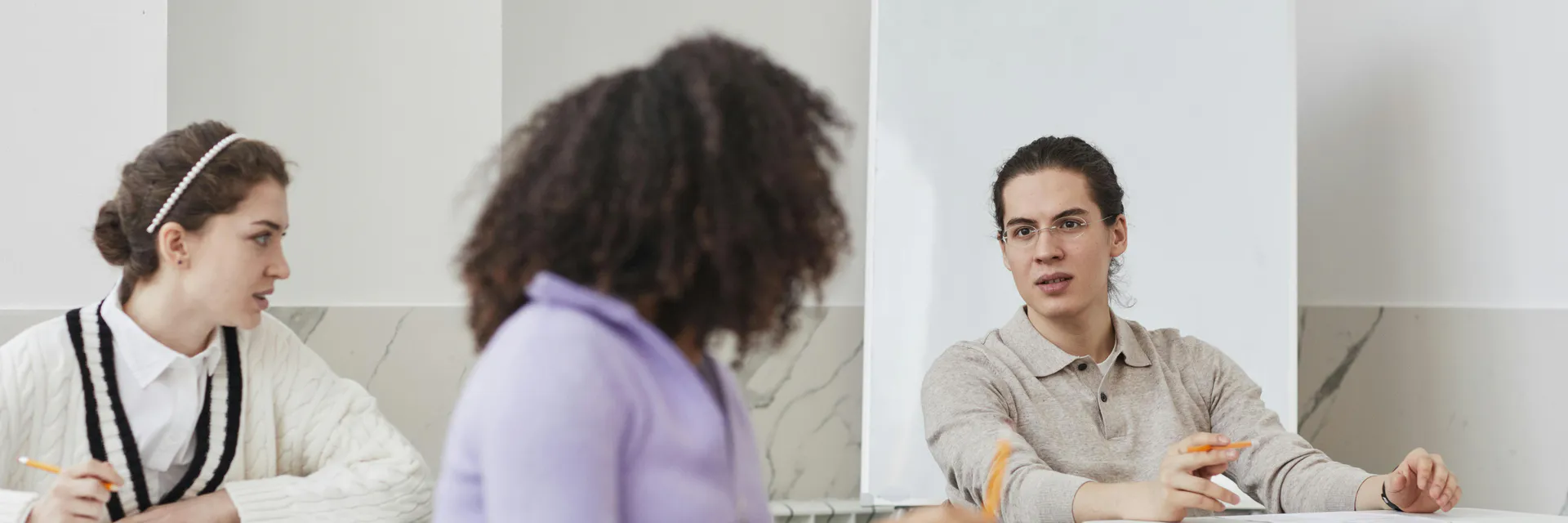
The role of students in VTS is central and active. They are asked to look closely at the image, giving them time to do so; they talk about what they observe, in response to the question "What is happening in this work?"; they validate their proposals with evidence from the work being analysed; they listen to and consider the opinions of others, commenting on the many possible interpretations of the same work; and they reformulate their own opinions based on what they have heard from their classmates.
a) Main Connections between John Dewey's Educational Philosophy and VTS: Experience as a Driver of Learning
John Dewey, in his book Experience and Education, argues as a fundamental idea in his educational philosophy that all genuine education comes from experience and the questions and issues that this experience generates.
This concept is particularly relevant in the educational theory and practice of museums in general, and more so when it comes to VTS, since this methodology allows the students to acquire direct experience of the museum object. It also encourages active observation, reflection and an object-centred, shared debate based on the students' concerns.
This is the kind of learning process that, as Dewey argues, is developed from within, based on the interests of the students. Far from the unidirectional, watertight and immovable, transmitting models of traditional teaching in museums, this process allows for the student to incorporate previous experiences of, essential in the fact of forming an opinion on what they are observing. Previous opinions are thus modulated to create new ones and there is a transaction between the individuals and their specific environment.
Therefore, according to what Dewey proposes, we can say that a valid experience that leads to real knowledge occurs, as it has a continuity (each experience takes a part of what has happened before and somehow modifies what will come later) and interaction (an experience is how it is, due to the transaction that takes place between the individuals and their specific environment).
If a rich experience is a tool and a goal in itself, the same can be said of the process of debate that is generated around the work in a VTS interpretation: debates generate knowledge which is transferable to other areas of competence but the process is also learning in itself.
Dewey tells us that an aim for the experience must also be determined, understood as an action plan based on the future outcome of actions. As a museum, the impact on students of the visits for formal education is very short-term, being limited to the specific experience of the visit or visit-workshop.
It is important to make the students aware of the process being followed during the VTS session so that they understand what they have been doing, and it is also necessary to link and gather together the different knowledge that the group has been exposing and modulating during the discussion so that they become aware of the body of information they have constructed.
Therefore, the VTS provide us with a teaching and learning model that fosters critical autonomy in front of the work based on an enriching experience of open debate.
b) Ties between the proposal of an education for understanding by Howard Gardner and VTS
In the chapter "Designing an Education for Understanding," in his book The Development and Education of the Mind, Gardner advocates for a model of education that stimulates interest in understanding deeper issues related to the world and life.
VTS addresses this point directly, as the learning process it proposes takes as a starting point the questions arising from the interests of the students; asking them to formulate hypotheses based on these interests; putting forth evidence-based justification for these hypotheses; reflecting on one's own observations and those of others; and promoting decision-making processes, based on available information.
Gardner argues that one of the current problems with teaching is that it aims to cover too much non-competency content, learned by heart. He proposes that we need to learn rather than memorise facts. The way to have lasting learning is to examine a few specific topics in depth, so as to teach comprehension. He warns us that non-contextualised memorised knowledge is forgotten: learning takes root when it is the result of rich, multifaceted and disciplinary research, which provides a sophisticated understanding.
In relation to these statements, we can appreciate that the VTS require the number of sessions of "interpreting" works to be limited, both in their duration as well as in the number of times that they are done, in order to focus in less contents but of higher quality, without exhausting the student in a repetition of the same debate routine; respecting the reasonable period of attention of each student performing the same task; and limiting the amount of new content that comes up for discussion, in order to enable in-depth examination and understanding.
VTS also proposes a contextualisation of the knowledge and learning that arises in a context of joint research, given that the observations are directly related to the work and come from the information network of the students, who work together to make observations and reach conclusions.
VTS provides a welcome shift in traditional teaching practices in museums, in which students were passive recipients of a simplified and summarised, unidirectional discourse on Art History, which was not contextualised in the framework of the students' knowledge.
An analysis of the four elements of the "path to understanding" that Gardner highlights for us, based on the contributions of VTS to learning, would provide us with the following reflections:
Learning from other appropriate institutions: VTS is a methodology that allows the museum to be a suitable institution for learning, as it does so in a way that facilitates deeper understanding of the work of art or object.
Directly addressing misconceptions: In this instance, perhaps VTS is more ambiguous, as one of its assumptions is precisely not to affirm or deny any of the conclusions reached by students. Perhaps we could reflect more broadly and point out that VTS, in an art museum setting, allows us to confront the misconception but widespread notion that in order to relate to the work of art we need an "interpreter", a moderator who explains what the work is about, as we alone would be unable to understand it. In other words, VTS allows misconceptions to be
directly confronted about art museums as places that are "difficult" to understand. It also addresses the insecurity that most visitors have about their own ability to be autonomous in front of the work of art.
Exercising in a reference framework that facilitates comprehension: this point has already been mentioned above, when we stated that the discussion about the work is contextualised because it is about a specific object and it is being shared by all participants. The knowledge generated is contextualised as it is based on, and is clearly justified by, this object.
Working on multiple ways of understanding: VTS do not provide closed interpretations of the work of art. Rather, they make the students aware of the many possible interpretations and leave it up to them to choose the one that best suits their worldview. Here the role of the moderator is crucial. He or she must accept each and every one of the students' contributions with neutrality and return them to the group, by paraphrasing them in the conditional tense, that is to say, always leaving the way open for their plausibility and suitability as interpretations of the work.
c) Aspects in which VTS respond to neuroscientific processes that affect teaching and learning
In his article Claves neurocientificas para la ensenanza y el aprendizaje (Neuroscientific keys to teaching and learning), Morgado explains how motor and mental habits are acquired differently and are also hosted in different areas of the brain from semantic knowledge. While repeated practice is essential to establishing motor and mental habits, semantic knowledge requires comparison and contrast between different information.
The best way to achieve relational and flexible memories, susceptible to being evoked in varied and different situations or contexts that originally generated learning, consists of comparing and contrasting (answering questions, summarising, analysing differences and similarities and inferring) between multiple and diverse information. Passive attitudes are not the best way to form relational and flexible memories, as they tend to form rigid memories, which are of little use when it comes to evoking memory in different contexts or ways.
According to this statement, we can therefore assess that VTS is an ideal methodology for the acquisition of semantic knowledge, as it consciously and systematically exercises this comparison and contrast between different information. The opinions of each member of the group provides us with visions that can be contrasted, nuanced, concordant, or expanded from the same evidence, and must be compared, evaluated, and reflected upon in order to redo or reaffirm one's own opinions and knowledge.
This knowledge is acquired in a contextual, but at the same time, conditional way. That is to say, in a flexible way, and therefore can be used in different contexts. No series of historical-artistic data has been learned about the artist or artistic movement, which may not be remembered in front of another work of art or may not have any connection to a different style or era.
What we have learned is a way of looking at the work and asking ourselves those questions that give us autonomy in front of an artistic creation, while being aware that our responses are just one of the many possible answers.
Another aspect that I found relevant is the statement that "the best way to learn is to try to teach, in such a way that the best way to teach consists precisely of inducing the learner to do so in the same way".
Thus, the learning technique that produces the best results consists of explaining what has been learned. This is also true when we evaluate what has been studied, given the fact that evoking the content not only evaluates, but also enhances the memory.
In an interpretation of a VTS work, the participants express their observations aloud, so they must pass their thinking through the mental process of organising it and turning it into words, with all the evolution and definition of the idea which takes place when it becomes oral.
Also, listening to it repeatedly, in the paraphrasing, by the moderator, allows on the one hand to validate it, as it is accepted and returned to the group by the character who acts as a reference in the process; and on the other hand, it allows us to evaluate it, as we gain a distance over it that provides us with information about which aspects require enriching or modifying.
All these processes also help to remember it, because as Morgado tells us, the fact of explaining content obliges us first to understand it and analyse in an orderly way its main points, processes that help to fix it in our brain.
Morgado also tells us that the brain needs time and repetition to create internal connections (synapses) that allow hosted and interrelated knowledge, with resting spaces between repetitions to allow information to be fixed. That is why distributed learning is more effective than intensive learning, as it avoids interference and gives time for the slow processes underlying the formation of consistent memories to take place.
We can say that VTS allows for distributed learning, as it is with the repetition of interpretations of works that the underlying processes that are relevant are acquired: the development of visual literacy (or autonomy in front of the work of art), the development of critical thinking; of language and communication skills; and fostering group spirit and mutual respect.
d) Working on emotional education based on VTS
The article Laintelligence emotional en la infancia y la adolescencia. Capitulo 2. De laintelligence emotional a la educación emotional explores how there is more than one model of emotional intelligence.
The most cited are those proposed by pioneers Salovey and Mayer in the early 1990s, and the best known by Goleman in 1995, who by structuring emotional intelligence into five key elements, laid the groundwork for his current study.
According to Goleman, emotional intelligence consists of:
- Self-awareness - knowing your own emotions
- Self-regulation – managing your emotions
- Motivation - motivating yourself
- Empathy – recognising the emotions of others
- Social skills - establishing positive relations with others
Emotional education is a continuous and permanent educational process, which aims to enhance the development of emotional skills as an essential element of human development, in order to train for life and in order to increase personal and social well-being.
The general agreement is that there are emotional skills that all people should learn, developed through a series of emotional education strategies.
Working in VTS can provide tools to work on emotional skills, directly or indirectly:
- Emotional Awareness: Knowing your emotions and the emotions of others. We can say that VTS, indirectly, allows us to assess how we feel: Do we want to talk? Are we afraid to do so? How do we feel about what we said? And how the others feel: How do they feel about what I say? Do they want to talk too? It should be borne in mind that this competence is not worked on directly, but that the teacher must take advantage of the synergies caused during the session with the group and develop them through other processes in the classroom.
- Regulation of Emotions: Providing a suitable response to emotions (a balance between repression and lack of control of these). Do we get frustrated when we can't talk when we want to? Is it hard for us to be quiet and focused on what others are saying? Or quite the opposite, I'd like to talk but don't dare to. Do we get angry if someone disagrees with what we say? Are we afraid to make mistakes? A good moderation of a VTS session will take care to give the word in an organised and regulated way, explaining beforehand what the mechanics of participation will be, so that the participants know and understand. Care should also be taken to regulate the interventions of some participants and encourage others, in order to give
each of them a space to express themselves according to their abilities. And above all, an emotionally safe environment will be built where no one is wrong and all the comments are received with the same level of acceptance, that is to say, that are all equally correct or incorrect.
- Emotional Autonomy: To not be seriously affected by the stimuli of the environment. This skill is worked on in a more tangential way, providing the students with an emotionally balanced space that allows them to regulate their emotions and level them to those of the group.
- Socio-emotional skills: Competencies that foster interpersonal relations. In this area, the work of the VTS is direct and has a strong impact on the group. Its mechanics require working on social skills, given that respect for the order of interventions and listening to the opinions of others is a first step that is worked on consciously in order to carry out the debate. It allows the students to perform the procedure, basic in democracy, of allowing the others to express their point of view; contributing their own ideas; hearing all the points of view of the group validated equally by the moderator; reflecting on their own ideas based on those of others; and generating collective knowledge, which leads directly to group cohesion and mutual respect for what can be achieved by working together.
- Life skills and wellbeing: The contributions of VTS are also indirect in terms of this competence, but the methodology allows learning from one's own interests, which are thus validated; providing security and nurturing the self-esteem of the students, who feel competent, autonomous and stimulated; and this creates mental structures applicable to other situations of debate, which broadens the worldview and reduces anxiety.
It is important that emotional education programmes are always accompanied by ethical principles: we must avoid exploitative or dishonest purposes, which would be totally counterproductive, as well as environments that generate tension and stress, which block the learning process (which also has a scientific basis, as explained in the video by Mara Dierssen: Construyendoolestes cerebros - Building Better Brains (TED Talks)).
The safe atmosphere of the VTS session, with a slow and respectful moderation, fully responds to these ethical principles.
e) Getting excited about learning through VTS
The last article to be examined is that of Francisco Mora. ¿Por qué el cerebro necesitaemotionarse paralerpender? (Why does the brain need to get excited to learn?). Research in the field of neuroscience shows that emotions are essential in the reasoning and decision-making processes, forming the basis of curiosity and attention, and are determinant in the learning processes.
The prefrontal cortex functions as a regulator of the governing area of emotions, the amygdala, and is the seat of executive functions, which allow us to plan, correct, and direct behaviour towards specific purposes.
How can VTS help executive functions work? Briefly, we can determine that the main executive functions are affected as follows:
Inhibitor Control: Ability that allows us to deliberately inhibit or control automatic behaviours, responses, or thoughts when the situation requires. A VTS session allows you to do this function as it asks the child to carry out a group activity in which they have to keep their attention to follow the thread of the discussion, giving them time to reflect and asking them to take turns.
Work Memory: Short-term memory that allows us to maintain and manipulate information that is needed to perform complex cognitive tasks such as reasoning or learning. The narrative component of the VTS (in which a child explains to the rest their narrative about the work, and this is repeated in the group in the form of paraphrasing by the moderator) helping to exercise this type of memory.
Cognitive Flexibilities: The ability to switch flexibly between different tasks, mental operations or goals. The formulation of hypotheses from a work and its immediate verbalisation that are given to the VTS involve the management of strategies of adaptation to unexpected situations, to think without rigidity or automatisms, using analogies and metaphors and posing open problems. However, VTS work from the perspective of various decision-making options and assume error as another element in the learning process.
It is often said that students are not motivated to learn, but what happens is that they are not motivated to learn what teachers want, but to learn many other things. We humans are curious and want to learn what catches our attention, or is different. Therefore, VTS, which is based on the students' curiosities, drawing their attention according to their previous experience, is a good motivational tool that puts the students at the centre of their learning allowing them to develop it from their interests.
While some emotions allow us to learn, others inhibit our ability to do so. Fear and stress are two of the main inhibitors of learning, reducing the "cloud" of neural contacts and thus the number of synapses that can be made.
The absence of fear and working in an emotionally secure environment make thoughts broader, more open, and free. Happier people tend to solve creative problems better by showing a greater ability to associate distant ideas and more open visual attention.
VTS creates an emotionally secure environment, where no one can be wrong as there are no right or wrong answers. To achieve this, it is crucial to be strict in the type of questions that are asked, which must be open. Care should be taken not to ask questions such as "yes or no" or "guess what I'm thinking", which generate right or wrong answers.
We also need to be very careful with paraphrasing, and accept all responses with equal neutrality, no matter how far they may be from our perception (or canonical) of the work. Showing more enthusiasm for some answers than for others or distorting the comment during paraphrasing will make students distrust the open conversation process.
Finally, I include here the list of practical actions proposed by Mora to arouse the excitement in the students and improve the educational processes and I make a brief comment on whether they can be addressed in whole or in part from the regular practice of VTS in the classroom:
- Showing enthusiasm about what we are doing: a VTS interpretation is fun, and the moderator should warmly welcome the opportunity to share opinions with students.
- Generating positive emotional climates in the classroom: not worrying about making mistakes, having time to think and listen, sharing opinions, creating collective knowledge, etc. All these are actions that promote group cohesion and develop social skills that generate in a positive climate.
- Encouraging active learning in which students are the protagonists: in VTS, the students are the active centre of the learning process.
- Linking learning to everyday situations: Our students are surrounded by visual culture but have very few tools to interpret it critically. With VTS they are given a tool that allows them to make their own interpretations.
- Taking into account the interests and prior knowledge of the students: as we said before, VTS debates are generated from the interests of the students and are a universal methodology that adapts to their cognitive level.
- Providing suitable challenges and continuous feedback: each work presents a small "mystery" to decipher, and has the return of the classmates to expand knowledge and reflections.
- Encouraging cooperative work at all levels: VTS discussions are based precisely on cooperative work.
- Arousing curiosity at the beginning of classes with cognitive conflicts and new strategies: it is very good to start a topic or project work by interpreting works in VTS. It also gives a lot of information to the educator about what prior knowledge and what
interests the students have on that topic, which allows them to guide the subsequent work.
- Prioritising social and emotional education: it is a work that is done in parallel in every VTS session.
- Promoting a growth mentality in the classroom away from limiting labels: in these sessions, other values and intelligences come into play than those that traditional education makes shine: therefore the previous roles are blurred and new abilities appear that modify pre-existing relationships and labels.
- Expressing positive expectations about the ability of students and looking with affection at students: this is achieved by highlighting the validity of all the contributions, validating them with paraphrasing and thanking them.
In conclusion, I would like to say that this analysis in terms of educational theory and learning processes has further strengthened my belief in Visual Thinking Strategies as a first-rate tool for fostering meaningful, open, experiential, and emotionally rich learning for students of all ages, which develops the main aspects of the most relevant and innovative philosophies in education and which also responds to the assumptions of how we learn from recent discoveries in neuroscience.