This study focuses on the learning strategies of learners from Francophone backgrounds immersed in English Medium of Instruction schools (EMI) in Yaoundé, Cameroon. It also investigates the challenges faced by the students in effectively applying and using these strategies. To this effect seven English medium of instruction schools were identified and chosen in the capital city of Yaoundé and used for this study. In the selected schools four hundred learners who hailed from Francophone homes and were immersed in the English Medium of Schools were chosen and used for this study. The tools engaged for this research endeavor comprised classroom observation, interview and the questionnaire. The results from our investigation showed that these learners used Cognitive, Metacognitive, Affective, Social as well as Authority-oriented strategies. It should be noted that the learners faced different challenges in applying the different strategies. In general the strategies worked out well because the students accomplished their goals which included success in learning content subjects as well as the acquisition of improved proficiency in the English language.
## I. INTRODUCTION
While some people view success as the goal of learning, be it language learning or, content subject learning is success (academic success) others have as main goal knowledge gain. Various methods and approaches are used in the learning process to achieve the expected goals. These methods used by these learners are known as learning strategies. While some learners use these strategies in an environment arranged or established for them, others use these strategies in an environment in which they are forcefully (unconsciously) registered. It is the case of Francophone learners registered in English Medium of Instruction schools (EMI). The study thus sets out to study the learning strategies of Francophone learners in EMI schools. The study is on Francophone learners studying in selected EMI schools in the capital city of Yaoundé. Since the 1990s Francophone parents have been registering their children in EMI schools. It was a bizarre phenomenon because a medium of instruction had expressly been set for this group of students following the historical realities of Cameroon. The
English Medium of Instruction (EMI) was established for Anglophone learners and the French Medium of Instruction (FMI) was established for Francophone learners, however, more and more Francophone learners tend to be registered in EMI schools.
Recent studies on EMI in the French-speaking regions of Cameroon (Anchimbe 2007, Kuchah 2013, Mforteh 2008) have identified the critical role of parent's perceptions of the economic and instrumental value of EMI on their decisions to send their children to English medium schools. According to Mforteh (2008) EMI was particularly popular in urban Francophone areas where younger parents perceived bilingual education in English and French as the basis for progress, educational opportunities, and social mobility. It is also claimed that the choice of EMI in Francophone Cameroon results from parent's awareness of the international spread of the English language (Kouega 1999; 329). Based on studies that examine the economic advantages of EMI (Casale and Posel 2011; Dearden 2014; Pinon & Haydon 2010), the driving force behind the significant growth in the use of EMI, particularly across the global south, is mainly an assumed relationship between proficiency in a 'global' language and the economic development of a country. Studies that have however addressed the current interest in EMI in Francophone regions of Cameroon (Abongdia & Willans 2014; Anchimbe 2007) have pointed to the instrumental benefits to individuals rather than for national development. Kouega (1999:39) studies the high demand of English-medium schools in urban centers results from the failure of the equal promotion of English with French (as stipulated by Section 1.1.3 of the 1996 constitution). He observed that some parents tend to register some of their kids in English-medium schools because they are not satisfied with the bilingualism policy of the country and are aware of the importance of the English language worldwide. The immersion is equally explained by the fact that many parents from Francophone homes had gone through EMI, it is thus evident that they registered their children in EMI schools.
## II. THE PROBLEM
More and more learners from Francophone homes tend to register in EMI schools and knowledge acquisition is one of the main goals. These learners will thus have to adopt methods and strategies to cope in this learning environment not designed for them from the onset. The learners might however encounter different challenges in using the different learning strategies.
## III. THEORETICAL FRAMEWORK
Two theoretical frameworks were used in this research work; Vygotsky's socio-cultural theory and Gagné's learning theory.
The socio-cultural approach emphasizes the interdependence of social and individual processes in constructing. Though young language learners (especially young English language learners) were at the heart of this approach, we will use this approach on learners who have already acquired the language and are thus developing strategies (consciously or unconsciously) to succeed academically. Vygotsky's socio-cultural theory explains how individual mental functioning is related to cultural, institutional, and historical context; hence, focus of the socio-cultural perspective is on the roles that participation in social interactions and culturally organized activities play in influencing psychological development. Vygotsky (1978) posited that social factors are necessary processes to development. He argued for the uniqueness of the social milieu and regarded sociocultural settings as the primary and determining factor in developing higher forms of human mental activity, such as voluntary attention, intentional memory, logical thought, planning, and problem-solving. His most outstanding work is the concept of Zone of Proximal Development (ZPD), which is regarded as a remarkable contribution in the domain of education and the learning process.
One of the fundamental concepts of sociocultural theory according to Lantolf (2000) is its claim that the human mind is mediated. Lantolf (2000) claimed that Vygotsky found a significant role for what he called tools in humans understanding the world and themselves. Vygotsky advocated that humans do not act directly on the physical world without the intermediary of tools. Symbolic or signs tools according to Vygotsky were artifacts created by humans under specific cultural and historical conditions, and as such carry with them the characteristics of the culture in question. These tools are thus primarily cultural. These cultural tools constitute the learners' environment.
The socio-cultural theory is now described as
Every function in the child's cultural development that appears twice: first, on the social level, and later, on the individual level; first, between people (inter psychological) and then inside the child (intra psychological). It applies equally to voluntary attention, logical memory, and the formation of concepts. The higher functions originate as actual relationships between individuals (Vygotsky, 1978: 57). The theory revolves around scaffolding, mediation, and zone of proximal development.
## IV. GAGNE'S LEARNING THEORY
Gagné is associated with the cumulative learning theory. His theory posits that behavioral learning results from cumulative effects of teaching (Kennedy L, 2009). Gagné considered learning as a significant causal factor in development rather than a factor merely involved in adaptation. Robert Gagné is viewed as a bridge theorist because he took the best of both worlds: behaviorism and cognitivism create his instruction and design. Gagné posits that learning results in behavioral changes that are observable. Gagné called these changes behavior outcomes. Gagné (1985, in Gagné, et al. (2005:7) contended that instruction must consider all external factors such as environment, resources, and management of learning activities which interact with internal conditions such as state of mind that the learner brings to the learning task, previously learnt capabilities, and personal goals of the individual learner. Gagné's internal factors that other instructional designers did not consider are very important factors that can affect the academic performance of learners in one way or another. Conditions of learning are important to Gagné's ideas of instruction. That is, internal conditions deal with what the learner knows prior to the instruction, external conditions deal with the stimuli that are presented to the learner, a typical example includes instructions provided by the teacher (Rostami K and Ishaq S, 2011).
In this theory, Gagné mentioned outcomes which are according to Gagné descriptions of educational goals in terms of what is to be accomplished through the prescribed learning activities (Ngussa B M 2014). Gagné also maintained a cognitive perspective in which learning was organized from an individual's effort to construct his or her own personal knowledge. Gagné mentioned different learning outcomes expected from learning.
The taxonomy of learning outcomes takes into consideration the Cognitive domain (cognitive strategies, intellectual skills as well as verbal information) and the Affective domain. Gagné put forward nine events of instruction which motivated him to set conditions for learning:
- Gaining attention Reception;
- Informing learners of objectives;
- Stimulating recall of prior learning Retrieval:
- Presenting stimulus material -Selective perception:
- Providing learning guidance- Semantic encoding:
- Eliciting performance (practice) - Response generation
- Providing feedback - Reinforcement
- Assessing performance - Metacognition
- Enhancing retention and transfer - Generalisation (Gagné R, 1992)
## V. RESEARCH METHODOLOGY
Four hundred respondents from seven (7) EMI schools were chosen for the study. The respondents were form five, lower sixth and upper sixth students.
Students from Francophone homes were chosen from different EMI schools in Yaoundé (both private and secondary). The students represented Francophone learners from the eight French-speaking regions of the country. Boys and girls were chosen for the research work. The respondents include a research population made up of four hundred students. Four hundred questionnaires were thus analyzed for this research work. The students came from seven different schools: Saint Benedict College, Government Bilingual High school (GBHS) Ekorezock, Government Bilingual Technical School Yaoundé (Ngoakele), Genius Centre, Holy Infant, Government Bilingual High school Etou-Gebe and Gaiété International School Complex. Nonpublic and public schools were chosen because the discipline and follow-up of students in private schools is believed to be different from that of government schools. Moreover, private schools do not always have an adequate (sufficient) trained staff. Furthermore, there seems to be a better follow up of students in private than in government schools. To avoid bias we chose public and private schools.
As mentioned earlier, students from form Five to upper sixth were selected for this research work. We chose these three classes because they are examination classes. In Form five, students sit for the Ordinary Level General Certificate of Education examination (O-level) and in upper sixth, students sit for the Advanced Level General Certificate of Education examination (A Level). However, in lower sixth, students prepare themselves for the A-level. Moreover, lower sixth students who deem themselves capable can decide to sit for A-level in lower sixth. Furthermore, these are classes in which the students are supposed to be more conscious since they have to go through end-of-course (ongoing) national examinations. Students are equally believed to be more focused and concentrated at this level and to have developed different learning strategies.
A class Observation was equally carried out to see how these students directly or indirectly use learning strategies in a classroom when they do not understand a lesson or when they answer a question during in school.
### a) Learning Strategies
The reading frequency of the students is addressed in this research work. Students were asked if they loved studying, why they loved studying and how they study both in school and at home.
Considering that these students are from French-speaking homes and are studying using English, the methods (strategies) used in learning the subjects which are taught (by teachers) and analyzed (by these learners) using the English language were equally addressed. We grouped the methods under different strategies. Added to this, the students were asked if they understood the lesson in class and how they work when they do not understand the lesson while in class.
We equally addressed the learning strategies used by the learners at home, as how they revised their lessons; moreover, the students were asked how they proceeded when they did not understand a lesson. The techniques will be classified accordingly. On the distributed questionnaires on learning strategies, the following answers were given by the respondents:
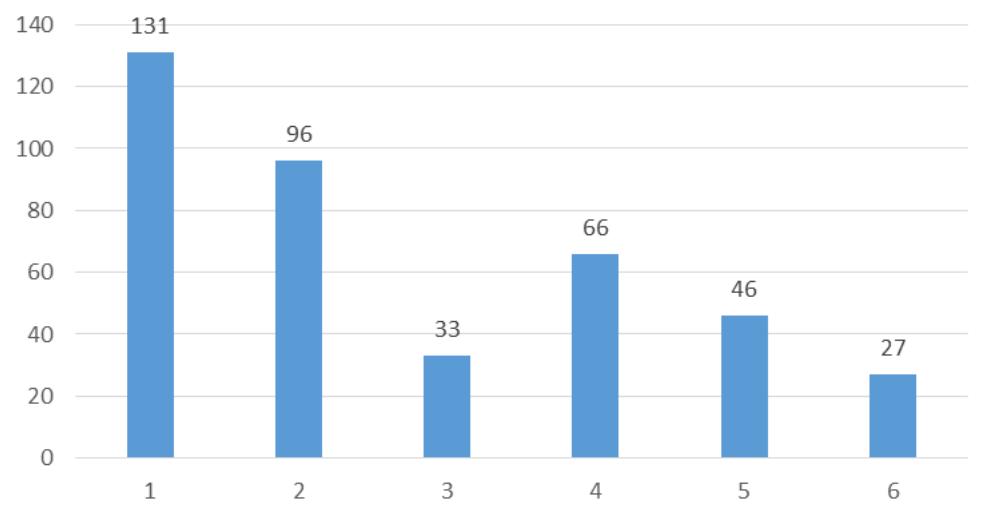
Of the 400 students who took part in this fieldwork,
- 131 (32.75%) students admitted asking questions to their classmates when they did not understand (social strategy);
- 96 (24%) students admitted asking questions to their teachers when they did not understand (social strategy; authority-oriented):
- 33 (8.25%) students said they listened to the lesson and later put this lesson into practice (metacognitive):
- 66 (16.5%) students admitted that they just copied their notes (did not care):
- 47 (11.75%) students paid attention to the lesson, took down notes (major points of the lesson) and later asked questions when necessary (cognitive strategies);
- 27 (6.75%) students said they discussed each other's difficulties amongst classmates after the lesson (social strategies).
<table><tr><td colspan="12">Learning Strategies in Classrooms</td></tr><tr><td colspan="5">Social Strategy</td><td colspan="2">Metacognitive Strategies</td><td colspan="2">Cognitive Strategies</td><td colspan="3">Do Not Care</td></tr><tr><td colspan="2">Request
classmate's help</td><td colspan="2">Request
teacher's help</td><td colspan="2">Discuss the lesson together</td><td>Practise the lesson</td><td colspan="2">Jot important points</td><td colspan="3">Just copy the notes</td></tr><tr><td>number</td><td>%</td><td>number</td><td>%</td><td>number</td><td>%</td><td>Number</td><td>%</td><td>Number</td><td>%</td><td>Number</td><td>%</td></tr><tr><td>131</td><td>32.75%</td><td>96</td><td>24.%</td><td>27</td><td>6.75%</td><td>33</td><td>8.25%</td><td>47</td><td>11.75%</td><td>66</td><td>16.5%</td></tr></table>
 Learning strategies
#### Learning Strategies of the learners
Based on the collected data, the researcher discovered that these students had different revision strategies like.
- Social strategies (studying with classmates)
- Plan their work (metacognitive strategies)
- Request the help of the teachers (authority-oriented strategies)
- Put the lesson into practice (metacognitive strategies)
- Take down notes: (metacognitive strategies)
- Draw a working timetable (metacognitive strategies)
- Carry out online research (metacognitive strategies)
- Discuss each others difficulty (motivational strategy)
- Summarise the lesson (cognitive strategy)
- Studying using the class timetable
- Authority-oriented
Regarding learning strategies, many students (32.75%) use social methods (address difficult questions with classmates or request their classmates to explain a lesson they have not understood). To Romero A (2012), as fundamental in learning activities especially in language learning activities. The social strategy is a way to improve the motivation of the student who is learning the language. The objectives of these learning strategies is mostly educational; that is success in classroom and examinations. They believe that believe that these learning strategies can help them succeed exams and move to the next level, enter into great universities or go out for better jobs. To Gagné (1985, in Gagne, et al (2005: 7), instruction must take into account the whole set of external factors like environment, resources and management of learning activities. These external factors interact with internal conditions such as state of mind that the learner brings to the learning task, previously learnt capabilities, and personal goals of the individual learner. It means that the environment of the student and personal goals consciously or unconsciously influence the learner in his or her learning environment. Social strategies enhance learning, that is, the learner learns with a goal in mind. Therefore, the learner puts in the necessary resources to achieve the expected objectives. In the different content subjects, each student uses different strategies. These students thus employ these strategies because they have various learning goals to attain. The students adapt these goals to their different learning strategies in order to obtain the behavioral and educational outcomes. The behavioral outcome here is what the individual expects to learn or to achieve (instrumental motivation). Considering that we have more individual than social strategies, the learners do not only depend on their teachers or on their classmates but more on themselves and their efforts. These factors come into play in the students learning. The strategies are thus individually goal-oriented. The learners usually request the aid of smarter classmates either from Anglophone or Francophone parentage or both. The social environment in which the learner finds his/herself equally contributes to the learning of the learner. Nevertheless, these learners unconsciously use these strategies. With these strategies, classmates or seniors (scaffolding) are involved. With the aid of classmates or seniors, these learners later construct their knowledge to make them independent independent and depend on themselves) by using the English language.
Furthermore, Gagné maintained a cognitive perspective in which learning was organized through individual's effort to construct knowledge. Using other documents or online research constitutes the personal research of the learner, the learner therefore tries to organize his/her personal knowledge by going beyond what was taught in class. It is important to note that these strategies are not only common to this group of learners. These strategies may seem simplistic, but these learners have to adapt to the Anglophone milieu in which they find themselves, they do not only have to adapt to the milieu but must equally succeed in this milieu, thus the use of these strategies. These strategies go beyond the simple revision of lessons taught in the classroom. Mastery of the English language is already an advantage for them, but they must use different resources. Linguistic adaptation at this level is at the academic level. Instrumental motivations are the main trigger behind this willingness to learn. Adaptation is equally viewed at the linguistic level with the fluent use of the English language. Considering that the learner always uses this strategy, this strategy becomes subconscious and consequently a routine for the learner, especially metacognitive strategies. Summarizing, an aspect of metacognitive etchique helps students to explain the meaning of information and to store this information in long-term memory (Senemoglu, 2010 in Nuri Doyan, 2015).
According to Gagné, there are different learning outcomes expected from learning. The taxonomy of learning outcomes considers the cognitive domain (cognitive strategies, intellectual skills and verbal information) and the affective domain. According to S S Wijirahayu and P Dorand (2018), we have to consider the importance of affective strategies in contributing to the student's speaking performance as far as language learning is concerned. Therefore, a model of affective techniques training, through the combination of variables is expected to overcome the challenges and create autonomous learning that impacts more the students speaking performance to increase the student's awareness and responsibilities to learn (S Wijirahayu and P Dorand (2018). These learning strategies include anxiety reduction, self-encouragement and monitoring emotions sub-variables. In the affective domain, we witness the interaction of students of how those who do not understand the lesson address their difficulties to their classmates to obtain better results. We equally noticed that stronger students tend to encourage weaker students. There was equally an aspect of monitoring, that is, weaker students accept to be monitored by the stronger ones. Moreover, positive attitudes of these students towards the English language and EMI constitute affective strategies which consciously or unconsciously motivate the students to succeed in EMI schools.
Regarding intellectual skills (which are part of metacognition strategies) mentioned earlier, the student tends to seek more information either online, from personal documents or their classmates. The students also tend to employ cognitive strategies such as assessing information from revised notes. These works here are more personal and individual considering that the expected outcomes of the used strategies are more personal than societal. It shows the academic consciousness of the students working to achieve their goals. The expected opportunities of these learning strategies are also outlined. Nevertheless, metacognitive strategies enable the learners to organize their skills.
Moreover, discussing difficulties amongst each other comes in as a motivational strategy. Rheinberg (2000) described motivation as an activating orientation to a target status which is regarded as positive. According to Rheinberg (2015), motivation influences the action duration and intensity. It implies that one of the main reasons why these students have attained the level in which they find themselves is their positive reaction towards EMI.
Furthermore, by using strategies such as online research, drawing a personal timetable or using other documents, the children go beyond the acquired knowledge learned in class by developing their learning skills and capacities. These students thus become intellectually autonomous; they move beyond their expected knowledge and capacities, adequately described in Vygotsky's Zone of Proximal Development (ZPD). Vygotsky's socio-cultural theory firstly assesses the children intellectual abilities then, secondly, evaluates the instructional practices. Vygotsky posited that a child could go beyond his present developing capacities. These actual capacities lead to other innovative and instructional learning capacities. While these students move from one class to another or from one level to another, they will adopt different strategies to adapt to the milieu (level) they find themselves. These strategies result from what they have learned and from their expected outcomes.
Online research and additional documents constitute tools used by learners in learning. This online research constitutes metacognitive strategies. It means that the learner upgrades knowledge and thus acquires new or additional information. The notion of intelligence comes in as Piaget (1983) defined intelligence as a particular instance of biological adaptation. It thus supposes that intelligence is essentially an organization and that its function is to structure the universe just as the organism structures its immediate environment (Plucker, 2004). The teacher and the learning environment (class room) enable the children to stimulate the students learning capacities, the teacher acts as a guide to the students, meanwhile English language use an adaptation strategy. In case a student does not master the English language, that student can neither read nor write the given lessons. These students thus use this linguistic strategy to develop other techniques which will permit them to adapt to their learning environment and to succeed in different class examinations. It can be explained by the fact that the students learn in the English language. We should note that that online research broadens the knowledge of the learner as he/she comes across different studies.
Social strategies are also used by these learners. The learners learn through interaction with their classmates and peers. There is a social and collaborative mode of learning as stipulated by Vygotsky; intelligence is developed through social interaction. The learners use this social interaction to elaborate other learning techniques which will develop their intelligence. Vygotsky believed that learning is done through interaction, through which the learner built sufficient skills to learn alone. Therefore, social strategies permit learners to understand through explanations given to them by their classmates, which the learners later develop or when they find themselves alone. Social strategies thus permit the learner to construct his/her knowledge. Furthermore, social learning strategies lead to cumulative learning as learners learn from each other, thus acquiring knowledge and abilities.
Regarding the above discussions, it is observed that these students consciously or unconsciously construct their knowledge through the different learning strategies employed, thus knowledge construction. Learning strategies are either carried out at the individual or societal level. These learning strategies are more mental (non-observable strategies) and behavioral (observable strategies). Behavioral strategies are mainly observed in classrooms. Non-observable strategies are mainly used at home or during revision. Behavioral strategies include taking down notes, summarizing, asking questions (either to the teacher or classmate) and discussing difficulties faced (amongst students).
It is however important to note that all these strategies result from the determination of the students to succeed. This determination comes from the attitudes and motivations of the students. These attitudes and motivations fall under affective strategies in the absence of these motivation and positive attitude towards EMI, these students could not develop strategies which will enable them to succeed in their learning environment. The motivation and positive attitudes constitute the mental aspect of the learning strategies. So according to (Claas Wegner1, Lea Minnaert and Friederike Strehlke 2013) learning strategies help to store particular facts in the long-term memory. Apart from the classical repetitive learning of word or vocabulary lists, content like rules and tables can be learned through memorizing techniques. Furthermore, learning strategies enable the learner to possess a good degree of autonomy and show initiative in learning processes, inspecting learning materials and understanding contents. This just implies that the outcome of learning strategies is knowledge construction.
## VI. DIFFICULTIES ENCOUNTERED BY STUDENTS
Though these students use different strategies to cope in the learning milieu in which they find themselves, these students equally have difficulties in using these strategies.
Out of the 131 students who used social strategies, 6 (4.6%) students admitted that sometimes they are shy to ask questions to their teachers when they do not understand a lesson in class 7 (5.38%) students admitted that sometimes they are shy to request the help of their classmates. Meanwhile 9 (6.9%) students admitted that when they ask questions to their classmates they are not convinced of the answers given to them by the latter. Out of the 130 students who used social techniques just 108 learners were able to cope. They have difficulties in different degrees. Furthermore, out of the 131 students who used social strategies 50 students admitted that sometimes they are humiliated by classmates when they ask proper explanations of the lesson.
Regarding cognitive strategies such as taking down notes, some students who used these strategies admitted that when they got back home they sometimes realized that some facts or points were missing and this rendered revision difficult.
Moreover, though these students use different techniques, their social techniques are mostly limited to the classroom environment, of the 400 students we interviewed, 280 students admitted that they receive little or no aid from their parents because their parents do not master the English language.
When the 66 students who admitted that they just take down notes were asked why they just copy down notes, 50 that is $83.3\%$ students admitted that they are afraid to ask questions to the teacher and classmates meanwhile ten that is $16.6\%$ students admitted that requesting better explanations from their classmates is a humiliation so they will instead try and understand the lessons by themselves.
## VII. PROPOSALS FOR OVERCOMING CHALLENGES
It is Important to note that more and more students from Francophone homes will be immersed in EMI schools, even outnumbering students from Anglophone homes. Consequently, a teacher who enters into such classes should be conscious of the fact that there are students from two different backgrounds in their classes and should thus adapt their teaching strategies in such a way that learners from francophone backgrounds will quickly grab the lesson.
Moreover, parents have a pedagogical role to play in this context, especially parents who have never been to EMI schools. These parents have to accompany their students both at the psychological and academic levels. There must be a continuous follow-up of these students when they get home, Moreover these parents must similarly make sure they are versed in the English language in such a way that English speaking is not only limited to the classroom environment but should equally be extended in homes,
## VIII. CONCLUSION
This work studied the learning strategies of Francophone learners in EMI schools. The focus was on content subjects. The collected data showed different strategies used by the learners. These strategies were both consciously and unconsciously used by the learners. The collected data showed that social strategies are the most used strategies by the learners in classrooms. Meanwhile, at home, these students mostly use cognitive and metacognitive strategies. English language speakers in EMI schools could equally use these strategies; however, these strategies are unconscious coping strategies used by Francophone learners in EMI schools. It should similarly be noted that these strategies are both non-observable that is mental strategies and noticeable strategies.
This study revealed that some of these students faced different challenges while using these strategies. These problems were mostly witnessed with students who used social and cognitive strategies. The difficulties are primarily at the psychological and affective levels. Teachers and parents have an important role to play in solving the different problems faced by their learners and children.
Generating HTML Viewer...
References
18 Cites in Article
E Anchimbe (2007). Linguistic Identity in Postcolonial Multilingual Spaces.
Daniela Casale,Dorrit Posel (2011). English language proficiency and earnings in a developing country: The case of South Africa.
J Deadern (2014). English as a medium of instruction -a growing global phenomenon.
Aleeza Leder Macek,Ronald Wang,Justin Cottrell,Emily Kay-Rivest,Sean Mcmenomey,J Roland, Jr.,Frank Ross (1985). Hyperbaric Oxygen Therapy for Sudden Sensorineural Hearing Loss – A Comorbidity Lens.
Rnehart Holt,Winston Unknown Title.
Gagné (1992). Principle of Instructional Design.
J Haydon,R Pinon (2010). English Language Quantitative Indicators⁚ Cameroon, Nigeria, Rwanda, Bangldesh, and Pakistan.
Jean-Paul Kouega (1999). Forty years of official bilingualism in cameroon.
K Kuchah (2013). Developing Programming through Age-Appropriate Software: KS1 Curriculum and Pedagogy.
J Lantolf (2000). Sociocultural theory and second language learning: Recent advances.
S Mforteh,A (2008). Language Attitude and Education in Multilingual Settings: The Case of Cameroon.
N Nel,H Mühler (2016). The Impact of teachers' limited English Proficiency on English Second Language Learners I South African Schools.
J Piaget (1983). P. H. Mussen and W. Kessen, Eds. Handbook of Child Psychology: Volume 1. History, Theory and Methods. New York: John Wiley, 1983. 590 pp. (Reviewed by Roger A. Dixon).
R Pinon,J Haydon (2010). English Language Teaching.
J Plucker (2004). Human Intelligence.
K Rostami,S Ishaq (2011). How to use Gagne's Model of Instructional Design in teaching Psychomotor Skills.
L Vygotsky,S (1978). Mind in society: The development of higher psychological processes.
S Wijirahayu,P Dorand (2018). Affective strategies, attitudes, and a model of speaking performance development for engineering students.
No ethics committee approval was required for this article type.
Data Availability
Not applicable for this article.
How to Cite This Article
Prof. Njwe Amah Eyovi. 2026. \u201cLearning Strategies of Francophone Learners in Selected English Medium of Instruction Schools in Cameroon\u201d. Global Journal of Human-Social Science - G: Linguistics & Education GJHSS-G Volume 23 (GJHSS Volume 23 Issue G1): .
Explore published articles in an immersive Augmented Reality environment. Our platform converts research papers into interactive 3D books, allowing readers to view and interact with content using AR and VR compatible devices.
Your published article is automatically converted into a realistic 3D book. Flip through pages and read research papers in a more engaging and interactive format.
This study focuses on the learning strategies of learners from Francophone backgrounds immersed in English Medium of Instruction schools (EMI) in Yaoundé, Cameroon. It also investigates the challenges faced by the students in effectively applying and using these strategies. To this effect seven English medium of instruction schools were identified and chosen in the capital city of Yaoundé and used for this study. In the selected schools four hundred learners who hailed from Francophone homes and were immersed in the English Medium of Schools were chosen and used for this study. The tools engaged for this research endeavor comprised classroom observation, interview and the questionnaire. The results from our investigation showed that these learners used Cognitive, Metacognitive, Affective, Social as well as Authority-oriented strategies. It should be noted that the learners faced different challenges in applying the different strategies. In general the strategies worked out well because the students accomplished their goals which included success in learning content subjects as well as the acquisition of improved proficiency in the English language.
Our website is actively being updated, and changes may occur frequently. Please clear your browser cache if needed. For feedback or error reporting, please email [email protected]
Thank you for connecting with us. We will respond to you shortly.