I. INTRODUCTION
Adenomyosis is a common, estrogen-dependent, a benign gynaecological disease characterized by endometrial glands and stroma invading, implanting, and proliferating within the myometrium to form diffuse or localized lesions. [1] Adenomyosis is common in women of childbearing age. The signs and symptoms include dysmenorrhea, menorrhagia, abnormal uterine bleeding, enlarged uterus, dyspareunia, and infertility, which can seriously affect the patient's quality of life. [2] About two-thirds of women who are diagnosed with adenomyosis are symptomatic and the most common symptoms include menorrhagia and dysmenorrhea. [3] The average age of presentation is usually above 40 years, although it can be seen in young women as well. [4] The prevalence of adenomyosis varies widely from to , depending on the method used for diagnosis and the rate of diagnosis during hysterectomy is approximately . [5] Adenomyosis often associated with hormone-dependent lesions such as endometriosis, uterine fibroids and endometrial hyperplasia/ polyps. Despite the prevalence and the severity of symptoms, the pathogenesis and etiology of adenomyosis yet not clearly understood. Epidemiological data suggest that a large number of births, spontaneous and induced abortions, and endometrial hyperplasia are associated with increased risks of adenomyosis. Other risk factors associated with adenomyosis include endometriosis, surgical trauma, cesarean section or curettage, and smoking. [4,6] Several evidences show the presence of association between infertility and adenomyosis where probable mechanisms involved including impairment of sperm transport, aberrant uterine contractility, alterations of adhesion molecules, cell proliferation, apoptosis, and free radical metabolism. [7] Adenomyosis is one of the causes of recurrent implantation failure during IVF treatment. [8] Traditionally, hysterectomy has been the only definitive treatment for patients with adenomyosis who do not need to preserve fertility. Other minimally invasive surgery like endometrial resection or ablation can improve the symptoms of menorrhagia but often fails to relieve dysmenorrhea. [7,9] At present, other medical treatments using suppressive hormonal treatment, such as oral contraceptive/low-dose estrogen (OC/LEP), danazol, aromatase inhibitor (AI), gonadotropin-releasing hormone analog (GnRH a) have been used to control symptoms of adenomyosis among women who are unwilling to undergo hysterectomy or who need to preserve fertility. Medical treatments for adenomyosis always follow the principles of the management of endometriosis, which are usually aimed at reducing the production of endogenous estrogen or inducing endometrial differentiation with progestin. The objectives of medical treatment are the inhibition of ovulation, abolition of menstruation, and achievement of a stable steroid hormone milieu, based on the concept that the responses of the eutopic and ectopic endometrium are substantially similar. Drugs used for medical treatment create a hypo estrogenic (GnRH agonists, Als), hyperandrogenic (danazol, gestrinone) or hyperprogestogenic (OCs, progestins) environment, with suppression of endometrial cell proliferation. [7,10] The levonorgestrel-releasing intrauterine system (LNG-IUS) has been approved in Europe for contraception since 1990. Because of the suppressive effect of levonorgestrel on the endometrium, LNG-IUS has been proven to be effective for the management of menorrhagia and dysmenorrhea. [11] The levonorgestrel-releasing intrauterine system (LNG-IUS), which releases of levonorgestrel every 24 hours during a 5-year period, has been proven to be effective for menorrhagia and dysmenorrhea. One systemic review and meta-analysis on effect of LNG-IUS on adenomyosis recommend that LNG-IUS is the preferred option over other hormonal therapies given its direct action on the uterus, low systemic levels of steroid hormone and long-acting user independent administration for women with adenomyosis, having desire for pregnancy or refuse hysterectomy as definitive treatment. [3,12] Potential mechanisms of LNG-IUS action are endometrial decidualization and atrophy, reducing endometrial blood flow and a decrease in the number of estrogen receptors in the endometrial glands and stroma. This may further prevent estrogen stimulation of myometrial adenomyosis causing the lesions to atrophy. The subsequent improvements in uterine smooth muscle contractility and reduced menstrual flow may explain the reduction in uterine volume. [13] Moreover, decreased expression of growth factors and the related receptors has been found in women with heavy bleeding and adenomyosis following LNG-IUS treatment. [14] Another randomized study showed a positive effect of LNG-IUS in around 100 women with adenomyosis suffering from heavy menstrual bleeding. Administration of LNG-IUS could reduce average blood loss by in adenomyosis patient with excessive menstruation. LNG-IUS demonstrates significant and comparable improvements in Hb levels to hysterectomy in treating adenomyosis-associated menorrhagia during the first year. Both treatments improve Health-related quality of life (QOL) but LNG-IUS seems to have superior effects on psychological and social life. [13,15] Dienogest, a novel
19-nortestosterone derivative, is a synthetic oral progestin that is highly selective for progesterone receptors. Several studies reported that dienogest is highly effective in reducing adenomyosis related pain. [16] Dienogest suppresses ovarian function and proves highly effective in the treatment of chronic pelvic pain. [17] Dienogest directly inhibits cellular proliferation and induces apoptosis in human adenomyotic cells. [18] It induces a mild hypoestrogenic and a potent local hypergestagenic environment that causes atrophy of endometriotic lesions without severe hypoestrogenic adverse effects. As there is similarity between endometriosis and adenomyosis in hormonal responses, dienogest is used for therapeutic alternative for symptomatic adenomyosis. [19] Hence, there is a strong need to develop well-tolerated medical treatments that provide effective outcomes for symptomatic adenomyosis. Ota et al. did a controlled clinical trial and showed that DNG and LNG-IUS could provide cost-effective, reversible, long-term treatment for patients with symptomatic adenomyosis, reducing the need for surgical intervention. [20] To choose between arrays of regimes of adenomyosis treatment, the impetus depends on patients' condition, facilities available, economic condition and general acceptability of the treatment regime concerned.
So, in this present study we aimed to evaluate and compare the effects of LNG-IUS and Dienogest among the woman with symptomatic adenomyosis.
II. OBJECTIVE OF THE STUDY
The main objective of the study was to evaluate and compare the effectiveness between LNG-IUS and Dienogest among the woman with symptomatic adenomyosis.
III. METHODOLOGY & MATERIALS
This was a randomized control clinical trial and was conducted in the Department of Reproductive Endocrinology and Infertility, Bangabandhu Sheikh Mujib Medical University (BSMMU), Shahbag, Dhaka, Bangladesh during the period from ____________ to ____________.
We included 20 patients with symptomatic adenomyosis diagnosis confirmed by transvaginal ultrasound in this study. All patients were divided by sequentially numbered sealed opaque envelopes into two groups- Group A & Group B. Among of 20 patients, 10 were in the group A and 10 patients were in the group B. Group A who received LNG-IUS and group B who received dienogest. Tabdinogest (Nuvista Pharma Ltd) was administered at a dose of once daily for 3 months continuously starting from days 2-5 of menstruation and Eloira (Pregna International, India), LNG-IUS, was implanted in strict accordance with the operating instructions within 7 days of the start of menstrual flow. The levonorgestrel-releasing intrauterine system (LNG-IUS) releases levonorgestrel 20mcg/day during a 5-year period.
These were the following criteria to be eligible for the enrollment as our study participants: a) Patients who were aged between 25-45 years old;
b) Patients with diagnosed case of symptomatic adenomyosis (menorrhagia and dysmenorrhea);
c) Patients with uterine length cm determined by ultrasound;
d) Patients who were willing to participate in the study; Anda) Patients with any contraindications with LNG-IUS or dienogest;
b) Patients with ovarian endometrioma more than in diameter;
c) Patients with undiagnosed vaginal bleeding;
d) Patients with the presence of uterine fibroids, including submucosal fibroids;
e) Patients with any acute illness or pelvic inflammation (e.g., renal or hepatic diseases, ischemic heart disease etc.) were excluded from our study.
Adenomyosis was diagnosed by presence of menorrhagia or dysmenorrhoea and based on patients' symptoms, physical examination & transvaginal ultrasonogram. Volume of uterus was measured by ultrasound and response for pain was measured on a visual analog scale (VAS) of 0-10 scale and volume of bleeding (regular, heavy, spotting) at the beginning of treatment and at interval of 3 months.
a) Uterine volume
The uterine volume was calculated using the formula for an ellipsoid (volume length anteroposterior diameter transverse diameter). [21]
b) Menorrhagia
Menorrhagia is defined as heavy menstrual bleeding (HMB) when menstrual blood loss
which interferes with a woman's physical, social, emotional and/or material quality of life. (De Cherney, Nathan, Laufer and Roman, 2019). Heavy menstrual bleeding was assessed by number of pads, passage of clots (size and number) and interference of quality of life.
c) VAS scale
The Visual Analogue Scale (VAS) will consist of a straight line of 10 cm with the endpoints defining extreme limits such as 'no pain at all=0' and 'pain as bad as it could be=10'. The patient was asked to mark her pain level on the line between the two endpoints. The distance (in cm) between 'no pain at all' and the 'mark' then will define the subject's pain. A higher score indicates greater pain intensity. Assessment is clearly highly subjective. The VAS was administered as a paper and pencil measure. In this study population, all patients rated their pain on a visual analog scale (vas, 0-10) before treatment and on next occasion, after 3 months of treatment. 0 - means no pain, 1-3 means mild pain, 4-7 means moderate pain, 8-10 means severe pain.
Statistical Analysis: All data were recorded systematically in preformed data collection form and quantitative data was expressed as mean and standard deviation and qualitative data was expressed as frequency distribution and percentage. Statistical analysis was carried out by using Statistical analysis was done by using SPSS (Statistical Package for Social Science) Version 26 for windows 10. Data was tested using paired t-test and chi-square test. P value was considered as statistically significant. Ethical clearance was obtained from Institutional Review Board (IRB) of BSMMU to undertake the current study.
| Variables | Group A (LNG-IUS) | Group B (Dienogest) | P-value | ||
| 25-34 years old | 5 | 50% | 10 | 100% | 0.01 |
| 35-45 years old | 5 | 50% | 0 | 0 | |
| Mean Age (years) | 34.80 ± 3.79 | 28.60 ±3.17 | 0.09 | ||
| Educational status | |||||
| Illiterate | 1 | 10% | 0 | 0.01 | |
| Primary & SSC | |||||
| HSC or above | 9 | 90% | 10 | 100% | |
| BMI(kg/m2) | 28.07±2.72 | 26.06 ± 2.46 | 0.07 | ||
| Previous pregnancy | 9 | 90% | 5 | 50% | 0.02 |
| Primary subfertility | 1 | 10% | 5 | 50% | 0.01 |
| Secondary subfertility | 7 | 70% | 3 | 30% | 0.01 |
| Ovarian endometrioma | 2 | 20% | 3 | 30% | 0.01 |
| Variables | At Baseline | At 3rdmonth | P-value | ||
| Group A (LNG-IUS) | Group B (Dienogest) | Group A (LNG-IUS) | Group B (Dienogest) | ||
| Dysmenorrhea | 10(100%) | 10(100%) | 8(80%) | 9(90%) | 0.001 |
| Pattern of menstruation | |||||
| Spotting | 0 | 0 | 0 | 2(20%) | 0.002 |
| Amenorrhea | 0 | 0 | 2(20%) | 2(20%) | 0.001 |
| Heavy | 8(80%) | 8(80%) | 0 | 3(30%) | 0.012 |
| Regular | 2(20%) | 2(20%) | 8(80%) | 3(30%) | 0.080 |
| Variables | Group A (LNG-IUS) | Group B (Dienogest) | P-value |
| VAS | |||
| At Baseline | 9.10±0.84 | 8.75 ± 1.14 | 0.000 |
| At 3rdmonth | 1.10 ± 1.10 | 4.30± 2.41 | 0.012 |
| Hemoglobin level (gm/dl) | |||
| At Baseline | 10.87 ± 1.42 | 10.82± 0.64 | 0.000 |
| At 3rdmonth | 11.57 ± 1.33 | 11.09± 0.53 | 0.000 |
| Uterine volume (cm3) | |||
| At Baseline | 268.08 ± 118.28 | 202.32 ± 117.76 | 0.000 |
| At 3rdmonth | 210.10 ±105.49 | 202.77 ± 118.33 | 0.000 |
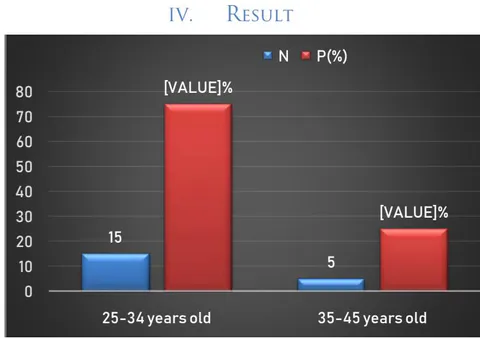
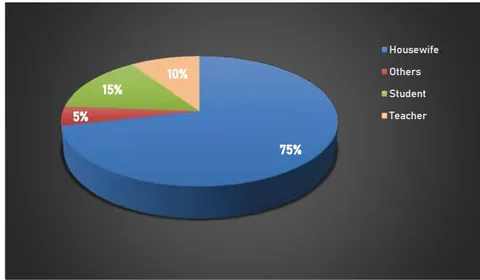
In this study figure 1 showed the age distribution among our study people. Majority of our patients (75%) were aged between 25 to 34 years old and 25% were aged between 35 to 45 years old. Here figure 2 showed the distribution of our study subjects based on their occupation. We found that majority of our patients were housewife (75%), 15% were students, 10% were teachers & 5% were from other occupation. In table 1 we showed the baseline demographic characteristics of our study population. We found the Mean ± SD of age was 34.80 ± 3.79 & 28.60 ± 3.17 among group A & B respectively. We found the mean of BMI was 28.07± 2.72 & 26.06 ± 2.46 respectively in group A & B. Previous pregnancy was found in 9(90%) & 5(50%) patients among group A & B respectively. We found primary subfertility in 1(10%) & 5(50%) cases of group A & B respectively. Secondary subfertility was found in 7(70%) patients in group A & 3(30%) patients in group B. We found ovarian endometrioma in 2(20%) & 3(30%) patients among group A & B respectively. In table 2 we showed the distribution of our study people based on dysmenorrhea & pattern of menstruation. Before treatment we found dysmenorrhea in 10(100%) patients among both groups. After 3 months interval we found dysmenorrhea 8(80%) & 9(90%) patients in group A & B respectively. Before treatment regular menstruation was found 20% in both groups; heavy menstruation was found 80% & 80% in group A & B respectively. At month spotting was found 20% in group B; amenorrhea was found 20% in both groups; heavy menstruation was found 30% in group B; regular menstruation was found 80% & 30% in group A & B respectively. Table 3 showed the clinical &laboratory variables among our study people. Before treatment the mean of VAS was 9.10±0.84 & 8.75 ±1.14 in group A & B respectively. At month the mean of VAS was 1.10 ±1.10 & 4.30±2.41 among group A & B and we found that pain was significantly lower among group A. Before treatment the mean of hemoglobin level was 10.87 ±1.42 & 10.82±0.64 n group A & B respectively. At month the mean of hemoglobin level was 11.57 ±1.33 & 11.09± 0.53 among group A & B and we found that hemoglobin level significantly increased among group A compared to group B. Before treatment the mean of uterine volume was & in group A & B respectively. At month we found the mean of uterine volume was & among group A & B and we found that uterine volume was significantly decreased among group A compared to group B patients.
V. DISCUSSION
In this study we found the majority of our patients (75%) were aged between 25 to 34 years old and 25% were aged between 35 to 45 years old. [Figure 1] In our study we found majority of our patients were housewife (75%), 15% were students, 10% were teachers & 5% were from other occupation. [Figure 2] We found the Mean ± SD of age was 34.80 ± 3.79 & 28.60 ± 3.17 among group A & B respectively. We found the mean of BMI was 28.07 ± 2.72 & 26.06 ± 2.46 respectively I group A & B. Previous pregnancy was found in 9(90%) & 5(50%) patients among group A & B respectively. We found primary subfertility in 1(10%) & 5(50%) cases of group A & B respectively. Secondary subfertility was found in 7 patients in group A &3 patients in group B. We found ovarian endometrioma in 2 & 3 patients among group A & B respectively. [Table 1] Before treatment we found dysmenorrhea in 10(100%) patients among both groups. After 3 months interval we found dysmenorrhea 8(80%) & 9(90%) patients in group A & B respectively. Before treatment regular menstruation was found 20% in both groups; heavy menstruation was found 80% & 80% in group A & B respectively. At month spotting was found 20% in group B; amenorrhea was found 20% in both groups; heavy menstruation was found 30% in group B; regular menstruation was found 80% & 30% in group A & B respectively. [Table 2] A study done by (Fedele et al.) inserted the device in 25 women with recurrent adenomyosis-related menorrhagia. Of the 23 women who completed 12 months of treatment, 2 had become amenorrheic, 3 were oligomenorrheic, 2 reported spotting, and 16 had regular periods. The authors speculated that the IUS produced decidualization and, subsequently, marked hypotrophy of the eutopic endometrium.[2] Another study (Barrington and Bowen-Simpkins) inserted the LNG-IUS in 50 women awaiting surgery and evaluated menstrual loss using a pictorial chart, a full blood count, and the measurement of ferritin. [22] By nine months post-insertion, bleeding was reduced to acceptable levels in 41 cases, with 4 subjects developing amenorrhea. These results were subsequently confirmed in larger cohorts. [9,23]
Before treatment the mean of VAS was & in group A & B respectively. At month the mean of VAS was & among group A & B and we found that pain was significantly lower among group A. Before treatment the mean of hemoglobin level was & n group A & B respectively. At month the mean of hemoglobin level was & among group A & B and we found that hemoglobin level significantly increased among group A compared to group B. Before treatment the mean of uterine volume was & in group A & B respectively. At month the mean of uterine volume was & among group A & B and we found that uterine volume was significantly decreased among group A compared to group B patients. [Table 3] A study done by (Yang et al.) showed that dienogest was more effective at relieving pain than LNG-IUS. After 3 months of treatment with dienogest, the patients' VAS score decreased from to , and pain control was more stable with extended duration of treatment. Dienogest also produced better control of dyspareunia and pelvic pain, symptoms that were poorly controlled by LNG-IUS, with a significant reduction in scores from to following 12 months of treatment.[24] These results are not consistent with our findings. (Yang et al.) also added that LNG-IUS was effective in reducing uterine volume in patients with adenomyosis, while dienogest demonstrated a modest effect in reducing uterine volume.[24] This finding is consistent with the findings of our study. Another randomized double-blind multicenter controlled study done by (Osuga et al.) found that 130 patients with symptomatic adenomyosis who adhered to dienogest for 52 weeks had a significant decrease in pain level scores and a decrease in the frequency of analgesic use. The pain scores decreased to at 24 weeks, and at 52 weeks, compared to baseline, indicating a more significant relief of dysmenorrhea in patients with symptomatic adenomyosis with long-term use of dienogest.[17] Clear advantages exist in treatment with the LNG-IUS in adolescents with HMB, dysmenorrhea, and pelvic pain/endometriosis, and, indeed, good results have been reported in young women with AUB, dysmenorrhea, and pelvic pain related to endometriosis, which is similar to our findings. [25]
VI. LIMITATIONS OF THE STUDY
Our study was a single centre study. We studied the effects of LNG-IUS & Dienogest on a few variables within a short study period. There are more variables of adenomyosis to be evaluated to know the effectiveness between LNG-IUS & Dienogest. After evaluating once those patients we could only follow-up them for 3 months and have not known other possible interference that may happen in the long term with these patients.
VII. CONCLUSION AND RECOMMENDATIONS
In our study, we tried to evaluate the effects of LNG-IUS and dienogest on patients with symptomatic adenomyosis. We found that LNG-IUS is a useful tool for HMB and dysmenorrhea in women of all ages. In our study the LNG-IUD is proved to be an effective approach compared to dienogest to treat adenomyosis. LNG-IUS is a promising and effective option for the management of adenomyosis. Its use effectively reduced the severity of symptoms, uterine volume and improved laboratory outcomes.
So further study with a retrospective and longitudinal study design including larger sample size needs to be done to increase the evidence-based knowledge about the effectiveness of these drugs which will help the clinicians to find an effective and safer medical treatment of adenomyosis.