
Lichen Species as Bio-accumulator of some Halogens on Mount Cameroon Valcano, West Africa

1
Ayuk Elizabeth Orock
2
A. B. Fonge
A. B. Fonge
3
E. M. Shemang
E. M. Shemang
4
M. Zhai
M. Zhai
5
C. E. Suh
C. E. Suh

Send Message

To: Author

GJHSS Volume 22 Issue B4

Article Fingerprint

ReserarchID

Q58R6

Lichen Species as Bio-accumulator of some Halogens on Mount Cameroon Valcano, West Africa Banner
  • English
  • Afrikaans
  • Albanian
  • Amharic
  • Arabic
  • Armenian
  • Azerbaijani
  • Basque
  • Belarusian
  • Bengali
  • Bosnian
  • Bulgarian
  • Catalan
  • Cebuano
  • Chichewa
  • Chinese (Simplified)
  • Chinese (Traditional)
  • Corsican
  • Croatian
  • Czech
  • Danish
  • Dutch
  • Esperanto
  • Estonian
  • Filipino
  • Finnish
  • French
  • Frisian
  • Galician
  • Georgian
  • German
  • Greek
  • Gujarati
  • Haitian Creole
  • Hausa
  • Hawaiian
  • Hebrew
  • Hindi
  • Hmong
  • Hungarian
  • Icelandic
  • Igbo
  • Indonesian
  • Irish
  • Italian
  • Japanese
  • Javanese
  • Kannada
  • Kazakh
  • Khmer
  • Korean
  • Kurdish (Kurmanji)
  • Kyrgyz
  • Lao
  • Latin
  • Latvian
  • Lithuanian
  • Luxembourgish
  • Macedonian
  • Malagasy
  • Malay
  • Malayalam
  • Maltese
  • Maori
  • Marathi
  • Mongolian
  • Myanmar (Burmese)
  • Nepali
  • Norwegian
  • Pashto
  • Persian
  • Polish
  • Portuguese
  • Punjabi
  • Romanian
  • Russian
  • Samoan
  • Scots Gaelic
  • Serbian
  • Sesotho
  • Shona
  • Sindhi
  • Sinhala
  • Slovak
  • Slovenian
  • Somali
  • Spanish
  • Sundanese
  • Swahili
  • Swedish
  • Tajik
  • Tamil
  • Telugu
  • Thai
  • Turkish
  • Ukrainian
  • Urdu
  • Uzbek
  • Vietnamese
  • Welsh
  • Xhosa
  • Yiddish
  • Yoruba
  • Zulu

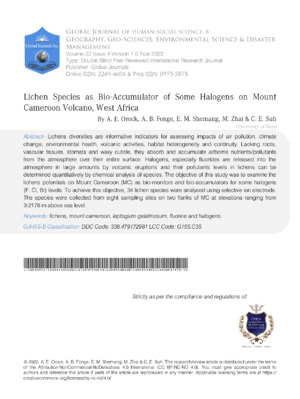
Lichens diversities are informative indicators for assessing impacts of air pollution, climate change, environmental health, volcanic activities, habitat heterogeneity and continuity. Lacking roots, vascular tissues, stomata and waxy cuticle, they absorb and accumulate airborne nutrients/pollutants from the atmosphere over their entire surface. Halogens, especially fluorides are released into the atmosphere in large amounts by volcanic eruptions and their pollutants levels in lichens can be determined quantitatively by chemical analysis of species. The objective of this study was to examine the lichens potentials on Mount Cameroon (MC) as bio-monitors and bio-accumulators for some halogens (F, Cl, Br) levels. To achieve this objective, 34 lichen species were analysed using selective ion electrode. The species were collected from eight sampling sites on two flanks of MC at elevations ranging from 3-2178 m above sea level.

Funding

No external funding was declared for this work.

Conflict of Interest

The authors declare no conflict of interest.

Ethical Approval

No ethics committee approval was required for this article type.

Data Availability

Not applicable for this article.

Ayuk Elizabeth Orock. 2026. \u201cLichen Species as Bio-accumulator of some Halogens on Mount Cameroon Valcano, West Africa\u201d. Global Journal of Human-Social Science - B: Geography, Environmental Science & Disaster Management GJHSS-B Volume 22 (GJHSS Volume 22 Issue B4): .

Download Citation

Alt text: Study on lichen species diversity on Mount Cameroon, focusing on their ecological significance and conservation.
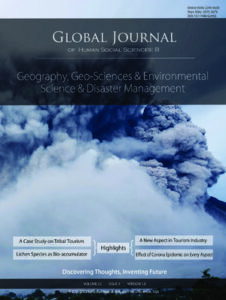
Issue Cover
GJHSS Volume 22 Issue B4
Pg. 19- 35
Journal Specifications

Crossref Journal DOI 10.17406/GJHSS

Print ISSN 0975-587X

e-ISSN 2249-460X

Keywords
Classification
GJHSS-B Classification: DDC Code: 577.03 LCC Code: QH540.4
Version of record

v1.2

Issue date

January 20, 2023

Language

English

Experiance in AR

The methods for personal identification and authentication are no exception.

Read in 3D

The methods for personal identification and authentication are no exception.

Article Matrices
Total Views: 1505
Total Downloads: 38
2026 Trends
Research Identity (RIN)
Related Research

Published Article

Lichens diversities are informative indicators for assessing impacts of air pollution, climate change, environmental health, volcanic activities, habitat heterogeneity and continuity. Lacking roots, vascular tissues, stomata and waxy cuticle, they absorb and accumulate airborne nutrients/pollutants from the atmosphere over their entire surface. Halogens, especially fluorides are released into the atmosphere in large amounts by volcanic eruptions and their pollutants levels in lichens can be determined quantitatively by chemical analysis of species. The objective of this study was to examine the lichens potentials on Mount Cameroon (MC) as bio-monitors and bio-accumulators for some halogens (F, Cl, Br) levels. To achieve this objective, 34 lichen species were analysed using selective ion electrode. The species were collected from eight sampling sites on two flanks of MC at elevations ranging from 3-2178 m above sea level.

Our website is actively being updated, and changes may occur frequently. Please clear your browser cache if needed. For feedback or error reporting, please email [email protected]
×

This Page is Under Development

We are currently updating this article page for a better experience.

Request Access

Please fill out the form below to request access to this research paper. Your request will be reviewed by the editorial or author team.
X

Quote and Order Details

Contact Person

Invoice Address

Notes or Comments

This is the heading

Lorem ipsum dolor sit amet, consectetur adipiscing elit. Ut elit tellus, luctus nec ullamcorper mattis, pulvinar dapibus leo.


High-quality academic research articles on global topics and journals.

Lichen Species as Bio-accumulator of some Halogens on Mount Cameroon Valcano, West Africa

Ayuk Elizabeth Orock
A. B. Fonge
A. B. Fonge
E. M. Shemang
E. M. Shemang
M. Zhai
M. Zhai
C. E. Suh
C. E. Suh

Research Journals





























































