LIGHTWEIGHT MULTIPRIORITY FRAMEWORK CLASSES FOR ANDWIDTH DIFFERENTIATION SERVICE

Send Message

To: Author

LIGHTWEIGHT MULTIPRIORITY  FRAMEWORK CLASSES FOR  ANDWIDTH DIFFERENTIATION SERVICE

Article Fingerprint

ReserarchID

CST1X25P

LIGHTWEIGHT MULTIPRIORITY  FRAMEWORK CLASSES FOR  ANDWIDTH DIFFERENTIATION SERVICE Banner

AI TAKEAWAY

Connecting with the Eternal Ground
  • English
  • Afrikaans
  • Albanian
  • Amharic
  • Arabic
  • Armenian
  • Azerbaijani
  • Basque
  • Belarusian
  • Bengali
  • Bosnian
  • Bulgarian
  • Catalan
  • Cebuano
  • Chichewa
  • Chinese (Simplified)
  • Chinese (Traditional)
  • Corsican
  • Croatian
  • Czech
  • Danish
  • Dutch
  • Esperanto
  • Estonian
  • Filipino
  • Finnish
  • French
  • Frisian
  • Galician
  • Georgian
  • German
  • Greek
  • Gujarati
  • Haitian Creole
  • Hausa
  • Hawaiian
  • Hebrew
  • Hindi
  • Hmong
  • Hungarian
  • Icelandic
  • Igbo
  • Indonesian
  • Irish
  • Italian
  • Japanese
  • Javanese
  • Kannada
  • Kazakh
  • Khmer
  • Korean
  • Kurdish (Kurmanji)
  • Kyrgyz
  • Lao
  • Latin
  • Latvian
  • Lithuanian
  • Luxembourgish
  • Macedonian
  • Malagasy
  • Malay
  • Malayalam
  • Maltese
  • Maori
  • Marathi
  • Mongolian
  • Myanmar (Burmese)
  • Nepali
  • Norwegian
  • Pashto
  • Persian
  • Polish
  • Portuguese
  • Punjabi
  • Romanian
  • Russian
  • Samoan
  • Scots Gaelic
  • Serbian
  • Sesotho
  • Shona
  • Sindhi
  • Sinhala
  • Slovak
  • Slovenian
  • Somali
  • Spanish
  • Sundanese
  • Swahili
  • Swedish
  • Tajik
  • Tamil
  • Telugu
  • Thai
  • Turkish
  • Ukrainian
  • Urdu
  • Uzbek
  • Vietnamese
  • Welsh
  • Xhosa
  • Yiddish
  • Yoruba
  • Zulu
Font Type
Font Size
Font Size
Bedground

Abstract

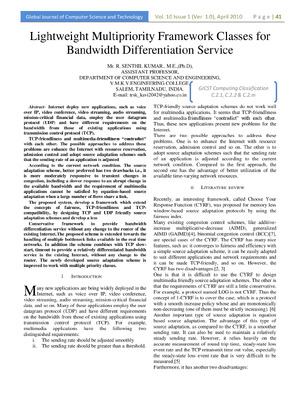
Internet deploy new applications, such as voice over IP, video conference, video streaming, audio streaming, mission-critical financial data, employ the user datagram protocol (UDP) and have different requirements on the bandwidth from those of existing applications using transmission control protocol (TCP). TCP-friendliness and multimedia-friendliness “contradict” with each other. The possible approaches to address these problems are enhance the Internet with resource reservation, admission control and adopt source adaptation schemes such that the sending rate of an application is adjusted According to the current network condition. The source adaptation scheme, better preferred has two drawbacks i.e., it is more moderately responsive to transient changes in congestion, including a slower response to an abrupt change in the available bandwidth and the requirement of multimedia applications cannot be satisfied by equation-based source adaptation when a large number of flows share a link. The proposed system, develop a framework which extend the concepts of fairness, TCP-friendliness and TCPcompatibility, by designing TCP and UDP friendly source adaptation schemes and develop a less Conservative framework to provide bandwidth differentiation service without any change to the router of the existing Internet.The proposed scheme is extended towards the handling of multiple bottleneck links available in the real time networks. In addition the scheme combines with TCP slowstart, timeout to provide a relatively differentiated bandwidth service in the existing Internet, without any change to the router. The newly developed source adaptation scheme is improved to work with multiple priority classes.

References

8 Cites in Article
  1. Cheng Chen,Zheng Guo Li,Yeng Soh (2007). MRF: A Framework for Source and Destination Based Bandwidth Differentiation Service‖.
  2. Z Li,C Zhu,N Ling,X Yang,G Feng,S Wu,F Pan (2003). A unified architecture for real time video coding systems.
  3. X Wang,H Schulxrinne (2005). -Incentivecompatible adaptation of internet real-time multimedia.
  4. R Jain,D.-M Chiu,W Hawe (1984). A quantitative measure of fairness and discrimination for resource allocation in shared computer systems.
  5. V Jacobson,M Karels (1990). Congestion avoidance and control.
  6. Y Yang,S Lam (2000). General AIMD congestion control.
  7. D Bansal,H Balakrishnan (2001). Binomial congestion control algorithms.
  8. S Floyd,M Handley,J Padhye (2000). A comparison of equation-based and AIMD congestion control Mar.

Funding

No external funding was declared for this work.

Conflict of Interest

The authors declare no conflict of interest.

Ethical Approval

No ethics committee approval was required for this article type.

Data Availability

Not applicable for this article.

How to Cite This Article

Dr.R.SENTHIL KUMAR. 1970. "LIGHTWEIGHT MULTIPRIORITY FRAMEWORK CLASSES FOR ANDWIDTH DIFFERENTIATION SERVICE". Global Journal of Computer Science and Technology GJCST Volume 10 (GJCST Volume 10 Issue 1).

Download Citation

Journal Specifications

Crossref Journal DOI 10.17406/gjcst

Print ISSN 0975-4350

e-ISSN 0975-4172

Keywords
Version of record

v1.2

Issue date
July 10, 2010

Language
English
Experiance in AR

Explore published articles in an immersive Augmented Reality environment. Our platform converts research papers into interactive 3D books, allowing readers to view and interact with content using AR and VR compatible devices.

Read in 3D

Your published article is automatically converted into a realistic 3D book. Flip through pages and read research papers in a more engaging and interactive format.

Article Matrices
Total Views: 4.2K
Total Downloads: 271
All Trends

Request Access

Please fill out the form below to request access to this research paper. Your request will be reviewed by the editorial or author team.
X

This is the heading

Lorem ipsum dolor sit amet, consectetur adipiscing elit. Ut elit tellus, luctus nec ullamcorper mattis, pulvinar dapibus leo.


High-quality academic research articles on global topics and journals.

LIGHTWEIGHT MULTIPRIORITY FRAMEWORK CLASSES FOR ANDWIDTH DIFFERENTIATION SERVICE

Dr.R.SENTHIL KUMAR
Dr.R.SENTHIL KUMAR