
I. INTRODUCTION
The authors Mauborgne & Kim [1] identified and published blue ocean strategy a totally unique and newer strategy which was found to be adopted by some of the businesses to make their ways through the existing competition in their respective markets. They found that these companies where on to make or develop their own markets rather emphasizing on projects to compete in the existing market which therefore existed as a competitive advantage for them as the newer self developed markets would abide by the competitive rules and regulations as implicated by themselves. The authors put in examples of National Youth Orchestra of Iraq making a successful cost reduction shift by dropping down their traditional hiring of guest conductors and soloists and European repertoire, and taking in fresh local talents from various Iraqi ethnic and religious groups. The French Groupe SEB was found to be another proven successful shift as their Acti-Fry who could make low cholesterol more healthier French fries with less oil consumption which transformed the market for French fry makers and now developed as packaged baked foods and oil free snacks market example Bingo baked chips [2]. Another example was mention as Tuzak room escape games witnessed in the entertainment industry [8]. In the book blue ocean strategy they mentioned three modules pertaining shift to blue ocean;
Mindset: Stretching mental limitations to witness true position of opportunities.
Tools: Use of proper and practical machinery to well ordered implication of blue ocean thinking into commercially viable products.
Human-Ness: Successful shifts depicted behavioural change as motivation to own and execute the process [3].
Blue ocean strategy Five Step Process;
Selecting the correct place to launch and build the correct Blue Ocean team for the initiative.
Thorough and well research about the present market situation.
Locating and identifying limitations in present market, discovering a new market-ocean for non-customers.
Organizing and building market limitations and developing replacing the opportunities with blue ocean.
Choosing the appropriate Blue Ocean move, conducting expeditious market tests, finalizing, and launching the shift [3].
Adapting this process makes the organization capable of relocating themselves from the boundaries of battling within the existing industry ("settlers") to make a shift towards sizeable value improvement ("migrators") and finally towards creating new value for humans who are non-customers (the "pioneers" of marketing-creating innovation)[3].
The authors [1] [8], also mentioned the avoidance of mindsets and strategies adopted by different companies with a view to get through the competition in the existing market comprising of same or similar industries as competitors which they termed as red ocean traps and red ocean strategy. The article investigates the existence of red ocean strategy.
II. RED OCEAN TRAPS [4]
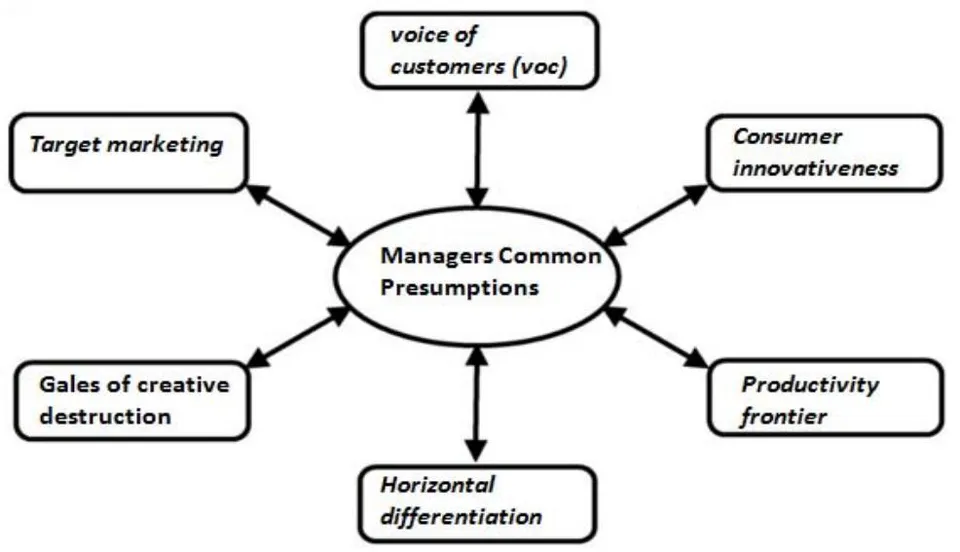
Very perfectly brought into sight and noticed by a number of researchers that humans who secure managerial positions in business organizations follow a similar and repetitive temperament to deal with the events at competition in their respective industrial markets. The authors [4], encountered in their research existence of six common presumptions depicting managers temperaments towards market competition that heavily impacted their final decisions [5]. These were termed by the authors [4] as red ocean traps.
Describing six temperaments or traps which limit managers in their shift to blue oceans [5];
Trap One: Seeing Market-Creating Strategies as Customer-Oriented Approaches – "voice of customers (voc)"
Making customer happier by providing them better and updated products. The commonly used approach of asking existing customers sometimes called as voice of customers 'VOC' [6] [7] whereby customers themselves defined their pursuit of happiness to identify what could make them more happier and more satisfied. Voice of customer decisions mostly counted on self-experiences and may thus act as a potential source of favouritism or fallaciousness which might lead to potentially misleading conclusions regarding consumer choice behaviour [9] [10] [11]. Blue ocean strategy is about changing noncustomers who do not prefer to opt the current industrial offerings. Strategies that failed to make appeal to customers Google glass and Sony's Portable Reader System where mentioned as examples of Trap one by the authors [4].
Therefore, Trap One: Seeing Market-Creating Strategies as Customer-Oriented Approaches is found to be a similar approach as majorly depending on voice of customers (voc) to make new offerings.
Trap Two: Treating Market-Creating Strategies as Niche Strategies – "Target marketing"
The strategies which majorly emphasize on discovery of a new segment of buyers in the existing market who haven't been yet served could rather act as a partition strategy resulting in a much smaller size of demands [4]. Niche in business means an opportunity to sell a particular product to a particular group of people [15]. Target marketing is comprises of three components: market segmentation, marketing targeting and product positioning [12] [13]. Targeting is proven to be logically supported only in the rare occasions where an organisation can only operate in one segment, as may be the case with geographical segmentation of retail operations [14]. Blue ocean strategy favours desegmentation and finding of more common things that could join different consumer groups together to make bigger size demands. Too much segmentation of market by Delta's Song airline venture made its demand size too small to be sustainable.
Therefore, Trap Two: Treating Market-Creating Strategies as Niche Strategies is found to be a similar approach as using target marketing to make new offerings.
Trap Three: Confusing Technology Innovation with Market-Creating Strategies—"Consumer innovativeness"
Building up a new market space should not be confused with what is called in scientific terms as invention. Scientific inventions and commercial innovation are two different things [18]. Innovation is described as an idea, practice, or object that is recognized as new by people or units that adopt it [16].
Innovation refers being able to provide goods and services separate from the competition and count profits on the value they provide to their customer [17]. Unless an enterprise is able to put in place the supremacy of its products in its customers' minds, a differentiation strategy based on relative product performance is likely to be ineffectual [19]. Consumer innovativeness, or "spotless usage" is the proneness to purchase new products constantly and more immediately surpassing other consumers [20]. Blue ocean says an invention should be well synchronized with its commercial objective to generate profits [5]. For example, Segway Personal self-balancing was unable to become a good commercial product since the product was't easy to use and inconvenient on the other hand Starbucks, Cirque de Soleil, Salesforce.com, are mentioned as successful examples of good commercially valued products [4].
Therefore, Trap Three: Confusing Technology Innovation with Market-Creating Strategies is found to be a similar approach as relying on Consumer innovativeness to create competitive advantage.
Trap Four: Equating Creative Destruction with Market Creation – "Gales of creative destruction"
New markets can be built without ending or replacing current products market. Creative Destruction, coined by Austrian economist Joseph Schumpeter in his 1942 work, Capitalism, Socialism, and Democracy (CSD), is a generative process within capitalism that "transforms the economic structure from within, continually destroying the old one, continually creating the new one" (see p. 83, [italics in original]). It is this "perennial gale" that every business operates in, and in that "each component of business strategy obtains its real importance" (p. 83) [21] [22]. Schumpeter's gales of creative destruction depicts how innovation is creative and beneficial in bringing new industries, revenues and employment, and at the same time causes destruction of some established firms, a wide range of goods, services and employments, and the dreams of unsuccessful entrepreneurs [22]. But Jacobson commit to paper (1992, p. 803), "no common laws of business exist" and "business triumph is a 'science of the specific' (p. 804) [23]. Thus, as the digital photography displaced photographic film, creation of Viagra's new market for lifestyle drugs, and Grameen Bank's as microfinance industry are some of the examples mentioned by the authors [1][2], associating market creation with creative destruction restricts an organization's opportunities.
Therefore, Trap Four: Equating Creative Destruction with Market Creation is found to be a similar approach as employing gales of creative destruction to built newer business opportunities.
Trap Five: Equating Market-Creating Strategies with Differentiation – "Productivity frontier"
A blue ocean strategy mentions differentiated value for customers must be accompanied with lower costs to the enterprises or firms in business. Companies that adopt differentiation strategies typically offer customized goods and services to consumers, so the prices are generally higher; companies that implement cost-leading strategies have a price advantage but are unable to meet the growing demands of consumers [26]. Yellow Tail wine and Salesforce.com are examples of business firms that offer high value at low cost. Porter defines productivity frontier as the "totality of presently adopted business practices at any given time". Businesses have general practice of selecting a strategic position along the "productivity frontier" [24]. Thus the productivity frontier represents the range of value-cost trade-offs available based on the construct and industrial norms. In 1990s, Moss-Kanter marked that businesses are "switching away from setting out their strategies in terms of lower cost and differentiated attributes." [25].
Therefore, Trap Five: Equating Market-Creating Strategies with Differentiation is found to be a similar approach as selecting a strategic position along the productivity frontier.
Trap Six: Equating Market-Creating Strategies with Low-Cost Strategies – "Horizontal differentiation"
Blue ocean strategy mentions that a low cost strategy should not be an act of compromise in product value provided to the customers. Product Differentiation means two goods are differentiated good if they are substitutes but not perfect substitutes.
Product differentiation types;
Horizontal: Different products with same price some customers will purchase one and some will buy other, it really depends on their preferences. Example: Pepsi and Coca Cola.
Vertical: Products are different and all customers would prefer one to the other if they were sold at the same price. Products are of distinct qualities. Example: Pentium III and Pentium II [27].
Cost leadership strategies are not required. If businesses prefer to choose in priority product positions (horizontal differentiation) simultaneously and then set prices, then the company with a cost advantage sets a price higher than its competitors [28]. Examples will include Cirque du Soleil Starbucks coffee and Dyson vacuum cleaners [4].
Therefore, Trap Six: Equating Market-Creating Strategies with Low-Cost Strategies is found to be a similar approach as using horizontal differentiation for product positioning.
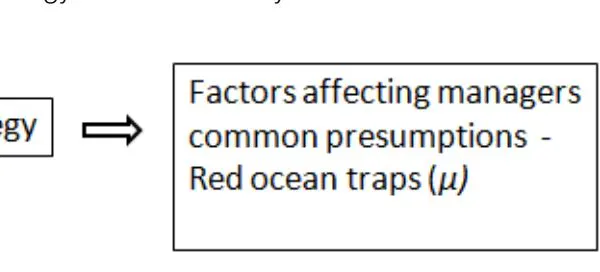
Consequently, the red ocean traps mentioned by the authors are factors that affect common presumptions depicting managers temperaments while initiating competitive strategies to gain leadership in their respective industrial markets [4].
III. RED OCEAN STRATEGY
Red ocean strategy comes into existence when companies try to perform better than their opponents to mark a much bigger share of current demands in the market. As the market space gets jam-packed, chances for profits and growth are minimized. Products get turned to commodities, and fierce competition turns the ocean meant to be market bloody as red ocean [1]. A competitive strategy which is an outcome of factors affecting managers common presumptions (see figure
- Toward an existing market is called a red ocean strategy.
Since the red ocean traps effectively anchor managers in red oceans jam-packed market spaces where companies engage in fierce competition for market share and obstruct them from entering blue oceans, previously unknown and uncontested market spaces with ample potential [4], they are the creators of red ocean strategies in various shapes and sizes. Managers develop corporate strategy with the industry and competitive analysis in mind to make a distinctive strategic position where they can outperform their opponents by constructing a competitive advantage [29].
Therefore, red ocean traps may be referred as the creators of dimensions which decide the shape, size and nature of a strategy and determines its existence as a red ocean strategy [1] [4].
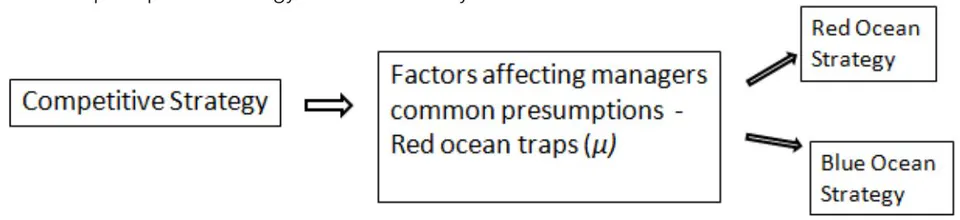
Note: stands for moderator it shows that red ocean traps act as a moderator in determining the category of a competitive strategy as red ocean or blue ocean.
IV. CONCLUSION
The pathways or strategies displayed as the red ocean traps are not inadequate or poor. What these pathways have not still is the path to successful market creating strategies. And when they drive market creating efforts that involve huge investments, they might result in new business models with not so good returns and thus are unsuccessful. That is why its really important to vouch the mental models and assumptions of the people who are central to executing market creating strategies. If these models and assumptions are found to be misaligned with the intended strategic purpose of new market creation, one needs to challenge, question and reframe them. Otherwise, one may fall into the red ocean traps.
a) Research Implications and Scope For Future Research
This review provides clarity and better understanding of what is to be avoided as the components of a red ocean strategy when purposefully working towards a new market creation. The information thus is useful for the academic researchers and strategy makers in the industry as the outcomes may help to develop and practice more effective business models. The researchers could further take the determinants of competitive strategy displayed in Figure 1 and 2, as an application to current market scenario to work on the variations derived.
Originality/Value - This review is the first to offer an in-depth overview of red ocean traps and red ocean strategy.