This is an empirical account of audience engagement as part of an academic study by the Federal University of Paraíba. The article explores the role of ephemerality in contemporary theatrical performance, emphasizing its impact on audience reception and their intersubjective experience. Thus, the experience described here points to the ephemeral as a tool for creating enchantment. The reflection focuses on the audience’s reaction to the words and actions of a performer juggling at the entrance to a theatre in João Pessoa, Brazil. References include Lev Semionovich Vygotsky’s proposal on the psychology of actor-creation, as well as the relational aesthetics described by Nicolas Bourriaud. The study detects a possible connection between what is understood as a mirror neuron and the Russian term “perezhivanie,” highlighting the degree of emotional engagement of the spectator and reflecting on the active role of the audience in a theatrical performance. Through an interdisciplinary analysis, this case study aims to effectively contribute to artistic research methodology and contemporary theatrical practices.
## I. INTRODUCTION
In some languages, especially French, dramatic art falls within the scope of what is designated as living arts. Accordingly, as to what is discussed here, it is crucial to start from an essential characteristic that constitutes such understanding. In the case of a happening that places living beings before others, voluntarily positioned for appreciation, we will start from a classic and unquestionable element that constitutes dramatic art (or theatre): ephemerality.
Due to its immediacy, dynamics and singularity, a work of dramatic art acquires a processual character with each presentation, requiring constant and necessary updating. In its literary aspect, in which the text was adapted or originally written to be performed on stage, dramatic art is initially characterized by incompleteness, as it is a text that calls for the advent of agents to give it life.
According to Franco Ruffini (apud FÉRAL, 1999), dramatic literature naturally has two components: the "text of the text" and the "scene of the text." The first is linked to the more literary element, structured to drive the plot, develop the fable and establish the conflict. In turn, the scene of the text deals with the character and things that concern him, "including the replicas and micro-situations that remain outside the conflict and the fable, giving rise to a certain unpredictability and free rein for the director and the actor" (p. 9). This concept expands the parameters related to the composition and presentation of a theatrical work, making understandable the exchange of activities involved in scenic creation, such as acting, writing a literary text and staging (which involves scenography, costumes, lighting and, sometimes, sound). This evolution affects the use of the stage space, which conventionally considered the stage of a theater as the only place for the representation of a text from dramatic literature.
For Aristotle, according to McLeish (2000), considering that dramatic art is based on an imitation that represents the human being in action in real life, the structure of this imitation however imposes differences in relation to reality. One of them refers to the imitated object that, although associated with the reality of life, becomes a matter of art, here made a means for imitation. Another difference concerns the method, as the object can be brought to the scene or imitated in different ways: through narrative or through the act of representation. In this sense, with regard to speech on stage, a brief reflection on art and feeling is in Vygotsky (1999).
Lev Semenovitch Vygotsky mentions a thought that was widely considered in the early twentieth century, in which the feeling experienced by the observer before a work would be linked to a common feeling (of joy, anger, sadness or any other), assuming art as a resonator, an amplifier or even a device transmitting a certain feeling that infects it. Vygotsky disputes this understanding and suggests that, to understand what art is, it would be necessary to add something more to the contagion of a familiar feeling. To this end, an example is used: one thing is the feeling aroused in the representation of a speaker, whose objective is "expressiveness," and another thing is the feeling aroused in the representation of a poet, which aims at "amazement." Just as wine is to the grape, art collects its material from life, producing something that is not yet in the properties of that material, something that is above it.
By itself, not even the most sincere feeling is capable of creating art. To this end, it not only lacks technique and mastery because even the feeling expressed in technique can never produce a lyrical work or a symphony; both things also require the creative act of overcoming this feeling, its solution, the victory over it, and only then does this act appear, only then is art realized. This is why the perception of art also requires creation, because for this perception it is not enough to simply experience with sincerity the feeling that dominates the author, it is not enough to understand the structure of the work itself: it is also necessary to creatively overcome one's own feeling, find one's catharsis, and only then will the effect of art be manifested fully. (Vigotski, 1999 p. 314)
In the then interwar period on the European continent (1920-1930), the Czech Jindrich Honzl recorded: "Action – the very essence of dramatic art – fuses the word, the actor, the costume, the setting and the music in the sense that we recognize them as conductors of a single current that crosses them, passing from one to another or through several at the same time" (Honzl, 1988, p. 145). Scenography abandoned the strictly complementary and decorative role it played until the end of the 19th century, making greater use of lighting resources and incorporating its effects into the malleability of the stage space, which also began to develop outside the so-called Italian stage. Thus, costumes and props stand out more and more as elements of dynamic meaning in the actor's body. In this context, it is also worth mentioning that ancient Andalusian poetry celebrated "the primitive union of poetry, music and dance (...) requiring the presence of a body, in the incessant restart of an encounter," as stated by Federico Garcia Lorca (apud Zumthor, 2007 p. 61). In other words, such poetics did not occur in the writing, reading or recitation of a literary text, but rather in the encounter and juxtaposition of various artistic expressions. It is also possible to see this practice in traditional Asian manifestations, where there is a combination of various artistic expressions, as is the case of Indian dramatic dance.
Such practices and understandings are important for what we intend to present in this look and reflection that focuses on a work presented at the Lima Penante Theater (Figure 1), located in the city of João Pessoa, Brazil, as a scenic exercise of the undergraduate course in Theater of the Federal University of Paraíba. The scene presented was composed as a preamble to a play, performed outdoors, in front of the theatre, which remained closed while the audience waited for it to open. It is a solo work in which the performer, typically dressed in costume, interacts with the spectators through speeches and the performance of activities related to the circus, such as juggling and fire-eating. Initially, the audience was waiting for the building to open to watch a play, when the artist appeared as someone who intended to enter the building, which he considered to be a castle where a party was being held. While the theatre was closed, the artist spoke to the spectators and then spoke about life and art, juggling clubs and, finally, the use of clubs with fire.
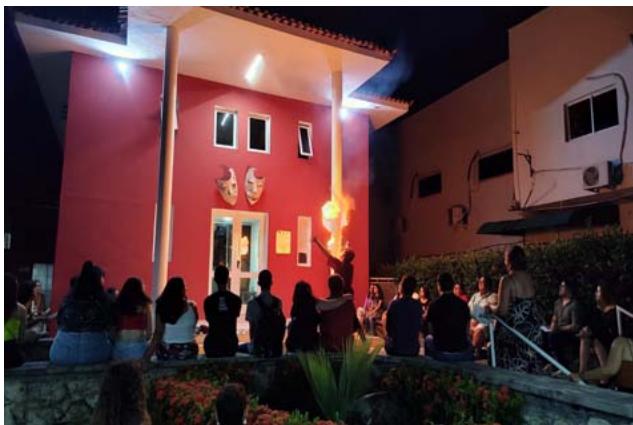 Fig. 1: Presentation in front of the Lima Penante Theatre. Photo by Osvaldo Anzolin.
The growing complexity of human relationships with the world and with life has led dramatic art to transcend imitation and make use of reality itself, proposing interaction with the spectator, who becomes a co-participant in the composition and execution of the scene. In a dramaturgy that deals with issues and practices unrelated to imitation, its composition shifts the axis of the action, which can now consist of events and tactile, auditory and olfactory sensations, going far beyond the verbal constitution.
## II. AN EMANCIPATION OF THE GAZE?
At the end of the performance at the Teatro Lima Penante, the actor-performer, pretending to be dead, remains lying on the floor. Since the scene preceded the performance of a play that would take place inside that theatre, one of the characters of that play opens the door of the building and invites the audience to enter.
Although presented with the characteristics of an intervention linked to the play that would take place inside the theater, that scene presented the conditions to become an isolated show. If in that context it was the foreshadowing of a work that would come later, there was a legitimate interest of the actor-performer in transforming his work into a separate show, preserving its characteristics of intervention. There were several reasons for this and the event experienced there invited us to reflect.
The combination of conventional artistic expressions (circus, theater, singing, dance), which have been intensely separated throughout history, has become common in recent times, which has resulted in the compositional restructuring of theater. As "significant polyphonies", in the sense presented by Dort (1988), multifaceted performances have begun to emerge not only in theater, but in each of these expressions. Such occurrence requires the spectator not only the ability to see and recognize, but also to conceive and participate in what is presented to him. In the context of scenic textuality, it would be what De Marinis (1987) calls "levels of reception," separated into extra- and intratextuality, enabling conditions to predict, already in the creation of a dramatic work, in which of these levels the spectator will be framed. At the intratextual level of the stage text, the receiver (hypothetical, ideal, virtual) will be led to a certain understanding through strategies contained in the writing, while at the extratextual level, the reading procedures will be triggered during the understanding of the text, and the spectator will be called to determine, for themselves, a highly particular understanding of the scenic result.
It is possible to observe in circus activities, such as juggling and the act of spitting fire, a cathartic power that provide a certain relief and renewal to the viewer. The body that experiences such activities does not dissociate life from the spectacle and, by the artist's dexterity, provides some enchantment to the laws of physics. According to Mario Fernando Bolognesi (2003), the use of words plays a secondary role in circus performances, because in its emergence the circus brought the adoption of the body as a fundamental element, establishing the image of a person who overcomes the limits of the possible, fulfilling certain topics of the poetic struggle of the romantic movement.
In the work presented in João Pessoa, Brazil, the actor-performer Cassiel Campos, member of our study group registered in the National Research Council (CNPq), conducted circus activities while verbally discussing art and life. The purpose was to encourage the audience to witness and participate in his acts and thoughts. The artist sought to lead viewers to perceive, in what they experienced, something connected to their daily life or their life story. The juggler's relationship with the flaming clubs and his act of breathing fire may be associated with frustrations and successes arising from life expectations, maintaining the audience's attention. The artist's mastery and dexterity, who gradually increased the number of clefs used, associating them with the Holy Trinity while playing with three clefs, then with the four elements of nature, and finally with quintessence, drawing looks of involvement and admiration from the spectators. Superimposed on words, such activities served as a means for resignifying what was spoken by the artist, an instrument to shift the meaning that, in principle, would be based on the word and was now in the field of polysemy.
## III. FOR THE FUTURE OF AN ENCHANTMENT
Juggling involves the manipulation of various objects, with the best known being the act of throwing and keeping one or more objects in the air at the same time with the use of the hands and, sometimes, also the feet.
The aforementioned scene, which occurred in front of the theatre, fits into what is called scenic juggling, a work composed for a public presentation. Its composition can result in three types, namely: a number, a show or an intervention. According to Santos (2012, p. 245), the first refers to a presentation lasting up to ten minutes, which can show the actor's dexterity in the manipulation of one or more objects. In turn, a juggling show can last up to ninety minutes long and occur as a theatre show or play. An intervention takes place in open spaces, interacting with the audience and without predetermined duration. Therefore, the abovementioned work is equivalent to an intervention.
As there is interaction with viewers, the proposed scene is updated and a new sign element can be chosen at each moment of the presentation. By stimulating empathic impulses, such initiative is in line with the relational aesthetic:
The artist's practice, their behavior as a producer, determines the relation that will be established with their work: in other words, what they produces, in the first place, are relations between people and the world through aesthetic objects. (Bourriaud, 2009 p. 59)
According to Vygotsky, the object of art – or aesthetic object – emerges from differentiated elements that compose it, such as the form and material used. He agrees with the idea that these components, however, do not integrate directly into the aesthetic object, but rather through the emotional tone they can bring:
(...) the aesthetic reaction resembles the act of playing piano: it is as if each component of the work of art touched the respective sensory key of our organism, receiving a sensory sound or tone as a response, and every aesthetic reaction consisted of emotional impressions that arise in response to keystrokes. (Vigotski, 1999 p. 259)
Continuing the reasoning, the author states that none of these elements that compose a work of art – its form or material – is important, as they are just keys. The impressions they evoke are very weak compared to the strong effects of the aesthetic reaction evoked by the work.
Considering that, in Performing Arts, the work occurs as a result of the presence and act of performing artists, the relation that is established with their work is linked to the relation that performers allow and develop with the audience. Depending on how this occurs, the viewer can become a co-author and consequent part of the work. Accordingly, the above scene contributes and makes us think, as it is the performance of circus activities in an intervention scene. In showing extreme skill in juggling up to five clubs, the artist Cassiel Campos, even uses his shoulders and feet in the performance, causing an empathic impulse in those who see him. His presentation also involves a speech about art and life, simultaneous to the juggling of clubs with and without fire. Rather than simple witnesses, some spectators compose the scene when they are called to balance a club. Subsequently, others are led to hold torches and, finally, much of the audience together with the artist cry out for the opening of the theatre door.
In this interaction, spectators become participants and are led to exercise alterity, having the feeling of acting and being together with the artist in his simultaneous speech and juggling. Seemingly, by leading spectators to perform together and fostering in them the impulses that evoke the sensation of identification and empathy, it can be said that this scenic work triggers what, in neuroscience, is called mirror neurons. And, if so, this happening brings to light the understanding for the term perezhivanie - or nepexubanie in Russian - used by neuroscientist Lev Semenovich Vygotsky in reflections on art. The term can mean lived experience in the sense of a state of mind aroused by the experience of a powerful impression or feeling.
At the end of the presentation, the use of burning clubs generates the involvement of the audience through visual perception of the fire "spit" by the artist. Here, vision captures what, according to Vygotsky, would be a technical element: fire is the key that provides the emotional tone of the aesthetic object. It is worth thinking whether this would not be the source for a possible state of enchantment in the viewer.
By constituting itself as a set, a system or a connection of signs, the staging of a work in theatre becomes scenic writing or text, raising this art to the proper place of intersubjectivity, a natural result of mutual bonds that foster empathy with instrumental signs that affect the spectator's state of soul.
For a long time, theatre was seen as a system founded on a regularly verbal basis of representation, setting limits to dramatic action and keeping the spectator in the role of receiver. It is evident that an open and polysemic scene gives the theatre audience an active role, with the power of co-authorship in the course of the aesthetic object.
Generating HTML Viewer...
Funding
No external funding was declared for this work.
Conflict of Interest
The authors declare no conflict of interest.
Ethical Approval
No ethics committee approval was required for this article type.
Data Availability
Not applicable for this article.
Dr. Jose Tonezzi. 2026. \u201cEnchantment and Lived Experience in Contemporary Actor’s Art\u201d. Global Journal of Human-Social Science - A: Arts & Humanities GJHSS-A Volume 25 (GJHSS Volume 25 Issue A4): .
This is an empirical account of audience engagement as part of an academic study by the Federal University of Paraíba. The article explores the role of ephemerality in contemporary theatrical performance, emphasizing its impact on audience reception and their intersubjective experience. Thus, the experience described here points to the ephemeral as a tool for creating enchantment. The reflection focuses on the audience’s reaction to the words and actions of a performer juggling at the entrance to a theatre in João Pessoa, Brazil. References include Lev Semionovich Vygotsky’s proposal on the psychology of actor-creation, as well as the relational aesthetics described by Nicolas Bourriaud. The study detects a possible connection between what is understood as a mirror neuron and the Russian term “perezhivanie,” highlighting the degree of emotional engagement of the spectator and reflecting on the active role of the audience in a theatrical performance. Through an interdisciplinary analysis, this case study aims to effectively contribute to artistic research methodology and contemporary theatrical practices.
Our website is actively being updated, and changes may occur frequently. Please clear your browser cache if needed. For feedback or error reporting, please email [email protected]
×
This Page is Under Development
We are currently updating this article page for a better experience.
Thank you for connecting with us. We will respond to you shortly.