Livelihood Diversification and Household Well Being of Buffer Zone Area of Nepal: A Case of Chitwan National Park

Keshav Raj Dhakal
Keshav Raj Dhakal
Tribhuvan University Tribhuvan University

Send Message

To: Author

Livelihood Diversification and Household Well Being of Buffer Zone Area of Nepal: A Case of Chitwan National Park

Article Fingerprint

ReserarchID

3TH4D

Livelihood Diversification and Household Well Being of Buffer Zone Area of Nepal: A Case of Chitwan National Park Banner

AI TAKEAWAY

Connecting with the Eternal Ground
  • English
  • Afrikaans

  • Albanian
  • Amharic
  • Arabic
  • Armenian
  • Azerbaijani
  • Basque
  • Belarusian
  • Bengali
  • Bosnian
  • Bulgarian
  • Catalan
  • Cebuano
  • Chichewa
  • Chinese (Simplified)
  • Chinese (Traditional)
  • Corsican
  • Croatian
  • Czech
  • Danish
  • Dutch
  • Esperanto
  • Estonian
  • Filipino
  • Finnish
  • French
  • Frisian
  • Galician
  • Georgian
  • German
  • Greek
  • Gujarati
  • Haitian Creole
  • Hausa
  • Hawaiian
  • Hebrew
  • Hindi
  • Hmong
  • Hungarian
  • Icelandic
  • Igbo
  • Indonesian
  • Irish
  • Italian
  • Japanese
  • Javanese
  • Kannada
  • Kazakh
  • Khmer
  • Korean
  • Kurdish (Kurmanji)
  • Kyrgyz
  • Lao
  • Latin
  • Latvian
  • Lithuanian
  • Luxembourgish
  • Macedonian
  • Malagasy
  • Malay
  • Malayalam
  • Maltese
  • Maori
  • Marathi
  • Mongolian
  • Myanmar (Burmese)
  • Nepali
  • Norwegian
  • Pashto
  • Persian
  • Polish
  • Portuguese
  • Punjabi
  • Romanian
  • Russian
  • Samoan
  • Scots Gaelic
  • Serbian
  • Sesotho
  • Shona
  • Sindhi
  • Sinhala
  • Slovak
  • Slovenian
  • Somali
  • Spanish
  • Sundanese
  • Swahili
  • Swedish
  • Tajik
  • Tamil
  • Telugu
  • Thai
  • Turkish
  • Ukrainian
  • Urdu
  • Uzbek
  • Vietnamese
  • Welsh
  • Xhosa
  • Yiddish
  • Yoruba
  • Zulu
Font Type
Font Size
Font Size
Bedground

Abstract

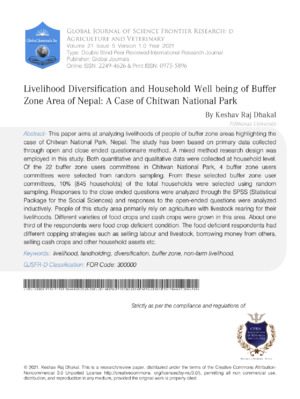
This paper aims at analyzing livelihoods of people of buffer zone areas highlighting the case of Chitwan National Park, Nepal. The study has been based on primary data collected through open and close ended questionnaire method. A mixed method research design was employed in this study. Both quantitative and qualitative data were collected at household level. Of the 22 buffer zone users committees in Chitwan National Park, 4 buffer zone users committees were selected from random sampling. From these selected buffer zone user committees, 10% (845 households) of the total households were selected using random sampling. Responses to the close ended questions were analyzed through the SPSS (Statistical Package for the Social Sciences) and responses to the open-ended questions were analyzed inductively. People of this study area primarily rely on agriculture with livestock rearing for their livelihoods. Different varieties of food crops and cash crops were grown in this area. About one third of the respondents were food crop deficient condition. The food deficient respondents had different copping strategies such as selling labour and livestock, borrowing money from others, selling cash crops and other household assets etc.

References

22 Cites in Article
  1. L Alobo (2015). Rural livelihood diversification in sub-Saharan Africa: a literature review.
  2. R Babatunde (2013). On-farm and off-farm works: complement and substitute? Evidence from Rural Nigeria.
  3. B Bishop (1990). Karnali under stress: livelihood strategies and seasonal rhythms in a changing Nepal Himalaya.
  4. D Carney (1998). Sustainable rural livelihoods: What contribution can we make? London: Department of International Development.
  5. Cbs (2012). National Planning and Housing Census 2011.
  6. J Chambers (1995). Preface.
  7. R Chambers,G Conway (1992). Sustainable rural livelihoods: practical concepts forthe 21 st century.
  8. K Dahal (2001). People’s Participation in Local Governance of Besishahar Municipality of Lamjung District in Western Nepal.
  9. K Dhakal (2018). People's perception on tourism related livelihoods: A case study of Patihani.
  10. F Ellis (2000). Rural livelihoods and diversity in developing countries.
  11. J Farrington,D Carney,C Ashley,C &turton (1999). Sustainable Rural Livelihoods: a Key Strategy for People, Environment and Development.
  12. G Gebru,F Beyene (2012). Rural household livelihood strategies in drought-prone areas: a case of Gulomekeda District, eastern zone of Tigray National Regional State, Ethiopia.
  13. S Haggblade,P Hazell,T Reardon (2010). The rural non-farm economy: prospects for growth and poverty reduction.
  14. W Hoeck,Van Der (2001). Water and rural livelihoods.
  15. R Johnson,Anthony Onwuegbuzie,Lisa Turner (2007). Toward a Definition of Mixed Methods Research.
  16. G Kassie,G Aye (2017). The Nexus between livelihood diversification and farmland management strategies in rural Ethiopia.
  17. Joseph Mbaiwa,Barbara Ngwenya,Donald Kgathi (2008). Contending with unequal and privileged access to natural resources and land in the Okavango Delta, Botswana.
  18. P Schuit (2011). Livelihood Strategies in the Buffer Zone of La Amistad Biosphere Reserve, Costa Rica.
  19. Ian Scoones (2009). Livelihoods perspectives and rural development.
  20. Daniel Start (2001). The Rise and Fall of the Rural Non‐farm Economy: Poverty Impacts and Policy Options.
  21. Shanti Chaudhary,Janak Raj Subedi (2002). Comparative Prevalence of Intestinal Helminths in Satar and Chaudhary Communities of Birtamode Municipality, Jhapa, Nepal.
  22. C Sulivan,S Rijal,M Shrestha,N Khanal,D O'regan (2004). An assessment of the potential impacts of climate-induced deglaciation on communities and their livelihoods in the Hindu Kush-Himalaya.

Funding

No external funding was declared for this work.

Conflict of Interest

The authors declare no conflict of interest.

Ethical Approval

No ethics committee approval was required for this article type.

Data Availability

Not applicable for this article.

How to Cite This Article

Keshav Raj Dhakal. 2021. \u201cLivelihood Diversification and Household Well Being of Buffer Zone Area of Nepal: A Case of Chitwan National Park\u201d. Global Journal of Science Frontier Research - D: Agriculture & Veterinary GJSFR-D Volume 21 (GJSFR Volume 21 Issue D5).

Download Citation

Healthy Buffer Zone in Nepal supports biodiversity and community livelihood.
Journal Specifications

Crossref Journal DOI 10.17406/GJSFR

Print ISSN 0975-5896

e-ISSN 2249-4626

Keywords
Classification
GJSFR-D Classification FOR Code: 300000
Version of record

v1.2

Issue date
August 7, 2021

Language
en
Experiance in AR

Explore published articles in an immersive Augmented Reality environment. Our platform converts research papers into interactive 3D books, allowing readers to view and interact with content using AR and VR compatible devices.

Read in 3D

Your published article is automatically converted into a realistic 3D book. Flip through pages and read research papers in a more engaging and interactive format.

Article Matrices
Total Views: 2036
Total Downloads: 983
2026 Trends
Related Research
Our website is actively being updated, and changes may occur frequently. Please clear your browser cache if needed. For feedback or error reporting, please email [email protected]

Request Access

Please fill out the form below to request access to this research paper. Your request will be reviewed by the editorial or author team.
X

Quote and Order Details

Contact Person

Invoice Address

Notes or Comments

This is the heading

Lorem ipsum dolor sit amet, consectetur adipiscing elit. Ut elit tellus, luctus nec ullamcorper mattis, pulvinar dapibus leo.

High-quality academic research articles on global topics and journals.

Livelihood Diversification and Household Well Being of Buffer Zone Area of Nepal: A Case of Chitwan National Park

Keshav Raj Dhakal
Keshav Raj Dhakal <p>Tribhuvan University</p>

Research Journals