The migration scenario faces different conditions, with emphasis on the context of education and its repercussions on the individual’s life. Therefore, the general objective was to investigate the living conditions of migrant students in Brazil. An Integrative Literature Review was carried out, involving: elaboration of the guiding question; literature search and sampling; data collect; critical analysis of studies; discussion of results; and presentation of the integrative review. The results made it possible to select 8 studies using the inclusion and exclusion criteria. Subsequently, a framework was developed to record information based on the “Preferred Reporting Items for Systematic Reviews and Meta-Analyses” protocol. Five points were grouped: Education, Housing, Labor Market, Income and Health. Prior to this, the profile of the migrant population was created. Finally, the need to build policies and enforce rights to guarantee better living conditions for the migrant population was highlighted, in the fight against social inequality in the Brazilian context.
Tallys Newton Fernandes de Matos ", Gabrielle da Silva Carvalho °, Jose Maria Ximenes Guimarães °, Aglay Galvão Francelino Mendonça ®, Diana Muniz Pinto, Cristina Albuquerque Douberin §, Maria Alailce Pereira Germano, Maria Cláudia de Freitas Lima, Jonas Loiola Gonçalves °, Danielle Silva Felix o, Andréa Cristina Capriata Silva €, Angélica Barreira Pinheiro € & Diego da Silva Ferreira
Habitação, Mercado de Trabalho, Renda e Saúde. Anterior a isto foi elaborado o perfil da população migrante. Por fim, foi evidenciado a necessidade da construção de políticas e efetivação de direitos na garantia por melhores condições de vida da população migrante, no combate à desigualdade social no contexto brasileiro.
## I. INTRODUÇÃO
S migrações podem afetar e transformar a experiencia cognitiva da pessoa que vivencia situações com outra sociedade. Isto envolve diferentes categorias desde o processo de recepção, lançando novas experiências de vida no exterior. As migrações de pessoas são processos de circulação de informação, conhecimento e diferenças. Quem migra amplia o contato com novos modos de ser, pensar, agir e viver na sociedade de recepção, resultando em novas informações e conhecimentos, modificando a experiencia e produzindo a diferença. Esta viagem para a cidade, país ou região empreendida pelo migrante, implica em estranhamento, adaptação, convívio e maior interação com a sociedade receptiva (Ferreira, 2020).
Neste cenário, destaca-se o Brasil que desde 2010 vem recebendo um grande contingente de migrantes e refugiados, principalmente da América do sul, América central e África. A maioria destes tem preponderância do Haiti, Venezuela, Colômbia, Bolívia e Uruguai. Vale ressaltar que de acordo com o Relatório Anual do Observatório das Migrações Internacionais (OBMigra), divulgado pelo Ministério da Justiça em 2021, o quantitativo de migrantes no Brasil chegou a 971.806 pessoas só em 2020. Esta população em condição de deslocamento deixa o país de origem impulsionado por diversos problemas como educação, economia, guerra, política e questões sociais, na busca por melhores condições de vida (Balzan et al., 2023).
Por conseguinte, um dos motivos que atrai os migrantes para o Brasil é a abertura política proporcionada pelo governo brasileiro. Isto se dá através de uma legislação inovadora com termos de migração e refúgio. Esta questão política e legislativa reflete simbolicamente uma dívida histórica do Brasil na construção dos períodos colônia, império e república, através da escravidão. Deste modo, os estrangeiros têm maior facilidade de emitir novos documentos e se fixarem no país (Barreto, 2020).
Diante disto, no contexto da educação, a busca dos migrantes por este segmento no Brasil envolve a oportunidade do ensino de qualidade para o engajamento no mercado de trabalho, prosperando o retorno ao país de origem ou a continuidade no Brasil. O Ministério da Educação do Brasil (MEC) salienta que a maioria dos estudantes são de origem Haitianos, Sírios e Africanos. Estes países ainda demonstram situação de vulnerabilidade social no ensino e no desenvolvimento humano igualitário para todos (Brasil, 2024).
Frente a essas questões destacamos as condições de vida, que como tema para pesquisas teve impulsionamento a partir da década de 1980, através de um levantamento por amostragem de domicílios concebido pela Fundação Seade (Fundação SEADE - Sistema Estadual de Análise de Dados) localizada no estado de São Paulo e vinculada à Secretaria da Fazenda e Planejamento, sendo centro de referência nacional na configuração de análises e estatísticas socioeconômicas e demográficas (Seade, 2022).
Nisto, a Pesquisa de Condições de Vida (PCV) é caracterizada como um levantamento por amostragem de domicílios, que envolve habitação, patrimônio familiar, frequência à educação, inserção no mercado de trabalho, rendimentos, utilização de serviços de saúde, renda, padrão de vida e envolvimento social. Estas características estão agrupadas em cinco pontos: Educação, Habitação, Mercado de Trabalho, Renda e Saúde. Logo, a importância da Pesquisa sobre Condições de Vida se dá na busca pela compreensão e mapeamento da tendência ao aumento da pobreza e aglomerações urbanas, como estratégia para subsidiar atividades de planejamento e avaliação de políticas públicas (Costa, 2003).
Neste sentido, é importante destacar a investigação sobre o contexto da migração na educação e suas diferentes repercussões em associação com as condições de vida frente ao contexto brasileiro. Com isso, o objetivo geral foi investigar as condições de vida em estudantes migrantes no Brasil.
## II. METoDOLOGIa
O presente estudo é do tipo qualitativo, cujo método é a Revisão Integrativa de Literatura (RIL). Este modelo de pesquisa é compreendido como uma abordagem diversificada, que sistematiza e analisa evidências, por meio de estudos experimentais e nãoexperimentais, na compreensão do fenômeno em questão. Ela caracteriza um condicionamento com diferentes finalidades e artefatos da literatura (Souza; Silva; Carvalho, 2010).
Foi operacionalizado seis fases, envolvendo: (1) Elaboração da pergunta norteadora; (2) Busca ou amostragem na literatura; (3) Coleta de dados; (4) Análise crítica dos estudos incluídos; (5) Discussão dos resultados; E, por fim, (6) Apresentação da revisão integrativa (Souza; Silva; Carvalho, 2010).
A primeira fase se deu através da pergunta norteadora orientada pelo acrônimo "PCC" (População/Problema, Conceito e Contexto). Neste sentido, foi questionado: "Como se dá as condições de vida em estudantes migrantes no Brasil?". Nisto, foi considerado "P" (Estudantes), "C" (Condições de vida) e "C" (Migrante). A demonstração desta elaboração está exposta no "Quadro 1".
Quadro 1: Elaboração da pergunta norteadora.
<table><tr><td></td><td>População /Problema</td><td>Conceito</td><td>Contexto</td></tr><tr><td>Adaptação</td><td>Estudantes</td><td>Condições de vida</td><td>Migrantes</td></tr></table>
Na segunda fase, busca ou amostragem na literatura, se deu nos bancos de dados "Scientific Electronic Library Online" (Scielo), "Literatura Latino-Americana e do Caribe em Ciências da Saúde" (Lilacs)" e "National Library of Medicine" (Pubmed)". Os descritores foram identificados na "Biblioteca Virtual de Saúde" (BVS) e "Medical Subject Headings" (MeSH), sendo selecionados de acordo com o interesse do estudo, sendo: Estudantes (Identificador DeCS: 13721), Condições de Vida (Identificador DeCS: 13306) e Migração (Identificador DeCS: 55122) (Biblioteca Virtual em Saúde, 2024). A escolha dos descritores se deu
através da leitura na nota de escopo junto ao significado, em associação com o tema, booleados por "AND" ("População" AND "Conceito" AND Contexto"; "População" AND "Conceito"; "População" AND "Contexto"), como classe de operação sobre variáveis e elementos pré-definidos (Biblioteca Virtual Em Saúde, 2024).
Foram incluídos artigos publicados em periódicos com Qualis entre "A" e "B", caracterizando relevância científica através de estudos direcionados a "ciências sociais" e "ciências da saúde" no Brasil. Foi excluído trabalhos duplicados com desarticulação do tema e texto. Foram excluídos resumos, teses, dissertações, trabalhos de conclusão de curso, livros, anais de evento e revisões. A pesquisa aconteceu em dezembro de 2023 no formato duplo cego (Ministério da Educação, 2016).
A "Scielo" identificou 52 estudos, seguindo 15 de triagem, 7 de elegibilidade e 5 incluídos. A "Lilacs" identificou 93 estudos, seguindo 22 de triagem, 5 de elegibilidade e 3 incluídos. A "Pubmed" identificou 5 estudos, seguindo O triagem, O de elegibilidade e 0 incluído. A representação destes dados está exposta na "Figura 1", no fluxograma do processo de seleção dos estudos, adaptado ao "Preferred Reporting Items for Systematic Reviews and Meta-Analyses" (PRISMA) (Jbi, 2014).
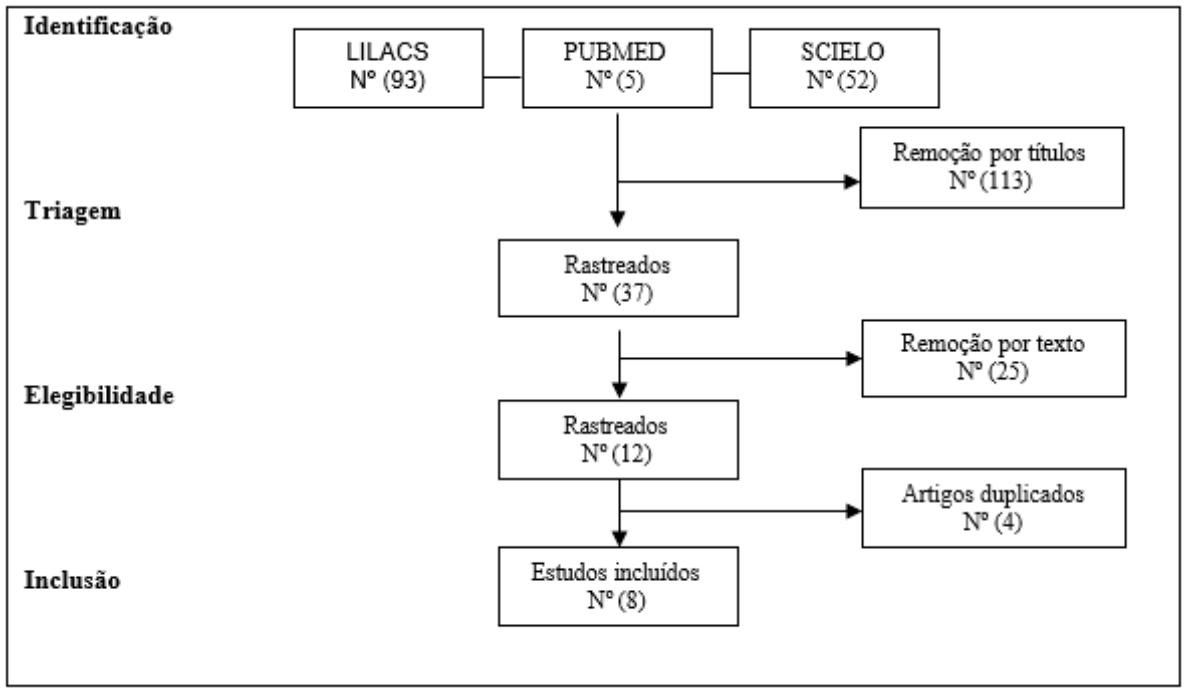 Fone: Elaborada pelos autores (2). Figura 1: Fluxograma do processo de seleção dos estudos.
A terceira fase, na coleta de dados, se deu através do desenvolvimento de um quadro registrando as informações-chave da fonte, com descrição anterior, envolvendo seguintes elementos: "Autor, Ano de publicação, Origem, Objetivo, População, Metodologia e Resultados". O quadro foi baseado e adaptado ao protocolo "Preferred Reporting Items for Systematic Reviews and Meta-Analyses" (PRISMA) (Jbi, 2014).
A quarta fase foi a análise crítica dos estudos incluídos através da leitura completa dos resumos dos artigos para identificar os níveis de evidência, sendo: (1) evidências resultantes da meta-análise de múltiplos estudos clínicos; (2) evidências obtidas em estudos individuais com delineamento experimental; (3) evidências de estudos quase-experimentais; (4) evidências de estudos descritivos e com abordagem qualitativa; (5) evidências provenientes de relatos de caso ou de experiência; E, por fim, (6) evidências baseadas em opiniões de especialistas (Souza; Silva; Carvalho, 2010). Abaixo, o "Quadro 2" específica as características citadas anteriormente.
Quadro 2: Níveis de Evidência.
<table><tr><td>Nível de Evidência</td><td>Descrição</td><td>N° de Estudos</td></tr><tr><td>Nível 1</td><td>Evidências resultantes da meta-análise de multiplos estudos clínicos controlados e randomizados;</td><td>0</td></tr><tr><td>Nível 2</td><td>Evidências obtidas em estudos individuals com delineamento experimental;</td><td>3 (37,5%)</td></tr><tr><td>Nível 3</td><td>Evidências de estudos quase-experimentais;</td><td>0</td></tr><tr><td>Nível 4</td><td>Evidências de estudos descritivos (não-experimentais) ou com abordagem qualitativa;</td><td>3 (37,5%)</td></tr><tr><td>Nível 5</td><td>Evidências provenrientes de relatos de caso ou de experiência;</td><td>2 (25%)</td></tr><tr><td>Nível 6</td><td>Evidências baseadas em opinições de especialistas.</td><td>0</td></tr></table>
A quinta fase, discussão dos resultados, se deu através do mapeamento descritivo das evidencias com base em princípios de comunicação científica, seguindo três etapas: (1) Apresentar os resultados em sequência lógica no texto ou nas ilustrações; (2) Enfatizar somente informações importantes sem repetir no texto o que consta nas ilustrações; E, por fim, (3) Indicar a significância dos resultados. A descrição dos resultados se baseou em: (1) Características dos sujeitos do estudo (amostra estudada), (2) Achado principal (Tratase da resposta à questão central da investigação) e (3) Outros achados (Dizem respeito aos objetivos secundários e informações adicionais relevantes, tais como resultados discrepantes ou em subgrupos) (Pereira, 2013).
A sexta fase, apresentação da revisão integrativa, aconteceu através da triangulação de dados com a análise e construção de categorias e temas, possibilitando transparência, metodicidade e fidelidade. Foi formulado teorias, fontes de dados e apreensão do fenômeno, exposta no tópico discussão com as principais finalidades, resultados e prerrogativas do estudo, de acordo com a pergunta inicial (Santos et al., 2020).
## III. RESulTadOS
Destaca-se que todos os estudos selecionados foram desenvolvidos no Brasil envolvendo os anos de 2017 (1), 2018 (1), 2019 (1), 2020 (2), 2021 (1), 2022 (1) e 2023 (1), estudos. Para estes estudos os termos comuns na formalização dos objetivos foram: Analisar, investigar, problematizar, identificar, compreender, construir, destacar. O número final de participantes/ público envolvidos nos estudos supracitados é de 52.316 estudantes distribuída em todas as regiões do Brasil.
Referente à questão metodológica ganha destaque os estudos com base na abordagem qualitativa em sua maioria, em que as propostas investigativas se basearam na linguística aplicada crítica; dados secundários com caracterização ecológica através de arquivos da Polícia Federal, Comitê Nacional para Refugiados e Relação Anual de Informações Sociais; modelo descritivo através da bola de neve; aplicação de inventários por meio de uma amostra de cunho transversal; entrevista semiestruturada; estudo transversal com aplicação de questionários; pesquisa ação através de grupo focal e oficinas; e por fim, estudo de caso com migrante refugiado que trancou a faculdade por questões financeiras. Os dados citados anteriormente estão expostos abaixo no "Quadro 3" com o registro de informações-chave.
Quadro 3: Registo de informações-chave da fonte.
<table><tr><td>N°</td><td>Autor</td><td>Ano</td><td>Origem</td><td>Objetivo</td><td>População</td><td>Metodologia</td><td>Resultados</td></tr><tr><td>01</td><td>ALVES-FREIES, L.; SILVA-NETO, U. I.; CÉSAR-COSTA, G. L.; SILVA-CRISPIM, R. C.; COSTA, J. C. A.; SOARES, A. K. S.</td><td>2023</td><td>Brasil</td><td>Analisar os efeitos da Covid-19 no bem e mal-estar psicológico de estudantes universitários(as) migrantes segundo marcadores sociais.</td><td>202 estudantes</td><td>Transversal</td><td>Os resultados constataram que a maioria dos participantes apresentou níveis severos de depressão, ansiedade e estresse, medianos de bem-estar. Pode-se destacar maior percepção de mal-estar psicológico em outros específicos por meio de variáveis socioeconômicas como raça, gênero, orientação sexual e classe social.</td></tr><tr><td>02</td><td>FERREIRA, A.
V. S.; BORGES, L. M.</td><td>2022</td><td>Brasil</td><td>Investigar os impactos da migração internacional na Saúde mental de estudantes de graduação da Universidade Federal da Integração Latino-Americana (UNILA).</td><td>18 migrantes</td><td>Descrição e exploratório</td><td>Foi identificado fatores de risco (pré e pós-migratórios) à Saúde mental dos estudantes, os sintomas psíquicos (pós-migratórios) e os fatores de proteção em Saúde mental (pré e pós-migratórios).</td></tr><tr><td>03</td><td>RODRIGUES, C. V.</td><td>2021</td><td>Brasil</td><td>Problematizar como aluno negro migrante sofre com os efeitos das divisões abissais no espaço universitário e produz uma resposta a algumas categorias estabelecidas no contexto.</td><td>1 migrante</td><td>Estudo de caso</td><td>A partir de suas narrativas na perspectiva de Linguística Aplicada Crítica é elaborado reflexões sobre linguagem, racialidade e decolonialidade, discutindo o conceito de raça, construindo social, histórica, cultural e discursivamente e a racialização das identidades reproduzem linhas abissais em diferentes segmentos da vida do estudante no espaço universitário e delimitam divisões coloniais de fala e silenciamento, legitimidade de exclusão.</td></tr><tr><td>04</td><td>ALBUQUERQUE, E. S. G. E.; BUENO, J. M. H.</td><td>2020</td><td>Brasil</td><td>Identificar variáveis cognitivas (raciocínio e funções executivas) e de comportamentos resistentes de estudantes universitários (i)migrantes que estivessem associados aos diferentes aspectos envolvidos na sua adaptação à vida acadêmica.</td><td>64 estudantes</td><td>Transversal</td><td>Os resultados indicaram que os preditores significativos das cinco dimensões das vivências acadêmicas foram aspectos da resiliência, não tendo sido avaliado nenhum preditor significativo de ordem cognitiva. Entre esses aspectos da resiliência, o "estilo estruturado" se destacou, por ter sido o preditor de TRS critérios distintos.</td></tr><tr><td>05</td><td>ASSIS, R. R.; HOEFEL, M. G. L.; SEVERO, D. O.</td><td>2020</td><td>Brasil</td><td>Compreender em que medida os direitos humanos dos estudantes originários de países africanos vinculados ao PEC-G da UnB estão contemplados e as possíveis repercussões sobre a saúde desses sujeitos.</td><td>12 estudantes</td><td>Pesquisa ação em grupo</td><td>As dificuldades de acesso à alimentação, à moradia e à saúde são presentes e afetam expressivamente a vida e a permanência desses estudantes durante sua formação no Brasil. Essa situação gera diversas repercussões sobre a saúde e o confiança de vida desses sujeitos, especialmente a saúde mental.</td></tr><tr><td>06</td><td>BAENINGER, R.; DEMÉTrio, N. B.; DOMENICONI, J.</td><td>2019</td><td>Brasil</td><td>Construir um perfil sociodemográfico da migração africana para o Brasil.</td><td>52.000 registros</td><td>Dados secundários</td><td>Através de registros administrativos foi desenvolvido 4 tópicos, envolvendo: O uso dos registros administrativos na análise das migrações internacionais; Os registros administrativos da Polícia Federal: uma análise do Sistema Nacional de Cadastros e Registros de Estrangeiros (SINCRE); Os registros administrativos do Comitê Nacional para Refugiados; Os registros administrativos do Ministério do Trabalho;</td></tr><tr><td>07</td><td>GRIGORIEFF, A. G.; MACEDO, M. M. K.</td><td>2018</td><td>Brasil</td><td>Destacar as condições do sujeito na experiência migratória, bem como a relevância da atenção direcionada às queima</td><td>1 estudante</td><td>Estudo de caso</td><td>Há um cenário de luto e melanocília no sentido de modalidades relativas ao investimento e desinvestimento psíquicos por parte do sujeito. Destaca-se ricos decorrentes da vigilabilidade psíquica em um universo marcado por complexidades psíquicas e existenciais.</td></tr><tr><td>08</td><td>LIMA, L. DE S.; FEITOSA, G. G.</td><td>2017</td><td>Brasil</td><td>Analisar os significados da experiência migratória de africanos(as) vinculados(as) ao Programa de Convenio Estudantil- PEC-G numa universidade localizada no interior do Nordeste brasileiro.</td><td>18 estudantes</td><td>Entrevista semiestruturada</td><td>As construções sinalizaram que a migração era uma forma de adquirir formação acadêmica em outros País. A instituição, através do PEC-G, facultava a concretização do projeto e da promoção social. No contexto disente, há um projeto individual e familiar evidente, por meio das visões de mundo e comportamento permitindo elaborar significados no processo de adaptação.</td></tr></table>
## IV. DISCuSsÃo
De acordo com a proposta investigativa dos eixos temáticos sobre as condições de vida, foram agrupados cinco pontos: Educação, Habitação, Mercado de Trabalho, Renda e Saúde. Anterior a isto foi elaborado o perfil da população migrante, para enriquecimento dos dados.
### a) Perfil da população migrante
A taxa de migração Internacional do Brasil teve um crescimento através da emissão de Registro Nacional de Estrangeiro (RNE) de $9\%$ entre 2000 e 2017. Referente aos países africanos esse ritmo foi de $11 {, } 5\%$, representando mais de 52 mil registros efetuados no período considerado (Baeninger; Demétrio; Domeniconi, 2019).
Segundo Baeninger, Demétrio e Domeniconi (2019), entre 2004 e 2015 (com pico em 2009) houve um crescimento paulatino de emissões de RNEs para africanos relacionado aos efeitos da Lei 6.815, de 2 de julho de 2009 (Lei da Anistia), que disciplinava a concessão de visto provisório de residência para o estrangeiro em situação indocumentada. Posteriormente, a situação se repetiu em 2017 relacionado a questão de refúgio com composição de fluxo maior da Angola (quase 13.500 migrantes registrados) representando $30\%$ dos registros.
Entre 1999 e 2018, as solicitações de refúgio recebidas cresceram $42\%$, com destaque de 99 solicitações em 1999 e aproximadamente 80 mil em 2018, com destaque para países africanos de $25,42\%$ (a.a.), representando quase $20\%$ das solicitações. Os maiores índices de nacionalidade por população migrante no Brasil neste período envolviam Senegal $( 28\% )$ e Angola $( 17\% )$. Destaca-se ainda Nigéria,
Congo, Gana, Guiné Bissau, Guiné, República Democrática do Congo, Togo, Somália, Marrocos, Camarões, Serra Leoa e Mali (Baeninger; Demétrio; Domeniconi, 2019).
#### ) Condições de Vida: Educação
Estudo desenvolvido por Baeninger, Demétrio e Domeniconi (2019) detectou que no contexto da educação houve 17.334 registros em 2017, com destaque para o sexo masculino e faixa etária entre $25 \textup { ‰}$ 40 anos. Neste período, foi observado a diminuição na busca pelo Sudeste que em 2000 era de $77\%$ e em 2017 passou para $55\%$. Houve ainda um aumento nítido na participação do Sul, que passou de $9\%$ para $26,7\%$.
Rodrigues (2021) salientou em estudo que a busca pela educação e ensino superior para estudantes migrantes no Brasil, se dá na tentativa de alcançar melhores condições de vida frente a sua vivencia no país de origem. Ou seja, a educação seria o caminho para o bem-estar e a qualidade de vida dos indivíduos.
Para Lima e Feitosa (2017), o acesso e oportunidade para estudantes de outro país a universidade é uma experiencia enriquecedora através do conhecimento cultural e linguístico. Isto é reforçado por meio da concepção de globalização para suprir as deficiências em países pobres e que ainda vivem regime de precarização por serem ex-colônias.
Apesar do comprometimento de retornar ao país de origem, os entrevistados salientam o desejo de continuar no Brasil pela possibilidade de emprego e continuidade nos estudos por meio do Programa Estudante Convênio de Pós-Graduação (PEC-PG) (Lima; Feitosa, 2017).
Isto pode apresentar rápida adaptação e satisfação ao contexto Brasileiro confirmado no estudo de Alves-Freires et al., (2023), que apresentou agravamento do mal-estar e baixo desempenho acadêmico nos estudantes ao retornarem ao país de origem por conta do período da Covid-19. Houve ainda quebra/reconfiguração de rotina (devido ao fuso horário), dificuldades nas questões familiares e econômicas (Alves-Freires et al., 2023).
### c)Condições de Vida: Habitação
Estudo desenvolvido por Assis, Hoefel e Severo (2020) investigou os direitos humanos em estudantes africanos no Brasil apontando que estes passam por inúmeros desafios na chegada ao Brasil, envolvendo: habitação, adaptação cultural, relações sociais e alimentação. Para os estudantes, existe fragilidade nas implementações do Programa Nacional de Assistência Estudantil, em que a habitação na Casa do Estudante Universitário (CEU) para migrantes é de apenas $5\%$ das vagas.
Grigorieff e Macedo (2018) ao narrar um jovem migrante enfatizaram um cenário precário de moradia na condição migrante. Segundo relato, o estudante descreve insatisfação com a vida que leva através de suas experiências frente a um contexto de preconceito. Ele narra ainda que suas condições de habitação são difíceis havendo dificuldade na reserva financeira para investimento em seus projetos.
Em contrapartida, Lima e Feitosa (2017) enfatizam clichês de estudantes migrantes africanos no Brasil, como: "país de oportunidades", "bom para viver" e "o país do futuro", associados à imagem no Brasil, como características compreendidas após a formação profissional. Os discentes salientam que o Brasil é um país liberal e possível de ter relações homossexuais, diferente do país de origem. Porém, no Brasil ainda há discriminação de raça e cor da pele (Lima; Feitosa, 2017)
Ainda assim, as variáveis cognitivas na relação com as vivencias de habitação e vida acadêmica, possibilita a adaptação. A dimensão pessoal das experiências significativas estrutura a autopercepção e o estilo de vida, na construção do futuro por meio da resiliência e boas relações sociais (Albuquerque; Bueno, 2020).
### d) Condições de Vida: Mercado de Trabalho
A migração no Brasil, principalmente envolvendo a África, teve crescimento significativo frente a inserção laboral formal contabilizando 1.170 registros em 2011, 5.098 em 2014 e 7.887 vínculos ativos ao final do ano de 2017. Esta participação ativa de vínculos de trabalho ganha destaque no setor de produção, bens e serviços industriais (região norte, sudeste, sul e centro-oeste) (Baeninger; Demétrio; Domeniconi, 2019).
Para Grigorieff e Macedo (2018), a experiência migratória, via projeto universitário envolvendo estudo de caso, é caracterizado por precariedade no princípio da experiência. Para exemplificar esta situação os autores caracterizam a experiência de um estudante migrante na busca por novas oportunidades iniciando o curso de contabilidade, porém por questões financeiras teve que abandonar. Sem auxílio do governo, foi necessário procurar emprego para sobrevivência e fornecimento de auxílio para a família no país de origem.
Por fim, Grigorieff e Macedo (2018) salientam que a funções laborais geralmente disponíveis envolvem serviços gerais, como recarga e descarga de mercadoria, no controle e abastecimento de produtos. O jovem descreve insatisfação com a vida que leva através de condição de migrante e corpo negro.
### e) Condições de Vida: Renda
Rodrigues (2021) caracterizou em estudo que a renda de estudantes migrantes no Brasil é precária e não existe estabilidade financeira. O estudo mostrou que muitos estudantes vivem em baixa linha financeira. Para Alves et al., (2023), estas pessoas em condições precárias de vida têm maior nível de mal-estar psicológico, depressão, ansiedade, estresse e baixo desempenho acadêmico.
Assis, Hoefel e Severo (2020) descrevem que a baixa renda gera problemas relativos à alimentação no cotidiano devido a diferenciação de valores no restaurante universitário, quando ainda não cadastrados no sistema. Para os estudantes, isso consiste num problema gravíssimo visto que, a alimentação em suas culturas originárias é tida como sagrada através de um momento de comunhão com família, amigos e até inimigos.
É importante ressaltar, no discurso anterior, que existe um cenário mascarado de fome quando não há recurso financeiro para custear a alimentação. Os estudantes justificam isso através dos seus valores e crenças declarando que não se nega comida para uma pessoa faminta (Assis; Hoefel; Severo, 2020).
Para Grigorieff e Macedo (2018) a experiência migrante geralmente objetiva novas oportunidades de vida. Porém, a ausência de efetividade nas políticas públicas de apoio ao estudante migrante condiciona estes ao trabalho precário na busca por renda e sobrevivência. Ou seja, a baixa renda gera condição precária de vida.
#### Condições de Vida: Saúde
Destaca-se que o acesso de estudante migrantes no Brasil ao Sistema Único de Saúde (SUS) não teve ênfase nos resultados dos estudos selecionados, compreendendo que este que existe uma invisibilidade ou "perca do olhar" para este segmento. Ao tratar de saúde, a realce dado foi direcionado para a saúde mental, através da associação sobre contextos no cotidiano que levam ao sofrimento psíquico.
Nisto, há um cenário de naturalização de estereótipos e preconceitos a respeito da cor da pele por meio das estruturas e relações sociais. Tal característica possibilita a sensação de inferiorização e exclusão da identidade do sujeito negro. Ou seja, existe um contexto de racismo individual e institucional, possibilitando sentimento de indiferença frente à cultura do novo país que reside (Rodrigues, 2021). Isto gera impacto grave na saúde metal desses estudantes através de 3 elementos essenciais, envolvendo: fatores de risco, sintomas psíquicos e fatores de proteção (Ferreira; Borges, 2022).
Os fatores de risco envolvem: Pré-migratórios (conflitos sociais e educacionais, migração forçada, conflito familiar, histórico de sofrimento psíquico, falta de preparo para a migração) e pós-migratórios (separações e perdas, estresse adaptativo, dificuldades financeiras, linguagem, etnocentrismo acadêmico e discriminação). Os sintomas psíquicos incorporam: Estados ansiosos (choque cultural, descontrole de peso, crise de ansiedade) somatizações (alteração do sono, dores de cabeça, amigdalite e dores de estomago) sofrimento acadêmico (desorganização de rotina, dificuldade de concentração e de aprendizagem) estados depressivos (solidão, tristeza, alteração da autoimagem, ideação/tentativa de suicídio). E ainda fatores de proteção: Pré-migratórios (apoio familiar, contato prévio no país, conhecimento linguístico e cultural) e pós-migratórios (qualidade educacional, rede de apoio, lazer, esporte, manutenção da cultura originaria, interculturalidade e autonomia) (Ferreira; Borges, 2022).
Neste sentido, Alves-Freires et al., (2023) descrevem que o sentimento de indiferença no Brasil proporciona depressão, ansiedade, estresse, emoções negativas, solidão e baixo sentido de vida. Porém, as pessoas migrantes que se consideram brancas estão menos propensas a obterem estes indicadores. Nestes últimos, há uma relação maior com sentimentos positivos que ainda se associa com classes sociais mais altas e a heterossexualidade. E quando não há identificação com a heterossexualidade a pessoa fica vulnerável a repercussões de depressão, ansiedade, estresse e solidão.
O cenário de incerteza e imprevisibilidade produz o adoecimento mental, que vai além do distanciamento do país de origem, cultura, relação com amigos e familiares, falta de acolhimento, dificuldades de acesso à habitação e o próprio cenário complexo no Brasil (Assis; Hoefel; Severo, 2020).
Por fim, a estratégia utilizada no enfrentamento deste contexto envolve a criação de redes de apoio e grupos de amigos com seus conterrâneos. Esta característica ressignifica experiência vivenciada motivando os estudantes na busca pela qualidade do ensino através do estudo gratuito (Lima; Feitosa, 2017).
## V. CONSIDErAÇÕeS FINaIs
É importante resgatar a pergunta norteadora que envolvia "Como se dava as condições de vida em estudantes migrantes no Brasil?". Nisto, foi considerado os seguintes pontos: Educação, Habitação, Mercado de Trabalho, Renda e Saúde.
O estudo apresentou que há um grande contingente migrante, com aumento frequente, na busca por educação no Brasil. Estas pessoas em sua maioria consegue a legalização e registro com rapidez, já outro quantitativo acontece através do refúgio e tem maiores dificuldades. Esta busca se dá devido à ausência de oportunidades no país de origem, tendo o Brasil como uma experiência enriquecedora e maior possibilidades de emprego e educação buscando melhorar as condições de vida.
O princípio da migração é caracterizado pela precariedade na habitação e dificuldade de isenção na Casa do Estudante Universitário. Nisto, os estudantes buscam a inserção do mercado de trabalho como estratégia de converter esta realidade. Porém, a dinâmica do cotidiano não possibilita uma reserva financeira para situações de demandas.
Tais características citadas anteriormente repercute o adoecimento mental através da depressão, estresse, ansiedade, sentimento de inferiorização, sensação de exclusão, solidão, emoções negativas e baixo sentido de vida, no cenário de incerteza e imprevisibilidade. Porém, a estratégia utilizada para reverter este cenário se dá através dos grupos e redes de apoio.
Por fim, o estudo evidenciou a necessidade da construção de políticas e efetivação de direitos na garantia por melhores condições de vida desta população, no combate à desigualdade social no contexto brasileiro.
Generating HTML Viewer...
References
20 Cites in Article
E Albuquerque,J Bueno (2020). The Effect of Resilience and Cognition on (Im)Migrant Students' Academic Adaptation.
L Alves-Freires,U Silva-Neto,G César-Costa,R Silva-Crispim,J Costa,A Soares (2023). Efeitos da COVID-19 no bem e mal-estar psicológico de estudantes universitários (as) migrantes.
R Assis,M Hoefel,D Severo (2020). Direitos humanos e repercussões à saúde de migrantes integrantes do Programa de Estudantes Convênio de Graduação (PEC-G) na Universidade de Brasília.
Rosana Baeninger,Natália Demétrio,Jóice Domeniconi (2019). Espaços das Migrações Transnacionais: perfil sociodemográfico de imigrantes da África para o Brasil no século XXI.
C Balzan,M Souza,J Pedrassani,L Vieira,A Santos (2023). Os desafios no acolhimento e no ensino de língua portuguesa para estudantes imigrantes e refugiados na educação básica.
L Barreto (2010). ANEXO A - ACORDO DE COOPERAÇÃO TÉCNICA – IPEA E MINISTÉRIO DA JUSTIÇA.
Biblioteca,E Virtual,Saúde,Bvs (2024). Sobre o DeCS/MeSH.
Brasil,Da Educação (2024). Cefet oferece curso gratuito de português para estrangeiros. Brasília: Ministério da Educação.
Graça Ferreira,Sandra Pereira (2009). REDES SOCIAIS E ENSINO HÍBRIDO: RELATO DO USO DO WHATSAPP COMO ESTRATÉGIA ATIVA DE ENSINO.
O Costa (2003). Pesquisa de condições de vida.
Alisson Ferreira,Lucienne Borges (2022). METAMORFOSES INTERCULTURAIS: O IMPACTO DA IMIGRAÇÃO NA SAÚDE MENTAL DE IMIGRANTES UNIVERSITÁRIOS LATINO-AMERICANOS.
Rubens Ferreira (2020). Estudantes estrangeiros no Brasil: informação e processos de produção de diferença.
A Grigorieff,M Macedo (2018). Singulares deslocamentos na experiência psíquica de migrar.
Joanna Briggs,Institute Joanna,Briggs Reviewers (2014). Table 3: Joanna Briggs Institute (JBI) critical appraisal checklist for systematic reviews and research syntheses..
Luciana Lima,Giulliany Feitosa (2017). SAIR DA ÁFRICA PARA ESTUDAR NO BRASIL: FLUXOS EM DISCUSSÃO.
Mauricio Pereira (2013). A seção de resultados de um artigo científico.
Caroline Rodrigues (2021). “SOU UM CORPO ESTRANHO NO CONJUNTO”: NARRATIVAS DE UM ESTUDANTE NEGRO MIGRANTE EM UMA UNIVERSIDADE BRASILEIRA.
Karine Santos,Mara Ribeiro,Danlyne Queiroga,Ivisson Silva,Sonia Ferreira (2020). O uso de triangulação múltipla como estratégia de validação em um estudo qualitativo.
Seade (2022). Fundação Sistema Estadual de Análise de Dados. Sobre o Seade.
Marcela Souza,Michelly Silva,Rachel Carvalho (2010). Integrative review: what is it? How to do it?.
No ethics committee approval was required for this article type.
Data Availability
Not applicable for this article.
How to Cite This Article
Tallys Newton Fernandes de Matos. 2026. \u201cLiving Conditions of Migrant Students in Brazil\u201d. Global Journal of Human-Social Science - A: Arts & Humanities GJHSS-A Volume 24 (GJHSS Volume 24 Issue A2): .
Explore published articles in an immersive Augmented Reality environment. Our platform converts research papers into interactive 3D books, allowing readers to view and interact with content using AR and VR compatible devices.
Your published article is automatically converted into a realistic 3D book. Flip through pages and read research papers in a more engaging and interactive format.
The migration scenario faces different conditions, with emphasis on the context of education and its repercussions on the individual’s life. Therefore, the general objective was to investigate the living conditions of migrant students in Brazil. An Integrative Literature Review was carried out, involving: elaboration of the guiding question; literature search and sampling; data collect; critical analysis of studies; discussion of results; and presentation of the integrative review. The results made it possible to select 8 studies using the inclusion and exclusion criteria. Subsequently, a framework was developed to record information based on the “Preferred Reporting Items for Systematic Reviews and Meta-Analyses” protocol. Five points were grouped: Education, Housing, Labor Market, Income and Health. Prior to this, the profile of the migrant population was created. Finally, the need to build policies and enforce rights to guarantee better living conditions for the migrant population was highlighted, in the fight against social inequality in the Brazilian context.
Our website is actively being updated, and changes may occur frequently. Please clear your browser cache if needed. For feedback or error reporting, please email [email protected]
Thank you for connecting with us. We will respond to you shortly.