
LMIC Facility-Lighting Limitation in Nigeria Fully Resolved by a Novel Frugal Polite-Light-Bank Technology

1
Hippolite Amadi
Hippolite Amadi
2
Amina L Abubakar
Amina L Abubakar

Send Message

To: Author

GJMR Volume 23 Issue K3

Article Fingerprint

ReserarchID

E7640

LMIC Facility-Lighting Limitation in Nigeria Fully Resolved by a Novel Frugal Polite-Light-Bank Technology Banner
  • English
  • Afrikaans
  • Albanian
  • Amharic
  • Arabic
  • Armenian
  • Azerbaijani
  • Basque
  • Belarusian
  • Bengali
  • Bosnian
  • Bulgarian
  • Catalan
  • Cebuano
  • Chichewa
  • Chinese (Simplified)
  • Chinese (Traditional)
  • Corsican
  • Croatian
  • Czech
  • Danish
  • Dutch
  • Esperanto
  • Estonian
  • Filipino
  • Finnish
  • French
  • Frisian
  • Galician
  • Georgian
  • German
  • Greek
  • Gujarati
  • Haitian Creole
  • Hausa
  • Hawaiian
  • Hebrew
  • Hindi
  • Hmong
  • Hungarian
  • Icelandic
  • Igbo
  • Indonesian
  • Irish
  • Italian
  • Japanese
  • Javanese
  • Kannada
  • Kazakh
  • Khmer
  • Korean
  • Kurdish (Kurmanji)
  • Kyrgyz
  • Lao
  • Latin
  • Latvian
  • Lithuanian
  • Luxembourgish
  • Macedonian
  • Malagasy
  • Malay
  • Malayalam
  • Maltese
  • Maori
  • Marathi
  • Mongolian
  • Myanmar (Burmese)
  • Nepali
  • Norwegian
  • Pashto
  • Persian
  • Polish
  • Portuguese
  • Punjabi
  • Romanian
  • Russian
  • Samoan
  • Scots Gaelic
  • Serbian
  • Sesotho
  • Shona
  • Sindhi
  • Sinhala
  • Slovak
  • Slovenian
  • Somali
  • Spanish
  • Sundanese
  • Swahili
  • Swedish
  • Tajik
  • Tamil
  • Telugu
  • Thai
  • Turkish
  • Ukrainian
  • Urdu
  • Uzbek
  • Vietnamese
  • Welsh
  • Xhosa
  • Yiddish
  • Yoruba
  • Zulu

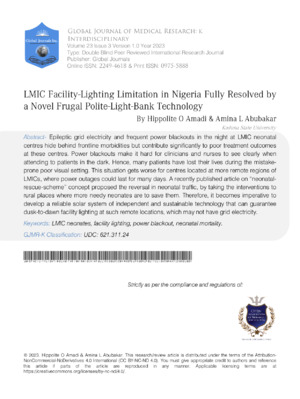
Epileptic grid electricity and frequent power blackouts in the night at LMIC neonatal centres hide behind frontline morbidities but contribute significantly to poor treatment outcomes at these centres. Power blackouts make it hard for clinicians and nurses to see clearly when attending to patients in the dark. Hence, many patients have lost their lives during the mistakeprone poor visual setting. This situation gets worse for centres located at more remote regions of LMICs, where power outages could last for many days. A recently published article on “neonatalrescue-scheme” concept proposed the reversal in neonatal traffic, by taking the interventions to rural places where more needy neonates are to save them. Therefore, it becomes imperative to develop a reliable solar system of independent and sustainable technology that can guarantee dusk-to-dawn facility lighting at such remote locations, which may not have grid electricity.

Funding

No external funding was declared for this work.

Conflict of Interest

The authors declare no conflict of interest.

Ethical Approval

No ethics committee approval was required for this article type.

Data Availability

Not applicable for this article.

Hippolite Amadi. 2026. \u201cLMIC Facility-Lighting Limitation in Nigeria Fully Resolved by a Novel Frugal Polite-Light-Bank Technology\u201d. Global Journal of Medical Research - K: Interdisciplinary GJMR-K Volume 23 (GJMR Volume 23 Issue K3): .

Download Citation

High-quality alt: Innovative LMIC facility lighting using frugal polite-light-bank technology.
Journal Specifications

Crossref Journal DOI 10.17406/gjmra

Print ISSN 0975-5888

e-ISSN 2249-4618

Keywords
Classification
GJMR-K Classification: UDC: 21.311.24
Version of record

v1.2

Issue date

May 24, 2023

Language

English

Experiance in AR

The methods for personal identification and authentication are no exception.

Read in 3D

The methods for personal identification and authentication are no exception.

Article Matrices
Total Views: 1133
Total Downloads: 23
2026 Trends
Research Identity (RIN)
Related Research

Published Article

Epileptic grid electricity and frequent power blackouts in the night at LMIC neonatal centres hide behind frontline morbidities but contribute significantly to poor treatment outcomes at these centres. Power blackouts make it hard for clinicians and nurses to see clearly when attending to patients in the dark. Hence, many patients have lost their lives during the mistakeprone poor visual setting. This situation gets worse for centres located at more remote regions of LMICs, where power outages could last for many days. A recently published article on “neonatalrescue-scheme” concept proposed the reversal in neonatal traffic, by taking the interventions to rural places where more needy neonates are to save them. Therefore, it becomes imperative to develop a reliable solar system of independent and sustainable technology that can guarantee dusk-to-dawn facility lighting at such remote locations, which may not have grid electricity.

Our website is actively being updated, and changes may occur frequently. Please clear your browser cache if needed. For feedback or error reporting, please email [email protected]
×

This Page is Under Development

We are currently updating this article page for a better experience.

Request Access

Please fill out the form below to request access to this research paper. Your request will be reviewed by the editorial or author team.
X

Quote and Order Details

Contact Person

Invoice Address

Notes or Comments

This is the heading

Lorem ipsum dolor sit amet, consectetur adipiscing elit. Ut elit tellus, luctus nec ullamcorper mattis, pulvinar dapibus leo.


High-quality academic research articles on global topics and journals.

LMIC Facility-Lighting Limitation in Nigeria Fully Resolved by a Novel Frugal Polite-Light-Bank Technology

Hippolite Amadi
Hippolite Amadi
Amina L Abubakar
Amina L Abubakar

Research Journals





























































