## I. INTRODUCTION
University libraries are literature and information service providers. They support departments at universities regarding literature requests. Library tasks include acquiring, licensing, and providing the necessary literature for research and teaching purposes. In teaching it is reasonable to supply students with easy and efficient access to this kind of information. The successful LMS redesign project pointing to better student support should definitely consider a better use of library services. The following essay will analyze possible requirements for a Next Generation LMS, except for technical, licensing, and data protection aspects which are analyzed afterward. Nowadays, in Covid-19 times, there's a discussion on the digitalization of the teaching process. We will examine how libraries can and should support virtual learning.
## II. INFORMATION LITERACY AS A SKILL
Libraries not only acquire and provide media but also teach information literacy. In Breivik and Gee [6, p. 193] we can find an early definition of information literacy. But you don't need information literacy not only for research but also for professional use of information and online search tools. For further information, see [44, 45]. This aspect, i.e. information literacy, is often ignored, like e.g. Bill Gates' keynote "Information at your fingertips": he gives an outlook on the future information society. He has no doubt about the user's ability to determine, collect and evaluate information [16]. The students' success, in fact, depend on the ability to find the parts of (scientific) data and publications that are relevant to their work. Additionally to literature provision, libraries should also supply the necessary skills to find and identify relevant literature. Reinitzer speaks of "assistance" and "support" [40, section 3 ii]. This need does not only apply to students, it also makes sense for pupils or employees in the economic environment [11, p. 9, 35]. An imparting of information literacy becomes more and more critical in librarians' work: they will be considered information brokers. The mission change in the 21st century is already part of discussion [49, p. 17 Organization section, 53, p. 66 section "The library in cyberspace)]. Especially the collaborative aspect is emphasized [3, p. 72 section "Collaboration: Creating Alliances"].
Universities emphasize more and more on teaching literacy skills. The perception started during the Bologna process in 1999, which pursued the goal of a Europe-wide education area and demanded the teaching of soft skills as interdisciplinary abilities and competencies [8, 13]. Information literacy is part of soft skills and should also be part of the curriculum, see [37], how published by the German Rectors' Conference Resolution in 2012 [21]. Please see [24, 44, 45] for more details on information literacy.
Nowadays, not only relevant specialist committees are discussing this object, but also the general public is aware of this matter [15].
Sometimes, libraries offer courses or events to teach information literacy [36], however, these are often separated from the "usual" teaching, i.e., the subject courses. Integrating the learning of information literacy directly into the classes seems to be more beneficial. When creating new teaching and learning environments, this environment also needs to reflect on how information literacy needs to be taught today.
One way of directly supporting students, and sometimes teachers, is to involve librarians in the learning environment. In this way the librarians can pass on their specialist knowledge now to the respective users or user groups if required. Bracsevits requests for such an active involvement: The "mediator" [note: the librarian] should be part of the community and actively help to shape it [7, p. 222].
Likewise, in the Anglo-Saxon world, the term liaison librarian is used \[25, p. 4\]: i.e. a person who acts as an intermediary or contact person who has the knowledge of how scientists of a specific discipline communicate with each other, and is able to give support to the process.
The tasks of librarians are thus changing: starting from acquiring, storing, and presenting literature, they are now becoming an active part of the communication process in respective scientific communities.
## III. INTEGRATION OF LITERATURE QUEST IN SUBJECT CLASSES
A learning management system is a working platform for students and their learning activities. The scientific community dissociates from the idea of creating a digital copy of the frontal teaching situation. An LMS, instead, should support students actively in their specific learning situation. The idea is described by the term Adaptive Personalized Learning Environment, APLE [42, section "1 Introduction"].
Depending on the situation, students need additional and supplementary literature for their studies, but today this kind of literature is managed separately. Of course, it would be more beneficial to integrate these features directly in the learning environment, i.e. the specific literature should be part of the adaptive personalized learning environment. A requirement that applies to both learners and teachers. In this way, teachers can implement and manage an ad-hoc pool of literature and quotations, tables, graphics, media files, etc. for the used teaching formats.
During their studies, as part of seminars students have to produce documents like essays, presentations, or lectures as practice and preparation for their final theses [54, section "Hausarbeitsassistenz für Studierende", i.e. "Homework Assistance for Students)].
In general, scientific work also means "working with literature". Students should also learn this way of working, particularly scientific writing. For more details on this argument, see [1, 18, 19, 27]. Scientific writing also includes the quest for relevant literature. Students are supposed to work independently on topics, as used in practices, exercises, or seminars, so they have to be able to perform a literature quest. Often students receive credit points for their work. In order to help students on this issue, you have to form them on data search; at this point, information literacy skills come into play [54]. Students have to pick the relevant information and data from many sources. They have to extract information and use it as excerpt or quote in their thesis.
In the "traditional" way of working, students go to the public library to search for and lend books, journal articles, but also other kinds of media (audibles, film documents, etc.). This way of working can present inconveniences [32]. Many content is now available in digital form and can be accessed comfortably from home [31, 33]. An evolution from a purely print-related offer to a virtual library represents an organizational challenge for libraries [47].
The results are collected, structured, and evaluated. It is usually done at home or work while, among other things, using tools such as literature management programs (e.g., Citavi [10], Zotero [55]). The data is extracted from these sources and used in quotes. Many sources are available in digitized form, but it is often necessary to return to analog, i.e., printed inventories. Media discontinuities are unavoidable, and while the data transfer from library catalogs is possible, this procedure is usually cumbersome because often only simple exchange formats such as CSV exist. In addition, the connection to literature management software is manufacturer-specific, and powerful software is often subject to a fee. Manual post-processing of the data often cannot be avoided. The media discontinuities, data conversions, and data structuring require time that is not available to students. It is also an obstacle to the workflow and 'learning flow' [43, section "Flow-Erleben", i.e., "Experiencing Flow"].
It should be considered how to digitize these activities to reach a pure and as complete as possible digital workflow. This kind of seminar and class, require not only scientific literature, but also assistance and instructions on how to write scientific reports. A library should be equipped with an adequate stock of literature. For more details, see [1, 4, 18, 19, 34, 39].
## IV. LIBRARIES AS PART OF THE COMMUNITY OF INTEREST
The research i.e. scientific working by using literature often takes place in seminars and technical classes, so it is reasonable to provide a follow-up. In the classes, a wide range of topics are worked on, and corresponding subtasks are given to the participants. The topic complex provides a common content framework, and thus the group of students forms a "community of interest". When the focus is on teaching information literacy in general, the library must be a member of this "community of interest" [7]. Being member can refer to the integration of literature sources (catalogs, databases) but it refers also to the librarians themselves because it is their task to teach information literacy. On the one hand, it is possible to treat information literacy in stand-alone introductory courses, i.e. in a rather abstract way. On the other hand, direct assistance can be provided on demand, in a given situation, with an actual request of a literature research process.
There are first successful steps in the field of the PoSuKo project (Portable Suchkontexe, i.e., portable search contexts, introduced by J. Haake, Chair of Cooperative Systems at FernUniversität in Hagen) [20]. The project was initially intended to support scientists. In second step it is used on a trial basis in a teaching environment, i.e., in seminars. The author, a member of the library, is involved in supporting research, i.e., database selection, literature quest strategies, etc. Using tools like a (scientific) thesaurus or classification can benefit content structuring and context expansion. A scientific thesaurus or classification is a subject ontology and it contains subject-specific terminology. Students must learn subject-specific terminology [9, 29 p. 104, 30]. It is another topic conveyed by libraries.
The specific design of the working methods applied by the community of interest, i.e., the most reachable digital workflow, must be coordinated with learners and with teachers. The library as a service provider shares the needs of the community. Not only the current working methods must be digitally mapped, but there must be started a discussion on future working methods in a Next Generation Learning Management System. The workshop held at FernUniversität in Hagen in August 2020 has discussed specific requirements regarding to the integration of the library that should absolutely be considered.
This (digital) workflow should map not only the student requirements, but also the teacher requirements: It is the teacher who determines the topics and recommends literature. The teacher's working methods can differ from those of the students.
An approach that considers this range of functions would support and train scientific work with literature (text, media, etc.), and promotes the acquisition of information literacy.
New perspectives of information literacy arise when one understands the interaction of library offers (catalogs, databases, etc.) and the learning management system as a virtual workplace for students and teachers. Involving librarians (primarily subject librarians) in the discussion board of an LMS supports and encourages the role of Liaison Librarians. Subject librarians are the contact persons; they are part of the specialist community because of their studies. They are the link between the professional world, i.e., teaching (seminars, etc.), and the library world that can be understood as an "information store" for scientific information.
Tréfás has explained that, very often, the personal literature needs of the users are often not known because the library's inventory is built up and maintained according to rather general principles [48, p. 697]. If the library is personally integrated into the user community, i.e., the scientific community and the learning community, the personal literature needs of the users would become visible to the library. In the library environment you can use as well newer developments such as artificial intelligence (A.I.).
Especially new formats like A.I., e.g., could help with inquiries by recognizing search intentions or creating new metadata, i.e. creating and curating "linked data collections" [46, p. 189]. The subject librarians can be involved on this matters since they have the necessary specialist knowledge. They can support the user and train an A.I. In such a scenario, the user's personal need for information is also addressed.
## V. BANKS AS PIONEERS
The world of finance, especially retail banking, has undergone significant changes since the commercialization of the internet. Today, it's usual to use online banking via the internet and web browsers. In addition, customers use finance apps on mobile devices. The offer of banking services via the internet has now become standard here. We have to see if library services can be used in the same way. The library services are getting available to the end customer, i.e., the library user, via the internet and web browser. We wonder if libraries can learn and benefit from the experiences of other sectors, in this case, the banking private customer business. In the following text, we will demonstrate similarities but also differences between the banks and libraries.
The most significant difference is that banks belong to the private sector, they have to generate profits, while (academic) libraries have an institutional function. Customers are free to choose their bank, while a university or institutional library is the primary contact for relatives of the institution regarding literature questions. Then again, libraries are competing with (private) search engine operators, online retailers such as Amazon, and document delivery services. It is essential that libraries achieve customer loyalty. According to Wild, customer loyalty can be increased if banks offer the right products at the right time, through the right distribution channel and, under the right conditions [52, p. 13]. This is undoubtedly transferrable to libraries. According to Walter, active customer care, i.e., services tailored to the individual customer, are the decisive measures for banks to build long-term customer relationships [50, p. 54]. The changed customer behavior leads to a multidimensional sense of entitlement [50, p. 54]. You can observe this also in the library world: the success of Amazon and Google Scholar proves this.
Likewise, in an online consultation of the banks, the software must have suitable functions. Felfernig et al. talk about dynamic interaction sequences, different interaction modes, control of the dialogue, evaluation of alternatives, and feedback on product suggestions [14, pp. 45-46]. You can transfer these general requirements to an advisory tool for libraries. Of course, the specific configurations must correspond to the requirements of library operations and user needs when searching for literature.
Mehlau notes that the banks' IT has increased security because of the sensitive financial customer relationships. The banks want to guarantee their customers a secure and trustworthy transaction \[28, p.
299\]. Library software is also subject to IT security regulations, such as data protection, because personal data is processed. However, you must see whether these safety regulations are sufficient, for example, when literature inquiry (e.g., patent information) allows conclusions to be drawn about internal company inquiry as part of an internship or a thesis in cooperation with an external company. Private companies stress on data confidentiality. In such a scenario, increased demands on the security of library software are advantageous.
Due to these considerations, banks have expanded the (virtual) bank account into a customer interface. You should consider which functionalities that map the banking processes can be transferred to the library world. This is not a 1-to-1 transfer, it is rather about identifying similar operations in the bank-customer relationship and in the library-user relationship and transferring them to the respective area. As the bank advisor maintains a relationship with his customer via the (digital) account, the librarian (subject/liaison librarian) can also keep a (customer) relationship with the student or scientist via the library account. It is about learning from other industries.
## VI. THE LIBRARY CATALOG AS SOCIAL MEDIA
Social media enable people to organize, form groups, share content and create new ones via the internet. Cooperative working requires a digital platform that supports collaborative work. The best-known example is probably Wikipedia [51]. In the library environment, there are efforts to develop the online catalog in such a direction.
Nowak et al. [38] describe "mashups" in this context, i.e., different file types and contents merged. According to Nowak et al., the term "mashup" is not sharply defined. Still, the user has a rough idea of what it is about: various elements for literature collections can be merged into a personalized start page in the web browser, such as the library catalog, search engines and the homepages of online journals. At this point, one can find other analogies to a bank account: on their start page, not only the financial transactions are recorded, but also stock prices or foreign bank accounts can be integrated and displayed. Libraries offer initial approaches to this in their online catalogs as extensions (catalog enrichment), e.g., title pages or tables of contents.
This is a personalization of each user's starting point ("homepage on the web") that differ from user to user. The creation or sharing of content ("user-generated content") is more likely to be found in social media or Web 2.0.
For example, Kneifel [26] claims for new catalog functions that are based on Web 2.0. A library catalog is thus changing from a mere reference tool to an interactive and participatory web application [26, p. 39].
User comments, for example, are visible to everyone and other users can add literature recommendations [26, p. 41, p. 44]. It is also possible to create links to social networks [26, p. 48]. The idea of the virtual community in library catalogs can also be found in Nowak et al. [38]. The use of mashups allows to integrate external content, and the co-working of many users creates a new content collection. This process primarily relates to Linked Open Data or data in the public domain [38, p. 158 section "Mixed Prospects)]. Czerwinski and Voß describe "LibraryThing" as a collaborative library 2.0 [12]. This application was not initiated by libraries but arose from a private initiative [12, p. 333 section "Organization and Scope"]. A unique feature is the joint tagging of works, i.e., the content-based indexing by the users [12, p. 335]. Cooperative working, i.e., the division of labor, makes it possible to process more extensive databases. What initially appears to be an advantage also has disadvantageous aspects, namely when the terms become fuzzy due to the free assignment of keywords [12, p. 336]. This remains a contrast to the "classic" library model, in which the data collection (proper indexing) and the description of the content (context-based indexing) are done by trained library staff and generates high-quality and homogeneous metadata. The metadata helps to simplify the search for scientific papers because only standardized terms are used. Therefore, database operators add great value to content indexing by using thesaurus or classification.
The user community consists of a voluntary association of individuals. The single 'members' are familiar with each other through personalization [12, p. 338 section "User communities"]. However, the user name (alias) is only meaningful to a limited extent, and the true identity of the user can remain hidden. Hidden identities allow misuse, as you can see, in many forums exists a user type ("trolls") who reduces the quality of the joint work due to destructive behavior.
Using Web 2.0 technology in a library environment, it is important to know how users create the content and how they do behave. Alluvatti et al. [2, p. 89, section "8. Conclusion and future work"] show two possible models: The first model consists of 3 phases and is used to manage significant, extensive content (during the first phase the content is growing slowly, during the 2nd one the content is growing constantly but more slowly and during the 3rd phases the content increases in a very dynamic manner). The second model consists of only 2 phases (starting with a slow growth followed by constantly growth) and is used to manage smaller content. The third phase doesn't exist. The starting phase is decisive. In order to get started there must be a minimum of "user-generated content" available or it must be created. Otherwise the dynamic process will not start at all. The author suggests to provide appropriate library account features to encourage the development process. E.g., when seminar participants have the possibility to create annotations (comments, keywords, etc.) for their literature collection these annotations help to create user-based work (homework, seminar lecture, etc.). The students are encouraged to collaborate because they gain credit points for their work. In this respect, the user's annotations are also sensitive data because they lead to personal votes. As described above, the library can provide support and quality assurance. In the starting phases the core of the community is formed by the members "student-subject librarian", or "seminar group-subject librarian". The involvement of the subject specialist already during the first phases assures a high content quality. This is very important because, as demonstrated by Baeza-Yates and Saez-Trumper, in a Web 2.0 application only few and very active users create content, whereas the major part is quite passive and does not use the possibility to interact. It also happens that user opinions are not taken into account ("digital desert"). How you can see the content-producing community is only a subset of the elite [5, section "6. Conclusions and future work"], and the elite of the professional community is not necessarily trained in information literacy. The help of specific library services, such as indexing according to standardized vocabulary, creating search strategies and search queries, etc., is therefore essential.
## VII. THE LIBRARY ACCOUNT AS PROTECTED INFORMATION AND KNOWLEDGE COLLECTION
While a broad discussion calls for the online catalog to be developed in the direction of Web 2.0, the author advocates implementing these functionalities first in the (protected, hence "private") library account. Doing so, data protection requirements should be satisfied. From a legal point of view, only the individual information release, such as literature lists, rating, or tagging of literature, must be considered separately. The library user can thus benefit from the personalized functions, but he does not have to worry about misuse or disclosure of data. This is another similar aspect as you can find in a bank account: the account and its contents are protected, and exclusively the owner and the bank have access. The owner (customer of the bank) has the option (the rights) to allow other financial service providers to access the account. In the following, more legal considerations can be found.
The library user is the owner of the library account. The account is the user's private environment and protected area where he can create dedicated information databases. While preparing an examination-relevant paper, the student doesn't want to share his literature and information databases, comments and conclusions. At this moment it's private data, that allows the student to gain learning credits. Only after getting the credits the student will decide which data to share and thus unauthorized access to the protected data must prevented. Today, the private data sets are stored on the user's PC or are available in analog form as (loaned) books or print copies on the user's office desk. At this point, digital workflow of a Next Generation LMS has to come in, which transfers analog or partially digital working methods into a protected digital environment.
A Next Generation LMS must be able to merge and combine different data types: "pure" literature, annotations about the relevance of a source (text, table, graphic, image,...) or to a specific topic. Also the intended purpose (e.g., for a seminar, a thesis) is important. Likewise, the role that takes the user is relevant: a teacher who recommends literature, or a student who has to search for literature, etc.
Librarians can provide specific support for content indexing (tagging). They can recommend the use of (subject) classifications or thesauri. It is extremely useful for database searches because the application of standard terms improves the quality of the user-generated content. The users can benefit from the librarians' skill knowledge, and the librarians become part of the community [7].
Specialist information services are already part of this community [41]. According to Riehm et al., these kinds of services are seen as "basic services". Advanced services like individual literature quests are context-related subject to intense competition with Google Scholar or other search engines [41, p. 179].
## VIII. NEW REQUIREMENTS FOR AN LMS
Digital learning environments are particularly suitable for providing customized learning environments to students. Today the "one size fits all" learning model doesn't fit modern requirements. A personalized learning environment instead, must guarantee the possibility to adapt to individual learning pace [42]. Library systems offer a customized environment i.e., the private library account. The choice of the software used is very important because it determines the range of functions that is provided to the single user. Today, many systems display only media issues or reservations. Library database providers also supply private accounts to their users. These accounts are independent of the respective university library and contain further options for customization, e.g., saving search history, search topics, etc. [22]. However, for the users it's not convenient to own and maintain multiple accounts. The present state of the art doesn't satisfy the user's needs. Other service providers, such as banks and insurance companies have recognized this disadvantage and, therefore, significantly expanded user account function ranges.
Many people today use online banking. An average online customer account [23] includes functions such as
- list of all (!) transactions over several years
- Search options
- contacts
- journal entries
Many features are available for smartphones by using the appropriate applications. The online account or smartphone app is the direct customer interface between the bank and its customers. In the same way, the library customer account should include analogous functions. Several functions are already listed in Kneifel [26, pp. 41 ff, section "Elemente eines Katalogs 2.0"]. The following list of issues in part coincides:
- interfacing to the library system, other databases, and free (online) text sources
- saving search queries and result lists
- storing of electronic documents
- access to the own library account
- list of all media ever issued
- rating and commenting on media
- use of a specialist vocabulary (thesaurus, etc.), tagging
- mapping media, search queries, and metadata, e.g., according to tasks (thesis, seminar, etc.)
- creating and storing literature collections
- collecting (electronic) documents
- collecting document excerpts (quotations, graphics,etc.)
- saving search queries, URLs, etc.
- commenting, rating, and sharing data (media, search queries)
- data searching
- tree structures on discussions should not only contain text, but
- electronic documents
- URLs, etc.
- media files (image, sound, film, animation)
- excerpts from documents (quotation, graphics, etc.)
- search queries on databases
- etc.
This short list includes personal and customized features as well as cooperative elements. Both working types should be supported, the independent work of the individual and the cooperative working in groups ("peers"). A different design of features according to the end user (i.e., learners and teachers) has to be considered.
## IX. LINK TO INFORMATION MANAGEMENT
The LMS can be considered as the students' personal learning environment or private workplace where to work and learn alone or in groups and exchange opinions and information; all activities are supported by access to literature. The system should integrate literature-related functions and services, that can be classified according to different levels:
Source level: Integration of one or more library user accounts. Listings of all issued media, with both loan and return date. Integration with other databases that provide separate customer accounts. Control of free (stand-alone) URLs ("internet sources"). The possibility to use comments, indexing, and sophisticated search features. The option to save electronic media (within copyright and license rules).
Search quest level: Option to connect to other databases etc. The possibility to collect queries and to use index by classification and thesaurus. Database providers often supply the search quest level. This option is provider-specific and independent of the library account. Several literature management programs provide these functions. In this case, a specific survey and evaluation of the software is reasonable.
Content level (quote level): Content management in general - different media types can be handled: electronic documents, but also media (film or audible files), entire documents, as well as excerpts (single pages, film scenes or audible excerpts, tables, graphics, etc.). These kinds of features are typically found in content management systems.
User level: Possibility to create comments at every level and to exchange opinions between users. Single exchange level features can differ according to the users involved: teachers (teacher-teacher exchange), students (student-student exchange), and teacher-student exchange.
The librarian integration would be particularly beneficial on search quest, and user level. This integration corresponds to the Liaison Librarian's idea.
Translating these ideas into terms used in the analog "(paper) age", you will speak of "desks", "hard copies", "bookshelves", "libraries", and "work groups". All these elements must be implemented in a digital way in order to generate a benefit. In the same way, you must consider the requirements and points of view of the different user types: teachers, learners and librarians. The following table gives a first overview of the various groups and their roles, tasks, and objectives.
Table 1: Role of the user groups and their requirements or activities.
<table><tr><td>Group</td><td>Source Level</td><td>Content Level</td><td>User Level</td><td>Objective</td></tr><tr><td>students</td><td>·research for
books,
journal
articles in
printed and
digital media
·research for
(free) online
sources</td><td>·collecting,
managing
and
commenting
on
quotations
(also tables,
figures,...)
etc.</td><td>·collecting and
structuring of
search results
·analysing and
rating search
results
·collecting and
evaluating
search questions
·co-working by
exchanging,
commenting
on search
questions and
results with
other
students or, if
needed, with
teachers,
librarians</td><td>·additional literature
for studies,
homework, etc.</td></tr><tr><td>teachers</td><td>·research for
books,
journal
articles in
printed and
digital media
·research for
(free) online
sources
·collecting
and
structuring
results
·comment on
search
results
·collecting
and rateeing
search
queries</td><td>·collecting,
managing
and
commenting
on
quotations
(also tables,
figures,...)
etc.</td><td>·collecting and
structuring of
search results
·analysing and
rating search
results
·collecting and
evaluating
search
questions
·co-working by
exchanging,
commenting
on search
questions and
results with
other
students or, if
needed, with
teachers,
librarians</td><td>·recommendation of
basic and supplementary
literature for
studies, term
paper, etc.</td></tr><tr><td>librarians</td><td>·purchasing,
licensing
media</td><td></td><td>·support with
specialist
research
(teaching of
information
literacy)
·support with
keywording
tagging,
commenting)</td><td>·supporting function
for teachers and
learners</td></tr></table>
In conclusion of this article, there is the given possibility for the library account to become the core of the customized information management. Now, the author will discuss the structure of a new digital information management system for universities. As shown, this system has to be applied on teaching and research and must integrate the library.
## X. TECHNICAL DESIGN
The features described above already exist in different software applications. Up to now, the integration of all these services into only one environment is not available. In order to create a new integration, you can choose between two possible solutions: on the one hand, a monolithic architecture, i.e., integration of all features in the same application, possibly even directly in the LMS, or, on the other hand, single, specific applications connected to each other via interfaces. Furthermore, the compliance with data protection, licensing, and copyright law must be guaranteed. For the end user, the software has to seem to be "made of one piece only" without the need to import, export, and convert data. A software should be user-friendly and intuitive to use; the user will accept the new software only if he can start to use it right ahead without waisting time on training. Otherwise, users won't apply the new tool, see [43 section "Summary and ideas for a modern learning management system)].
## XI. HYPOTHETICAL EXAMPLE
The image is intended to illustrate how work with text, media, and sources could look like. This is only one possible user view. In the background – invisible to the user - is running the management and administration of discussion inputs, sources, and citations. On-demand, the library can provide access to specific sources. A librarian (specialist) as an information specialist, can support the quests and organization of the results. He contributes to database selection, search queries, or the use of classifications. All systems are part of the same network. Therefore, a user can create a search quest to databases from within the discussion tree, and the results (hit list selection or full text) can be displayed in this view and managed in a library account. In the example, it's possible to start further search queries using classification codes. Using keywords or tagging, and using classification codes is also more helpful, since a standardized scientific community vocabulary is used. A librarian specialist guarantees the quality level (selection of technical terms). Another aspect is that in the LMS, in a virtual group (e.g., seminar), only one specific topic is discussed. A librarian supports the single user in finding the particular information essential for the user. Involving a specialist in the academic discussion, its role changes from a pure literature service provider (literature acquisition and management) to an active member of the academic community (as described above [7, 25]).
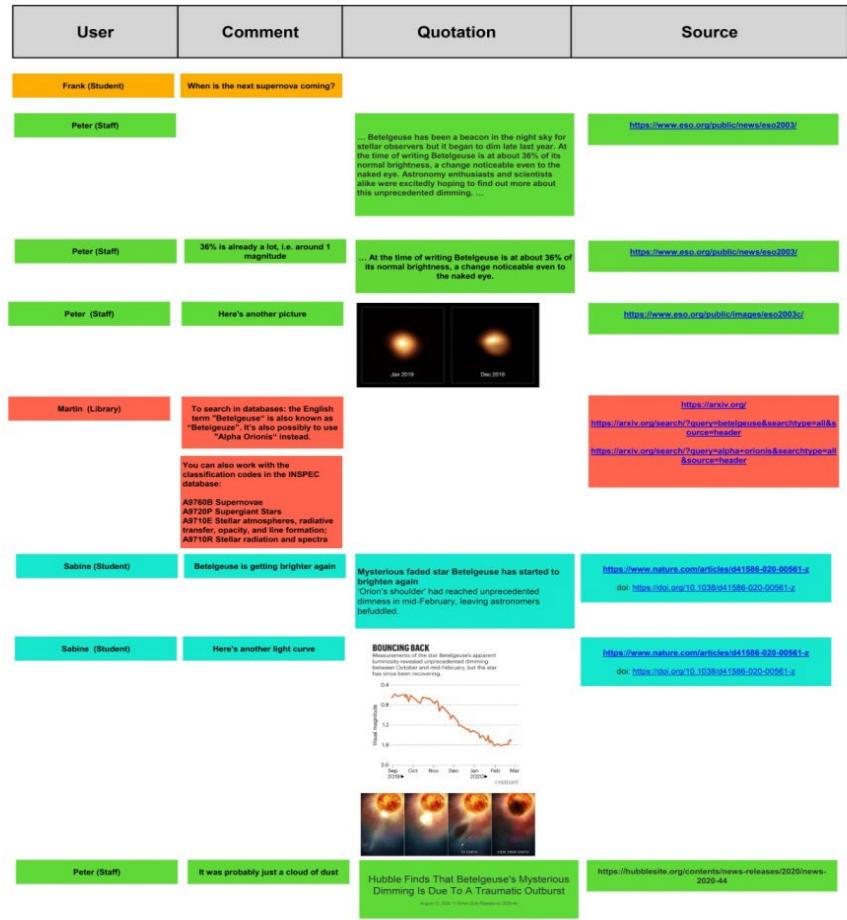 Fig.1: Hypothetical discussion in an LMS containing citation and source support. The librarian is part of the community, and can support the discussion with indexing according to classification or thesaurus. Afterwards the librarian helps to run the output search queries in databases.
## XII. NOTE ON THE LEGAL SITUATION
The author is not a lawyer, but he sees the need for a legal discussion on the subject. The following reflections should be considered as the starting point for the analysis of the legal aspects.
As this article was first published in German, the following reflections are based on German copyright law.
Copyright law (UrhG) [17] is primarily relevant for publishing. According to law, a library permits users to copy up to $10\%$ of a work and individual contributions from specialist journals ( $\S 60$ e section 4 UrhG and $\S 60$ e section 5 UrhG). These are personal copies that must not be passed on. Only the citation is permitted according to $\S 51$ UrhG.
Likewise, when a discussion tree produces a work (publication) similar to the hypothetical example shown above: here, too, in the case of publication, it must be decided in advance who has the ownership of the different rights.
The same when students or teachers leave the university: who has the ownership rights on the discussion tree, the quotation, and the literature collection?
Can these collections be used in other classes? Only these few questions show that we have a very complex legal situation. Before starting the platform development, in order to prevent potential disputes, it's better to achieve reliable legal clarification on these issues.
Another legal discussion concerns data and privacy protection. Users who rate literature will initially do so for personal interest. After all, everyone has to decide for themselves which literature to select and why they have chosen it. In the environment of a personal library account, this information is initially protected, but when it gets shared, data protection law comes to play. Playing mind games by looking at the personal comments, it's possible to identify to what degree the student has understood the literature. You should prevent any kind of abuse. However, since these annotations are released in an LMS, i.e., a protected environment, possible misuse is restricted or even stopped. The publication or transfer of data is subject to restrictions because the library user, learner, and teacher, decide for themselves how to handle the data. It is very important because in an LMS, all users are known (real names), whereas on free accessible web alias names are usually used.
Also on this subject, a detailed discussion with the experts can ensure legal security.
## XIII. CONCLUSION
Libraries, as literature service providers, support students and teachers in university classes. The currently used Library Management systems sully only a few links to library catalogs and licensed content. In a Next Generation LMS, a closer integration of these items seems reasonable. In virtual classes, librarians can be directly involved as information specialists. They can support the search quests for literature in general, and, can also offer customized services to the users. In this way, information literacy is conveyed relatively better than in pure library events because the starting point is always the students' and teachers' concrete information needs. An LMS should offer the possibility of literature and information management. There should be a direct connection between customer accounts and the library, and the literature management should be expanded to information management.
Not only the users benefit from this, but also the library as an institution because it will be possible to identify the exact literature needs of the single users. Likewise, the librarians can pass their skills directly to the users. They are acting as information specialists and train the users on information literacy.
A correct implementation should also apply to legal aspects, in order to guarantee legal certainty regarding licensing, copyright and data protection law. The legal certainty should also promote user acceptance.
### ACKNOWLEDGEMENT
This paper was first published in German language. It is based on a presentation "Online-
- Workshop: Next Generation Learning Management System", held at FernUniversität in Hagen, Germany, in cooperation CampusSource, Germany, and ETH Zürich, Switzerland, 19. and 20. August, 2020.
- Presentation:
- https://www.campussource.de/events/e2008nextgenlms/vortraege.html (last check 2023-01-11)
- German article:
- Roos, M.: Mögliche Anforderungen an ein LMS aus Bibliothekssicht. In: eleed - e-learning and education, special edition 2021. https://eleed.campussource.de/archive/se2021/5321 (last check 2023-01-11)) urn:nbn:de:0009-5-53210 (last check 2023-01-11)
Generating HTML Viewer...
References
48 Cites in Article
Volker Ahrens (2020). Abschlussarbeiten richtig gliedern in Naturwissenschaften, Technik und Wirtschaft.
Giovanni Alluvatti,Andrea; De Capiluppi,Giuseppe Ruvo,Marco Molfetta (2011). User Generated (Web) Content: Trash or Treasure.
Greg Anderson (1994). MIT -The Distributed Library Initiative: Collaboration, Vision, Prototyping.
Nicola Vittorio (2023). European Doctoral Programs in Light of EHEA and ERA.
Alexander Felfernig,Jannach,; Dietmar,Christian Russ,Markus Zanker (2003). Wissensbasierte Technologien für die virtuelle Beratung von Fondsprodukte.
Allgemeine Frankfurter,Zeitung (2009). Schlüsselqualifikationen: Parlieren geht über Studieren.
Bill Gates (1994). Information at your fingertips.
Alfred Pernice (2021). Formelle Gesetze im römischen Rechte.
Hilary Glasman-Deal (2010). Science Research Writing for Non-Native Speakers of English.
Regina Graßmann (2018). Theoriebegriff in den Natur- und Ingenieurwissenschaften.
Jörg Haake,Martin Roos,Till Schümmer (2014). POSUKO: POrtable SUchKOntexte zur Vernetzung von Bibliotheken, Verlagen und Wissenschaftlern.
Michaela Jausen (2012). Markenbildung im digitalen Zeitalter – Alles neu, nichts anders?.
Janice Jaguszewski,Karen Williams (2012). New Roles for New Times: Transforming Liaison Roles in Research Libraries.
Fabienne Kneifel (2010). Der Katalog 2.0. Mit Web 2.0 zum Online-Katalog der nächsten Generation.
Bruno Kremer (2014). Vom Referat bis zur Examensarbeit.
Jens Mehlau,Ingo (2003). Die Bedeutung des IT-Sicherheitsmanagements für Finanzdienstleister.
Toshiro Minami,Kensuke Baba (2014). Publisher's Information.
Umi Mokhtar,Zawiyah Yusof (2015). Classification: The understudied concept.
Cornel Dora (2009). Die digitale Bibliothek Ostschweiz – geteilte Freude ist doppelte Freude.
Helmut Kury (2010). Fink, Daniel, Freiheitsentzug in der Schweiz. Formen, Effizienz, Bedeutung.
Neue Zürcher,Zeitung (2010). Die Digitalisierung verschafft der Bibliothek mehr Ausstrahlung.
Edmund Neugebauer (2011). Von der Idee zur Publikation.
(2000). The New York Times Book Reviews 2000.
(2005). The New York Times.
Annemarie Nilges,Irmgard Siebert (2002). Informationskompetenz im Curriculum. Das Studienbegleitende Ausbildungskonzept zur Vermittlung von Informationskompetenz der Universitäts-und Landesbibliothek Düsseldorf.
Manfred Nowak,Lambert Heller,Sascha Korzen (2010). Mashups und Bibliotheken.
Thomas Plümper (2012). Effizient schreiben.
Sigrid Reinitzer (2000). Bibliotheken zwischen Gutenberg und Gates: Rolle der wissenschaftlichen Bibliotheken in einer sich neu formierenden Medienlandschaft.
Ulrich Riehm,Dirk Hommrich (2017). Zur Einführung: Fachportale, Fachinformationsdienste, Wissenschaftsnetzwerke – Merkmale webbasierter, wissenschaftlicher Informations- und Kommunikationssysteme.
Niels Seidel,Haake,M Jörg,Marc Burchart (2020). From Diversity to adaptive Personalization: The Next Generation Learning Management System as Adaptive Learning Environment.
Kerstin Steimle (2020). Glow erleben.
Wilfried Sühl-Strohmenger,Jan-Pieter Wilfried; Barbian (2017). Informationskompetenz und die Herausforderungen der digitalen Wissensgesellschaft.
Anneke Thiel (1999). Innovative Projekte in Forschung, Lehre und Infrastruktur.
Bob Travica (1999). Organizational aspects of the virtual library: A survey of academic libraries.
David Tréfás (2019). Digitale Transformation und die Verbesserung der Wirkung von bibliothekarischen Dienstleistungen Improved Efficiency of Library Services and the Digital Transformation.
Johan De Vries,Leo Minnigh (1994). Information Specialists in the Future Academic Library: Flexible Tightrope Walkers.
Georg Walter (2003). Kundenmanagement bei Banken -Von reiner Transaktionsorientierung zu einem und umfassenden Beziehungsansatz.
Oliver Wild (2003). Strategische Bedeutung neuer Technologien im Bankgeschaft -Entwicklungen an der Kundenschnittstelle.
Jonathan Willson (1995). Enter the cyberpunk librarian: future directions in cyberspace.
Claudia De Witt,Heike Karolyi (2020). Anforderungen an ein Next Generation LMS zur Unterstuẗzung von Personalisierung aus bildungswissenschaftlicher Perspektive.
No ethics committee approval was required for this article type.
Data Availability
Not applicable for this article.
How to Cite This Article
Martin Roos. 2026. \u201cLMS System Requirements from the Libraries’ Point of View\u201d. Global Journal of Human-Social Science - G: Linguistics & Education GJHSS-G Volume 23 (GJHSS Volume 23 Issue G1): .
Explore published articles in an immersive Augmented Reality environment. Our platform converts research papers into interactive 3D books, allowing readers to view and interact with content using AR and VR compatible devices.
Your published article is automatically converted into a realistic 3D book. Flip through pages and read research papers in a more engaging and interactive format.
Our website is actively being updated, and changes may occur frequently. Please clear your browser cache if needed. For feedback or error reporting, please email [email protected]
Thank you for connecting with us. We will respond to you shortly.