This paper is descriptive in nature and examines various aspects of the Energy Sector as related to LNG. India’s energy sector must critically balance rising energy demands, environmental concerns, economics, and energy security. With the government’s goal to increase the share of natural gas in the energy mix from 6% to 15% by 2030, Liquefied Natural Gas (LNG) has emerged as a critical energy component. LNG is a method for transporting natural gas over long distances when pipelines are not feasible. The article examines LNG’s expanding role in India’s energy portfolio, focusing on several key aspects, including economic advantages, energy security, and generating local employment through the development of LNG infrastructure. Environmentally, LNG significantly reduces air pollutants and CO₂ emissions. Challenges to LNG adoption are also considered, including infrastructure deficits, regional accessibility issues, price volatility, and competition from renewable energy sources. The article concludes by discussing the future of LNG in India’s energy mix, recommending further investment in infrastructure, stable LNG pricing, and policy measures to support LNG’s role as a transition fuel. It also recommends steps for the Government and the LNG industry to maximize the use of this form of energy. By addressing these challenges, LNG can play a strategic role in enhancing India’s energy security, environmental sustainability, and economic resilience.
## I. INTRODUCTION
India, as one of the world's fastest-growing economies, faces a rising demand for energy to fuel its industrial growth, urbanization, and economic development. Historically dependent on coal, oil, and biomass, the country's energy mix has led to challenges related to air pollution, energy security, and sustainability. This reliance on fossil fuels has made it crucial for India to adopt cleaner energy sources as it works towards achieving its Net Zero pledge.
As a cleaner and more efficient energy source, LNG has the potential to diversify India's energy imports, reduce pollution, and provide a stable supply to meet its ever-increasing energy needs. The Indian government has set an ambitious goal of increasing the share of natural gas in the energy mix from $6\%$ to $15\%$ by 2030. [1] This article explores the impact of LNG on India's energy landscape, highlighting its economic, environmental, and geopolitical implications. It examines the role of LNG in reducing dependence on oil imports, lowering coal imports for the power sector, enhancing energy affordability, and mitigating emissions. It also addresses challenges such as infrastructure limitations, price volatility, and competition with renewable energy sources. By understanding LNG's position in India's energy basket, we can appreciate both its immediate benefits and its potential as a bridge to a cleaner energy future. [2]
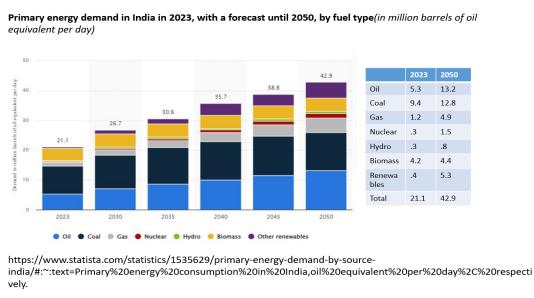
Figure 1: Primary Energy Demand in India in 2023
Source: Primary energy demand by fuel type India 2023-2050., https://www.statista.com/statistics/1535629/primary-energy-demand-by-source-india
Figure 1 illustrates the growth in demand for LNG in India's energy mix over the years, projecting an increase to 4.9 million barrels of oil equivalent per day in 2050, compared to 1.2 million barrels of oil equivalent per day in 2023. [3]
## II. ROLE OF LNG IN INDIA'S ENERGY TRANSITION
LNG is natural gas liquefied at $-160^{\circ}\mathrm{C}$. During the liquefaction process, natural gas is purified to a very high level, enhancing its combustion properties. Natural gas, particularly in the form of LNG, is universally recognized as a cleaner fuel compared to traditional fossil fuels such as coal and oil. One of its main advantages is its significantly lower emissions profile. When burned, natural gas produces about $50\%$ less carbon dioxide $(\mathrm{CO}_{2})$ than coal and around $20 - 30\%$ less than oil, aiding in the reduction of greenhouse gas emissions that contribute to global warming. Additionally, it emits negligible amounts of sulfur dioxide $(\mathrm{SO}_{2})$ and other pollutants that are major contributors to air quality issues, especially in urban areas. [4]
Quoting the statement of IEA Director of Energy Markets and Security, Keisuke Sadamori, "India's gas market is entering a new phase of growth, supported by significant infrastructure. The prospect of higher gas demand in India coincides with an expected wave of new global LNG supply. However, it will require careful planning and market coordination to ensure supply security and to help gas compete in a price-sensitive market," [5]
Source: Petroleum Planning & Analysis cell https://www.isbf.org/blogs/strengthening-india-s-ing-ecosystem-investigating-collaborative-efforts-to-boost-ing-finance structure
Source: Petroleum planning & Analysis cell: https://www.ibef.org/blogs/strengthening-india-s-lng-ecosystem-investigating-co/
laborative-efforts-to-boost-lng-infrastructure [7]
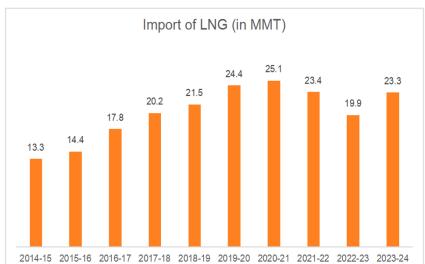
Figure 2: Import of LNG In 2023-24, 23.3 MMT of LNG was imported to India from many gas-surplus countries, mostly after long-term contracts. Advancements in LNG infrastructure, including regasification terminals and pipelines, have made natural gas accessible to a wider range of sectors, supporting its use as a bridge fuel during the transition to renewable energy sources. LNG infrastructure in India is helping exports of LNG. Thus, restriction on the use of only locally available gas is negated. While methane leaks from natural gas extraction and distribution pose an environmental challenge, strict regulations and advanced technologies for leakage detection can mitigate these risks, further positioning natural gas as an essential component of sustainable energy strategies.
LNG is economically competitive compared to other fossil fuels, primarily due to its cost efficiency, stable pricing methods, and versatility across sectors. For industries such as power generation, fertilizers, and transportation, LNG is very suitable with lower costs than oil and coal. It also has a high energy yield per unit. Additionally, LNG usage incurs lower environmental compliance costs. The global LNG market's growth has stabilized the cost of energy imports, particularly for oil. India benefits economically by reducing its reliance on volatile oil markets through diversified LNG imports from Qatar, the U.S.A, and Australia. As global demand for cleaner fuels grows, LNG's cost competitiveness in the energy mix ensures a balanced and sustainable economic future.
LNG infrastructure plays a pivotal role by providing the flexibility and scalability required to meet the growing energy demand across diverse sectors. Key components of this infrastructure include regasification terminals, which convert imported LNG back to gaseous form for distribution, along with an expanding network of pipelines. These pipelines transport natural gas to power plants, industrial hubs, and urban areas, creating a nationwide distribution system. Expanding this network supports government goals to increase the share of natural gas in the energy mix and promotes less polluted cities.
## III. GOVERNMENT POLICIES AND LNG INFRASTRUCTURE IN INDIA
Demand for LNG is growing in urban areas and industries. To achieve the goal of $15\%$ LNG in India's energy mix by 2030, the government has introduced a series of initiatives and investments. These include expanding LNG infrastructure, such as terminals, pipelines, and city gas distribution networks.
The focus is on developing LNG regasification terminals along India's Western coast in the states of Gujarat and Maharashtra. These terminals facilitate large-scale LNG imports, enabling India to diversify its energy sources and reduce its dependency on oil and coal. The government is also encouraging investments in new terminals along the Eastern coastline to expand LNG access and storage capabilities.
In addition, the expansion of the national gas pipeline network is crucial for transporting natural gas to industries and urban centers across the country. Many private players are being awarded contracts for laying these additional pipelines. Initiatives like the Pradhan Mantri Urja Ganga Project also aim to supply natural gas in underserved regions. Moreover, investments in city gas distribution systems and compressed natural gas (CNG) stations support the use of cleaner fuel in urban areas for households, transportation, and commercial use. Finally, the government policy on the use of CNG in public transport increases demand for LNG at ports.
The Indian government encourages the growth of LNG imports and infrastructure, recognizing LNG's role in achieving the country's energy and environmental goals. To increase LNG's share in the energy mix, the government has reduced tariffs on LNG imports and simplified import regulations and policies that facilitate the establishment of LNG infrastructure. By lowering tariffs, the government makes LNG a more competitive option for industries such as power generation, manufacturing, and transportation, allowing them to access cleaner energy at more affordable prices.
The government has also relaxed procedures and approval systems for establishing LNG infrastructure, including regasification terminals, storage facilities, and pipelines. The Petroleum and Natural Gas Regulatory Board (PNGRB), India's key regulatory body for the gas sector, has simplified licensing processes and introduced open-access policies for pipelines. This enables both private and public entities to invest in and operate LNG terminals, enhancing competition and facilitating infrastructure development. City gas distribution (CGD) licenses have been expanded to cover more urban areas, promoting LNG's use as a clean fuel in residential and commercial sectors. The government's "One Nation, One Gas Grid" initiative aims to integrate the pipeline network across states, further supporting LNG's reach. Special Economic Zones (SEZs) and industrial hubs enjoy additional benefits, such as tax breaks on LNG use.
## IV. LNG TERMINALS
India has expanded its LNG import capacity over the past decade to support its increasing energy demands. LNG terminals have been established in coastal states such as Gujarat, Maharashtra, and Kerala, with additional terminals planned for the Eastern coast. These facilities are designed to import, store, and regasify LNG, transforming it from liquid back to gaseous form so it can be distributed through pipelines to meet industrial, commercial, and residential energy needs. [10]
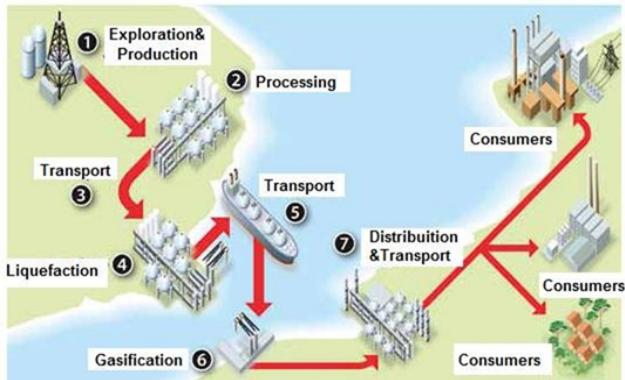
Figure 3: LNG Import and Regasification Infrastructure
The sketch in Figure 3 illustrates the complete process of LNG import and regasification infrastructure. The terminals in Gujarat, including those at Dahej, Hazira, and Mundra, are among the largest in the country and have played a pioneering role in India's LNG import infrastructure. Maharashtra's terminal at Dabhol, Jaigarh, along with the terminal at Kochi in Kerala and Ennore in Tamil Nadu, further enhances India's import capacity, supplying gas to industries and urban areas while also encouraging a shift away from coal and oil.
Dahej LNG Terminal: India's first LNG terminal, located at the port of Dahej, has a capacity of 17.5 million tonnes per annum (MMTPA) and is in the process of increasing to 22.5 MMTPA. It has storage capacity for two jetties, with the first able to handle up to 220,000 cubic meter LNG tankers and the second able to handle up to 265,000 cubic meter vessels. It is owned and operated by Petronet LNG, India's largest LNG importer.
Hazira LNG Terminal: It is owned and operated by Shell Energy India (SEI). This deep-water, multi-cargo port is situated 25 kilometers from Surat. It features a protected harbor design with a 1,000-meter approach channel, a draft of 11.5 meters, and a turning radius of 600 meters.
Dabhol LNG Terminal is owned by Konkan LNG Ltd (KLL) and was commissioned in 2013. It consists of three storage tanks, each with a capacity of 160,000 cubic meters, and has a receiving capacity of 5 MTPA, providing access to natural gas for India's southern and western states.
Kochi LNG Terminal: It is a regasification terminal operated by Petronet LNG in Puthuvype, Kochi, with a capacity to store and distribute 5 million tonnes per annum. It has a long-term contract with Australia for LNG.
Ennore LNG Terminal: It is an LNG import, storage, and regasification terminal in Tamil Nadu, located at Kamarajar Port, formerly known as Ennore Port. The facility is operated by Indian Oil LNG Private Limited, a joint venture of Indian Oil Corporation Limited (IOCL). The terminal has a capacity of 5 MMTPA.
Mundra LNG Terminal (Gujarat): A joint venture between the Adani Group and Indian Oil Corporation, this terminal has a capacity of 5 MTPA and supports industrial growth in western India.
Jaigarh LNG Terminal (Maharashtra): Developed by H-Energy (now part of the Hiranandani Group), this terminal has a capacity of 4 MTPA and features a floating storage and regasification unit (FSRU), enhancing India's flexible LNG import capabilities.
The Indian government is also focusing on expanding LNG facilities along the eastern coast, with planned projects in states such as Odisha and Andhra Pradesh. The Visakhapatnam LNG facility is in an advanced stage of completion. These new terminals will enhance energy access for the Eastern and North-Eastern regions of India.
## V. CASE STUDY OF EXPANSION OF DAHEJ LNG TERMINAL SINCE 2005
As the Dahej LNG terminal is India's first LNG 'Receiving and Regasification Terminal', its growth over the years directly reflects the increase in LNG usage and imports in India. It began with an initial capacity of 5 MMTPA at Dahej, Gujarat. The terminal's capacity has been expanded in phases and currently stands at 17.5 MMTPA, with further expansion planned to reach 22.5 MMTPA in additional phases. The terminal has 8 LNG storage tanks and various vaporisation facilities. In FY 2023-24, PLL handled approximately $74\%$ of the nation's total LNG imports and accounted for roughly $34\%$ of the overall natural gas consumption in the country. Details of the expansion are shown as under.
First Expansion (2009): Increase to 10 MMTPA. Due to the growing demand for natural gas in the power, fertilizer, and city gas distribution sectors, Petronet LNG undertook its first capacity expansion. By 2009, the terminal's capacity was doubled from 5 to 10 MMTPA. This phase included the construction of additional storage tanks and enhancements to the regasification infrastructure. The second jetty was commissioned to accommodate a higher number of LNG cargoes. New send-out pipelines and vaporizers were also added to manage the increased flow of regasified LNG (RLNG).
Second Expansion (2016-2017): Scaling up to 15 million metric tons per annum (MMTPA). In response to sustained industrial demand and increased imports of spot and term LNG cargoes, Dahej's capacity was further expanded to 15 MMTPA by 2017. The company added new Shell-and-Tube vaporizers, pipeline systems, and upgraded the existing unloading and storage infrastructure. This expansion enabled PLL to engage in more long-term agreements with global LNG suppliers and supply additional LNG to various sectors, including city gas, refineries, and steel plants.
Third Expansion (2019): Reaching 17.5 MMTPA. By June 2019, the Dahej LNG Terminal's capacity was further expanded to 17.5 MMTPA, making it one of the largest LNG terminals in South Asia. This expansion included the commissioning of additional regasification units, increased unloading arms, and enhancements in pipeline evacuation capacity. It also involved debottlenecking the existing facilities to optimize performance. The capacity boost was strategic, enabling India to import more LNG to meet its growing energy demand.
Fourth Expansion (2019): Reaching 22.5 MMTPA. The fourth expansion, which adds an additional 5 MMTPA of capacity, raises the overall total to 22.5 MMTPA and was scheduled for commissioning by June 2025. Petronet LNG has now delayed the launch of the expanded import capacity at the Dahej facility due to logistical challenges and security concerns following the flare-up in India-Pakistan relations. Consequently, the launch has been postponed to September 2025.
Dahej Terminal is the largest single-location LNG storage and regasification terminal in the country, handling 3538 LNG cargoes as of September 30, 2024. The terminal also offers tolling services to small and bulk customers. To cater to small customers who do not have gas pipeline connectivity, Dahej supplies LNG to these customers, which is transported via cryogenic trucks. PLL Dahej is the first terminal to start loading LNG onto trucks for supply to areas that have not yet been reached by pipelines. Today, it has four truck loading bays and serves as a hub for developing the small-scale LNG business.
The author visited the Dahej LNG terminal to gain a better understanding of LNG infrastructure in India and received a first-hand briefing from officials at Petronet LNG.
## VI. ECONOMIC IMPACT OF LNG IN INDIA
Energy Cost Saving Liquefied Natural Gas (LNG) is a much cheaper and more efficient energy source, particularly for industries with high energy demands, such as fertilizers, petrochemicals, and refineries. In recent years, LNG prices have been relatively lower than those of crude oil, driven by the global surplus of natural gas reserves and the expansion of liquefaction and regasification infrastructure. As a result, industries are shielded from the sharp price fluctuations commonly associated with oil. Fertilizer production depends heavily on natural gas as a feedstock for ammonia synthesis. Similarly, refineries, which consume vast amounts of energy for crude distillation and cracking, benefit from LNG's efficiency and lower costs. LNG's efficient combustion properties mean that it generates more energy per unit, making it highly economical for industries' output and cost management. As LNG combustion produces less wear and tear, it is associated with lower maintenance costs for LNG-powered equipment. By switching to LNG, industries gain the double benefits of cost savings and lower carbon emissions, aligning with global sustainability goals and potential regulatory incentives.
The development of LNG infrastructure enhances employment opportunities, both directly and indirectly. As the demand for LNG rises, investment in new LNG terminals, pipelines, and distribution networks becomes essential. This infrastructure development requires a diverse workforce, leading to the creation of numerous jobs across various sectors and fostering community development through both direct and indirect job creation. Most new LNG pipelines pass through remote areas; their construction and maintenance employ local manpower and construction equipment, boosting the local economy and development. The construction phase of LNG terminals involves skilled labor, including engineers, construction workers, electricians, and project managers. These projects often continue for several years, thus providing long-term employment. Once operational, LNG terminals require staff for operations, maintenance, and safety management, leading to long-term job creation.
The LNG sector also requires specialized training programs to equip the workforce with necessary skills. These initiatives promote a culture of skill development, benefiting local communities by enhancing workers' employability and contributing to the overall economic growth of the region.
LNG plays an important role in diversifying India's energy imports, significantly reducing the country's reliance on oil from specific regions, especially West Asia. By importing LNG, India can access a broader range of suppliers, including countries like the United States, Australia, and various nations in Africa and Southeast Asia. To compare the volumes of LNG imports, the total LNG traded in the world in 2022 was 402.8 MMTPA, with India importing 20.79 MMTPA, which accounted for $5\%$ of the global total. During his second term, Trump is focusing on increasing LNG production due to developments in shale gas extraction techniques, particularly horizontal drilling and hydraulic fracturing (fracking), also known as the "Shale Revolution." Many other countries have very high export capabilities that India needs to exploit, as shown in Figure 4.
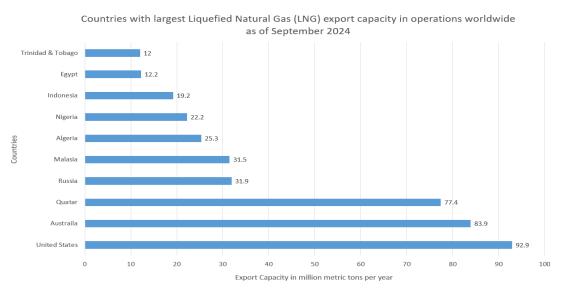
Figure 4: Countries with Largest LNG Export Capacities in Operations Worldwide
Source: https://www.statista.com/statistics/1262074/global-ing-export-capacity-by-country/#:~text=The%20United%20States%20has%20the,million%20metric%20tons%20per%20year[11]
This diversification mitigates the risks associated with price volatility and supply disruptions that often accompany reliance on a limited number of oil-producing regions. As global LNG markets continue to expand, India can negotiate better terms and prices, enhancing its energy security and economic stability. Investing in LNG infrastructure further supports this diversification strategy, enabling the country to build a robust supply chain that includes import terminals, regasification facilities, and transportation networks. By tapping into the potential of LNG, India not only secures its energy future but also ensures a resilient and sustainable economy.
## VII. ENVIRONMENTAL IMPACTS OF LNG USAGE
Reduction in Air Pollution: LNG burns more cleanly and efficiently; thus, the transition to LNG as a major energy source, especially in urban areas, represents an important step toward improving air quality and reducing environmental pollution and health risks. The combustion of LNG results in lower emissions of sulfur oxides, nitrogen oxides, and particulate matter, making it an effective alternative for urban environments plagued by air pollution. Coal and diesel contain high levels of sulfur, which contribute to acid rain and respiratory problems in humans. By replacing these fuels with LNG, cities can achieve dramatic reductions in sulfur emissions, leading to improved air quality and health outcomes for residents. Nitrogen oxide emissions are a major contributor to ground-level ozone formation and smog. LNG combustion emits significantly lower NOx levels compared to other fossil fuels. Particulate matter (PM) is another major pollutant associated with fossil fuels. These fine particles cause cardiovascular and respiratory diseases. This reduction in air pollution will encourage more urban areas to switch to CNG and LPG, leading to more efficient pipelines for supply to meet demand. More demand requires better regasification plant facilities and, to complete the chain, more LNG imports. Lower CO2 Emissions. The use of LNG offers significant advantages in reducing carbon dioxide (CO2) emissions, making it an important player in the fight against climate change. While natural gas is still classified as a fossil fuel, it emits approximately $50\%$ less CO2 compared to coal and $20 - 30\%$ less than oil when combusted for energy. By transitioning from coal and oil to LNG, India can make substantial progress toward its climate goals, particularly in sectors such as power generation and transportation. This shift not only helps lower overall greenhouse gas emissions but also supports India's aim to increase the share of cleaner energy sources in its energy mix. Furthermore, LNG's role as a transitional fuel is vital for integrating renewable sources like solar and wind into the energy grid.
Methane Emissions Concerns: Concerns regarding methane emissions from infrastructure and transportation remain significant. Methane, the primary component of natural gas, is a potent greenhouse gas with a global warming potential over 25 times greater than that of carbon emissions over a 100-year period. Leakages can occur at various points in the LNG supply chain, including extraction, processing, transportation, and regasification. These emissions not only undermine the climate benefits of switching to LNG but also present challenges in accurately assessing its overall environmental impact. Even small leaks can contribute substantially to greenhouse gas concentrations in the atmosphere, particularly in regions with extensive natural gas infrastructure. To mitigate these concerns, it is crucial to implement robust monitoring and management practices aimed at detecting and minimizing methane emissions. Advanced technologies such as infrared cameras and drone surveillance can help identify leaks.
## VIII. GEOPOLITICAL IMPLICATIONS OF LNG IN INDIA'S ENERGY SECURITY
India's energy security is at a critical juncture as the nation's economy grows and energy demands surge. LNG has emerged as a vital component of India's energy portfolio, addressing the dual challenges of energy access and environmental sustainability. Beyond its economic and environmental significance, LNG has profound geopolitical implications, particularly in energy independence, strategic relations, international partnerships, and trade agreements. It also provides India with greater diplomatic leverage in international negotiations, especially as energy becomes a core issue in global politics.
a) Energy Independence: India's heavy reliance on oil imports, primarily from volatile regions such as West Asia, has long posed strategic challenges. LNG presents a way to diversify energy imports, thereby reducing vulnerability to geopolitical disruptions. By sourcing LNG from different countries, India strengthens its energy independence.
b) Diverse LNG Sources: India imports LNG from major exporters, including Qatar, Australia, and the United States. Each of these regions offers distinct advantages. Qatar has been a reliable supplier of LNG, with India securing long-term contracts for consistent supply. The geographical proximity of Qatar to India ensures lower transportation costs and quicker delivery times. Australia provides another layer of diversification. As a stable supplier with significant production capacity, Australia offers India an alternative source that mitigates overdependence on the Middle East. Australia has become a major trading partner in all fields of energy, thus adding to this advantage. The U.S. has emerged as a significant LNG exporter, offering India access to advanced energy technology and flexible contracts. Russia remains an important energy partner, with projects like the Arctic LNG initiative exemplifying India's willingness to explore unconventional sources to secure its energy future.
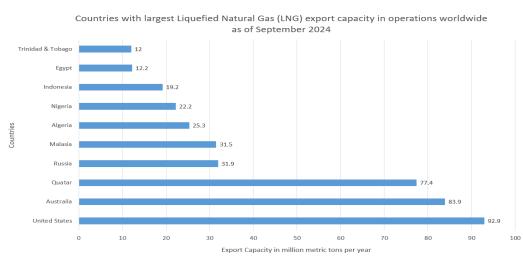
Figure 5: LNG Exports for a Selection pf Exporters, 2014-2024
Source: https://www.iea.org/data-and-statistics/charts/lng-exports-for-a-selection-of-exporters-2014-2024 [13], As we analyze Figure 5, which shows LNG exports from the USA, Australia, Qatar, and Russia, we see that Qatar has been a regular supplier since 2014 with a long-term contract. USA exports have been consistently rising since 2016 and are currently the largest exports to India. Similarly, India has been importing large quantities from Australia.[14]
c) Strategic Storage and Infrastructure Development: To maximize the benefits of diversified LNG imports, India has invested in strategic storage and infrastructure. The development of LNG terminals, regasification facilities, and pipelines ensures efficient distribution and utilization. Strategic reserves of LNG further buffer against supply shocks, enhancing resilience. Figure 6 shows the storage tank capacity of LNG for various countries. India has a storage tank capacity of 3.1 million cubic meters, while Japan has the highest at 18.7.
Figure 6: Storage tank capacity for LNG in 2003, by major county/territory
Source: https://www.statista.com/statistics/723079/lg-global-st orage-tank-capacity-by-country/ [12]
d) Environmental Considerations: As a cleaner fuel, LNG aligns with India's environmental goals. This transition not only fulfills domestic sustainability targets but also enhances India's global standing as a responsible energy consumer.
e) International Partnerships and Trade Agreements: India's LNG strategy is linked to its foreign policy. Partnerships and trade agreements with major LNG-exporting countries are essential for securing long-term energy supplies and enhancing bilateral relations. India has long-term contracts with Qatar for LNG imports, ensuring stable supply volumes. The U.S. has offered India flexible contracts and shorter-term agreements, including collaboration in technology transfer and joint ventures, promoting innovation in India's energy sector. Despite global sanctions and geopolitical complexities, India has sought agreements with Russian energy firms for various forms of energy. India's connections with Australia extend beyond LNG to broader energy cooperation. The two nations have pursued joint ventures in renewable energy and carbon capture technologies, complementing their LNG trade.
f) Balancing Trade With The United States: With seven industrial-scale LNG plants already operating and liquefaction capacity totaling more than 92 mtpa, the U.S. has emerged as one of the globe's top three LNG exporters. [6] India's LNG trade with the United States has grown substantially due to the shale gas revolution. The U.S. became the second-largest LNG supplier to India in 2024, accounting for about 6.6 MMT, or nearly $28\%$ of total LNG imports. This trade is strategically important as it helps reduce India's trade deficit with the U.S., which has historically been in America's favor. In FY 2023- 24, India's overall goods trade deficit with the U.S. was around $15 billion, down from previous years, due in part to energy imports. Long- term LNG contracts signed between Indian firms (like GAIL and Petronet LNG) and American suppliers such as Cheniere Energy and Dominion Energy ensure stable pricing and supply. U.S. LNG, priced off Henry Hub (a relatively stable index), is often more competitive than spot market purchases, reducing India's vulnerability to price shocks. U.S. LNG exports reach India through the Cape of Good Hope, avoiding the volatile and piracy-prone Strait of Hormuz and Suez Canal, which are chokepoints for Middle Eastern energy exports. This alternate route offers logistical and security advantages, especially during geopolitical tensions in West Asia. With Trump Tariffs war and India coming out as a major exporter to the USA, LNG imports are becoming a balancing factor that India can leverage to its advantage.
g) Balancing Geopolitical Risks and Opportunities: India's major shift to LNG imports opens avenues for strategic diplomacy and economic growth. It can mitigate risks through diversification, sourcing LNG from multiple regions and thereby reducing the impact of geopolitical tensions in any single area. It should focus on building strategic reserves as a buffer against supply shortages and price spikes. To ensure market flexibility, India should shift towards flexible contracts, such as spot purchases and hybrid pricing models, enhancing its ability to adapt to market fluctuations. Spot purchases from the USA are expected to increase significantly with Trump's new focus on energy imports, and India should be prepared to exploit this opportunity. Energy cooperation with countries like the U.S. and Qatar has spillover effects, fostering investments and technology transfer. Finally, by positioning itself as a major LNG importer, India can influence regional energy dynamics.
## IX. CHALLENGES AND LIMITATIONS OF LNG IN INDIA
a) Indigenous LNG Vessels: India is significantly behind in manufacturing its own LNG vessels; thus, it largely depends on hiring, which increases the cost of transportation and reduces flexibility in LNG imports. LNG vessels are primarily categorized based on the containment system they use, which includes Moss-type vessels, known for their robust design and ability to handle high pressures, and Membrane-type vessels, which feature prismatic tanks lined with a thin membrane, maximizing cargo space and improving carrying efficiency. LNG carriers generally have capacities ranging from 125,000 to 266,000 cubic meters. Larger vessels, also known as Q-Max ships, can carry up to 266,000 cubic meters of LNG, thereby reducing transportation costs per unit of cargo. As the global demand for cleaner energy grows, LNG vessels will play an increasingly pivotal role in shaping the energy landscape. India should invest heavily in shipbuilding and focus on constructing LNG carriers. [13]
b) Infrastructure Deficits: India's transition to LNG as a significant energy source faces challenges due to infrastructure deficits. The existing LNG infrastructure is concentrated in a few states, leading to regional imbalances. To address these challenges, substantial investments in expanding the pipeline network and constructing new terminals are essential. Encouraging collaboration between public and private stakeholders can facilitate the development of a more integrated LNG infrastructure. By overcoming these infrastructural limitations, India can unlock the full potential of LNG as a key component of its energy transition strategy, promoting cleaner energy access nationwide.
c) Price Volatility: The price fluctuations of LNG pose a significant challenge for India as it seeks to enhance its energy security and transition to cleaner fuels. LNG is often contracted on a long-term basis, which theoretically stabilizes prices for consumers. However, global market conditions, such as geopolitical tensions, supply chain disruptions, and shifts in demand from major consumers, can cause substantial price fluctuations. Such volatility can strain India's financial resources and disrupt its energy budget, particularly for industries that rely heavily on stable energy costs. To mitigate the impact of price volatility, India should secure long-term contracts with multiple suppliers, invest in domestic LNG production, develop strategic reserves, implement flexible purchasing strategies, and establish a buffer against sudden price spikes. With improved technologies for gas production and the USA willing to sell more gas under Trump's new energy policy, the prices of LNG imports are likely to decrease, bringing significant economic relief to India.
d) India's Domestic Gas Production Constraints: India faces significant challenges related to domestic natural gas production, which is currently limited and unable to meet the country's growing energy demands. The constraints in domestic production stem from various factors, including outdated technology, regulatory hurdles, and inadequate investment in exploration and infrastructure. The government has made efforts to attract foreign investment and improve the regulatory environment; however, India remains heavily dependent on imported LNG to fulfill its energy needs.
e) Competition with Renewable Energy: India has set ambitious goals to achieve a larger share of renewables, reducing reliance on fossil fuels, including natural gas, in a bid for sustainability and to meet international climate commitments. The cost of solar and wind energy has significantly declined, making them increasingly attractive for India's energy mix. This price drop challenges LNG's role, especially in sectors where renewable energy can provide a viable alternative. As awareness grows around the benefits of renewable energy, there is a stronger push for zero-emission technologies. LNG, though cleaner than other fossil fuels, is still viewed as less desirable in the long term compared to renewables.
## X. RECOMMENDATIONS FOR THE
### GOVERNMENT OF INDIA AND THE INDIAN LNG INDUSTRY
Infrastructure Expansion: LNG will remain the main method of natural gas transportation for years to come. While India has made significant progress, further investment in LNG terminals, regasification units, and pipeline networks is essential to accommodate rising demand. New ports and LNG terminals must be constructed. India's eastern coastline needs more such facilities.
Long Term Contracts: Natural gas, being a cheaper and more efficient form of energy, must fit properly into India's energy diversity. Although we have good relations with Qatar, the USA, and Australia for LNG imports, we need to explore newer sources and transportation routes, as well as invest in LNG infrastructure and long-term contracts in other countries. Central Asia and Africa can be explored for this.
Shipbuilding Infrastructure: Sea lanes of communication are becoming increasingly important, and therefore, a greater number of specialized ships need to be built under the 'Make in India initiative'. If LNG carrier ships are manufactured in India, it will make LNG imports more economical and diverse.
Exploring Chabahar Port in Iran for Central Asian and Caspian Gas: Chabahar Port is a port in Iran that India is developing to serve as a transit route for trade with Central Asia and Afghanistan. The port is located on Iran's southeast coast along the Gulf of Oman. Iran, the Caspian Sea, and Central Asia have an abundance of gas reserves. India can develop an LNG liquefaction and transport facility by investing its own funds, thus creating a permanent infrastructure outside India for LNG imports.
Policy Reforms: Streamlined policies and regulatory frameworks are necessary to attract investments and ensure the competitiveness of LNG in India's energy mix. SEZs may receive special incentives to develop unloading and regasification terminals. [16]
Technological Innovations: Adopting advanced technologies, such as floating storage and regasification units (FSRUs), can reduce costs and enhance accessibility in remote areas. The USA is prepared to assist us in technological advancement in exploration and drilling.
Centres of Excellence in Universities and Think Tanks: The government should fund major energy universities in India, such as Pandit Deendayal Energy University in Gandhinagar and IIT ISM in Dhanbad, to establish Centres of Excellence in Natural Gas.
Geopolitical Stability: Maintaining balanced foreign relations is crucial for securing uninterrupted LNG supplies. India's capability to navigate complex geopolitical landscapes will determine the effectiveness of its LNG strategy.
## XI. CONCLUSION
The geopolitical implications of LNG in India's energy security extend far beyond diversification and cleaner energy. LNG serves as a bridge to a sustainable and resilient energy future. By leveraging its LNG strategy, India not only addresses its energy challenges but also strengthens its position as a global economic and diplomatic powerhouse.
### ACKNOWLEDGMENTS
I sincerely thank PDEU for inspiring me to write this Research article
Disclosure of Interest
No potential competing interest was reported by the author.
Funding
No funding was received
Generating HTML Viewer...
References
19 Cites in Article
Kannan Srinivasan (1996). LNG Policy for Power-More Questions than Answers.
Subhadip Ghosh,Rajarshi Majumder,Bidisha Chatterjee (2024). Natural Gas Matters: LNG and India’s Quest for Clean Energy.
(2025). Primary energy demand by fuel type India 2023-2050.
(2025). Future of Energy Security summit: Energy Secretary opening remarks.
Purva Jain (2024). Greenhouse Gas Estimates of LNG Exports Must Include Global Market Effects.
No ethics committee approval was required for this article type.
Data Availability
Not applicable for this article.
How to Cite This Article
Dr. Rakesh Kumar. 2026. \u201cLNG in Indias Energy Transition: Balancing Geopolitics, Sustainability, and Economic Growth\u201d. Global Journal of Human-Social Science - H: Interdisciplinary GJHSS-H Volume 25 (GJHSS Volume 25 Issue H3): .
Explore published articles in an immersive Augmented Reality environment. Our platform converts research papers into interactive 3D books, allowing readers to view and interact with content using AR and VR compatible devices.
Your published article is automatically converted into a realistic 3D book. Flip through pages and read research papers in a more engaging and interactive format.
This paper is descriptive in nature and examines various aspects of the Energy Sector as related to LNG. India’s energy sector must critically balance rising energy demands, environmental concerns, economics, and energy security. With the government’s goal to increase the share of natural gas in the energy mix from 6% to 15% by 2030, Liquefied Natural Gas (LNG) has emerged as a critical energy component. LNG is a method for transporting natural gas over long distances when pipelines are not feasible. The article examines LNG’s expanding role in India’s energy portfolio, focusing on several key aspects, including economic advantages, energy security, and generating local employment through the development of LNG infrastructure. Environmentally, LNG significantly reduces air pollutants and CO₂ emissions. Challenges to LNG adoption are also considered, including infrastructure deficits, regional accessibility issues, price volatility, and competition from renewable energy sources. The article concludes by discussing the future of LNG in India’s energy mix, recommending further investment in infrastructure, stable LNG pricing, and policy measures to support LNG’s role as a transition fuel. It also recommends steps for the Government and the LNG industry to maximize the use of this form of energy. By addressing these challenges, LNG can play a strategic role in enhancing India’s energy security, environmental sustainability, and economic resilience.
Our website is actively being updated, and changes may occur frequently. Please clear your browser cache if needed. For feedback or error reporting, please email [email protected]
Thank you for connecting with us. We will respond to you shortly.