
I. INTRODUCTION
Loanwords, whether standard or colloquial, and the varied linguistic alterations they undergo have been an area of interest for many phonologists and researchers (see Babel, 2016; Boersma and Hamann, 2009; Bueasa, 2015; Chang, 2008; Haspelmath, 2009; Iribemwangi, 2013; Kang, 2010; Madiba, 1994; Mamarara, 2010; Yip, 2006; Zivenge, 2009). It is for this reason that recent studies on loanwords have evolved from a minor curiosity to a phenomenon meriting serious and sustained study (Kenstowicz and Suchato, 2006). According to Zivenge (2009:10), "Nativization has become an important aspect in contemporary studies because language contact has been greatly facilitated by globalization". In this nativisation process, loaned words are often altered linguistically to suit the characteristics of the receiving language (Hock, 1991). Needless to say, these alterations are also notably evinced in the Tshivenda language, particularly in the process that called 'nativisation' or 'adaptation' (Chimhundu, 2002). When adapting a loanword, Kenstowicz and Suchato (2006) aver, "the speaker tries to remain faithful to the source word while still making the loan conform to the native language (L1) segmental inventory, phonotactic constraints, and prosodic structures". The aim of this article is to illustrate how the Tshivenda language demonstrates the flexibility and productivity of its phonetics, phonology, morphology and semantics in accommodating the words it borrows from various languages. It is further highlighted that Tshivenda accommodates loanwords whilst managing to preserve its identity by remodelling such words to conform to its linguistic patterns and structure. By loanword or lexical borrowing, it is meant the process by which a word is transferred from one language (the source language) into another (the recipient language), or simply an introduction of new words to a language, to express concepts (Haspelmath, 2009; Makoe, 2004; Poulos, 1985). Thus, in an effort to highlight how Tshivenda borrows words from various languages, i.e., Xitsonga, Northern Sotho, IsiZulu, isiXhosa, IsiNdebele, Chishona, English and Afrikaans (Maumela and Madiba, 1996) and successfully adapts them, this article also discusses at length how linguistic contacts affect(ed) Tshivenda. This is important, considering that, when "people with different languages and cultures are usually in regular contact with one another [...], their languages and cultures also come into contact and inevitably influence each other" (Mamarara, 2010:1). Mamarara's view is cherished by Chokoe (2000:96), who asserts that:
When two cultures come into contact, there ought to be some form of acculturation, that is, the fusion of two or more cultures. During this process, one culture becomes dominant over the other, and thus the dominated culture acquires more from the dominant one. It is during this process that even language is transferred from the dominant culture to the dominated culture.
Although various factors such as the need-filling motive, scientific and social advances, age of the loanword, speakers' knowledge of the donor language and their attitude towards the donor language, and prestige, among others, are responsible for lexical borrowing (Haspelmath, 2009), in this article, however, considerable focus is solely on language contact as a propellant of lexical borrowing by Tshivenda. The article also shows that when words are being borrowed into the recipient language, in this case Tshivenda, such words are either getting adopted or adapted (Bueasa, 2015). By adoption, Bueasa means "the process of borrowing words from the source language, yet keeping the loanwords' original form and pronunciation as it is in the source language, as if the word is getting copied from the source language and pasted into the recipient language" (2015:2). According to Bueasa (2015:2), adopted words are sometimes called foreignisms. In contrast, "adaption refers to the process where loanwords undergo certain phonological, morphological, syntactic, or orthographical alterations" (Bueasa, 2015:2). Loanword nativisation is foregrounded here whilst bearing in mind that there are basically three positions that may be assumed when describing the process (Kenstowicz and Suchato, 2006). Briefly, the exponents of the first position (i.e. LaCharité and Paradis, 2005; Jakobs and Gussenhoven, 2000), assert that loanword adaptation is performed by bilinguals who draw on their native-like competencies in both the donor and recipient languages to discern equivalences between phonological categories and structures that abstract away from the details of the phonetic realisation in each grammar (Kenstowicz and Suchato, 2006). The second position opposes the first in that, the hypothesis held by its exponents (i.e. Silverman, 1992, Peperkamp and Dupoux, 2003), is that the surface form of the foreign loan is mapped to L1 phonological categories and schemata in extragrammatical speech perception module on the basis of language-independent acoustic similarities. This article prefers an intermediate position which posits that the loanword adaptation process essentially takes into account a variety of factors to achieve the best match to the source word including phonetics and orthography (see Shinohara, 2000; Steriade, 2001; Yip, 2002). On the latter position, Kenstowicz and Suchato (2006:2) proffer that, "the adapter is not a passive recipient of the speech perception module but exercises active control over the native grammar in shaping the loan, as well as possibly calling on implicit knowledge of phonetic similarity to fashion adaptations that lack a precedent in the native system". In this article, the native Tshivenda speakers' linguistic competence in altering loanwords for the purposes of conforming such words to the native (Tshivenda) lexical inventory is borne in mind when discussing the nativisation of foreignisms.
II. THE CLASSIFICATION, CHARACTERISTICS AND CONTACTS OF TSHIVEN DA
Tshivenda is spoken mainly in the Vhembe District and further north of the Limpopo Province in South Africa (Dakalo, 2009; Mulaudzi, 1987). The Tshivenda language belongs to the Bantu language family (a sub-category of the Niger-Congo family), and according to some scholars, Tshivenda emerged as a distinct dialect in the 16 century (Loubser, 1988, 1989; Stayt, 1931; Wentzel, 1983). The Bantu language family is found in the area which runs from about 3 degrees north latitude southwards as far as the Cape (Ziervogel and Ferreira, n.d.:5). Ziervogel and Ferreira (ibid) further state that the languages of the northern areas have been much influenced by the Nilotic and Sudanic languages, the languages of the Northern neighbours of the Bantu. As a result of the genetic relationship that exists among Bantu languages, Tshivenda shares similar linguistic features such as specific noun classes, an open syllable structure, an extensive agreement system and a vocabulary similar to Sesotho, although its grammatical structures are closer to Chishona, which spoken in Zimbabwe. Tshivenda is a tonal language and acoustic prominence is awarded to the penultimate syllable of the last word in a sentence. Tshivenda is also an agglutinative code with a very complex morphology. Its orthography makes an extensive use of diacritic symbols for the representation of speech sounds foreign to languages such as English. The debate on whether Tshivenda has six or seven dialects, oscillates around the following dialects: Tshiilafuri, Tshironga, Tshilaudzi or Tshimanda, Tshiphani, Tshimbedzi, Tshilembethu and Tshiguvhu (Mulaudzi, 1987; Dakalo, 2009). Standard Tshivenda is Tshiphani, which consists of seven vowels, where five of them are basic vowels and two are raised vowels (Milubi, 2004; Mulaudzi, 1987). In terms of consonants, Tshivenda has bilabials, labio-dentals, interdentsals, palatals, alveolars, velars, nasals and a glottal sound. Words in Tshivenda are built upon morphological patterns that include sequences of consonants and vowels (CV). Tshivenda syllables differ from those in English and Afrikaans, for instance, precisely because the syllable pattern of Tshivenda is predominantly CV whereas English syllables, for example, allow consonant clusters (CCV) and a coda.
a) Possible Origins of the Vhavenđa and the Tshivenda Language
Makhado (1980:12-13) states that Tshivenda shows substantial similarities with the languages spoken in Central Africa, such as Chishona, Chichewa, Chinsenga, Luganda, Swahili, Tshiluba and Bemba, implying that Tshivenda either had contact with these languages or originated from them. The Central Africa hypothesis is, however, disputed by Lestrade (1927), Loubser (1988; 1989) and Madiba (1994), on the basis that there is no proof of the existence of a similar tribe to the Vhavenda in Central Africa. Other accounts hold that the Vhavenda and consequently the Tshivenda language, originated from the Great Lakes (Gottschling, 1905; Lestrade, 1932; Stayt, 1931; Wilson, 1969). Lestrade (1960) and Mathivha (1973), on the other hand, believe that the Vhavenda originated from Malawi, a hypothesis supported by Gottschling (1905), Lestrade (1960), Stayt (1931), van Warmelo (1960) and Wilson (1969). This hypothesis is linked to the belief that the Vhavenda originated from the Great Lakes (in East Africa) (Gottschling, 1905). Ralushai (1977), Madiba (1994) and Hanisch (2008) all refer to the legend that some Vhavenda chiefs such as Sinthumule claimed to speak Malawian languages, leading to the assumption that the Vhavenda originated from Malawi. Mathivha (1973:1) adds that Tshivenda forms a bridge between the languages of Central and North-east Africa and languages of Southern Africa. He recognises the Tshivenda vowel and consonant systems as similar to those of Swahili, Luganda, Chichewa (Malawian language), Shona and Kikuyu. Probably in view of Mathivha's hypothesis, Makhado (1980:11) says: "A striking feature is that there are similarities between the Tshivenda vocabulary and the languages spoken in areas where the Vhavenda are believed to have gone past or lived before they proceeded to the south". Although it is unclear which lakes the different traditions specifically point to, there is a strong possibility that the Vhavenda might have stayed around Lake Victoria or Lake Tanganyika before they migrated further south. Archaeological evidence also supports the fact that some Bantu tribes stayed around Lake Victoria, Lake Tanganyika and Lake Albert before migrating to the south (Phillipson, 1977). The present authors are yet to find substantial and recent records on the origin and migration of the Vhavenda from and to some of aforementioned areas. Thus, no contact between Vhavenda and other tribes in the area can be established except the contact which the Bantu tribes had with Sudanic languages (Madiba, 1994).
b) Tshivenda's Contacts with Sudanic Languages
The contact between the Bantu tribes and Sudanic people is said to have had led to the adoption of animals such as cattle and sheep and also some pottery wares by the former from the latter (Phillipson, 1977). Madiba (1994) acknowledges that there are similarities between some Tshivenda names to the proto-forms for animals such as nombe (cattle), which was derived from the starred word *gòmbè (cattle or nombe in Tshivenda) and nngu (sheep, nngu in Tshivenda), derived from the starred Bantu word *gú. The Tshivenda forms appear to be very close to those of the proto-language may indicate that the Vhavenda got these forms directly from the proto-language. Mullan (1969) and Netswera (2012) say the Vhavenda were displaced from these areas by the Malawian invaders who came into the area from the Congo region around 1600 and occupied the territory on both sides of the Lake Nyasa. From this area, the Vhavenda are said to have moved southward into Sena (across the Zambezi in north-eastern Zimbabwe), possibly leading to yet another hypothesis on the Vhavença's origins, i.e., the Vhukalanga Origins Hypothesis (Lestrade, 1927).
c) Vhukalanga as the Possible Origin of the Vhavenda
Mutenda in (Makhado, 1980:8) says the Vhavenđa and Vhalemba migrated to the present Venda from Zimbabwe or Vhukalanga (Mashonaland) at a place called Hamambo (cf. Khorommbi, 1996:16). Vhukalanga is taken by certain scholars as referring to the present Zimbabwe (Sengani, 2019). Loubser (1988, 1989, 1991) acknowledges that some of the Vhavenđa clans (i.e., the Singo) actually originated in Zimbabwe rather than Central Africa. Loubser supports this argument by referring to the names of the earliest Singo chiefs such as Lozwi (Rozvi), Mambo, Dyambeu and Thohoyandou which are all titles of the Rozwi rulers who inhabited the western part of Zimbabwe (Madiba, 1994). Hence, the following Tshivenda names also resemble those of the Rozwi/Rozvi, namely; Nyadenga, Dombo, Madanda, Bvumbi, Makoni, Nyatsimba, Ndou (Zhou). The similarity of the names seems to be an indication that the Vhavenđa had some connection with the Rozwi. Lestrade (1960: xxv) established that the Vhavenđa are intimately associated with other Shona groups like the Kalanga, which necessitates the question of whether the Vhavenđa people are an offshoot of the Rozwi or whether they were an independent tribe which later became part of the Rozwi Changamire dynasty. Kuper (1979:63) in accord with Lestrade asserts that "both the [Vhavenđa] and Lovedu [Balobedu] tribes were formed by offshoots of Shona tribes who imposed themselves as ruling sections upon local Sotho-speaking majorities". The probability, however, could be that the Vhavenđa had a common origin with the Rozwi, who are said to have originated from around Lake Tanganyika (Tanzania). Hence, "more recently," reveals Hanisch (2008:121), "certain local people are trying to prove linguistic similarities between Tshivenda and East African languages". The findings of such studies are yet to be located by the present authors. Apparently, these local people focus more specifically on the suffix nyika because it shows the link between the former German colony, Tanganyika, and one of the legendary Vhavenđa leaders, Dimbanyika (Hanisch, 2008), or Dambanyika (Khorommbi, 1996), so named because he refused to be installed as king after his father, Ntindime, died in 1688 (Nemudzivhadi, 1994a:2). "Nyika" also occurs "in the Shona language, as a reference to land" (Hanisch, 2008:121), which is quite in line with the hypothesis which points to Vhukalanga as being the possible origin of the Vhavenđa.
Although one may refute Zimbabwe as the Vhavenda's place of origin, one cannot dispute that the Vhavenda's sojourn in this area has been supported by historical evidence (Stayt, 1931; Wentzel, 1983). The
Vhavenđa are said to have stayed around the Matongoni Mountain (Von Sicard, 1952:10), where the prominent Changamire Rozwi dynasty established their capital (Loubser, 1990:15). The sojourn of the Vhavenđa in the Shona country thus resulted in the Vhavenđa absorbing a considerable amount of Shona culture and language (Lestrade, 1960:1). The Vhavenđa appear to have been influenced more by Western Shona than by other Shona groups such as the Korekore, Manyika and others (Wentzel, 1983:170-171). By Western Shona, it is meant particularly the Kalanga and Rozwi dialects. Wentzel (1983) has written fairly extensively on the relationship between Kalanga and Venda, where differences are also realised in the lexicon, phonology and the syntax of these two languages. These differences show that although Tshivenda has been influenced by Rozwi, the influence is not so great that the Vhavenđa can justifiably be regarded as an offshoot of Rozwi. It seems the Vhavenđa broke away from the Rozwi around 1680s (Loubser, 1989:58).
d) The Vhavenḍa's Arrival at Limpopo and Linguistic Fusions
Concerning the Vhavenđa's date of arrival in the land south of the Limpopo, there are still considerable different opinions. The date of their arrival, however, seems to range from the end of the 17 century to the beginning of the 18 century (Stayt 1931; Wentzel, 1983). According to Hanisch (2008:122), "the 18 century dates given to the arrival of a 'unified' group of people into the Soutpansberg relate to the arrival of the Singo, who linguistically speaking, were western Karanga, coming from the central-western parts of Zimbabwe". These people, according to Hanisch (2008:122), "are accepted to have been the unifying factor in drawing the earlier clans together to form a centralised political system under the legendary Chief Thohoyandou." This view is echoed by Carnerly (1994b) who states that the coming of the Vhasenzi in the late 1600s, various Vhavenđa clans and other groups living in Soutpansberg became politically united under the central authority of Vhasenzi and their ruler, Dambanyika. It is not clear whether by Vhasenzi, Carnerly means the Singo only or the whole nation of the Vhavenđa. This centralised political system is said to have become part of a state similar in structure to that of the Great Zimbabwe and Khami Empires of Zimbabwe (Carnerly, 1994b). Carnerly (1994b:28) also records that under Thohoyandou's leadership, who was supposedly enthroned after the death of his nephew (Nemudzivhadi, 1985), the political boundaries extended further south to Pietersburg with the Olifants River in the south east and the Sand River in the west. This is probably why other accounts consider the Northern Transvaal as the Vhavenđa's place of origin (see Mmbara, 2009; Netswera, 2012). Loubser (1988; 1989; 1990; 1991) says the 'real' Vhavenđa originated from the Northern
Transvaal, while other groups migrated much later into the area. Loubser (1989:54) further says "the archaeological results thus support the current notion of local origins" (1989:54). Loubser excavated different areas in Venda which were occupied by the early Vhavenda and made this conclusion on the basis of the comparisons of ceramic styles, settlement patterns and mitshejo (stone walls) patterns found in these areas. Loubser's findings also reveal that the Mapungubwe ceramic style marks the earlier Shona settlement south of the Limpopo while the Khami ceramics show the arrival of new Shona dynasties from Zimbabwe. In the south of the Soutpansberg, the earliest ceramic style found was the Eiland followed by Moloko. Both are Sesotho styles and show the presence of the Sesotho speaking people in the land south of the Limpopo long before the Vhavenda (Madiba, 1994). This overlapping "indicates the close interaction between Shona and Sotho speakers, then the development of Tavhatchena and Letaba Venda language" (Loubser, 1989: 58). Emanating from this is the belief that the Tshivenda language is a result of a fusion between Sesotho and Chishona (Madiba, 1994). According to Loubser (1989:54), "by the mid-fifteenth century Shona-speaking immigrants from Zimbabwe settled in the northern Transvaal and interacted with the local Shona and Sotho inhabitants". As a result of this interaction, the Vashona and Basotho communities developed a common Vhavenda identity by the mid-sixteenth century (Loubser, 1989).
e) Hypotheses on the Dual Character of Tshivenda
Although Loubser recognises the fusion of the Vashona and the Basotho ceramic styles, there is, however, no established conclusion on other aspects such as how the Vashona's and Basotho's languages came to be fused. This is why it is a problem for scholars to account for the dual character of the Tshivenda language. The plausible explanation is that the amalgamation of Sesotho and Chishona "can be attested by the affinities which [Tshivenda] is said to have with these languages" (Lestrade, 1932:21). Loubser (1988, 1989), Schoefield (1937) and Sinton-Schoetter (1971) offer a substantiation for these affinities in light of the parallels found by archaeologists between the Vhavenda's pottery and its adjacency to the Basotho and Vashona styles. In attempting to account for the dual character of the Tshivenda language, Phillipson (1972) alludes to intermarriage as the probable explanation. In this intermarriage, the Vhavenda men are said to have married Chishona-speaking wives while the Tshivenda-speaking wives were married by the Sesotho-speaking men (Phillipson, 1972:201). In this regard, Loubser acknowledges traditions that hint at intermarriage between the Basotho under the Raphulu and the Shona-speaking Tshivhula dynasty (1991:418). Huffman (2005) and Huffman and du Piesanie (2011) concur that the Vhavenda's origins in South Africa are linked to the story of Mapungubwe.
f) The Vhavenđa's Linguistic Contacts in the Transvaal (Limpopo)
In their postmigratory contacts in the Transvaal, the Vhavenda intensely came into contact with other groups such as the Basotho, Shona groups such as the Lembethu and Twanamba, and at a much later stage, they also came into contact with other languages such as Xitsonga, IsiZulu, English and Afrikaans (cf. Huffman, 2005:58). After settling in Venda, the Vhasenzi and the Vhalemba are said to have lost their Karanga affinities through intermarriage with Vhangona wives, and were assimilated into Tshingona (Tshivenda) culture and language (Netswera, 2012:11). To this day, there are still conflicting accounts on the origin of the Vhavenda and the Tshivenda language. All in all, the Vhavenda's oral traditions predominantly present three successive cultural influences, namely: (1) the Vhangona groups who were found at Mapungubwe, (2) Shona groups from Zimbabwe (such as Lembethu and Mbedzi), and (3) Singo groups from Zimbabwe who conquered the country (Huffman, 2005:58). Thus, an attempt to account for the origin and character of the Tshivenda can only be stretched to a point of tediousness, precisely because of the ambivalences and ambiguities that characterise the subject. It is hoped that by foregrounding the conflicting hypotheses on the origins of Vhavenda, Tshivenda and Tshivenda's contact(s) with other languages may yield some insight into the lexical inventory of the Tshivenda language.
III. METHODOLOGY AND THEORETICAL PERSPECTIVES
The study adopted the qualitative approach and descriptive design, respectively. Moreover, the study relied on the intuitive method in that the analysts identified loanwords in Tshivenda introspectively (cf. Netshisaulu, 2012), while a more data-driven methodology was also assumed through a systematic identification of loanwords within a predetermined set of loanwords from previous loanword research, and the Tshivenda grammar manuals. For expository and analytical convenience, the article discussed Tshivenda loanwords in light of (a) Loanwords which undergo neither segmental nor analogical alterations; (b) Loanwords which undergo segmental alterations but no analogical alterations, and (c) Loanwords which undergo both segmental and analogical modification to correspond to Tshivenda word patterns. The study also elucidated loanword nativisation in view of both the phonological and morphological changes that loanwords undergo within an Adaptability Scale which exhibits three positions. The first position in the scale is the Merely Adopted (MA) loanwords, which undergo no alteration but rather keep their source language's form and pronunciation as it is. The second position is that of Partially Adopted (PA) loanwords, which undergo phonological changes but no morphological alterations. Finally, the third position in the Adaptability Scale is that of Fully Adopted (FA) loanwords, which undergo both phonological and morphological changes to conform to Tshivenda patterns. Furthermore, the current study employed the Generative Phonology Model (Chomsky and Halle, 1968) and CV-Phonology Model (Clements and Keyser, 1983), as its theoretical lynchpins. Clements and Keyser (1983) specifically designed the CV-Phonology Model to deal with the syllable (Katamba, 1989). The Generative Phonology Model, on the other hand, assigns the correct phonetic representations to utterances in a way that reflects the native speakers' internalisation of grammar (Zivenge, 2009). The Generative Phonology Model's major concerns are the phonological processes underlying surface phonetic forms. Zivenge (2009) adds that the dominant view is that the native speakers of a language unconsciously know the nature of the phonological structure of their language. Thus, in the subsequent section, the discussion on how loanwords are adapted bears in mind how a native Tshivenda speaker is likely to adapt a loanword into the Tshivenda lexical inventory based on his or her internalisation of Tshivenda grammar.
IV. LINGUISTIC ADAPTATION IN TSHIVENĐA
In this section, examples of loanwords and how they are adapted into the Tshivenda language are provided and discussed. To achieve this, a prototype of the phases undergone by the loanword during the adaptation process in Tshivenda is used. The phases include phonetic adaptation, phonological adaptation, morphological adaptation and semantic adaptation, respectively. This can be best illustrated through an example of how the loanword, 'Coke', is adapted into Tshivenda. In the English language, the word 'Coke' may refers to a fizzy drink (i.e., Coca Cola beverage), cocaine or a black substance that is produced from coal and burnt to provide heat (Oxford Advanced Learner's Dictionary, 2015). When adapted into Tshivenda and prior to its broadened meaning, the word simply refers to a fizzy drink; any fizzy drink, for that matter.
a) Phonetic Adaptation
To actualise the phonetic adaptation of the word 'Coke', a native speaker of Tshivenda would first listen to the speech sounds in the loanword in its original form against the speech sounds of the native language (Tshivenda). In other words, the native speaker will isolate the speech sounds of the loanword, and then proceed to search for such sounds in his or her language in an effort to relate them to those speech sounds present in the loanword. In this instance, the native speaker will isolate the first speech sound, 'C' in the word 'Coke', which in Tshivenda is represented by the speech sound, [Kh](aspirated, velar speech sound). The following speech sound, although only one, 'o', sounds like 'ou' when articulated in the word 'Coke'. Thus, the adapter will represent the sound as [ou] in Tshivenda, according to the sound he or she hears when articulating the speech sounds in the loanword. The subsequent sound, 'k' is similar in sound to the first, 'C', and is thus also represented as [kh] in Tshivenda. The last speech sound, 'e' in 'Coke' sounds like 'u' when articulated. Hence, the Muvenda adapter represents it orthographically as [u]. On this basis of phonetic representation (and adaptation), the resultant word then becomes, Khoukhu. Succinctly put, the adapter listened to the sounds and represented them in harmony with the Tshivenda orthography as thus:
(1)
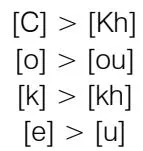
Notable in the above example is that the orthography of the loanword is different from the resultant adaption. Thus, in adapting the loanword, the adapter's focus is on matching the sounds of the loanword with the sounds of his or her native language system; focus is not on the 'spelling', but solely on the sounds of the word. In Tshivenda, the adaptation of the loanword begins with the adaptation of sound.
b) Phonological Adaptation
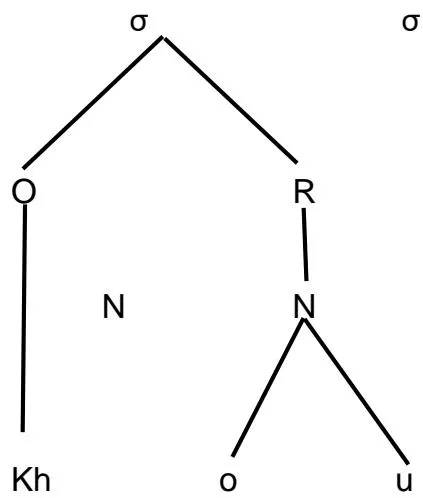
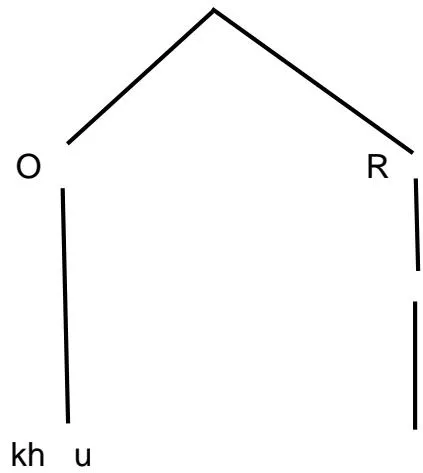
From phonetic adaptation, the adapter must then proceed to the phase that may be termed 'phonological adaptation'. Here, particular focus is on whether the resultant word, Khoukhu, conforms to the syllable pattern(s) of Tshivenda or not. Due to spatial limitations, other phonological aspects such as tone and phonemes will not be discussed, only the Tshivenda syllable structure and/or pattern will be considered. In this instance, the adapter must confirm that the syllables of the word, Khoukhu, align with the Tshivenda language's typical syllable structure, as indicated below:
c) Morphological Adaptation
From phonological adaptation, the adapter must proceed to the morphological adaptation of the loanword, where considerable focus must be on, among other things: (a) determining the word category into which the loanword (Khoukhu) falls in Tshivenda; (b) if it is a noun, determining which noun class the loanword falls into; (c) determining the number of morphemes in the loanword; (d) affixation, i.e., determining whether the loanword permits prefixation and/or suffixation, for example. In fulfilling these four aspects, the adapter may confidently affirm that the loanword has been successfully adapted, morphologically. In the case of Khoukhu, the adapter will have to confirm that the word is a noun, that its noun class in Tshivenda is +9 (N(i)-) in singular form and +10 (Dzi-) in plural form, that the word essentially has two morphemes, namely; the noun class prefix (N(i)-/Dzi-) and the noun stem (-Khoukhu); and that, the locative suffix, -ni, for example, can be attached to the noun, resulting in Khoukhuni ('at the Coke'). In this instance, the adapter may then affirm that Khoukhu is morphologically adapted into the Tshivenda lexicon.
d) Semantic Adaptation
From morphological adaptation, the adapter may also consider the meaning of the loanword, bearing in mind that the meaning of the loanword may either broaden, narrow, completely change or not change at all. At the first level of meaning, Khoukhu in Tshivenda may certainly mean the actual fizzy drink produced by the Coca Cola Company. However, Khoukhu may also acquire connotative meanings such as 'bribe money' or 'a gift'. In some instances, Khoukhu may be replaced by the word often treated as its synonym in Tshivenda, Kholoğirinki (Cold drink), where the word Kholoğirinki still means either a cold beverage (Coke), a bribe or a gift. Thus, the adapter will have to be well-versed in the varied semantic applications of the loanword, and use it appropriately. Upon undergoing each of the four phases, phonetic adaptation, phonological adaptation, morphological adaptation and semantic adaptation, the word Khoukhu would then be considered part of the Tshivenda language's lexical inventory.
e) Morpho-Phonological Processes Accompanying Loanword Nativisation in Tshivenda
Although the above description of how the loanword 'Coke' is adapted into Tshivenda may be taken as a prototype of how loanwords are generally adapted into Tshivenda, it must be noted, however, that the example does not delve deeper into any morphophonological rules and processes that the adapter must consider, or at least use to account for the distinctions between 'Coke' (English) and Khoukhu (Tshivenda), for example. It is for this reason that it is deemed necessary to highlight some morpho-phonological processes and/or changes that occur during the loanword adaptation in Tshivenda. Firstly, it must be stated that Tshivenda predominantly loans nouns and verbs from English and Afrikaans, and notable in its borrowing process is that, when nouns are loaned from English and Afrikaans, they lack a prefix and noun class, but when adapted into Tshivenda, they are assigned a prefix and noun class. Implicit in this is that Tshivenda is a prefixational or prefixal language. For instance,
When borrowing nouns from English and Afrikaans, either a singular or plural prefix is attached to the noun when it is adapted into Tshivenda. The aspect of affixation which often manifests either the singularisation or pluralisation of nouns, must not be ignored when describing loanword adaptation in Tshivenda. Whereas the English language, for example, entails the epenthesis of the consonant/s/ at the end of the base noun to denote plurality, i.e./school(s)/, Tshivenda, as a prefixal language, deems this grammatically aberrant. Instead, the Tshivenda employs a plural prefix. This may be evinced in the following morphological environment:
Whilst on the prefixation of loaned nouns, it is also imperative to hint at the nativisation of an object word of noun class 9, which is done by inserting an invisible noun affix [N(i)-] in Tshivenda (cf. Zivenge, 2009). In Tshivenda, the affix [N(i)-] denotes animals and objects such as the 'computer'. The [N(i)-] affix signifies singular objects other than those in Class 3 (Mi-) in Tshivenda. In a loanword (noun) such as 'computer' (Khomphiyutha/Khomphyutha), the prefix is invisible because it cannot be articulated together with the stem of the base-word. It is only realised grammatically, but does not form part of the word's phonics. Notable in the word /kæmpju:tə/> [komphyutha] is that only the stem is audible, although the class prefix [N(i)-] is grammatically present. The class affix [N(i)] also determines the concordial agreement for the base-word [khomphyutha], e.g., (Ni) khomphyutha (ni) a dura/Khomphyutha i a dura, 'The computer is expensive'. In terms of pluralisation of the word Khomphyutha, the Vhavenda insert the plural prefix [Dzi-](class +10) to the noun stem instead of attaching the English suffix /s/ at the end of the stem because this is unacceptable in Tshivenda. Thus, the pluralisation of 'computer' in Tshivenda requires the insertion of the Class 10 affix, which is both monosyllabic and invisible. It is not articulated together with the noun stem [khomphyutha] but it is grammatically realised. In this sense, the Muvenda adapter is assumed to possess this intuitive knowledge when adapting the word into the Tshivenda language.
There are also notable structural changes in the sound patterns of the loanwords when they are adapted into Tshivenda. In such instances, sound changes in loanwords result in the loss of the original speech sounds of the loanword. Sound changes may be caused by the absence of a matching speech sound in Tshivenda, e.g.:
Notable in the above examples is that the prefixes of the loanwords changed completely and where vowels were juxtaposed, one vowel disappeared while the other remained. This is so because there are loanwords from Afrikaans and English whose sound patterns are unacceptable in Tshivenda, to begin with. For instance, the word, brood (bread) assumes the following syllable pattern: CCVVC (C= Consonant; V=Vowel), whereas in Tshivenda, where the typical syllable structure is CV, the syllable pattern is: CVCVCV (Vhurotho). Another observation here is that clustered consonants in a loanword are separated by a vowel when the loanword is adapted into Tshivenda. This is so because Tshivenda does not permit a cluster of consonants in its sound patterns. Furthermore, apart from juxtaposed vowels in loanwords having one vowel disappear, for example, other phonological processes such as vocalisation may be noted when a loanword is adapted into Tshivenda, as revealed in the example below:
In Tshivenda, the loanword boek (book) becomes bugu. Note that the vowels /oe/ in boek were replaced by /u/ in Tshivenda. This is ascribed to the native adapter's orthographic representation of how the vowels sound in the loanword (phonetic adaptation). Also note that the voiceless speech sound /k/ becomes /g/ in Tshivenda when the loanword is adapted. This vocalisation process may be explained thus in Tshivenda:
\begin{array}{c} [ + \text {voiced} ] \\\bigwedge_ {\substack {\text {Boek} [ - \text {voiced} ] \\[ \mathbf {g} ] [ + \text {voiced} ]}} \end{array}\tag{5}In the example above, the juxtaposed vowels /oe/ in boek are voiced in Tshivenda (Milubi, 2004). As already indicated, when the vowels/oe/ are articulated in the word boek, they sound like the vowel/u/. Furthermore, the two voiced vowels/oe/ precede the voiceless speech sound /k/. When articulated, the voiced vowels /oe/ spread their +voiced features to the voiceless speech sound /k/, which upon receiving the +voiced features becomes a voiced speech sound /g/. Arguably based on its phenotype, the resultant word is expected to be pronounced Bug (as in Boog), if one were to isolate and articulate each sound as per articulatory phonetics' prescribed by the International Phonetic Alphabet (IPA). However, since the Tshivenda syllable has no coda, that is, it has no words that terminate with a consonant; all Tshivenda syllables are open, the adapter is compelled to add the vowel /u/ after the vocalised speech sound /g/, resulting in the word, bugu. Thus, it is possible that non-vocalised speech sounds in a loanword be transformed into vocalised ones in Tshivenda. Noteworthy in such instances is that the place of articulation of the speech sound rarely changes in Tshivenda, i.e., /k/ is a velar speech sound and /g/ is a velar speech sound.
In the nativisation of loanwords in Tshivenda, one finds a Merely Adopted word such as khomphyutha (computer). It is a merely adopted word in the sense that, it does not undergo a complete alteration when it is adapted into Tshivenda. Of course, it does not keep the source language's form orthographically, but because it retains its pronunciation as it is in the source language, the word is merely adopted into Tshivenda. Where words are Partially Adopted in Tshivenda, that is, words that exhibit phonological changes but no morphological alterations, it must be noted that the syllable structure of Tshivenda would have, in some way or the other, be disregarded in order for such a word to be incorporated into Tshivenda. An example is the word, muphresidende, (as opposed to muphuresidende) (president). One may note the violation of the Tshivenda syllable structure, i.e. the CV syllable pattern, in 'phre' which is phonologically aberrant in Tshivenda. This example is encapsulated here in an effort to highlight the orthographic inconsistencies that tend to characterise the principles undergirding the spelling of loanwords in Tshivenda (see Tshikota and Musehane, 2020). It is as a result of these orthographic inconsistencies, among other factors, that Partially Adopted loanwords inevitably pervade the Tshivenda lexicon. Be that as it may, Tshivenda predominantly manifests Fully Adopted loanwords, where loanwords undergo phonological and morphological changes to conform to the Tshivenda patterns. The phases undergone by the word 'Coke' and the necessity of affixation (prefixation) in borrowed nouns, as shown above, are indicative of Tshivenda's success at yielding a majority of Fully Adopted loanwords.
V. CONCLUSION
This study discussed how loanwords are adapted into the Tshivenda linguistic environment. It further highlighted the various phases that a loanword generally undergoes prior to its incorporation into the lexical inventory of Tshivenda. The phases that the loanword undergoes when it is adapted into Tshivenda are essentially phonetic, phonological, morphological and semantic adaptations. In discussing these phases, the goal was to illustrate that loanwords are phonetically, phonologically, morphologically and semantically altered to comply with the Tshivenda phonotactic and other linguistic constraints. Some morpho-phonological processes that are observable in loanword nativisation such as vocalisation, vowel epenthesis and deletion were briefly alluded to. Syllabification and affixation were also targeted, albeit briefly, in an effort to show that they can account for the differences between Tshivenda and the languages from which it borrows words.