I. INTRODUCTION
Since the early 1990s, logistics outsourcing practices have grown over time, fostering the emergence of Logistics Service Providers (LSPs). These are new players specializing in controlling the physical flow of goods and information, whether internal, upstream or downstream, associated throughout the supply chain (Savy, 2007). Among the wide range of logistics operations that these cover, the transport of goods figures prominently, which remains the activity most outsourced by customer-shippers (Roy, 2004).
Indeed, used in combination or individually, transport makes it possible to serve the hinterland of goods from different horizons. The predominance of the transport activity over the other services offered by PSLs (order preparation, handling, storage, inventory management, etc.) is explained in particular by the evolution of production and distribution systems (internationalization of trade, increase in "Just-In-Time" and "Cross-docking" operation). From a simple performer in transport, the freight carrier is henceforth assimilated to an expert "developer of turnkey solutions" (Roques and Michrafy, 2003), participating in the development of logistics plans for its customers (Boissinot and Kacioui-Maurin, 2009). Also, by entrusting the transport of their goods to specialized service providers, shippers thus seek expertise and know-how that are lacking externally (Roussat and Fabbe-Costes, 2000), so that their products are delivered to the right place, at the right time, and above all in the right quantity and quality and all this at the lowest price. The transport process must therefore meet logistics performance objectives, that is to say, create value not only for the carrier but also and above all for the shippers (the shipper and the recipient of the goods) and the customers of these shippers (Pellegrin-Romeggio, 2008; Mevel and Morvan, 2010; Loudghiri, 2014).
Today, the theme of the factors that condition the logistics performance of PSLs is the subject of an anthology of research in logistics management. Several studies have focused on identifying the sources of the logistics performance of LSPs. According to these, the logistical performance of these providers depends mainly on their resources, skills and logistical capacities (Karia and Wong, 2013; Aziz and al., 2015; Alkhatiband al., 2015; Karia and al., 2015; Zawawi and al., 2016; Kuo and al., 2017; Zawawi and al., 2017; Hamed, 2019). Karia and al (2015) analyzed the effect of bundling of resources on the logistics performance of LSPs in Malaysian territory. The results of their study underline that the LSPs who manage to develop and combine their resources (technological, physical, human, relational, and organizational) and their logistical capacities (in particular, the demand management interface) with one another better performance and manage to dominate their competitors in terms of costs and quality of service. Along the same lines, Huang and al (2006) discovered from an empirical study of Taiwanese LSPs that, by emphasizing better coordination of supply chain activities through increased responsiveness, companies PSL tend to achieve better logistics performance. Other research carried out in Singapore, China and even Taiwan recognizes that the logistics capacities of the LSP, that is to say their ability to create and deploy resources in order to meet the expectations of their customers-shippers improve the logistics performance (Zawawi and al., 2017). Logistical innovation, flexibility to adapt to sudden changes in the market environment, etc. are all logistical capacities that constitute the "backbone of any LSP" (Yang and al., 2009) and represent themost important element among the factors of competitiveness which could help these companies, to gain and to maintain a competitive advantage (Liu and al., 2010).
In the light of this work, we noted that: on the one hand, the results of these studies highlight the relationship between the possession and the combination of the resources, skills and logistical capacities of LSPs with their logistical performance. Nevertheless, we have noticed that no author has been interested in combining the three constructs into a single conceptual model. On the other hand, we have observed a lack in the number, until now very limited, of works that have included the developing countries of the African continent in their field of investigation. It is in this context that the main objective of our research is therefore to develop a conceptual model that would allow us to assess the relationship between the resources, skills and logistics capacities and the logistics performance of the freight carrier, in an African country in development like Cameroon.
Indeed, although research on explanatory factors of logistics performance has aroused enormous interest from researchers, particularly in Southeast Asian countries such as Indonesia, Malaysia, Africa in In general, the field of explanatory research on this theme remains very little explored. A study to our knowledge was conducted in Ghana by Sohail and al. (2004). In Cameroon more specifically, research into logistics management is quite rare (Eyenga, 2010; Tsapi and Assene, 2014) and more particularly that concerning LSPs (Gouanlong and Bidisse, 2017; Bidisse and al., 2019, Gouanlong and al., 2020). It is within this framework that the main objective of our research is therefore to develop a conceptual model which would allow to assess the relationship between the resources, skills and logistics capacities and the performance of the freight carrier, in a developing African country like Cameroon.
To achieve this objective, we have organized this contribution around three points: first, we will present the concept of logistics performance (1). Next, we will present the three main theories that can explain the logistics performance of PSLs in general, and freight carriers in particular (2). Finally, we will propose the possible determinants of the logistics performance of these service providers identified in the existing literature (3).
1. Definition of logistics performance in freight transport
Faced with the current environment, marked by dynamism and ever-increasing competition on a planetary scale, the sustainability of a company inevitably refers to performance requirements (Chappaz-Gillot and Destais, 2007). In the specific context of logistics service, Wang et al.(2010) point out that the concept of PSL performance translates into quality, flexibility and on-time delivery. Neely and al.(1995) for their part, assimilate the logistics performance of PSLs through 4 components: costs, quality, deadlines and flexibility, which also influence shippers in the choice of their service providers. For some authors, in particular Huoand al.(2008), the logistics performance of LSPs is fundamentally built on two major dimensions, logistics costs and the level of logistics services.
In the specific case of the freight transport service, the logistics performance of the transporter is measured through its effectiveness and efficiency (Krauth et al., 2005). As part of this research, we define the logistics performance of the freight carrier as its ability to deliver a quality service, that is to say to transport goods on time and as is, and at a lower cost to the charger. More precisely, it refers to the ability of the transport provider to generate added value for itself and for its customers, thanks in particular to deliveries of goods on time and in full, to the absence of theft and damage or loss of goods during the journey, etc. This conception of logistics performance converges with that adopted by many authors in logistics management, who moreover assimilate it to the competitive performance of the LSP (Wong and Karia, 2010; Zawawi et al., 2016; Zawawi et al., 2017).
Based on the constituent elements of performance in freight transport identified by Lambert (1991) and Grand (1997), and following a large review of the literature on the fundamental characteristics of efficient transport, we have retained the following assessment attributes: time, reliability, availability, transport quality and compliance, which appear in table 1 below. This choice can be explained in large part by the obvious insistence of certain authors on the importance of these criteria, in the evaluation of the logistical performance of a LSP in general, and of a transport provider in particular.
| Attributes | Définition Authors | |
| The delivery time | Also called "cycle time", this is the duration of a delivery cycle from receipt of the order to delivery of the goods | Wang and al. (2010), Roques (2014) |
| Reliability of transport | It corresponds to the ability to correctly deliver the right product, to the right place, on time, under the required packaging conditions, in quantity, in documentation and to the right customer. | Morana and Pinardi (2003), Butner and Moore (2006) |
| Availability of transport | It represents the ability to deliver products according to needs, on time and under expected conditions, under penalty of causing stockouts for the customer. The commercial risk can then lead the customer to cancel orders, or to detach himself from the carrier in the event of non-availability of the products. | Grand (1997), De Beaumont (1994). |
| Transport quality and compliance | the orders delivered must comply with customer requests and must not include any errors, resulting in particular from their preparation. Likewise, the products must be delivered according to the rules inspired by their characteristics: respect for the cold chain for temperature-controlled products, or even respect for stability for fragile products. | Grand (1997)De Beaumont (1994). |
In the transport sector, offering quality service at a lower cost is a major issue and represents a permanent challenge for service providers in this sector of activity. Efficient customer service in terms of cost, time and quality of service is thus presented as an essential asset to guarantee a stable and lasting presence of the freight carrier on the market and generate added value for shippers, by allowing them to" also achieve their own goals with greater efficiency.
II. THEORIES EXPLAINING THE LOGISTICS PERFORMANCE OF TRANSPORT PROVIDERS
Many authors link the logistical performance of these service providers to the logistical resources, skills and capacities available to them (Karia and Wong, 2013; Aziz and al., 2015; Alkhatib and al., 2015; Karia and al., 2015; Zawawi and al., 2016; Kuo and al., 2017; Zawawi and al., 2017; Hamed, 2019). This approach to logistics performance leads us to consider the resource theory of Wernerfelt (1984) and Barney (1991), the theory of central skills of Hamel and Prahalad (1990) and that of dynamic capacities of Teece and al. (1997), to advance the idea that these assets are the determinants of the strategic behavior and performance of the freight carrier. For these authors, what gives a company a competitive advantage are its assets (resources, skills and capabilities) and its ability to combine them to produce superior performance.
a) The
The theory of resources has gradually entered the logistics literature. A number of research works have identified and analyzed the strategic resources for LSPs, as well as their effects on their logistics performance (Chiu, 1995; Panayides, 2007; Lai and al., 2008; Yang and al., 2009; Karia and al., 2012; Karia and Wong, 2013). Indeed, in the complex and competitive logistics sector, it is essential for PSLs to have access and be able to combine and develop the right resources, in superior logistics performance. Drawing on the work of Mentzer and al. (2004) and RBV, Karia and Wong (2013) developed a theoretical model of the logistics resources and capacities of LSPs, which they called the theory of logistics resources, also known as "Resource-Based Logistics". (RBL), which determine the logistics performance of LSPs. According to the categorization made by Alkhatib and al. (2015), logistics resources can be subdivided into tangible and intangible resource groups, as shown in Table 2 below:
| Groups | Subgroups Definition | |
| Tangible resources and capacities | • Physical | Ability of the LSP to acquire, use and maintain logistics vehicles, machines, tools and other equipment (eg. transport vehicles, insurance contracts, etc.). |
| • Technological | Ability of the LSP to acquire, use and maintain advanced logistics technologies (GPS, internet, etc.), with a view to exploiting them with other physical resources, in order to carry out logistics activities effectively and efficiently. | |
| Intangible resources and capacities | • Human | Art of the LSP to recruit, train, remunerate and motivate its staff. |
| • Relational | Ability of the LSP to create and maintain healthy long-term relationships with other members of the supply chain, willingness to cooperate. | |
| • Organizational | Shared values, principles and philosophy of the LSP on different themes such as trust, quality management, etc. | |
The essential mission of the carrier is to ensure the availability of products in the right place, in the right quantity and at the right time. To do this, he must have adequate logistical resources to manage the flow of products and information in order to meet the expectations of the customer-shipper.
b) The
Briefly, competence refers to the ability of a company to use resources to achieve a given objective. For a company, this is know-how that it possesses and that it knows how to use in the context of its various processes, to achieve better performance (Quelin, 1997). Thus, the firm's core competencies represent unique combinations of resources and skills, enabling it to generate competitive advantage and create value for its clients (Hamel and Prahalad, 1990). Logistics, a favorite field for LSPs, now requires real management skills within logistics chains (Corbin, 2008). Also, the conduct of logistics activities calls for two types of skills in the sense of many authors, as shown in Table 3 below:
| Groups | Sub groups Definition | |
| Managerial skills (Fabbe-Costes and Colin, 1995) | ·the "knowledge" | All knowledge and intelligence (ability to understand, design and decide).It is this level that is used for the analysis of (unforeseen) environmental disturbances. |
| ·the"do it" | This is the space for realization (demand for new services, quality level, etc.).It is in this space that the key or fundamental skills reside. | |
| ·the "know-how" | This space concerns all the means directly requested by the space of doing. It includes methods, procedures and technologies. | |
| Organisational skills(Corbin, 2008; Roques, 2014) | ·Planning of logistics activities | process aimed at organizing the activities of the supply chain by making decisions at the strategic, tactical and operational level |
| ·Management of flows in the supply chain | Decision-making, at each stage of the chain and for each stakeholder, in order to determine when and in what quantity to launch an activity. | |
| ·Coordination of logistics chain activities | Since the logistics chain is in essence the result of interdependent links, a coordinated supply chain is more efficient than an uncoordinated supply chain. | |
These 2 skill categories, for LSPs, offer multiple possibilities for differentiation at the intra-industry level and in terms of their strategic positioning, vis-à-vis their shipper customers, allowing them to better satisfy them.
c) The contribution of the theory of dynamic capacities
In the field of logistics service in general and that of transport service, the theory of dynamic capacities of Teece and al. (1997) fits perfectly into the achievement of logistics performance. The implementation of these capabilities ensures the flexibility, quality and reliability of the movement of goods and associated information within the transport chain (Burmeister, 2000). Some authors (Shang and Marlow, 2005; Lu, 2007; Green and al., 2008; Yang and al., 2009; Kuo and al., 2017) have thus highlighted the implications of the theory of dynamic capacities in the improvement of the logistics performance of LSPs.
Logistics capabilities are seen as the ability of LSPs to create and deploy resources in order to satisfy their customers and improve their logistics performance (Lai, 2004). Meeting customers' requirements on time, ensuring delivery of goods on time, the ability to solve problems, helping customers achieve their own goals, providing accurate information on the cargo in transit are among the mainlogistics capacities of a LSP that significantly affect its logistics performance (Zawawi and al., 2017). Zuraimi and al. (2012) have identified the ability to conduct operations in a flexible manner, logistics innovation, and achievement of economies of scale, knowledge and feedback to the customer, as essential capacities for competitiveness of LSPs and the creation of their competitive advantage.
In short, these different theoretical approaches that we have used in the context of this study seem to be the most appropriate in the study of PSLs in general and of freight carriers in particular, because their performance strongly depends on the diversity of available assets.to meet the logistics needs of their customers.To meet the wishes expressed by them, carriers must meet a dual requirement in the transport service offer: (i) make the best use of the resources acquired over time to serve customers, while (ii) exploring new ways of improving their performance and that of their customers (Quelin, 2003), since "within industrial and commercial supply chains, logistics providers play an increasingly central role:good coordination of the flow of goods and information.Their performance directly conditions both their competitive advantage but also that of their customers and more broadly that of the supply chains in which they are integrated "(Brulhart and Claye-Puaux, 2009, p.1). Therefore, it is imperative to proceed with an integrated management of flows along the logistics chain, which necessarily involves:
The use of best practices for the management and coordination of flows along the supply chain: that is to say the establishment of close relations with the most serious partners upstream and downstream, the creation of the bases of common data between the actors involved in the management of flows for better visibility for rational decision-making, the harmonization of information systems and working methods, the sharing of information and knowledge between the different players (Information and Communication Technologies, software packages, Electronic Data Interchange, Global Positioning System) to ensure the traceability and real-time monitoring of goods;
The acquisition and strengthening of the resources, skills and strategic capacities of the carrier (human, financial, physical, technological resources, technical skills in logistics, management; service capacity, innovation, adaptation, etc.).
III. LOGISTICS PERFORMANCE FACTORS IN FREIGHT TRANSPORT
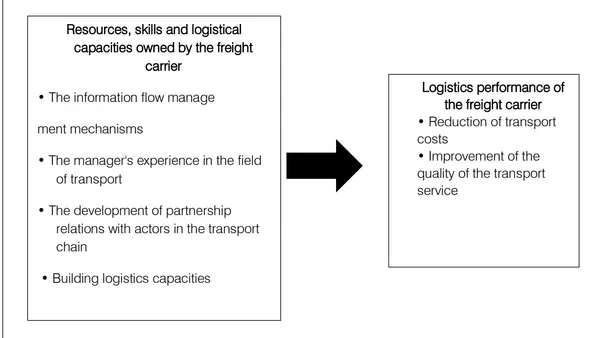
For many authors, inter-firm competition has been replaced by competition between logistics chains and that the implications of the logistics performance of a link in the chain will necessarily have repercussions on the overall logistics performance of the supply chains in which it is integrated. (Hiesse, 2009). Thus, the levers of the logistics performance of LSPs in general have been identified by researchers in the logistics literature. Our ambition in this investigation is not to take stock of all the determinants of this performance, but rather to focus on those that would most influence this logistics performance. We have retained four (04): the information flow management mechanisms, the manager's experience in the field of transport, the development of partnership relations with the upstream and downstream actors of the transport chain and the strengthening logistics capacities.
Proposition 1: Information flow management mechanisms (Evangelista and Sweeney, 2006; Stefansson and Lumsden, 2009; Evangelista and al., 2013; Sternberg and al., 2014; Hsuan and al., 2015; Karia and al., 2015).
Today, LSP information systems represent a strategic element for all of their activities (transport, handling, storage, etc.). Thanks to IT tools and networks, internal and external which are based on technologies linked to the Internet, in particular Electronic Data Interchange (EDI), the use of the Global Positioning System (GPS), most of the information used are now processed and exchanged between the various players upstream and downstream of the transport chain. In addition, the sharing of information plays a central role in inter-organizational relations and on the performance of the various actors involved in the transport chain (shippers, customs administrations, employees, etc.). A constant exchange of information internally and between the stakeholders in the transport relationship promotes the responsiveness and fluidity of the process of making goods available in order to meet delivery deadlines as well as possible and/or to readjust them if it turns out to be necessary.
Proposition 2: The manager's experience in the field of transport (Chiu, 1995; Brah and Lim, 2006; Panayides, 2007; Ellinger and al., 2008; Karia and Wong, 2013; Karia and al., 2015; Hsuan and al. al., 2015).
Strategic management has always been at the heart of business concerns, and creating a sustainable competitive advantage leading to superior performance is a key element for businesses. In the context of logistics activities, the focus is therefore on the experience of the transport provider in managing the flow of goods, in explaining its logistics performance. The relationship between the carrier's professional experience and its logistics performance is, in this case, approached from the perspective of the development and accumulation of skills and strategic knowledge for the company.
Proposition 3: The development of partnership relations with upstream and downstream actors in the transport chain (Morgan and Hunt, 1994; Tate, 1996; Brulhart, 2002, 2005; Brulhart and Favoreu, 2006, Brulhart and Claye-Puaux, 2009; Saglietto, 2013; Karia and al., 2015; Sachdev and al., 2015).
The Supply Chain, of which the transport of goods is an integral part, constitutes a network of interdependent partners whose overall objective is customer satisfaction at a lower cost. With the current evolution of competition (chrono competition) and the ever increasing demands of shippers, transport providers can hardly succeed by relying only on their own resources. The establishment of strategic partnerships between the different actors of the transport chain, allows them to adjust each other in time and space, to ensure the overall efficiency of the system put in place for the routing of merchandise. In this perspective, the intervening parties must constantly improve the coordination of their interventions, despite their sometimes distinct and divergent interests. A number of authors have carried out research on the importance of establishing a partnership relationship between the PSL and its various stakeholders in this area. These authors have come to the conclusion that the establishment of partnerships between all the players in the transport chain, allow them to improve their performance and competitiveness respectively, and above all to create added value for the shipper.
Proposition 4: Building logistics capacities (Lai, 2004; Shang and Marlow, 2005; Panayides, 2007; Liu and al., 2010; Hsuan and al., 2015; Karia and al., 2015; Sachdev and al., 2015; Aziz and al., 2016; Zawawi and al., 2016).
The choice of a logistics strategy is determined both by the objectives of the company, but also by its resources and capabilities. To be effective, a company must be able to constantly question its capabilities, in order to better coordinate and manage the flows that pass through it to optimally meet the needs of its customers. The logistics capacities of the LSP represent the basis of their activities. Several previous research has affirmed the existence of a significant positive relationship between a company's capabilities and its performance.
First of all, carrying out the freight transport activity requires service providers in the sector to have physical and human resources, able to provide the level of service desired by the shipper at a lower cost. The management of the supply chain by supposes to invest in the key processes allowing to manage in an adequate way, the supply chain. Second, LSPs are now faced with an unstable environment, characterized by fierce competition and extraordinary technological development. In this context, the competitiveness of these service providers depends on their adaptability and flexibility. Finally, mobilizing the innovation capacities of LSPs is often cited as a source of competitive advantage and performance. For many authors who have looked at the logistics performance factors of LSPs, a company is able to reach the highest level of its overall performance, on the condition sine qua non of being creative in developing newsoffers enabling them to meet the demand for logistics services from shippers.
Taking into account the proposals that we have just formulated, we have developed the conceptual model of our study which is presented as follows, with Figure 1 below:
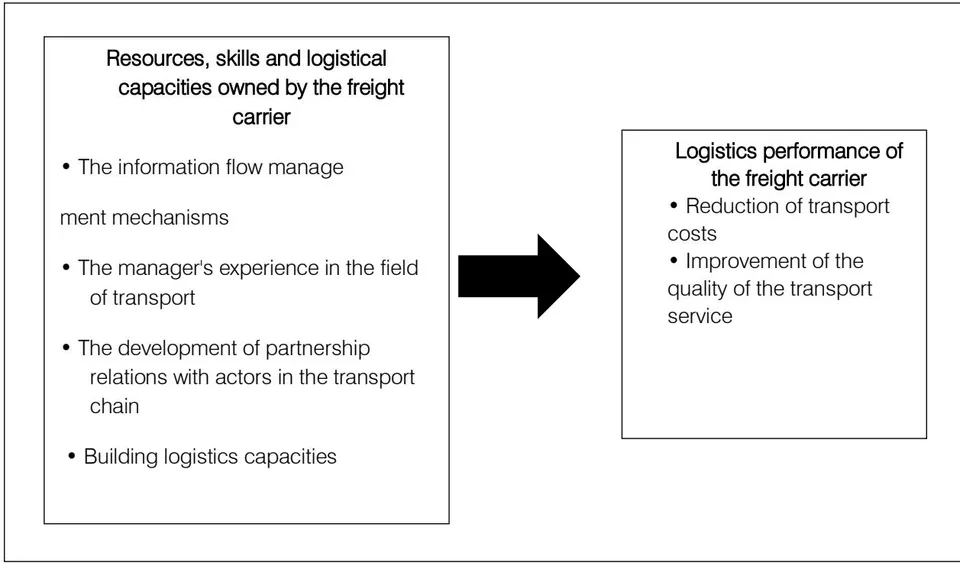
Figure 1: Conceptual model of research To test this model, two successive phases will be adopted. The first qualitative, of an exploratory nature, aims to clarify theoretical concepts and allow the most recurrent variables to be retained with a view to subsequent operationalization (Evrard et al., 2003). To do this, two maintenance guides have been developed, which take up the central themes of our research problem: one was administered to shippers and the other to freight carriers. The second phase is quantitative in nature. This involves constructing, from the results of the qualitative study, a questionnaire that will be administered to freight carriers. As for the methods of analyzing the data that will be mobilized, we plan to use first a descriptive analysis in order to characterize the sampled freight transport companies, then a factor analysis which will allow us to identify the relationships between all the variables of our model, and finally, multiple linear regression, in order to confirm or invalidate the research hypotheses that will be formulated (Evrard and al., 2003).
IV. CONCLUSION
The contribution of our research is essentially theoretical. The objective of this article was to summarize the literature on the sources of the logistics performance of freight carriers, with particular emphasis on the factors that can be controlled by these providers themselves. Theoretical currents on the logistics performance factors of LSPs in general and of transport providers more precisely, have allowed us to formulate seven research hypotheses that convey positive relationships between logistics performance and its various common threads. These assumptions, which are based on the resources, skills and logistical capacities of carriers, combine the use of modern information flow management tools, the sharing of information internally and with upstream and downstream players in the transport chain, the manager's experience in the field of transport, the development of partnership relations with actors in the transport chain, the strengthening of service capacities, the strengthening of adaptation capacities, the reinforcement of innovation capacities in logistics performance. However, although the contribution of this paper is great on the theoretical level, it presents the limitation of remaining conceptual. However, this study could be much more interesting if this review of the literature on logistics performance factors were followed by an empirical phase. Given this failure, this research will be extended, by testing the hypotheses thus formulated on a sample of freight transport companies in a developing country like Cameroon.