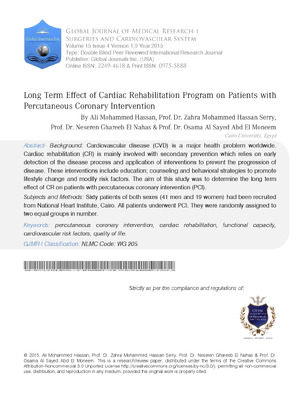
Long Term Effect of Cardiac Rehabilitation Program on Patients with Percutaneous Coronary Intervention

Ali Mohammed Ali
Ali Mohammed Ali
Prof.Dr. Zahra Mohammed Hassan Serry
Prof. Dr. Neseren Ghareeb El Nahas
Prof. Dr. Osama Al Sayed Abd El Moneem
Cairo University Cairo University

Send Message

To: Author

Long Term Effect of Cardiac Rehabilitation Program on Patients with Percutaneous Coronary Intervention

Article Fingerprint

ReserarchID

6Q8E5

Long Term Effect of Cardiac Rehabilitation Program on Patients with Percutaneous Coronary Intervention Banner

AI TAKEAWAY

Connecting with the Eternal Ground
  • English
  • Afrikaans
  • Albanian
  • Amharic
  • Arabic
  • Armenian
  • Azerbaijani
  • Basque
  • Belarusian
  • Bengali
  • Bosnian
  • Bulgarian
  • Catalan
  • Cebuano
  • Chichewa
  • Chinese (Simplified)
  • Chinese (Traditional)
  • Corsican
  • Croatian
  • Czech
  • Danish
  • Dutch
  • Esperanto
  • Estonian
  • Filipino
  • Finnish
  • French
  • Frisian
  • Galician
  • Georgian
  • German
  • Greek
  • Gujarati
  • Haitian Creole
  • Hausa
  • Hawaiian
  • Hebrew
  • Hindi
  • Hmong
  • Hungarian
  • Icelandic
  • Igbo
  • Indonesian
  • Irish
  • Italian
  • Japanese
  • Javanese
  • Kannada
  • Kazakh
  • Khmer
  • Korean
  • Kurdish (Kurmanji)
  • Kyrgyz
  • Lao
  • Latin
  • Latvian
  • Lithuanian
  • Luxembourgish
  • Macedonian
  • Malagasy
  • Malay
  • Malayalam
  • Maltese
  • Maori
  • Marathi
  • Mongolian
  • Myanmar (Burmese)
  • Nepali
  • Norwegian
  • Pashto
  • Persian
  • Polish
  • Portuguese
  • Punjabi
  • Romanian
  • Russian
  • Samoan
  • Scots Gaelic
  • Serbian
  • Sesotho
  • Shona
  • Sindhi
  • Sinhala
  • Slovak
  • Slovenian
  • Somali
  • Spanish
  • Sundanese
  • Swahili
  • Swedish
  • Tajik
  • Tamil
  • Telugu
  • Thai
  • Turkish
  • Ukrainian
  • Urdu
  • Uzbek
  • Vietnamese
  • Welsh
  • Xhosa
  • Yiddish
  • Yoruba
  • Zulu
Font Type
Font Size
Font Size
Bedground

References

24 Cites in Article
  1. C Viviane,P Nele,Catherine De (2015). Aerobic interval training and continuous training equally improve aerobic exercise capacity in patients with coronary artery disease.
  2. M Falk,M Charlotte,D Kathrin (2010). Effectiveness of nonpharmacological secondary prevention of coronary heart disease.
  3. Hanan Rahim,Abla Sibai,Yousef Khader,Nahla Hwalla,Ibtihal Fadhil,Huda Alsiyabi,Awad Mataria,Shanthi Mendis,Ali Mokdad,Abdullatif Husseini (2014). Non-communicable diseases in the Arab world.
  4. I Graham,D Atar,K Borch (2007). European guidelines on cardiovascular disease prevention in clinical practice.
  5. M Warner (2012). Cardiac rehabilitation past, present and future: an overview.
  6. S Keteyian,I Pina,B Hibner (2010). Clinical role of exercise trainingin the management of patients with chronic heart failure.
  7. K Christensen,M Jordan (2008). Pumping up cardiac rehab, exercise guidelines for post-heart surgery clients.
  8. Ole Kemi,Ulrik Wisløff (2010). High-Intensity Aerobic Exercise Training Improves the Heart in Health and Disease.
  9. M Munkvik,T Rehn,G Slettalokken (2010). Training effects on skeletal muscle calcium handling in human chronic heart failure.
  10. O Havik,B Sivertsen,A Relbo (2007). Depressive symptoms and all-cause mortality after heart transplantation.
  11. G Borg,H Linderholm (1967). Perceived exertion and pulse rate during graded exercise in various age groups.
  12. Sidney Smith,Emelia Benjamin,Robert Bonow,Lynne Braun,Mark Creager,Barry Franklin,Raymond Gibbons,Scott Grundy,Loren Hiratzka,Daniel Jones,Donald Lloyd-Jones,Margo Minissian,Lori Mosca,Eric Peterson,Ralph Sacco,John Spertus,James Stein,Kathryn Taubert (2011). AHA/ACCF Secondary Prevention and Risk Reduction Therapy for Patients With Coronary and Other Atherosclerotic Vascular Disease: 2011 Update.
  13. D Wood,K Kotseva,S Connolly,C Jennings,A Mead,J Jones,A Holden,D De Bacquer,T Collier,G De Backer,O Faergeman (2008). Nurse-coordinated multidisciplinary, family-based cardiovascular disease prevention programme (EUROACTION) for patients with coronary heart disease and asymptomatic individuals at high risk of cardiovascular disease: a paired, cluster-randomised controlled trial.
  14. J Redfern,T Briffa,E Ellis,S Freedman (2009). Choice of secondary prevention improves risk factors after acute coronary syndrome: 1-year follow-up of the CHOICE (Choice of Health Options In prevention of Cardiovascular Events) randomised controlled trial.
  15. Judith Susan,M Nigel,H (2011). Systematic review of the effect of diet and exercise lifestyle interventions in the secondary prevention of coronary heart disease.
  16. E Fatemeh,S Masoumeh,M Seyed (2012). Exercise-based cardiac rehabilitation improves hemodynamic responses after coronary artery bypass graft surgery.
  17. C Raymond,L Leonard,L Linda (2014). Predictors of Improvement in Exercise Tolerance after Cardiac Rehabilitation in Patients with Acute ST Elevation Myocardial Infarction Received Primary Percutaneous Coronary Intervention in Hong Kong.
  18. L Yu,Y Gu,X Feng (2014). The application of the transtheoretical model in patients rehabilitative exercise after percutaneous coronary intervention.
  19. S Masoumeh,G Fatemeh,R Katayoun (2013). Does significant weight reduction in men with coronary artery disease manage risk factors after cardiac rehabilitation program?.
  20. G Manzoni,V Villa,A Compare (2011). Short-term effects of a multidisciplinary cardiac rehabilitation programme on psychological well-being exercise capacity and weight in a sample of obese inpatients with coronary heart disease: A practicelevel study.
  21. A Kiat,E Cook,H Kiat (2008). Weight loss and fitness in patients with coronary artery disease through cardiac rehabilitation—A long-term follow-up.
  22. G Pantaleo,T Pier,M Roberto (2008). Global secondary prevention strategies to limit event recurrence after myocardial infarction.
  23. A Tarik (2012). The rising menace of diabetes in the Middle East: time for action.
  24. Y Hany,R Tamer,E Khaled Impact of gender difference on PCI outcome in Egyptian diabetic patients: Prospective two center registry.

Funding

No external funding was declared for this work.

Conflict of Interest

The authors declare no conflict of interest.

Ethical Approval

No ethics committee approval was required for this article type.

Data Availability

Not applicable for this article.

How to Cite This Article

Ali Mohammed Ali. 2015. \u201cLong Term Effect of Cardiac Rehabilitation Program on Patients with Percutaneous Coronary Intervention\u201d. Unknown Journal GJMR-I Volume 15 (GJMR Volume 15 Issue I4).
Download Citation

Journal Specifications
Keywords
Classification
GJMR-I Classification NLMC Code: WG 205
Version of record

v1.2

Issue date
November 10, 2015

Language
en
Experiance in AR

Explore published articles in an immersive Augmented Reality environment. Our platform converts research papers into interactive 3D books, allowing readers to view and interact with content using AR and VR compatible devices.

Read in 3D

Your published article is automatically converted into a realistic 3D book. Flip through pages and read research papers in a more engaging and interactive format.

Article Matrices
Total Views: 4020
Total Downloads: 2036
2026 Trends
Related Research
Our website is actively being updated, and changes may occur frequently. Please clear your browser cache if needed. For feedback or error reporting, please email [email protected]

Request Access

Please fill out the form below to request access to this research paper. Your request will be reviewed by the editorial or author team.
X

Quote and Order Details

Contact Person

Invoice Address

Notes or Comments

This is the heading

Lorem ipsum dolor sit amet, consectetur adipiscing elit. Ut elit tellus, luctus nec ullamcorper mattis, pulvinar dapibus leo.


High-quality academic research articles on global topics and journals.

Long Term Effect of Cardiac Rehabilitation Program on Patients with Percutaneous Coronary Intervention

Ali Mohammed Ali
Ali Mohammed Ali <p>Cairo University</p>
Prof.Dr. Zahra Mohammed Hassan Serry
Prof. Dr. Neseren Ghareeb El Nahas
Prof. Dr. Osama Al Sayed Abd El Moneem

Research Journals