
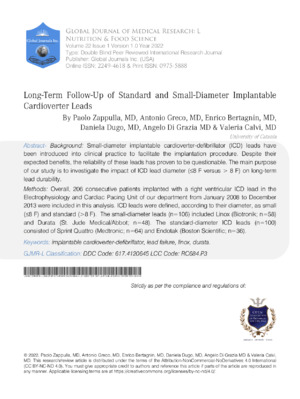

Long-Term Follow-Up of Standard and Small-Diameter Implantable Cardioverter Leads

Article ID

79399

Long-Term Follow-up of Standard and Small-Diameter Implants Video for Leads.

Long-Term Follow-Up of Standard and Small-Diameter Implantable Cardioverter Leads

Paolo Zappulla
Paolo Zappulla University of Catania
Antonio Greco
Antonio Greco
Enrico Bertagnin
Enrico Bertagnin
Daniela Dugo
Daniela Dugo
Angelo Di Grazia
Angelo Di Grazia
Valeria Calvi
Valeria Calvi
DOI

Abstract

Background: Small-diameter implantable cardioverter-defibrillator (ICD) leads have been introduced into clinical practice to facilitate the implantation procedure. Despite their expected benefits, the reliability of these leads has proven to be questionable. The main purpose of our study is to investigate the impact of ICD lead diameter (8 F versus > 8 F) on long-term lead durability. Methods: Overall, 206 consecutive patients implanted with a right ventricular ICD lead in the Electrophysiology and Cardiac Pacing Unit of our department from January 2008 to December 2013 were included in this analysis. ICD leads were defined, according to their diameter, as small (8 F) and standard (>8 F).  The small-diameter leads (n =106) included Linox (Biotronik; n = 58) and Durata (St. Jude Medical/Abbot; n = 48). The standard-diameter ICD leads (n = 100) consisted of Sprint Quattro (Medtronic; n = 64) and Endotak (Boston Scientific; n = 36).  Results: After a median follow-up of 7.3 years, lead failure rate was significantly increased for small-diameter leads compared with standard-diameter leads (6.6% vs 1%; P = 0.035). No difference in lead survival probability has been observed between Linox and Durata small-diameter leads (93% vs 92.7%; P = 0.71). The majority of lead failures presented as noise (87.5%), without detectable abnormalities on fluoroscopic evaluation. Conclusions: Our single-centre study showed that both Linox and Durata small-diameter ICD are associated to be more susceptible to a greater risk of lead failure as compared to standard-diameter ICD leads. In this perspective, a comprehensive vigilance strategy including home monitoring is warranted for early detection of lead failure.

Long-Term Follow-Up of Standard and Small-Diameter Implantable Cardioverter Leads

Background: Small-diameter implantable cardioverter-defibrillator (ICD) leads have been introduced into clinical practice to facilitate the implantation procedure. Despite their expected benefits, the reliability of these leads has proven to be questionable. The main purpose of our study is to investigate the impact of ICD lead diameter (8 F versus > 8 F) on long-term lead durability. Methods: Overall, 206 consecutive patients implanted with a right ventricular ICD lead in the Electrophysiology and Cardiac Pacing Unit of our department from January 2008 to December 2013 were included in this analysis. ICD leads were defined, according to their diameter, as small (8 F) and standard (>8 F).  The small-diameter leads (n =106) included Linox (Biotronik; n = 58) and Durata (St. Jude Medical/Abbot; n = 48). The standard-diameter ICD leads (n = 100) consisted of Sprint Quattro (Medtronic; n = 64) and Endotak (Boston Scientific; n = 36).  Results: After a median follow-up of 7.3 years, lead failure rate was significantly increased for small-diameter leads compared with standard-diameter leads (6.6% vs 1%; P = 0.035). No difference in lead survival probability has been observed between Linox and Durata small-diameter leads (93% vs 92.7%; P = 0.71). The majority of lead failures presented as noise (87.5%), without detectable abnormalities on fluoroscopic evaluation. Conclusions: Our single-centre study showed that both Linox and Durata small-diameter ICD are associated to be more susceptible to a greater risk of lead failure as compared to standard-diameter ICD leads. In this perspective, a comprehensive vigilance strategy including home monitoring is warranted for early detection of lead failure.

Paolo Zappulla
Paolo Zappulla University of Catania
Antonio Greco
Antonio Greco
Enrico Bertagnin
Enrico Bertagnin
Daniela Dugo
Daniela Dugo
Angelo Di Grazia
Angelo Di Grazia
Valeria Calvi
Valeria Calvi

No Figures found in article.

Paolo Zappulla. 2026. “. Global Journal of Medical Research – L: Nutrition GJMR-L Volume 22 (GJMR Volume 22 Issue L1): .

Download Citation

Journal Specifications

Crossref Journal DOI 10.17406/gjmra

Print ISSN 0975-5888

e-ISSN 2249-4618

Classification
GJMR-L Classification: DDC Code: 617.4120645 LCC Code: RC684.P3
Keywords
Article Matrices
Total Views: 1555
Total Downloads: 30
2026 Trends
Research Identity (RIN)
Related Research
Our website is actively being updated, and changes may occur frequently. Please clear your browser cache if needed. For feedback or error reporting, please email [email protected]

Request Access

Please fill out the form below to request access to this research paper. Your request will be reviewed by the editorial or author team.
X

Quote and Order Details

Contact Person

Invoice Address

Notes or Comments

This is the heading

Lorem ipsum dolor sit amet, consectetur adipiscing elit. Ut elit tellus, luctus nec ullamcorper mattis, pulvinar dapibus leo.


High-quality academic research articles on global topics and journals.

Long-Term Follow-Up of Standard and Small-Diameter Implantable Cardioverter Leads

Paolo Zappulla
Paolo Zappulla University of Catania
Antonio Greco
Antonio Greco
Enrico Bertagnin
Enrico Bertagnin
Daniela Dugo
Daniela Dugo
Angelo Di Grazia
Angelo Di Grazia
Valeria Calvi
Valeria Calvi

Research Journals






























































