I. INTRODUCTION
Implantable cardioverter-defibrillator (ICD) devices have been broadly shown to be efficacious for sudden cardiac death prevention and are nowadays recommended in high-risk subsets, either in primary or secondary prevention setting. The main structural weakness of an ICD system lies in the leads. The anticipated lead failure rate increases with age, reaching up to 20% in at least 10-year old leads [3]. Lead technology evolution has followed in a decreased annual failure rate, approximately from 4% to 0,3% [4]. Small-diameter ICD leads have been introduced into clinical practice to improve the implantation procedure and to reduce the odds of subclavian vein thrombosis. Although their expected benefits, the long-term performance of these leads is still an area of uncertainty [5-7]. Two high-profile safety alerts were conducted in October 2007 (Sprint Fidelis, Medtronic) and December 2011 (Riata, St. Jude Medical). For Sprint Fidelis, in 2007, an increased early failure rate mainly due to conductor fracture was observed [8] and, in subsequent years, failure rates of 2.8 - 3.8% per patient/year were reported [7, 9]. On the other hand, Riata leads showed conductor externalization [10] that may remain electrically silent for longer periods. Prospective screening of Riata leads by high-resolution fluoroscopic imaging found a 15% prevalence rate of externalized conductors after a mean follow-up of 4 years [11]. Afterward new small-diameter ICD leads, Durata, St Jude Medical now Abbot and Linox, Biotronik, has been introduced into the market.
The main purpose of our study is to investigate the impact of ICD lead diameter (£8 F versus > 8 F) on long-term lead durability among patients who underwent ICD leads implantation at our centre.
II. MATERIALS AND METHODS
a) Patient selection and implantation procedure
For the purpose of the current analysis, 206 consecutive patients in whom a right ventricular ICD lead had been implanted in the Electrophysiology and Cardiac Pacing Unit of our cardiology department from January 2008 to December 2013 were included. According to their diameters, ICD leads were categorized as small-diameter (£8 F; n=106) or standard-diameter (>8 F; n=100). The small-diameter leads were Biotronik Linox (model S and SD; n=58) and St Jude Medical/Abbot Durata (model 7122 and 7170; n=48). The standard-diameter ICD leads were Medtronic Sprint Quattro (model 6947 and 6935; n=64) and Boston Scientific Endotak (model 0148, 0155, 0295 and 0296; n=36). At the time of implantation, baseline ICD leads characteristics were collected in a dedicated database, including electrical parameters (e.g. R-wave amplitude, capture threshold, and pacing and high-voltage impedances), type of lead fixation, number of shock coils and lead model. All implantations procedures were carried out by interventional cardiologists with great experience on electrophysiology and cardiac pacing. Venous access for lead insertion was the subclavian vein in all cases.
b) Definition of lead failure
Lead failure was relied on one or more of the following features: recurrent non-physiological high-rate sensing (electrical noise) without any explanation; a sudden pace/sense or high-voltage impedance change (>100% increase or >50% decrease) or values outside the interval of 200-1500 Ω or 20-200 Ω, respectively; a sudden increase in right ventricular threshold; unexplained loss of sensing accompanied by R-wave amplitude decrease.
c) Follow-up
Patients were usually discharged from hospital the day after the implantation procedure and were followed-up at the ICD outpatient clinic at 1 month, every 6 months thereafter, and whenever an ICD shock or a device alert occurred. At each visit, electrical ICD parameters were analysed and recorded in the ICD database.
d) Statistical analysis
Categorical variables are expressed as numbers and percentages, while continuous variables are reported as either mean and standard deviation (SD) or median and interquartile range (IQR), as appropriate. Student's t-test was used for comparison of continuous data and analysis of variance, and chi-squared test was used for comparison of categorical data. A P-value <0.05 was considered statistically significant. Cox regression analysis was used to identify predictors of lead failure. Survival was analyzed by the Kaplan-Meier method, and between-groups differences by log-rank tests. All statistics were performed using SPSS 20 (IBM, Armonk, NY).
III. RESULTS
a) Baseline patient characteristics
Overall, 206 patients underwent ICD implantation at our hospital from January 2008 to December 2013. There were no between-groups differences with regards to several baseline patients' characteristic, including age, sex, left ventricular ejection fraction and body mass index (Table 1).
Primary prevention indication (75% vs 89.6%; P = 0.006) and septum as pacing site (8% vs 24.5%; P = 0.001) were significantly associated with small-diameter leads usage (Table 1).
Notably, the median follow-up duration was significantly longer for standard-diameter leads as compared to small-diameter leads (90.4 months, IQR 72.3-96.5 vs 80.7 months, IQR 72.3-95.5; P =0.003), due to a change in lead procurement and use throughout the study period.
| Variables | Standard diameter | Small-diameter | P-value |
| Age at implantation (years) | 66 (57-62) | 62 (55-68) | 0.62 |
| Female sex | 14 (14%) | 23 (21.7%) | 0.15 |
| BMI (kg/m2) | 28.4 (4.3) | 28.1 (6.1) | 0.3 |
| LVEF (%) | 32 (8) | 31 (10) | 0.25 |
| CAD | 58 (58%) | 63 (59.4%) | 0.83 |
| Primary prevention | 75 (75%) | 95 (89.6%) | 0.006 |
| Secondary prevention | 24 (25%) | 11 (10.4%) | 0.01 |
| Single-chamber | 42 (42%) | 42 (39.6%) | 0.73 |
| Pacing site | |||
| • Apex | 92 (92%) | 80 (75.5%) | 0.003 |
| • Septum | 8 (8%) | 26 (24.5%) | 0.001 |
| Follow-up (months) | 90.4 (72.3-96.5) | 80.7 (72.3-95.5) | 0.003 |
b) Clinical outcomes
During a median follow-up of 7.3 years, lead failure occurred in 7 (6.6%) small-diameter leads (4 Linox and 3 Durata) and in 1 (1%) standard-diameter lead (Endotak).
Seven-year lead survival rates were 92% for small-diameter leads and 99% for standard-diameter leads (Figure a). Accordingly, the log-rank test showed a significantly decreased lead survival among small-diameter leads (P = 0.035).
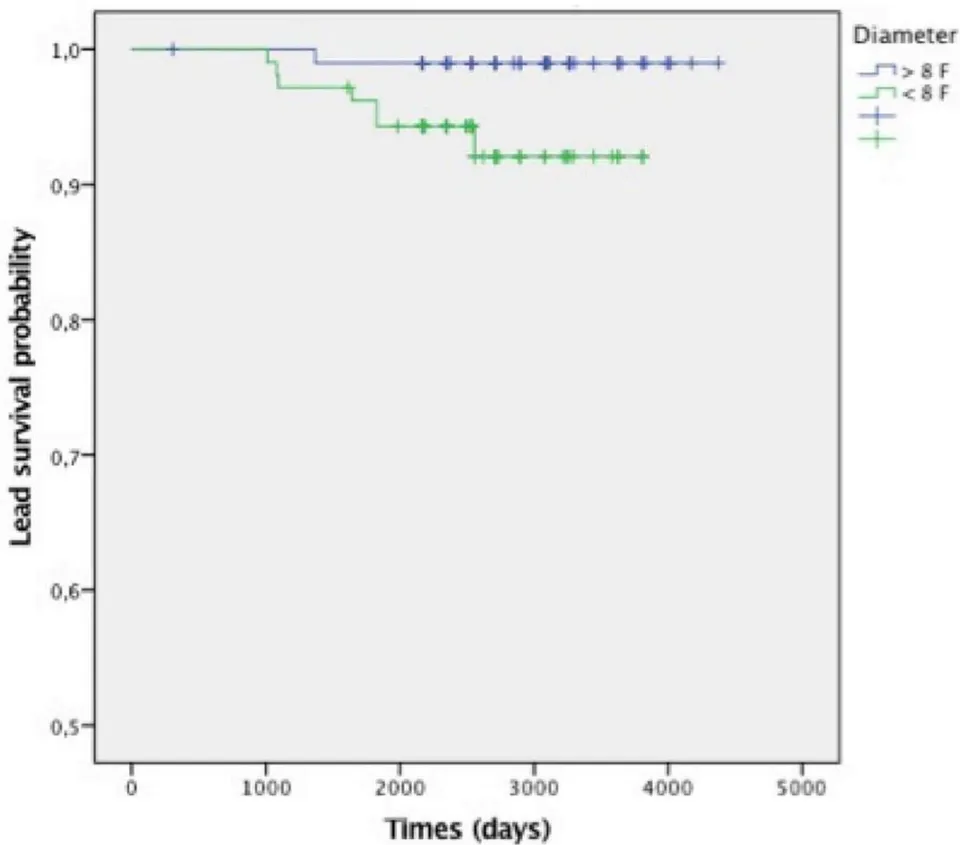
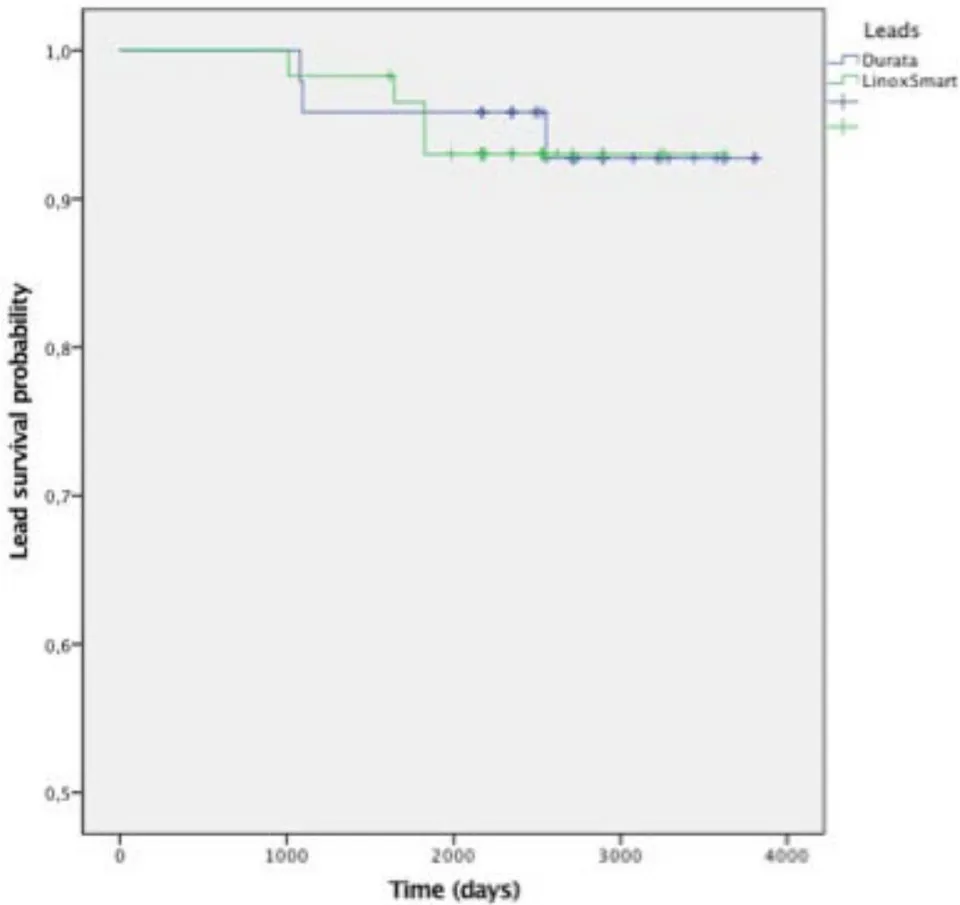
No difference in lead survival rate arose between small-diameter Linox and Durata leads (93% vs 93.7%; P = 0.71) (Figure b).
Clinical features and device data for lead failure cases are shown in Table 2. The larger number of lead failures (87.5%) showed up as non-physiological high rate signals (noise), resulting in shocks in 2 patients. There were three cases of increased pacing threshold and one case of increased impedance without any evidence of non-physiologic noise. The fluoroscopic evaluation of all failed leads was normal. Lead extraction was executed successfully in two patients (Patients 4 and 7) and the extracted leads were not submitted to the manufacturer for further testing. Furthermore, all lead failure were confirmed by manufacturers' engineers, who analysed all intracardiac electrograms and fluoroscopic evaluation.
No independent predictors of lead failure were detected by Cox regression model.
| Case | Age at implantation (years) | Underlying aetiology | ICD indication | Lead Model | Lead Age (months) | Presentation | Inappropriate Shock |
| 1 | 69 | Idiopathic DCM | Primary prevention | Endotak Reliance 0155 | 45.6 | Noise | No |
| 2 | 55 | Ischemic DCM | Primary prevention | Linox Smart SD 65/16 | 54.7 | Noise and increased pacing threshold (3.5 V/1.5 ms) | Yes |
| 3 | 64 | Ischemic DCM | Primary prevention | Linox Smart SD 65/16 | 60.8 | Noise | Yes |
| 4 | 63 | Ischemic DCM | Secondary prevention | Linox Smart SD 65/16 | 60.0 | Noise | No |
| 5 | 58 | Ischemic DCM | Primary prevention | Linox Smart SD 65/16 | 33.7 | Noise and increased pacing threshold (3 V/1 ms) | No |
| 6 | 67 | Idiopathic DCM | Primary prevention | Durata 7120 | 36.0 | Increased pacing or shock impedance (>1500 Ω) | Yes |
| 7 | 65 | Ischemic DCM | Primary prevention | Durata 7120 | 85.2 | Noise and increased pacing threshold (4.8 V/1.5 ms) | No |
| 8 | 77 | Idiopathic DCM | Primary prevention | Durata 7120 | 36.5 | Noise | No |
IV. Discussion
The results of this single-centre observational retrospective study reveal a higher incidence of lead failure among small-diameter leads. Linox and Durata leads were the small-diameter leads implanted at our centre. Seven-year lead survival rates were 93% and 93.7% for Linox and Durata, respectively. The incidence of Linox and Durata leads dysfunction still remains controversial. Linox S (single-coil) and Linox SD (dual-coil) leads, as 8-F silicone-insulated ICD leads, were released in April 2006 and February 2007, respectively. Moreover, the Linox series have not long been marketed and have been substitute by the Linox Smart series. These leads are covered with an additional Silglide® surface coating, further evolved into the Linox Smart ProMRI and the Linox Smart DX series.
A product performance report by Biotronik indicated a cumulative lead survival of 95.2% at 7 years for the Linox S and 95.0% at 9 years for the Linox SD [12], almost several single-centre [13-15] and multicentre [16] studies have suggested high rates of lead failure, contradicting the self-reported data from the manufacturer. These studies have reported 5-year Linox lead survival rates ranging between 85.3% and 93.6%, which are similar to our findings. Furthermore, the results of the Biotronik Galaxy and Celestial registries [12], with a mean follow-up of 2.3 years for Linox Smart leads, report a lead failure rate of 2.2% at 3 years, which likely underestimates the true performance of these leads in terms of over sensing development. In our study, the electrical noise mostly develops from the third year onward, beginning with 1- or 2-second episodes, which became more frequent and prolonged, leading to suspicion of progressive deterioration of lead integrity. The exact mechanism of Linox Smart lead failure is unknown, but, given the structural similarities with the Riata lead (St. Jude Medical/Abbott), we believe that it could be due to silicone abrasion due to movement of the internal conductors, sometimes followed by conductor externalization.
The 6.8-F Durata (model 7122, single-coil) was released in September 2007. Unlike the Linox and Endotak leads, the Durata lead is coated with an additional protective sheath of a polyurethane-silicone co-polymer (OptimTM) with an abrasion resistance 50 times greater than silicone.
Several changes were made in the structure of the Durata leads compared to RiataTM/Riata STTM leads, to prevent lead malfunction. The inner central lumen was reduced, the wall thickness form cable to the outer edge of the lead was increased by 50%, the lead body size was increased from 6.3 to 6.8-F, the shock coil became slightly curved and low titanium material was added to remove structural defects for a better fatigue life. St. Jude/Abbott, in their product performance report in an "Update on Durata lead performance," also stresses that Optim-covered leads show very low rates of abrasion in actively monitored registries. Survival probabilities after 5 years are between 97.4 and 98.0% for the various models of Durata [17]. In our study the survival was 98.5% after 5 years but decreased after 7 years to 92.3%. It is useful to compare the results of the current study to previous analyses of Durata performance. A search of the MAUDE database by Shah et al. [18] for abrasion reports on Durata, Endotak, and Sprint Quattro showed a significantly higher incidence of lead failure for Durata than for the other two leads. They observed that 69.5% of the reported Durata insulation failures were identified to be the result of interaction between the lead and the ICD generator, indicating a possible time dependency for abrasion risk. Hauser et al. [19] found Durata ICD leads are susceptible to internal insulation gapes that may follow in failure to treat ventricular arrhythmias or in noise/oversensing with unsuitable therapy. In our study, there was only two case of inappropriate shock and two cases of oversensing. To explain the underlying mechanism, the incessant movement of the redundant conductor cables touching the lumen's siliconewas hypothesized [19-21]. In the long time, the inner silicone is abraded from the inside-out beneath a rigid shocking coil. When ethylene tetrafluoroethylene (ETFE) isharmed, the exposed conductor cable contacts the coil. The effect depends on the cable exposed: if it is a sensing cable, noise is the most presumable consequence; if it is a high-voltage cable, a low impedance pathway shorts the cable to the coil and avoids the delivery of a shock. There is not Durata's Optim outer insulation under the shocking coils and thus does not insulate or restrain cable movement in these locations. In this feature, Durata is such like to non-Optim Riata and Riata ST leads.
This study is affected by several limitations. The study design was a single-centre retrospective cohort analysis and an underestimation of lead failure cannot be excluded. The exact mechanism of lead failure was not confirmed by manufacturers' structural and functional analyses, mainly due to the clinical chose whether to extract or leave the lead. In the study all the leads were implanted with the subclavian technique. Subclavian puncture is known to have a higher lead complication rate and might have led to an increased incidence of insulation failure caused by subclavian crush syndrome. The number of implanted leads was too low to warrant any definite conclusion on the long-term performance of this group of leads.
V. CONCLUSION
Our study showed that small-diameter ICDs are associated to a greater risk of lead failure. Although the exact mechanism by which leads fail has not been fully explained so far, abnormal electrical parameters were present in the majority of cases. In this perspective, a comprehensive vigilance strategy including home monitoring is warranted for early detection of lead failure. Furthermore, a multicentre study including a large number of patients should be conducted, and further data are required to inform future guidelines for the management of patients with Linox and Durata leads.
Acknowledgments: All authors contributed equally to the manuscript and read and approved the final version of the manuscript.
Conflict of interest: none declared