




Macroeconomic Factors for Stock Return in Nepal

Send Message

To: Author

Macroeconomic Factors for Stock Return in Nepal

Article Fingerprint

ReserarchID

9110U

Macroeconomic Factors for Stock Return in Nepal Banner

AI TAKEAWAY

Connecting with the Eternal Ground
  • English
  • Afrikaans
  • Albanian
  • Amharic
  • Arabic
  • Armenian
  • Azerbaijani
  • Basque
  • Belarusian
  • Bengali
  • Bosnian
  • Bulgarian
  • Catalan
  • Cebuano
  • Chichewa
  • Chinese (Simplified)
  • Chinese (Traditional)
  • Corsican
  • Croatian
  • Czech
  • Danish
  • Dutch
  • Esperanto
  • Estonian
  • Filipino
  • Finnish
  • French
  • Frisian
  • Galician
  • Georgian
  • German
  • Greek
  • Gujarati
  • Haitian Creole
  • Hausa
  • Hawaiian
  • Hebrew
  • Hindi
  • Hmong
  • Hungarian
  • Icelandic
  • Igbo
  • Indonesian
  • Irish
  • Italian
  • Japanese
  • Javanese
  • Kannada
  • Kazakh
  • Khmer
  • Korean
  • Kurdish (Kurmanji)
  • Kyrgyz
  • Lao
  • Latin
  • Latvian
  • Lithuanian
  • Luxembourgish
  • Macedonian
  • Malagasy
  • Malay
  • Malayalam
  • Maltese
  • Maori
  • Marathi
  • Mongolian
  • Myanmar (Burmese)
  • Nepali
  • Norwegian
  • Pashto
  • Persian
  • Polish
  • Portuguese
  • Punjabi
  • Romanian
  • Russian
  • Samoan
  • Scots Gaelic
  • Serbian
  • Sesotho
  • Shona
  • Sindhi
  • Sinhala
  • Slovak
  • Slovenian
  • Somali
  • Spanish
  • Sundanese
  • Swahili
  • Swedish
  • Tajik
  • Tamil
  • Telugu
  • Thai
  • Turkish
  • Ukrainian
  • Urdu
  • Uzbek
  • Vietnamese
  • Welsh
  • Xhosa
  • Yiddish
  • Yoruba
  • Zulu
Font Type
Font Size
Font Size
Bedground

Abstract

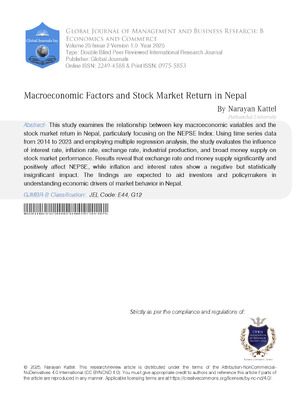
This study examines the relationship between key macroeconomic variables and the stock market return in Nepal, particularly focusing on the NEPSE Index. Using time series data from 2014 to 2023 and employing multiple regression analysis, the study evaluates the influence of interest rate, inflation rate, exchange rate, industrial production, and broad money supply on stock market performance. Results reveal that exchange rate and money supply significantly and positively affect NEPSE, while inflation and interest rates show a negative but statistically insignificant impact. The findings are expected to aid investors and policymakers in understanding economic drivers of market behavior in Nepal.

I. INTRODUCTION

The stock market plays a crucial role in economic growth by mobilizing capital for investment. In Nepal, the stock market is relatively young and influenced by various internal and external macroeconomic forces. Despite its potential, NEPSE has shown high volatility, raising concerns about investor understanding of these macroeconomic influences.

This study aims to explore the trends and relationships of key macroeconomic variables with the Nepal Stock Exchange Index (NEPSE), offering insight for investors and policymakers.

II. RESEARCH PROBLEM

The Nepal Stock Exchange exhibits frequent volatility, partially driven by limited awareness of the macroeconomic forces affecting it. This research seeks to answer:

  • What are the recent trends in macroeconomic indicators?
  • How do these indicators correlate with and influence NEPSE?

III. OBJECTIVES

  1. To identify the trends of selected macroeconomic indicators.

  2. To examine the relationship between these indicators and NEPSE.

  3. To analyze the impact of these variables on stock returns.

IV. HYPOTHESES

  • H1: Broad Money Supply (M2) significantly impacts NEPSE.
  • H2: Inflation Rate significantly affects NEPSE.
  • H3: Policy Interest Rate significantly influences NEPSE.
  • H4: Exchange Rate (USD/NPR) significantly affects NEPSE.
  • H5: Industrial Production significantly influences NEPSE.

V. METHODOLOGY

Design: Quantitative research using time series analysis.

Period: 2014-2023.

Data Sources: Nepal Rastra Bank (NRB), NEPSE, SEBON, and Ministry of Finance (MOF).

Analytical Tools: Descriptive statistics, correlation analysis, and multiple regression.

VI. VARIABLES

Dependent Variable: NEPSE Index (proxy for stock market return).

Independent Variables:

  • Interest Rate (IR)
  • Inflation Rate (INF)
  • Exchange Rate (ER)
  • Industrial Production (IP)
  • Broad Money Supply (M2)

VII. RESULTS AND DISCUSSION

Inflation and Interest Rate: These had a negative but statistically insignificant impact on NEPSE. Exchange Rate and Money Supply (M2): Showed positive and statistically significant impacts. Industrial Production: Positive influence, but statistically insignificant.

These findings suggest that among the variables studied, exchange rate and money supply are the most influential in determining NEPSE movements.

VIII. CONCLUSION

Macroeconomic variables significantly influence the Nepalese stock market. Particularly, broad money supply and exchange rate exhibit a strong and positive effect on NEPSE. The results underscore the importance of monetary stability and foreign exchange policy in shaping market behavior.

IX. RECOMMENDATIONS

  • For Investors: Monitor macroeconomic trends, especially exchange rates and money supply.
  • For Policymakers: Formulate consistent monetary and exchange rate policies to ensure market stability.
  • For Researchers: Explore additional variables such as remittance, political stability, and foreign investment in future studies.
References

4 Cites in Article
  1. Nepal Research Department (2014). Macro Modeling Practices at Nepal Rastra Bank.
  2. Nai-Fu Chen,Richard Roll,Stephen Ross (1986). Economic Forces and the Stock Market.
  3. E Fama (1981). Stock returns, real activity, inflation, and money.
  4. Donatas Pilinkus (2010). MACROECONOMIC INDICATORS AND THEIR IMPACT ON STOCK MARKET PERFORMANCE IN THE SHORT AND LONG RUN: THE CASE OF THE BALTIC STATES / MAKROEKONOMINIAI RODIKLIAI IR JŲ ĮTAKA AKCIJŲ RINKOS INDEKSUI TRUMPUOJU IR ILGUOJU LAIKOTARPIU: BALTIJOS ŠALIŲ ATVEJIS.

Funding

No external funding was declared for this work.

Conflict of Interest

The authors declare no conflict of interest.

Ethical Approval

No ethics committee approval was required for this article type.

Data Availability

Not applicable for this article.

How to Cite This Article

Dr. Kattel. 2026. "Macroeconomic Factors for Stock Return in Nepal". Global Journal of Management and Business Research - B: Economic & Commerce GJMBR-B Volume 25 (GJMBR Volume 25 Issue B2).

Download Citation

Journal Specifications

Crossref Journal DOI 10.17406/GJMBR

Print ISSN 0975-5853

e-ISSN 2249-4588

Keywords
Classification
GJMBR-B Classification JEL Code: E44
G12
Version of record

v1.2

Issue date
November 25, 2025

Language
English
Experiance in AR

Explore published articles in an immersive Augmented Reality environment. Our platform converts research papers into interactive 3D books, allowing readers to view and interact with content using AR and VR compatible devices.

Read in 3D

Your published article is automatically converted into a realistic 3D book. Flip through pages and read research papers in a more engaging and interactive format.

Article Matrices
Total Views: 267
Total Downloads: 13
All Trends

Request Access

Please fill out the form below to request access to this research paper. Your request will be reviewed by the editorial or author team.
X

This is the heading

Lorem ipsum dolor sit amet, consectetur adipiscing elit. Ut elit tellus, luctus nec ullamcorper mattis, pulvinar dapibus leo.

High-quality academic research articles on global topics and journals.

Macroeconomic Factors for Stock Return in Nepal

Dr. Kattel
Dr. Kattel

