
1. Introduction
Small open economies face persistent macroeconomic constraints arising from limited domestic markets, concentrated production structures and high exposure to external shocks. Dependence on international trade and capital flows narrows policy options, while global fluctuations are rapidly transmitted into domestic conditions. As a result, policymakers operate within a constrained environment in which price stability, external balance and growth cannot be simultaneously achieved without trade-offs.
The article compares Iceland and Malta 1964-2007, i.e. from Malta’s independence until it joined the Eurozone on the 1 January 2008. In 1964, Iceland was economically more advanced than Malta and remained so throughout the period reviewed. It was hit by a financial crisis in 2008 which Malta mostly escaped. Malta enjoyed overall a stronger economic growth than Iceland over 1964-2007 (Jónsson, 2024; Jónsson et.al., 2025; 2026).
The period reviewed spans major transformations in the international monetary system, including the collapse of Bretton Woods, the oil shocks of the 1970s, globalisation and the shift toward market-oriented policy frameworks in the 1980s and 1990s. The comparison identifies institutional and strategic factors that shaped macroeconomic stability, drawing on national accounts data, central bank publications and academic literature.
This article contributes to the literature in three ways. First, it provides a long-run comparative perspective that complements existing cross-sectional and single-country studies. Second, it advances an integrated analytical framework in which fiscal, monetary and exchange-rate policies are treated as mutually dependent components of a broader regime. Third, it highlights the central role of institutional coherence rather than individual policy instruments in sustaining macroeconomic stability in small open economies (Persson & Tabellini, 1990, 2000; Dixit & Lambertini, 2003; Cordina, 2006; Bénassy-Quéré et al., 2019).
This article argues that macroeconomic performance in small open economies is best explained by the coherence of the policy regime - the interaction of exchange-rate strategy, institutional credibility, and fiscal coordination. Its central claim is that stability depends not on any single policy tool, but on the overall consistency of the regime. Using a comparative historical political economy approach, the study examines how fiscal, monetary and exchange-rate policies interact. Rather than treating these areas as separate, it views macroeconomic outcomes as the result of their combined configuration.
2. The Analytical framework
Building on the macroeconomic trilemma (Obstfeld et al., 2005), the core argument advanced is that macroeconomic performance in small open economies is determined by what may be termed a credibility - coordination mechanism, in which outcomes depend on the degree of coherence across three interdependent elements:\
the exchange-rate regime,
institutional credibility, and
fiscal coordination.
Figure 1 summarises this mechanism. External shocks - such as terms-of-trade fluctuations, capital-flow volatility and global inflation - generate adjustment pressures that must be absorbed by the domestic economy. The exchange-rate regime determines the primary adjustment channel, either through nominal exchange-rate movements or through internal price and wage flexibility. However, the effectiveness of this adjustment process depends critically on the broader institutional environment.
Institutional credibility shapes the formation of expectations and the extent to which economic agents perceive policy commitments as sustainable. Where credibility is weak, exchange-rate adjustments are rapidly transmitted into inflation dynamics, particularly in the presence of indexation and strong wage bargaining structures. Fiscal coordination, in turn, conditions whether macroeconomic policies operate in a mutually reinforcing manner or at cross purposes. Expansionary or fragmented fiscal behaviour can undermine monetary and exchange-rate objectives, while disciplined and aligned fiscal policy can stabilise expectations and support policy consistency.
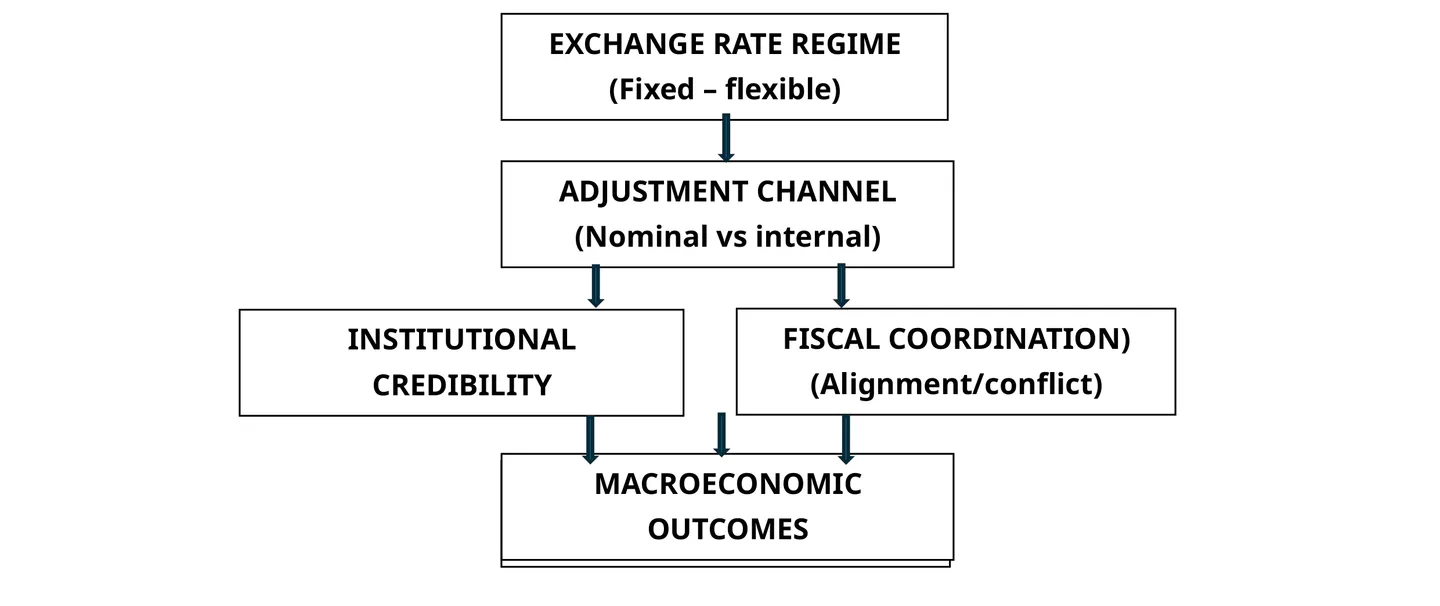
These elements interact to determine the degree of policy regime coherence, defined as the internal consistency of fiscal, monetary and exchange-rate policies within a given institutional setting. Where coherence is high, policy instruments reinforce one another, expectations remain anchored and macroeconomic stability is more likely to be sustained. Where coherence is weak, policy interactions become destabilising, generating inflation volatility, repeated adjustments and reduced policy effectiveness.
The comparative design of this study allows for the identification of how similar structural constraints can produce divergent outcomes through different configurations of this mechanism. Iceland and Malta shared key features of small open economies - limited domestic markets, concentrated production structures and exposure to external shocks - but adopted contrasting policy regimes.
Despite shared structural characteristics, the two island states adopted different strategies. Iceland, which became republic in 1944, relied on exchange-rate adjustments until the 1990s within a fragmented institutional framework, while Malta, which after independence in 1964, pursued exchange-rate stability supported by coordinated policies. These differences produced contrasting macroeconomic outcomes. Sources on structural problems and policy issues of small states relevant for the stud include Blöndal (1986), Alesina et.al. (1998), Easterly and Kraay (2000), Armstrong (2003), Briguglio (1991) and Cordina (2006).
3. Fiscal Policy
This section examines how fiscal policy interacted with the credibility - coordination mechanism outlined in Figure 1. Fiscal policy influenced macroeconomic outcomes not only through aggregate demand, but through its role in sustaining or undermining - the credibility of the overall policy regime. In Iceland, fragmented governance and extensive quasi-fiscal activity weakened coordination, allowing fiscal expansion to reinforce exchange-rate adjustments and inflation dynamics. In Malta, by contrast, centralised fiscal control enabled closer alignment with exchange-rate commitments, strengthening policy credibility and limiting destabilising interactions (Blöndal, 1986; Cordina, 1992; Guðmundsson & Zoëga, 2000).
3.1. Iceland
Public expenditure grew significantly over the study period, reflecting welfare growth, significant infrastructure investments and escalating public transfers (see Tables 2 and 3). Fiscal policy was also driven by sectoral and distributional objectives, particularly in support for fisheries and agriculture, social security, as well as by targets of full employment and programs reducing regional inequalities. Expansionary fiscal measures interacted with exchange-rate adjustments and widespread indexation, which reinforced inflationary pressures. Institutional features further constrained fiscal effectiveness.
During the 1970s and 1980s, expansionary fiscal measures - often motivated by distributional and sectoral objectives - interacted with a flexible exchange-rate regime in ways that amplified macroeconomic instability. Exchange-rate devaluations were frequently used to restore competitiveness in the export sector, particularly fisheries, but these adjustments fed into domestic price and wage dynamics which, as wages were indexed, fuelled a new inflationary spiral. Fiscal policy did not consistently counteract these pressures; instead, indexed transfers, subsidies and tax structures often reinforced inflationary tendencies (Nordal, 2022). Fiscal policy was thus at times pro-cyclical and contributing to macroeconomic volatility (Blöndal, 1969; 1977; 1983; 1986).
Improvements emerged in the 1990s through institutional reforms and better coordination. Changes in wage bargaining, monetary strategy and exchange policy were instrumental in reducing inflation and in improving fiscal discipline, contributing to greater macroeconomic stability.
Tables 1 and 2 summarise the steady growth of state income and expenditures as a percentage of GDP over the period reviewed; expenditures are both by sector and by economic classification.
Table 1. State expenditure and income in Iceland 1961-2007, by sectors, % of GDP
| 1961 | 1970 | 1980 | 1990 | 1998 | 2007 | |
|---|---|---|---|---|---|---|
| Public administration | 2,4% | 2,9% | 2,8% | 3,2% | 3,3% | 4,2% |
| Education | 2,8% | 4,3% | 4,4% | 4,8% | 5,7% | 7,4% |
| Health | 2,0% | 3,2% | 5,5% | 6,8% | 6,9% | 7,5% |
| Social, housing, culture | 8,0% | 9,0% | 8,3% | 10,6% | 11,1% | 12,1% |
| Industry, fisheries, agriculture | 5,3% | 4,3% | 4,9% | 4,9% | 2,8% | 2,9% |
| Infrastructure | 3,5% | 4,7% | 4,5% | 3,6% | 2,9% | 2,9% |
| Other | 1,1% | 1,0% | 1,4% | 1,9% | 1,5% | 0,6% |
Includes local authorities. Source: Statistics Iceland https://px.hagstofa.is/pxis/pxweb/is/Efnahagur/Efnahagur__fjaropinber__fjarmal_opinber__fjarmal_opinber/THJ05992.px/table/tableViewLayout1/?rxid=d4da916d-b297-45ac-832a-fc3e726ccce0
Table 2. State expenditure in Iceland 1961-2007, economic classification, % of GDP
| 1961 | 1970 | 1980 | 1990 | 1998 | 2007 | |
|---|---|---|---|---|---|---|
| Public consumption | 10,1% | 12,7% | 16,7% | 18,5% | 20,4% | 25,2% |
| Depreciation (-) | -0,8% | -1,0% | -0,6% | -0,8% | -0,9% | -2,1% |
| Interest paid | 0,2% | 0,6% | 1,6% | 3,7% | 3,6% | 6,3% |
| Producer subsidies | 4,8% | 3,3% | 3,6% | 3,5% | 1,7% | 1,5% |
| Income transfers | 5,3% | 5,5% | 5,1% | 6,9% | 6,8% | 5,4% |
| Capital accumulation | 2,8% | 4,6% | 3,6% | 4,1% | 3,7% | 4,7% |
| Capital transfers | 2,1% | 3,1% | 2,9% | 2,6% | 1,4% | 1,7% |
Includes local authorities. Source: Statistics Iceland https://px.hagstofa.is/pxis/pxweb/is/Efnahagur/Efnahagur__fjaropinber__fjarmal_opinber__fjarmal_opinber/THJ05992.px/table/tableViewLayout1/?rxid=d4da916d-b297-45ac-832a-fc3e726ccce0
The Icelandic experience demonstrates that a fiscal regime characterised by fragmented governance and weak coordination could undermine the credibility of the overall macroeconomic framework, particularly when combined with an exchange-rate strategy based on repeated adjustments. The Icelandic case, therefore, shows how weak fiscal coordination could transform exchange-rate flexibility from a stabilisation tool into a source of persistent macroeconomic instability (Guðmundsson & Zoëga, 2000; Guðmundsson, et al., 2000).
3.2. Malta
In contrast to Iceland, Malta’s centralised fiscal structure facilitated closer alignment with exchange-rate and monetary objectives. Although fiscal imbalances emerged at times, the broader framework supported policy coherence and helped sustain macroeconomic stability.
In the years following independence, fiscal policy was shaped by the need to transition from dependence on British military expenditure to a more diversified and self-sustaining economy. During the 1970s, substantial revenues from base-leasing agreements generated high levels of public savings, which supported a relatively stable fiscal position. After the expiration of these agreements in 1979, Malta lost an important source of public revenue. The Labour government at the time sought to avoid fiscal instability through:
firm state intervention in production and employment.
tight regulation of imports and domestic consumption to protect the balance of payments and fiscal stability.
efforts to maintain budgetary balance with limited reliance on external borrowing.
Fiscal policy in this period was therefore closely tied to a broader strategy of economic self-reliance and employment protection, even if this implied inefficiencies and growing quasi-fiscal burdens through public enterprises.
Malta went through a break of policy in 1987. That year marked the return to office of the conservative Nationalist Party (PN), following a sixteen-year run by the Labour Party. The new government dismantled the trade and fiscal regime of the previous government, which had focused on domestic economic growth and consolidation of national finances. This had included strict foreign exchange regulation, balanced trade through a protectionist regime of import controls and import substitution, restricted consumption, balanced budgets and minimal national debt. The new Nationalist government put Malta firmly back on the path of a market economy. Fiscal deficits became more persistent, public debt rose steadily and state enterprise subsidies and restructuring costs remained important fiscal pressures (Fenech, 1988; Briguglio, 1988; 1991).
Unlike Iceland, however, Malta’s fiscal expansion remained constrained by its commitment to a stable exchange-rate peg, meaning that fiscal excess could not easily be monetised through inflation or currency depreciation.
Despite these challenges, Malta’s fiscal policy was more closely integrated with its exchange-rate strategy than in the Icelandic case. The maintenance of a stable exchange-rate regime required a degree of fiscal discipline to sustain external balance and policy credibility. At the same time, fiscal deficits and rising debt emerged during periods of expansion—especially under policy regimes favouring liberalisation and public investment—the broader commitment to exchange-rate stability constrained excessive fiscal divergence (Cordina, 1992).
Institutional reforms in the 1990s further strengthened policy alignments. Financial liberalisation, the development of domestic capital markets and preparations for European Union membership increased the importance of credible fiscal management. The prospect of Eurozone accession imposed additional discipline, as convergence criteria required reductions in public debt and deficits. By the early 2000s, fiscal consolidation had become a central policy objective, reinforcing the credibility of the exchange-rate peg and facilitating Malta’s participation in the Exchange-rate Mechanism II.
Although not without fiscal strain, the centralised structure and external anchoring mechanisms helped align fiscal policy with monetary and exchange-rate objectives. This alignment strengthened policy credibility and reduced the likelihood of destabilising interactions between policy domains (IMF, 1997; Grech, 2000; 2015). Figure 2 summarises the growth of state revenue per capita 1980-2007 and Table 3 the state expenditure as % of GDP 1980-2005.
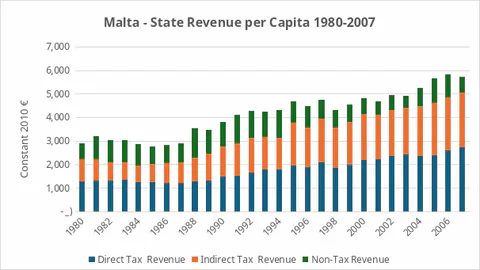
Table 3. State expenditure as % of GDP – Malta
| 1980 | 1990 | 2000 | 2005 | |
|---|---|---|---|---|
| Personal emoluments | 10% | 10% | 10% | 9% |
| Contributory benefits | 5% | 6% | 7% | 7% |
| Non-contributory benefits | 4% | 4% | 3% | 3% |
| Other current expenditure | 10% | 10% | 10% | 9% |
| Public debt servicing | 1% | 1% | 4% | 4% |
| Capital expenditure | 7% | 8% | 5% | 6% |
| Total: | 37% | 39% | 39% | 38% |
Source: Grech (2015, p. 24).
3.3. Comparative perspective
The comparison of fiscal policy in Iceland and Malta highlights the importance of institutional structure and policy coordination in shaping macroeconomic outcomes. Both countries experienced an expansion of the public sector over time, where fiscal policy played a significant role in addressing social and economic objectives, including income distribution and sectoral support.
However, the effectiveness of fiscal policy differed markedly. In Iceland, fragmented governance structures and extensive quasi-fiscal activities limited coordination and weakened the overall policy framework. In Malta, by contrast, a more centralised fiscal structure and the disciplining effects of an exchange-rate commitment - later reinforced by the European integration process - helped sustain greater policy coherence (Jónsson, 2024).
These differences underscore a central implication of the analytical framework: fiscal policy contributed to macroeconomic stability not only through its direct economic effects, but through its role in supporting or undermining - the credibility and consistency of the broader policy regime. Where fiscal, monetary and exchange-rate policies were aligned, stability was more likely to be sustained. Where coordination was weak, even well-intentioned policies could generate destabilising outcomes.
4. Monetary Policy
Monetary policy interacted with the credibility–coordination mechanism outlined in Section 2. The experiences of Iceland and Malta illustrate two contrasting trajectories: one in which monetary policy was frequently accommodated to exchange-rate and sectoral pressures, and another in which it evolved within a more stable and coordinated policy regime.
4.1. Iceland
Until the 1990s, monetary policy failed to function as an independent nominal anchor because it was repeatedly subordinated to exchange-rate adjustments and fiscal pressures.
The Central Bank lacked independence and authority and acted at times like a government advisor on major policy decisions. Frequent exchange-rate devaluations, used to restore short term competitiveness and profits of the fisheries sector, fed directly into inflation through import prices and indexation of wages. Monetary policy accommodated these dynamics rather than anchoring expectations, resulting in persistent inflation and high nominal interest rates. Reforms of exchange policy in the late 1980s and 1990s improved credibility. Monetary policy became more focused on price stability and inflation subsided. The adoption of inflation targeting in the early 2000s marked a further institutional shift, although new vulnerabilities emerged with financial liberalisation (Edwards, 2018; Jónsson et al., 2018; Nordal, 2022). Monetary policy during the 1960s and 1970s was closely intertwined with broader economic policy objectives, including full employment and sectoral support (Guðmundsson & Kristinsson, 1997; Guðmundsson et al., 2000).
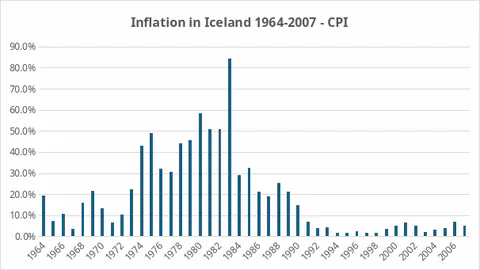
The widespread use of indexation—covering wages, financial contracts, and public expenditures—further entrenched inflation dynamics and reduced the effectiveness of conventional monetary tools. In this environment, monetary policy was largely subordinated to the exchange-rate regime and the broader political economy of sectoral adjustment. Figure 3 exposes the hyperinflation rates in Iceland during the 1970s and 1980s.
Expansionary fiscal measures and indexed transfers contributed to aggregate demand pressures, while the lack of effective coordination limited monetary policy’s capacity to counteract them. The result was a prolonged inflation–devaluation cycle, in which exchange-rate adjustments, wage increases and inflation became mutually reinforcing.
Institutional reforms and changes in wage bargaining began to restore policy credibility in the late 1980s and early 1990s. Monetary policy became more focused on price stability, and the exchange-rate regime was used more explicitly as a nominal anchor within a narrower band. These developments, combined with improved fiscal discipline, contributed to a significant reduction in inflation rates and greater macroeconomic stability. By the early 2000s, the adoption of an inflation-targeting framework marked a further step toward a more conventional and credible monetary regime. However, this transition also exposed new risks and vulnerabilities, particularly in the context of financial liberalisation and increased capital mobility (Jónsson et al., 2018).
4.2. Malta
In contrast to Iceland, Malta’s monetary policy evolved within a more stable and coordinated macroeconomic framework, characterised by a consistent commitment to exchange-rate stability. The Central Bank of Malta, established in 1968, operated within a system of administrative controls, including regulated interest rates and capital restrictions. While these arrangements limited the scope for market-based monetary policy, they contributed to a relatively stable nominal environment during the period reviewed (Falzon, 1994; Adonis, 2011; Grech, 2015; Grech et al., 2018).
Malta’s monetary regime was anchored by its exchange-rate strategy, which provided a credible nominal reference point for expectations. This commitment constrained the scope for independent monetary policy but enhanced overall policy credibility by aligning domestic monetary conditions with the requirements of the exchange-rate regime.
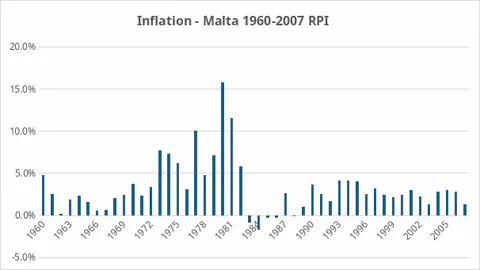
Inflation remained relatively low and stable, and interest rates were moderate by international standards. The banking system, characterised by conservative lending practices and reliance on domestic deposits, further supported monetary stability by limiting exposure to external financial shocks. In contrast to Iceland, where monetary policy was often reactive, Malta’s framework emphasised predictability and consistency. Figure 4 shows that, overall, inflation was significantly lower in Malta than in Iceland.
The 1990s marked a period of significant transformation, as Malta shifted toward more market-oriented monetary instruments. Financial liberalisation, the development of domestic capital markets and the gradual removal of administrative controls increased the role of interest rates and open market operations in the monetary regime. Institutional reforms strengthened the Central Bank’s independence and operational capacity.
Preparations for EU membership and eventual Eurozone participation imposed additional discipline on monetary and fiscal policy, reinforcing the credibility of the exchange-rate peg. Participation in the Exchange-rate Mechanism II further constrained policy discretion but provided a clear framework for convergence. By the mid-2000s, Malta had effectively aligned its monetary policy with that of the Euro area, achieving low inflation and stable financial conditions (Grech 2015; Grech et al., 2018).
4.3. Comparative perspective
The comparison underscores a key implication of the analytical framework, as applicable to the study period 1964-2007 (Figure 1): monetary policy could not be evaluated in isolation from the broader policy regime. Its effectiveness depended not only on the instruments available to central banks, but on the consistency of fiscal behaviour, the structure of the exchange-rate regime and the credibility of policy commitments, as highlighted by the credibility - coordination mechanism.
In Iceland, monetary policy was subordinated to exchange-rate adjustments, resulting in instability. In Malta, monetary policy contributed to stability primarily by maintaining a credible nominal anchor. Although this approach limited policy flexibility, it reduced the likelihood of destabilising interactions between fiscal, monetary and exchange-rate policies.
5. Exchange-rate policy
Exchange-rate policy mediated the relationship between domestic conditions and the international environment of the two open economies. Within the analytical framework developed, the exchange-rate regime played a dual role: It determined the mechanism through which external shocks were absorbed, and it served—explicitly or implicitly—as a nominal anchor shaping expectations of inflation and policy credibility. The effectiveness of the exchange-rate policy, therefore, depended not only on the choice of regime but on its consistency with monetary and fiscal policy and on the institutional capacity sustained over time (Scicluna et.al., 1985; Ghosh et.al., 2003).
5.1. Iceland
Iceland’s exchange-rate flexibility functioned as an adjustment mechanism. The devaluations supported export competitiveness but contributed to inflation through higher import prices and wage dynamics. It was shaped by structural constraints but amplified by institutional weaknesses of the Icelandic economy, including a narrow export base centred on fisheries and a high sensitivity to fluctuations in terms of trade. Business cycles in Iceland were often incongruous with business cycles of key trading nations, but improved management of the fisheries has since the 1990s provided a more stable operating platform for the industry and reduced the need for sector-specific aid and transfers and exchange-related interventions. Although reforms in the 1990s improved stability, the regime remained vulnerable. The shift to set inflation targets in 2001 marked a move toward a floating regime, with the exchange-rate remaining an adjustment mechanism. The effectiveness of the exchange-rate policy was limited by its interaction with domestic institutions and policy dynamics. Widespread wage indexation and strong collective bargaining structures meant that the inflationary effects of devaluation were rapidly transmitted into wage increases. In turn, higher wages eroded the initial gains in competitiveness, often prompting further devaluations. This process generated a self-reinforcing inflation–devaluation cycle that persisted in the 1970s and 1980s (Nordal & Tómasson, 1985; Agnarsson et al., 1999; Mishkin, 2003; Zoëga, 2017).
Government’s policy trade-offs, particularly in the 1970s and 1980s, prioritised exchange-rate policy targets over monetary and fiscal policy concerns, reducing unemployment but creating inflationary pressures and worsening budget deficits. Indexation was the government’s counterfeit medicine, which hid the negative effects of inflation. Independent monetary policy was non-existent during the 1970s and 1980s, while national economic downturns or negative outlooks were repeatedly addressed by devaluations and extensive transfer payments. Political courage to make major structural changes was lacking as is often the case in very small states.
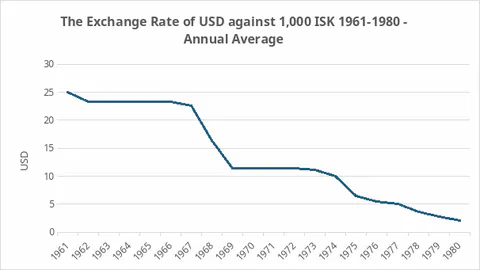
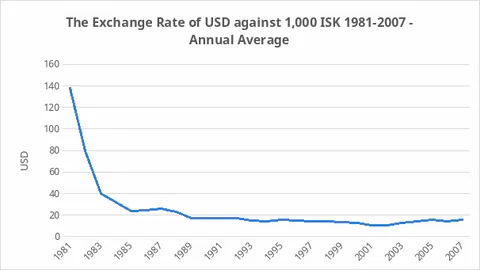
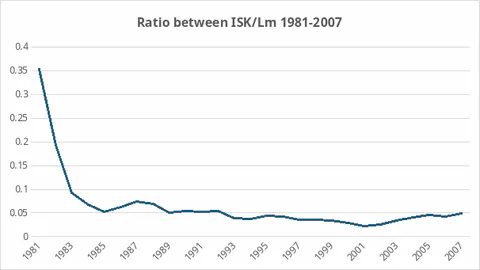
Please note that 100 ISK was converted into 1 ISK on 1/1 1981; hence the difference in scale between Figures 5 and 6.
A gradual shift occurred in the 1990s, as institutional reforms and improved policy coordination began to restore credibility. The exchange-rate regime was reoriented toward greater stability, with narrower fluctuation bands and a more explicit role as a nominal anchor. This shift contributed to reduced inflation and greater macroeconomic stability.
In 2001, Iceland formally abandoned its exchange-rate target and adopted an inflation-targeting framework with a floating exchange-rate. This transition marked a move toward a more conventional monetary regime. However, it also implied that the exchange-rate would once again serve as a channel of adjustment to external shocks. The Icelandic experience thus illustrates both the potential and the limitations of using the exchange-rate as an instrument of adjustment in a small open economy.
5.2. Malta
In contrast, Malta’s foreign exchange-rate policy was characterised by a sustained commitment to exchange-rate stability, a central pillar of its macroeconomic framework. Following independence in 1964, the Malta pound was initially pegged to the British pound. The Maltese Lira was introduced as a national currency in 1972 at parity with sterling (£M1 = £1 sterling). This parity weakened after sterling floated in June 1972 and Malta began moving away from a sterling peg toward a basket-based arrangement in the later 1970s, reflecting the country’s trade patterns and external economic relationships. This strategy aimed at providing a stable nominal anchor in a highly open economy dependent on external trade and capital flows.
Malta’s exchange-rate regime functioned primarily as a credibility-enhancing anchor rather than as an instrument of short-term adjustment, contrary to that of Iceland. By maintaining a stable exchange-rate, as summarised in Figures 7, 8, and 9, policymakers signalled a commitment to low inflation and macroeconomic discipline. This constrained the scope for discretionary monetary policy but contributed to stable expectations and reduced inflation volatility (Scicluna & Agius, 1985; Delia, 1986; Briguglio, 1989, 1995; Ellul, 1998). The effectiveness of this approach depended on the consistency of supporting policies. Fiscal policy, although subject to periods of expansion and rising debt, was ultimately aligned with the requirements of exchange-rate stability, particularly in the context of the European integration process. Monetary policy was similarly oriented toward maintaining the peg, with interest rate adjustments and liquidity management used to support external balance and defend the exchange-rate. Institutional developments in the 1990s reinforced this framework. Financial liberalisation, the strengthening of the Central Bank’s role, and the development of domestic financial markets enhanced the capacity to manage monetary conditions within a fixed exchange-rate regime. At the same time, preparations for EU membership and eventual Eurozone participation imposed additional constraints, requiring adherence to the convergence criteria for inflation, fiscal deficits and public debt.
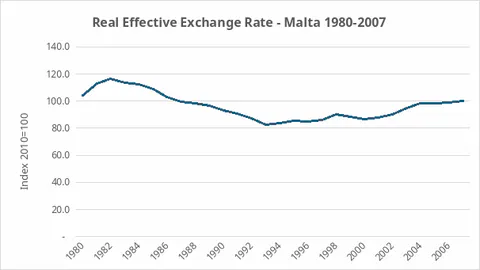
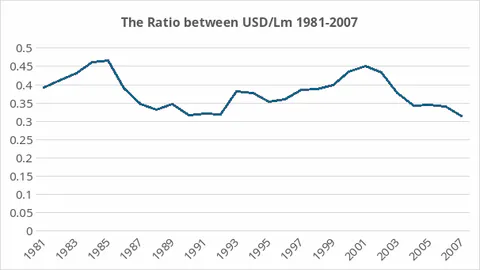
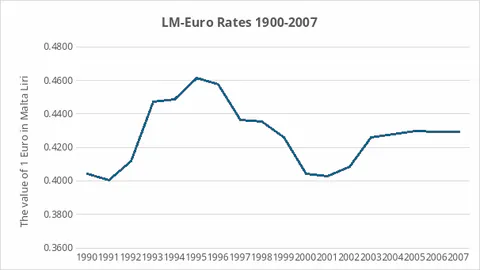
Malta’s participation in the Exchange-rate Mechanism II from 2005 further solidified its commitment to exchange-rate stability. The lira remained at its central parity throughout this period, reflecting strong policy credibility and market confidence. The adoption of the euro in 2008 marked the culmination of this strategy, effectively replacing the national exchange-rate regime with membership in a larger monetary union.
5.3. Comparative perspective
The outcome of the contrasting exchange-rate regimes of Iceland and Malta over the period 1964-2007 are summarised in Figure 10. Iceland’s flexible regime, especially in the 1970s and 1980s, enabled adjustment but contributed to inflation and instability in the absence of credible coordination. Malta’s fixed regime constrained flexibility but enhanced stability through credible anchoring during the best part of the 1964-2007 era. The effectiveness of exchange-rate policy in both island states depended on its consistency with their broader institutional and policy frameworks.
6. Conclusion
This study has demonstrated that macroeconomic outcomes in these two small open economies were during the period reviewed shaped not only by external exposure and structural vulnerability, but also and often more decisively by the coherence of domestic policy regimes. The comparison of Iceland and Malta shows that fiscal policy, monetary arrangements and exchange-rate regimes were not highly effective as independent policy instruments. Their effectiveness depended fundamentally on the degree to which they were mutually reinforcing and embedded within a credible institutional framework. Where policy objectives and instruments were aligned, they strengthened credibility, anchored expectations and enhanced economic resilience. Where they were misaligned, they could have generated cumulative instability, policy inconsistency and heightened vulnerability to external shocks.
The findings challenge approaches that have evaluated fiscal, monetary and exchange-rate policies in isolation. Instead, they have shown the importance of policy regime consistency as a central determinant of macroeconomic performance. The experiences of Iceland and Malta suggest that the long-term success of small states have depended less on the adoption of any particular policy instrument - whether a fixed exchange-rate, a flexible currency, or a specific fiscal stance and more on the capacity to maintain coherence across the broader policy framework within which these instruments operated. The comparison shows that this misalignment can persists if the authorities lack the political strength to engaged in the necessary economic policy and structural adjustments. Such measures can be hard to implement as they may in the short-run lead to economic and social dilemmas, although they are beneficial in the long-run.
More broadly, the study contributes to the literature on small-state political economy by highlighting the pivotal role of credibility and coordination in managing the constraints of openness. Small economies have not been able to eliminate their exposure to international markets, external shocks or structural dependence. They have, however, been capable of conveying these external pressures through their domestic economies. The article manifests that the decisive question is not whether policymakers have chosen fiscal discipline, monetary autonomy or exchange-rate stability, but whether these choices have formed a coherent and credible regime capable of commanding confidence in an inherently uncertain world at the time of the study.
7. Acknowledgements
The authors acknowledge the overall guidance, comments, and critical suggestions of Godfrey Baldacchino, professor at the University of Malta.